By Reshat Kripa
Part Fifteen
Memorie.al / “Sometimes, when a child is struck by heavy trials from their tenderest age, in the secret corners of their soul, a kind of scale is born – a terrifying scale – with which they weigh the affairs of this world. Feeling their own innocence, they submit to fate without a word. They do not complain at all. He who has no reason to reproach himself, does not reproach others!”
(Victor Hugo, “The Man Who Laughs”)
SHATTERED YOUTH
Dedicated to family and society,
The Author
Continued from the previous issue
JORGO
In the summer of 1957, Jorgo was discharged from the army. He had served in a labor battalion. I noticed a change in his character. That cheerful boy who used to sing Labëri songs so beautifully had turned into a silent man. He hardly engaged in conversation at all. He only spoke when asked. At times, he would detach himself from the world around him and sink into his own solitude.
This state of mind worried me. He, who used to talk to me with such passion about various matters, had now become passive. Something must have happened. And I had to find out what it was.
-“Jorgo, we have shared many hardships together. Tell me, what is troubling you?”
He didn’t answer immediately. He reflected for a few moments, and then spoke:
-“If you spit upward, it falls on your face; if you spit downward, it falls on your feet. That is what happened to me. My home has become a grave. My father has made my life miserable. He always blames me for the family’s situation. During the three years I was in prison, not a soul was heard from. I was discharged from the army, and yet he treats me like a stepson. I don’t know what to do. I feel sorry for my mother. She suffers, but she doesn’t have the courage to speak to him because he stifles her.”
I had realized this back in prison, where for nearly three years; no one came to visit him. Nevertheless, I had to talk to him, to give him courage so he could find faith in his future.
-“Listen, Jorgo, I understand your plight. Get married and move out on your own. Start your own family. You aren’t the only one who has had to do this.”
In that moment, it seemed as if he understood me. For a few days, I saw him more cheerful and approachable. He spoke more openly. But as the days passed, sadness clouded him once again.
– “I have made a decision,” he told me.
-“What decision?”
-“I’m going to escape. There is no place for me here anymore.”
-“Have you thought about the consequences?”
-“Let happen what may. Either I make it, or I get killed. Will you come too? We can go to Çatistër under the pretext of visiting my grandmother, and from there, we can escape easily.”
The temptation was great. We had discussed the possibility of escaping since we were in prison. But circumstances had changed. It was clear to me that my escape would mean internment for my entire family. As for Jorgo’s family, nothing would happen to them; everyone knew how his father treated him. I could not be the cause of a catastrophe for my family.
-“Jorgo, I’m sorry to turn down your request. I have a family now toward whom I have obligations. I advise you to give up on this idea as well.”
More than a month passed. I thought Jorgo had moved on. Then, one day, out of the blue, he vanished. I waited two days, hoping to run into him. On the third day, I went to his house. At the gate, I saw his mother. Her eyes were filled with tears. As soon as she saw me, she motioned for me to come inside. With a trembling voice, she spoke:
-“Jorgo took Miço. He took the spoons and forks and left.”
She could barely speak Albanian. Just then, his brother arrived and clarified:
-“He had a fight with father. Father slapped him. He took two or three spoons and forks and left, saying they would never see him again – that he would live on his own.”
-“But do you have any idea where he might have gone?”
-“We know nothing. Father was going to report it to the Internal Affairs Branch today.”
I understood everything. Jorgo must have escaped. He had taken the spoons and forks to throw them off the scent and buy himself time. I inquired about him indirectly to see if he had settled somewhere, but there was no news.
I was in agony. I expected to be summoned for questioning at any moment. After two days, a policeman appeared at my gate.
-“Take your ID card and come with me. You are wanted at the Passport Office for verification.”
I thought this was the end. Regardless, I decided to act as if I knew nothing. The passport office was nearby, in a three-story building behind the farmers’ market. They put me in a room on the ground floor. An officer sitting behind a desk took my ID and began to inspect it. After a moment, he signaled to the policeman, who locked me in the adjacent room.
The room was completely empty. It reminded me of the Sigurimi cells. I don’t know how long I stayed there, but it was certainly more than two hours. Every moment, I expected the prison van to arrive and take me to the State Security cells.
Finally, the policeman entered again and said:
-“Follow me!”
I followed behind him. He led me back to the previous room. The officer was still at his desk, holding my ID. At another table sat a girl typing something on a typewriter.
“Surely, she is typing my arrest warrant,” I thought to myself.
The officer shot me a look as if trying to read my mind and said:
-“Where do you work?”
-“At the woodworkers’ cooperative.”
-“Why isn’t it recorded in your ID? Don’t you see there is a specific page for this?”
-“No one ever asked me for it.”
-“And why haven’t you looked into it yourself?”
-“I didn’t know.”
The officer fell silent for a long time. Silence reigned in the room. Nothing could be heard except for the clicking of the girl’s fingers on the typewriter. Finally, he spoke:
-“Take your ID, and tomorrow morning, go to the head of personnel to have the proper entry made.”
I breathed a sigh of relief. I had escaped arrest. I practically ran home. There, they were waiting for me with frozen hearts. I explained what had happened. I said nothing about Jorgo because I didn’t want to worry them. It was clear to me that this whole game was played because of his escape. Perhaps they suspected I had fled with him.
The next day, I reported to the personnel office. As soon as Chief Shameti saw me, he said with indifference:
-“What do you want?”
-“The passport office sent me to have my workplace recorded in my ID.”
-“Go away, I don’t have time for you!” he replied harshly.
-“The passport office sent me,” I repeated.
-“Let them stamp it themselves if they want to.”
I left without another word. I understood the meaning of this game. A few days later, news of Jorgo’s escape spread throughout Vlora. He had fled with Ismail Mustafaraj from Çeprat. Through his village, Çatistra, they had managed to cross into Greece. They stayed there for two years before moving to America. He continued his studies and graduated as a chemist. But luck was not on his side. Cancer overcame him. He closed his eyes in a foreign land without ever hearing from his loved ones. His father did not shed a single tear. His mother, however, could not endure the grief and passed away a few years later.
NERI
The days passed. They were all alike. An eternal monotony. Once work ended, we would return home, and in the evening, we’d go out with friends for the usual stroll. Sometimes, when we had money, we went to the cinema. Sundays were for football. We would gather and follow the national championship matches on the radio or at the stadium.
I hadn’t seen Neri for several days. I didn’t know if she was ill or if there was another problem. Moreover, I didn’t dare ask anyone. She was something that belonged only to me, and as such, I had to resolve it myself. But how?
One afternoon, I went to visit Uncle Nuri. They were an elderly couple who had no children. Recently, they had taken a girl from the orphanage. Uncle Nuri loved Tatiana – that was her name – very much. He talked about her all day long. His face glowed when he spoke. I stayed until evening.
I began to wander the city streets. I didn’t see a single familiar face, or perhaps it just seemed that way to me. A feeling of nostalgia washed over me. Where were the times gone by which, despite their problems, were full of life? Or was it just age bringing on this feeling? I thought that by leaving prison, I would find peace.
I thought I would no longer be haunted by sad events. But now that I was out, I encountered phenomena I had never even imagined. A different world was surrounding me. I felt an emptiness within that I didn’t know how to fill. I don’t know how, but my feet led me to Neri’s alley. I snapped out of it when I found myself near her gate. That gate stirred many memories.
The creak of a gate woke me from this daydream. I noticed her gate was opening. I moved to the other side of the alley. I saw her coming out with a boy. I felt ashamed to be there. She saw me, froze, and nearly collapsed.
He caught her by the arm and asked:
-“What happened?”
-“Nothing, I almost tripped on a stone.”
In fact, there wasn’t a single stone on the road, but he didn’t notice.
-“Shall we go back inside?”
-“No, no, let’s keep walking.”
He put his arm around her and they walked away. I stood there watching them. The alley was deserted. She turned her head back and looked at me. Her eyes were shimmering. To me, it seemed they were filled with tears. Perhaps it was just my illusion. After a moment, they disappeared. My legs were trembling. I sat on a stone bench (sofat) near a gate. I put my head in my hands and thought. I realized that our love had set like the sun.
-“What is wrong? Are you ill?” – I heard a voice speak to me.
I looked up and saw her father before me.
-“No, thank you, I’m fine!” – I replied.
I stood up and walked away. He made a gesture as if I were mad. He was right. I was indeed mad with love for his daughter. It was the last time I ever walked down that street. I left thinking about what had happened. My face had taken on a different look. It was obvious I was deeply shaken. When my mother saw me, she asked:
-“What happened to you? Your face looks terrible.”
-“It’s nothing,” I lied. “I was touched by Uncle Nuri’s love for Tatiana.”
I went upstairs to Fatushja’s room. I took out the poem I had dedicated to Neri five years ago. I had kept it with love. The paper had yellowed with time. Here and there, the letters had faded. I read it and reread it. What should I do with it? Keep it still? To whom could I dedicate it? It was dedicated only to Neri. It could belong to no one else. I tore it into small pieces and threw them away. Its verses were recorded in my mind. I felt a pain in my heart.
THE LABOR UNIT
The labor unit was a new kind of semi-prison. The work, the food, and the sleeping conditions were almost the same. So was the treatment of the soldiers. The only difference was that we had no guards to escort us when we went to and from work, and the right to leave the base depended on the commander’s whim. In two years as a soldier, I was given only six days of leave to go home. Instead of a real rifle, we were given wooden ones, as if we were children playing a game.
We were mobilized on June 17, 1958. At the military branch, my father and Qamile had come to see me off. My mother had been hospitalized in Tirana, and Fatushja had gone with her. We embraced. In my father’s eyes, I thought I saw tears. At sixty-six, his heart was beginning to fail him. I spoke to him and boarded the truck. He composed himself. The trucks set off.
We arrived in Tirana and were stationed at Unit 5310 in the Ali Rizaj barracks. Our battalion commander was Major Zyber Lloshi, a generally good and polite person. The company commander, Nystret Veria, wasn’t a bad man either, though he was a bit talkative.
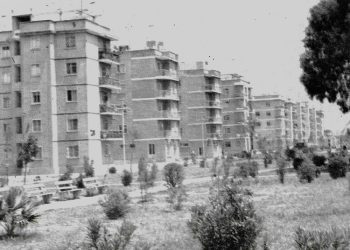
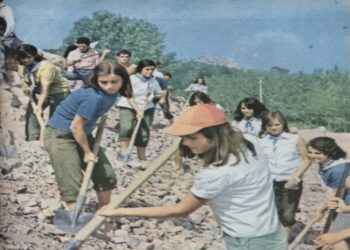
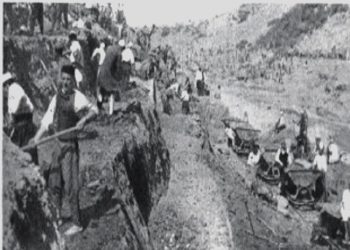
We worked on the construction of the Brewery as well as two-story “populit” (wood-fiber) apartment buildings at the textile combine. Our squad was part of the second group. We were a squad of carpenters. In truth, only Irfan Aliaj knew anything about the trade. But in the army, you learn everything. And so did us.
In the unit, I met many good friends. I should mention Petrit Çepele from Roskovec – the brother of Tefik and Refik Çepele, with whom I had been in prison; Agim Liku, whose father, Muharrem Liku, was killed in the November 1944 massacre in Tirana; Aleksandër Belevski, Zyhdi Turdiu, Halit Bakalli, and Ihsan Banka from Tirana; Halit Turkeshi from Durrës; Skënder Meta, Shaqir Elbasani, Shemsi Basha, and Esat Kurtabegu from Shkodra, and many others.
After a year, our unit was transferred to “Zogu i Zi,” on Durrës Street. We worked on building apartments on “Kavaja Street,” across from the Catholic Church. Our construction technician was a civilian named Vasil Tole. He was a very good guy. He had worked with Agim for a time. He taught me how to read and implement blueprints, which would serve me greatly in the future.
Besnik had been brought to the New Prison Hospital in Tirana. The more than ten years he had spent in prison had affected his heart. I bought some food with the little money I had, adding what Drita had given me, and one Sunday, I went to visit him. When the guards saw me in a military uniform, they were surprised. They didn’t want to let me in, but I insisted, and they were forced to agree.
I found him incredibly thin. He had suffered a great physical decline compared to when I had seen him in the Çerma and Bubullima camps. I felt a great pain.
-“How are you?” – I spoke, trying not to show my despair.
-“Very well,” – he replied with a steady voice. – “The worst is over, and little remains. Only two years left, and we will all be together.”
-“Yes, brother, and we shall never be separated again!”
Then I told him about all the family members. He listened intently. When we parted, he said:
-“Give everyone a loving hug for me!”
When I returned to the unit, the battalion commander summoned me.
-“Where were you?” – he asked.
At first, I didn’t want to tell him, but I realized he had been tipped off by the prison authorities, so I said:
-“At the prison, visiting my brother.”
-“What was he sentenced for?”
-“Agitation and propaganda.”
-“Does he have much time left?”
-“Two years.”
-“Fine, fine, but I advise you not to go visit him again.”
I realized the advice was given sincerely. All that evening, I could see my brother’s wasted face. In January 1960, we were transferred to Unit 4300 in Durrës. We worked on building houses at the Dajlan Bridge. My time in that unit was marked by nothing special worth writing about.
The last three weeks were spent at Unit 2200 in Dushk, Lushnje. There, we performed deep plowing (qilizmë) to plant vineyards. I had been appointed squad leader. There were ten men in my squad. Among us was a highlander known for his swagger and arrogance. He hardly worked at all. Even the little work he did was done poorly. Everyone knew this. This led to the unit’s operative officer coming for an inspection one day. He was from the villages of Vlora.
I don’t remember his name. He took some soldiers from other squads and ordered them to see if we had done the plowing correctly. With the greatest insolence, they declared the work had been done poorly by everyone, which was not true at all. The operative lined up the squad in the mess hall. He began to criticize us harshly for the work, specifically targeting me as the squad leader. I objected. I did not accept that the work was done poorly. He became enraged and said:
-“Are you trying to sabotage the work?! This isn’t your father’s garden to do as you please. I could put you in irons for this.”
I realized I had to remain silent. From that day on, I was dismissed from my post as squad leader. Fortunately, these were the last days of my service. On June 1, 1960, I was discharged. Finally, I had completed this duty as well.
I returned to my family. They had moved back to our house. I started work as a bricklayer at the Military Enterprise. Veli had managed to secure a certificate for me as a sixth-category bricklayer from the “21 Dhjetori” Enterprise, for which we had worked while serving as soldiers in Tirana.
We worked on the construction of the Aviation School. Later, we moved to the construction of the officers’ hotel, behind the “Adriatiku” Hotel. The construction technician was Andrea Bellua, who was performing his military service. The brigadier was my prison friend, Filip Daullja. Andrea and Filip, seeing my skills, wouldn’t let me work as a bricklayer. Thanks to my ability to implement blueprints, they left me to do the surveying and set the elevations. Because of this, my squad mates nicknamed me “the engineer.” And so my life continued, building walls and dreaming of freedom./Memorie.al