

Memorie.al / There are developments for which death seems to be the only answer. For an artist, death may raise the glory they never had in life, or it may strip away the fame they once enjoyed. There are artists who, due to the sluggish and unstable development of Albanian society, find themselves like “infidels” in a circle of Purgatory – neither living nor dead, neither famous nor forgotten. One among them is the sculptor Janaq Paço, whose name occasionally resurfaces like the legend of an artist who, with his own hands, shattered a cycle of nudes created during that bleak decade for Albanian art, the 1960s and 70s. These were nine statues for which he was denounced during the 4th Plenum of the Central Committee of the Labor Party of Albania.
From those naked bodies, only the heads have survived. To our surprise, they rest atop a wardrobe belonging to Lida Paço, in her home on “Kavaja Street.” She is the sculptor’s 85-year-old widow. We say “to our surprise” because we did not know that a person who shared her life with Paço and is the heir to his work still lives. The children are in emigration; Lida is home all the time, but no researcher, gallery, or art institution has ever knocked on this door. A monograph or an introductory catalog is the smallest and last thing we lack from Paço.
“Aside from the public monuments or those in the National Gallery, Janaq’s works are in a warehouse at ‘Kodra e Priftit,’ and many are scattered. There is no catalog, and researchers have never come to show interest. He never had a proper studio. He wanted a space to exhibit his works, which he used to stack on top of each other as if in a basement. Some we had to throw away because they were ruined by the dampness!”
Lida – the sister of pianist Lola Gjoka, educated at the “Queen Mother” institute and later at the “Santa Cecilia” Conservatory in Rome – is now somewhat calmer and feels she can better appreciate her husband’s contribution and art. Once, everything was a struggle; hence she adds: “You have no idea how it was. The queues, the ration cards – it was a major problem!”
Paço was a reserved nature who did not speak even to Lida about his work; in fact, she had never seen the nudes, which were kept hidden behind curtains in the studio. “I would go to his studio, but he didn’t like anyone interfering with his work. I didn’t even know he had worked on nudes. He kept everything inside. I didn’t see the nudes even when the exhibition opened in 1993.
The shattering of the nudes was a very difficult moment for our family. He withdrew into himself. He used to say they were following him. He had the idea that someone was stalking him. He became nervous, and later, Parkinson’s set in. The heads of the nudes remained in the studio until the landowner showed up. We scattered the works here and there until we brought them home!”
From the moment Janaq Paço shattered the nudes, it was difficult for him to hold his head high. He was no longer invited by the League of Writers, and he naturally withdrew. As the system neared its end, it seemed that whatever he had to achieve, he had achieved. His regret was the lack of exhibition. Lida never heard this regret spoken aloud from his mouth, but as we shall see in the interview with sculpture professor Fatos Kola, Janaq Paço had totally withdrawn to create what he desired. The 1970s and 80s were a heavy blow for him, yet simultaneously, he was highly productive.
This is what Naxhi Bakalli, his friend and colleague, recalls: “This man of few words, one of those who, as the people say, ‘speaks and weighs,’ this measured and balanced man observed and judged without being swept away by the fleeting vortex of circumstances. He told me that in his youth, it was hard to restrain the energies ‘boiling inside me; while, with time, it feels as though I am discharging the excess loads and I ask myself: As we ripen, do we become wiser, or perhaps it is the opposite?! Naturally, as we age, we tire and desire a quieter life. The fate of everyone in this deceptive world cannot be predicted, no matter how much we try to guess.’ Thus, step by step, Janaq opened up completely.”
He opened up completely with himself. It seemed he had settled his accounts with society as far back as the 1940s, when he conceived a center for Tirana in the complex of ministries decorated with sculptures and artworks, almost with a “Fontana di Trevi” atmosphere. This blueprint sleeps in Lida’s house, while the sculptor took the mystery with him forever.
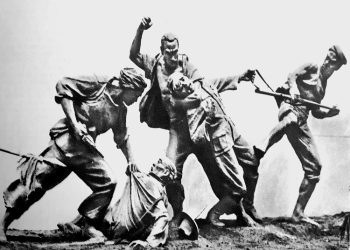
In addition to the 30 or more sculptures preserved in old Tirana, there are the “Gladiators”—two giant monuments that the sculptor’s nephew, Nikolin Kurti, is trying to see in public one day. Since their creation in 1973, they were intended to be placed at the entrance of the Durrës amphitheater. Two years after his death, the Gladiators were placed in the Archaeological Museum, also in Durrës. The family gifted them to the state on the condition they be cast in bronze. Each work is 3.5m tall and weighs 250kg.
In the passport of objects inventoried as national heritage, they are valued at 100,000 euros. They are property in Lida Paço’s name. Meanwhile, Nikolin now raises the question: “Janaq Paço never even got to have a coffee over his work. What am I supposed to do with this work?!” The National Gallery of Arts has refused to undertake any project for their exhibition. Paço cannot break through the membrane of oblivion in the institutions that train young artists, such as the Academy of Arts, where he is not studied.
Biography
Janaq Paço was born in Konitsa in 1914, attended high school in Thessaloniki, and in 1933 entered the Academy of Fine Arts in Athens. He had the fortune to study and work with Rodin’s student, Konstantinos Dimitriadis. He returned to the homeland in 1941. After the liberation, he worked as a sculpture teacher at the Artistic Lyceum in Tirana, where he eventually retired. From 1949 to 1959, he worked on the “Skanderbeg” monument located in Krujë.
In 1968, the “Skanderbeg” of Tirana was inaugurated, of which he was a co-author with Odise Paskali and Andrea Mano. In the 1960s-70s, he realized a cycle of nudes which he would shatter with his own hand in 1975. He created two busts of Fan Noli completed in 1960 and a bust of Aleksandër Moisiu.
In 1973, he completed the “Gladiators” (3.5m), intended for the entrance of the ancient Amphitheater of Durrës. In 1982, he finished the sculptural group “Skanderbeg with the People,” located at the entrance of the Historical Museum of Krujë. At the age of 70, he was awarded the title “People’s Sculptor.” In the “spring ’90” exhibition at the National Gallery of Arts, he won first prize with “Portrait of a Girl,” which the previous year had been banned from exhibition, labeled a “modernist work.” He passed away on July 11, 1991.
Interview with Sculptor Fatos Kola, former student of Janaq Paço
Anti-form has won; we have lost Paço. Do you say that Janaq Paço was forgotten while still alive?
Janaq Paço, along with Odise Paskali, is the creators of new 20th-century Albanian sculpture. Both brought the essence of world sculpture – Paskali from Italy, Paço from Greece – two homelands of sculpture. Both were creators of the first Albanian school during the time of the Monarchy, when creative forces experienced an awakening. Paço had been a student of Konstantinos Dimitriadis, a student of Auguste Rodin. From the 1940s to the 70s, Paço played a massive role as an artist and teacher; all Albanian sculptors emerged from him.
Which is his most accomplished work?
His masterpiece is the “Skanderbeg” in Krujë, realized in the 1950s, when the first steps of sculpture placed in civic squares were taking shape. This work became both his glory and his drama. It was an achievement in how a work is placed in space, how it projects into the environment – a harmony between the life of the monument and its surroundings. After this, the drama begins. The jealousy and egoism of those people who crave glory but, lacking the ability, begin to achieve it through other means.
Are you referring to what happened in the 1970s?
No, I would say it started earlier, precisely because Janaq belonged to Western school and culture. After the 1950s, Paskali and Paço increasingly withdrew. They were almost never trusted with another public work. We no longer see Janaq in the squares, except for two busts of Qemal Stafa and Avni Rustemi, which are a brilliant example of portraiture in space. To my generation, during academic years, they were never spoken of.
Did you know him closely?
Yes, I had the fortune to know him. I began my studies at the Artistic Lyceum in 1972 when he was a teacher there. There were three great teachers at that Lyceum: Janaq Paço, Naxhi Bakalli, and Ramadan Sokoli, who radiated a different kind of teaching. Janaq Paço used to say: “You must be silent yourself so that the work may speak.”
I knew him at his end, in his glory, when he was freed from all obligations, finally leaving behind that fashion of sculpture that came from the Eastern school and following his own self-belief. In 1981, I defended my diploma with a theoretical thesis on Janaq Paço.
Had you seen the works he shattered with his own hand?
In my theoretical writing, I wanted to mention to my teachers a master they never mentioned in our academic training. After his retirement, a deathly silence began for him. I was one of those who adored his sculpture; we adored him as a being who, through his silence and mission, excluded political and ideological education from our minds. This was a great lesson left by Janaq Paço. In the 1960s-70s, they began to exclude him precisely for this teaching outside ideological codes, and then they never trusted him with another monument.
So, he trusted himself. He began to shut himself in the studio; he communicated with no one; he feared that rising ideology. Those were years when artists began to be punished. It was at this moment that he realized these human figures.
Precisely here we have his reawakening as an artist. The 1970s and 80s were the years when he peaked in solitude, with the aim of escaping obligation. This is where his studies took wing – projections for city squares, a multitude of sculptures he created that we no longer have.
People speak of nudes, but we are dealing with figures that are freed from all superficial engravings and could be placed in interior settings. There is the liberation of beauty, the relationship of lovers – because there are many scenes of lovers – not love in haystacks, not love at the lathe; Janaq Paço liberates himself to love. He trusts that which is the strangest state and truth of being: love. These works have no equal in Albanian art.
The world does not yet know our Janaq Paço; perhaps it only knows the drama of the shattering of his works, of his beauties. It is the drama of a nation that shatters the beauties it kept hidden, because it was demanded by those messengers who wanted to know: what does the artist think and feel?! Thus they discovered what Janaq Paço understood and felt, and he dared to confess to a few friends, who then went and reported: “Janaq, people are being arrested.” And he, apparently, got scared. We are dealing with a drama that films cannot portray and my mouth cannot narrate – what he felt and endured!
After a dramatic time, a good portion of Albanian artists were eliminated; some took their things with them to the grave. Janaq was one of them, and that was the drama. What we have lost of him is much greater than what we have preserved. It is true that he shattered his own works, but imagines what it means to shatter your own soul. Cynics might say he shattered them himself because we didn’t shatter them for him. In 1993, the first and last exhibition of the shattered works was opened: “The Nudes and the Dictatorship.”
I had the fortune to restore them in ’91, when the first exhibition of his shattered works opened, and they are not just nudes. They are genuine plastic creations, entirely modern. He was not a nudist; his worldview aimed for the ideal of the human figure. I saw while restoring them how a true sculpture was built, outside any fashion, unburdened by European trends, the Greek school, or classical sculpture. Others made art for others. In this context, he was a free spirit relating to the absolute.
Paço’s inspirations did not come from the conceptual ideological paradigm that lived through the most dramatic century of Albanian life. Unfortunately, he was eliminated by his own students; the silence toward him is a silence that accuses. One form of elimination is to create the psychosis of annihilation. And they achieved this with Janaq Paço. Today, it is a great loss and drama that an artist like him is left with so few works. And we have only one public work while Albania is filled with landmarks, anti-forms, ideologies, and anti-inspirations which have nothing to do with humanity and love.
Thus, the artist of love was annihilated with premeditation, and pseudo-artists won. His shattered works are a symbol of truth and drama, and we need not refer to any other artist in this country, where for 50 years the most horrific violence was projected. Finally, regarding Janaq Paço, if we remain silent, what the wise say is true: “A people who do not intend to learn lessons do not deserve the right to live in this era where cultures and nations are annihilated.” Memorie.al