By Dashnor Kaloçi
Part fifteen
Memorie.al / The history of parliamentary elections in our country, or more accurately, the attempts at elections, have its origins in the era of Ottoman rule when Albania was part of the Turkish Empire. One of the first Albanian deputies elected to the first Turkish Parliament, which opened its proceedings in December 1877, was Abdyl Frashëri. However, that parliament did not last long, as it was dissolved by the Sultan himself due to the outbreak of the Russo-Turkish War. Following the dissolution of Turkey’s first parliament, there were several other attempts at elections, but they all failed for various reasons. The first regular elections in Albania were held only in 1908, when the Young Turks came to power in Turkey. Those elections were not direct but were held through representation, otherwise known as the two-tier voting system (secondary electors).
The first Turkish Parliament opened on December 10, 1908, and out of 266 deputies, 27 were Albanians elected from the four vilayets of Albania. At that time, members of the “Committee of Union and Progress” in Turkey, which included many Albanians, split and grouped into three political factions. The first group was “Union and Progress” (the Turkish-Macedonian party) with 164 deputies, consisting of 130 Turks, 5 Arabs, 1 Greek, and 15 Albanians, led by Hasan Prishtina, a deputy from Kosovo.
The second group, called “Liberal Union” (the Greek-Albanian party), consisted of 45 deputies and included 12 Albanians led by Ismail Qemali. Among the other Albanian deputies in the Turkish Parliament at the time were Esad Pashë Toptani, Nexhip Draga, Rexhep Pashë Mati, etc. After 1908, there were several other elections where Albanians continued to vote for their representatives in the Turkish Parliament, a process that lasted until November 1912, when Independence was proclaimed and Ismail Qemali was elected head of the Government.
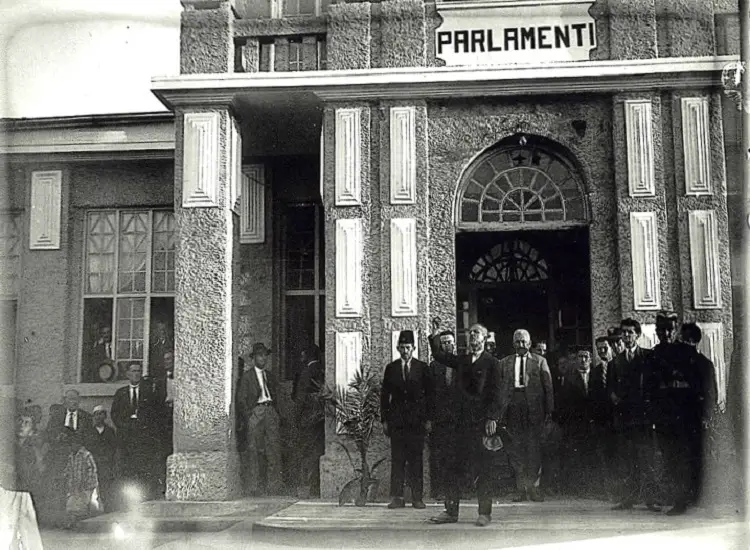
Meanwhile, the first parliamentary elections in Albania took place in the spring of 1921, as they had not been held until then due to World War I, in which Albania was also involved. The first Albanian Parliament opened on April 21 of that year; the first building of the Albanian Parliament was located where the Academy of Sciences stands today. In that parliament, 76 deputies participated, elected following a relatively regular process from the nine prefectures of the country: Berat, Durrës, Elbasan, Gjirokastra, Korça, Kosovo, Shkodra, Vlora, and the Albanian colony in the USA.
As in the past, those elections were conducted through a system of representation, or secondary electors, where based on territorial division, representatives of each province had the right to elect their deputy. The aforementioned, along with a brief history of parliamentary elections in Albania from that period until 1991, has been published by Memorie.al in previous issues. Here, we are publishing the complete Basic Statute of the Albanian Republic (the Constitution) of 1925, where a special place is held by the parliamentary election legislation of that time, as well as the Parliament’s regulations regarding the rights and duties of deputies, published by the “NIKAJ” Printing House in 1925.
Continued from the previous issue
THE PENAL CODE OF 1928
BOOK TWO: Felonies (Delicts)
Felonies Against Public Order
CHAPTER I: Incitement to Commit a Crime
- ARTICLE 272. – Anyone who, publicly, incites another to commit a crime, shall be punished for the sole act of incitement:
- With rigorous imprisonment from three to five years, if the incitement is for a felony for which a punishment greater than rigorous imprisonment is assigned.
- With rigorous imprisonment or imprisonment for up to two years, if the incitement is for a felony for which one or the other of these punishments is assigned.
- In all other cases, with a heavy fine of up to one thousand gold francs.
- In the cases provided in numbers 2 and 3, the punishment imposed on the inciter cannot exceed one-third of the maximum punishment assigned for the crime for which the incitement is made.
- ARTICLE 273. – Anyone who, publicly, defends by praising an act which the law provides for as a felony, or incites disobedience to laws, or incites hatred between different social and religious classes against one another, in a manner dangerous to public peace, shall be punished with imprisonment from three months to one year, and with a heavy fine from fifty to one thousand gold francs.
CHAPTER II: Association for Committing Crimes
- ARTICLE 274. – When five or more persons associate to commit felonies against the administration of Justice, or public faith, or public integrity, or against good customs and family order, or against the person or property, each of them shall be punished, for the sole act of association, with rigorous imprisonment from one to five years.
- If those associated roam through the fields or public roads and two or more of them carry weapons with them, or keep them in a deposited place, the punishment is rigorous imprisonment from three to ten years.
- If among these there are instigators or leaders, the punishment for them is rigorous imprisonment from three to eight years in the case shown in point I of this article, and from five to twelve years in the case shown in § II.
- To the punishments shown in this article, the placement under special surveillance of the Public Security Authority is always added.
- ARTICLE 275. – Anyone who, outside the cases provided in Article 65, provides shelter or helps or procures food for the associates or one of them, shall be punished with rigorous imprisonment for up to one year.
- He who procures food or provides shelter for one of his close relatives shall not be punished.
- ARTICLE 277. – Anyone who participates in an association directed toward committing the felonies provided in Article 273, shall be punished with imprisonment from six to eighteen months and with a heavy fine from one hundred to three thousand gold francs.
CHAPTER III: Incitement to Civil War, Formation of Armed Groups, and Public Intimidations
- ARTICLE 278. – Anyone who commits an act directed toward inciting civil war, or bringing about destruction, looting, or bloodshed in any place of the Republic, shall be punished with rigorous imprisonment from five to twenty years, and if the objective has been achieved, even partially, shall be sentenced to death.
- ARTICLE 279. – Anyone who, outside the cases provided in Article 144, with the aim of committing a specific crime, forms an armed group, or takes high command or a special function in it, for this sole act, shall be punished with rigorous imprisonment from three to seven years.
- ARTICLE 281. – Anyone who, with the sole purpose of bringing about public terror, or causing public disturbances or disorders, detonates or sets, with that purpose, dynamite or other explosive machines or items that bring about such an effect, or bombs, lethal or incendiary machines, shall be punished with rigorous imprisonment from four to ten years; and if this act is committed in a place and time where a large number of people are gathered, or during a time of public danger, alarm, public calamity, or destruction, the punishment is rigorous imprisonment from eight to twelve years.
- ARTICLE 282. – Shall be punished with rigorous imprisonment from three to twelve years:
- Anyone who counterfeits national or foreign currency that has legal or commercial tender in Albania.
- Anyone who alters genuine currency by any means, making it appears to have a higher value.
- Anyone who, having conspired with the person who committed or joined to commit the counterfeiting or alteration of currency, introduces it into the State, spends it, or by other means puts it into circulation or procures it for others with the intent to spend it or put it into circulation.
- If the legal or commercial value represented by the counterfeited or altered currency is very high, the punishment is rigorous imprisonment from five to fifteen years.
- If the intrinsic value (intrinseque) of the counterfeited coins is equal to or higher than the value of genuine coins, the punishment is rigorous imprisonment from one to five years.
- ARTICLE 283. – Anyone who alters coins of the type indicated in the preceding article, reducing their value by any means, or having conspired with the one who altered the coin in that manner, performs any of the acts indicated in point 3 of that article, shall be punished with rigorous imprisonment from one to five years.
- ARTICLE 284. – Anyone who, without having conspired with the person who committed the counterfeiting or alteration, spends or puts into circulation counterfeited or altered currency, shall be punished:
- In the cases indicated in numbers 1, 2, and 3 of article 282, with rigorous imprisonment from one to seven years;
- In the case provided in point II, with rigorous imprisonment from three to ten years;
- And in the case provided in article 283, with rigorous imprisonment from three to thirty months.
- If the offender received the currency in good faith (bonne foi), the punishment is imprisonment for up to six months or a heavy fine of up to two thousand gold francs.
- ARTICLE 285. – Anyone who counterfeits luxury gold coins (florinj luksi) or decorations manufactured by the State, or anyone who manufactures them or reduces their value by any means, as well as anyone who brings such counterfeited gold coins from abroad or puts them into circulation, shall be punished with rigorous imprisonment from one month to three years.
- ARTICLE 286. – Anyone who counterfeits or alters within Albania foreign currency, other than those indicated in number 1 of article 282, or reduces their value, or introduces them into the State, or spends them, or puts them into circulation by any other means, shall be punished with half of the punishments respectively assigned in the preceding articles.
- ARTICLE 287. – Anyone who, having purchased luxury gold coins not knowing they were counterfeited, spends or otherwise puts them into circulation, shall be punished with a heavy fine of up to two thousand gold francs.
- ARTICLE 288. – In the event that the counterfeiting performed on the currency is easily recognizable, the assigned punishment shall be reduced by one-sixth up to one-half.
- ARTICLE 289. – Anyone who manufactures or possesses tools destined solely for counterfeiting or the alteration of currency shall be punished with rigorous imprisonment from one to three years, and those tools shall be confiscated.
- ARTICLE 290. – When the punishment of rigorous imprisonment is applied for the felonies provided in the preceding articles, a heavy fine and the placement under special surveillance by the Public Security Authority shall always be added.
- ARTICLE 291. – The perpetrator of any of the felonies provided in the aforementioned articles shall not be punished if, before the authority discovers it from any other source, they manage to stop the counterfeiting, alteration, or circulation of those currencies.
- ARTICLE 292. – For the effects of penal law, papers with public credit are equated with currency.
- By the term “papers with public credit,” it is understood, besides those having legal tender as currency, those papers or tickets to the bearer (au porteur) issued by the Government, which form negotiable titles, as well as all those papers with legal or commercial tender issued by institutions upon authorization.
CHAPTER II: Counterfeiting of Seals, Public Stamps, and Their Impressions (empreinte)
- ARTICLE 293. – Anyone who counterfeits the Seal of the State destined to be placed upon government acts, or uses such a counterfeited seal, even if made by others, shall be punished with rigorous imprisonment from three to six years and a heavy fine.
- ARTICLE 294. – Anyone who counterfeits the seal of a State authority, or of a Municipality (Bashki), or of a neighborhood or village Council, or of an institute placed by law under the care of the State, a Prefecture, or a Municipality, as well as anyone who uses such seals, even if counterfeited by others, shall be punished with rigorous imprisonment from three months to two years, and a heavy fine of up to two thousand gold francs.
- ARTICLE 295. – Anyone who counterfeits stamps (damka), punches, marks, or other tools destined by law or Government order for a public certification, or uses such tools, even if counterfeited by others, shall be punished with rigorous imprisonment from one to five years, and a heavy fine from fifty to three thousand gold francs.
- The same punishments apply to anyone who, without being an accomplice in the counterfeiting, puts up for sale items upon which those counterfeited tools has been used.
- ARTICLE 296. – Anyone who counterfeits only the impressions (figurave) of the tools indicated in the aforementioned articles, by means not capable of producing others like it, and which does not constitute the use of a counterfeited tool, shall be punished with rigorous imprisonment from six months to three years in the case of article 293, and from two months to one year in the case of articles 294 and 295, and in all cases with a heavy fine of up to one thousand gold francs.
- ARTICLE 297. – Anyone who counterfeits stamps, postage stamps, and state revenue marks shall be punished with rigorous imprisonment from two to five years and a heavy fine from one thousand to three thousand gold francs.
- ARTICLE 298. – Anyone who counterfeits seals for stamped papers, for postage stamps, or for revenue marks, or watermarked papers (letra filigramin) destined to have the impressions of those seals placed upon them, shall be punished with rigorous imprisonment from one to three years, and with a heavy fine of up to five hundred gold francs.
- ARTICLE 300. – Anyone who uses stamps or postage stamps that have been previously used or cancelled shall be punished with a heavy fine of up to one thousand gold francs.
- ARTICLE 301. – Anyone who, without having been an accomplice in any of the felonies provided in the aforementioned articles, possesses counterfeited seals or stamps, or tools destined solely for the counterfeiting indicated in those articles, shall be punished with rigorous imprisonment for up to two years or a heavy fine of up to two thousand gold francs, or both combined.
- ARTICLE 302. – Anyone who, having obtained genuine official seals, stamps, punches, or marks indicated in this chapter, uses them to the detriment of another or for their own profit or that of others shall be sentenced to the punishments assigned in the aforementioned articles, reduced by one-third to one-half.
- ARTICLE 303. – Anyone who counterfeits or alters tickets for railways or other public transport services, or uses such counterfeited or altered tickets, even if made by others, shall be punished with rigorous imprisonment [and/or a fine] from fifty to one thousand gold francs.
- ARTICLE 304. – Anyone who erases or by any means removes from postage stamps, revenue marks, or any of the tickets noted in the preceding article, the marks placed to indicate that they have been used, or uses such items altered in this manner, shall be punished with rigorous imprisonment for up to three months and a heavy fine of up to five hundred gold francs./Memorie.al