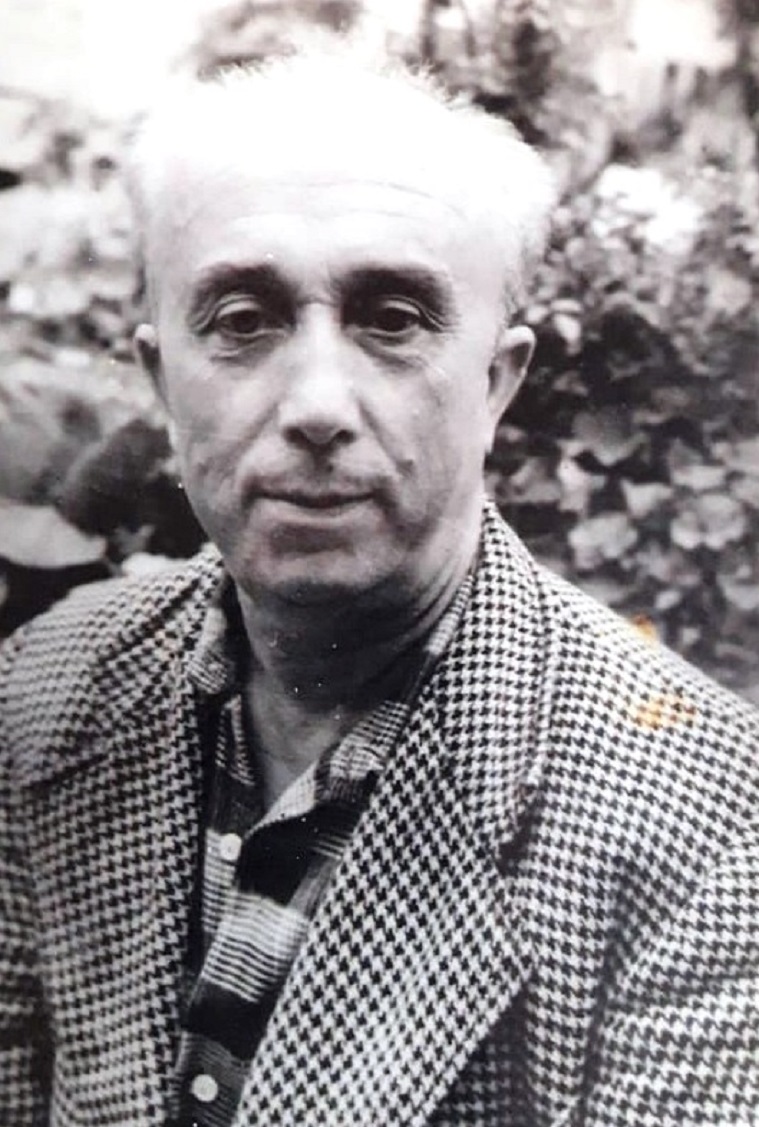
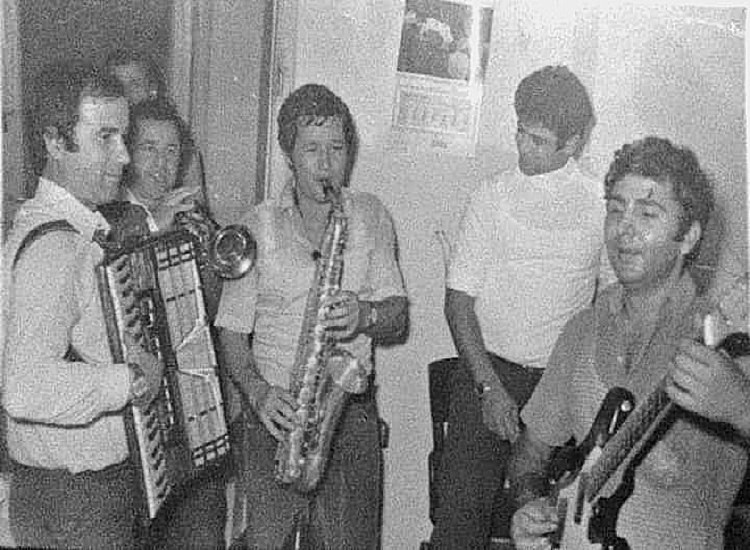
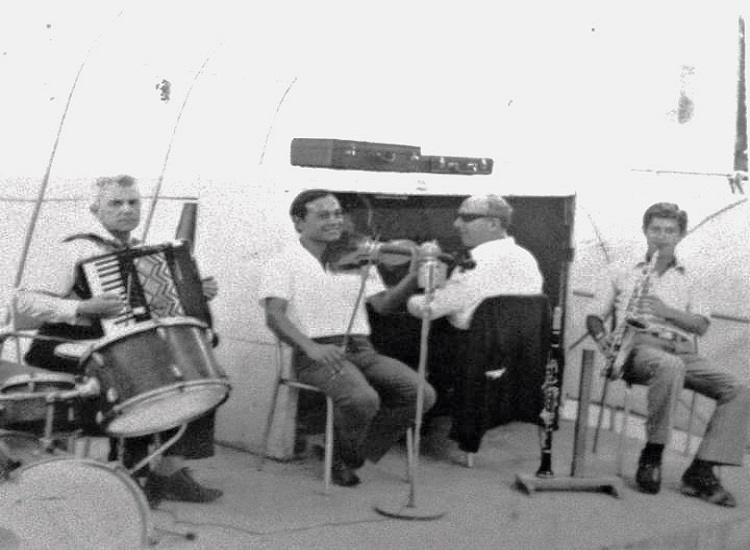
Memorie.al / In the late 1970s, the Durrës Brass Band included, among others, three members with the same last name: Bushi. It was not the first time that two or three instrumentalists from the same family contributed to the city’s most popular artistic formation. This had also occurred with artists from the Quku, Barushi, Driza, Domi, Dervishi, or Vezi families. However, the two brothers, Nikolin and Albert Bushi – the former a clarinetist and the latter a trumpeter – had joined the formation following in the footsteps of their father, the instrumentalist and teacher, Gjergj. Nearly 40 years after his death, although almost forgotten in official documentation, Gjergj Bushi remains in the memory of Durrës musicians as one of the most interesting figures of the city’s artistic backdrop in the second half of the last century.
The impetus for this article came from long telephone conversations during the coronavirus days with friends and colleagues living both inside and outside the country. The translator Pirro Dollani, from the other side of the Atlantic in Las Vegas, shared some of his early memories from when, as a violinist in the city’s Philharmonic Orchestra at the turn of the 1960s and 1970s; he had met and performed alongside Gjergj Bushi.
I had heard the name of this passionate instrumentalist and teacher from the late trumpeter Jusuf Xhumrri, author of “Kënga e Marinarit” (The Sailor’s Song), who told me that he had received his first solfège lessons from Gjergj Bushi.
We partially reconstructed the figure of Gjergj Bushi – as a man, instrumentalist, and mentor to dozens of future brass artists – with the help of one of his four children, Nikolin, now 61 years old. Although, appearing as if burdened by guilt, he repeatedly told me: “We have preserved very little of my father’s values.”
Gjergj Bushi was born in 1922 in Durrës. Some of his family members still live in the ‘Lagja e Re’ (New Neighborhood), where Gjergj grew up. He completed part of his high school education in Greece, where he first came into contact with wind instruments and for two consecutive years frequented the neighboring country’s musical circles. Even when he went to Rome for university studies, he became part of youth student musical groups.
As evidenced by his eldest son, Nikolin, Gjergj Bushi interrupted his law studies during the fascist occupation of Albania and returned to his homeland, like many other fellow students. After a few years of work, the young man’s normal life became complicated, and the communist state’s stance toward him turned very harsh. What had happened? Three of his relatives had been declared enemies, and for this reason, his name was also targeted.
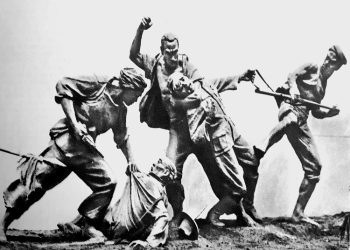
In 1951, Prenga, one of his brothers, escaped to Yugoslavia, while Gjergj had received a warning to be careful four years prior. His cousin, Captain Vlash Bushi, along with two other companions, was killed in 1947 during an attempt to escape to Italy on a military motorboat. Later, this event became the theme of the movie “Silent Duel” (Duel i Heshtur).
Another brother of Gjergj Bushi, Pashku, had completed theological studies and served briefly as a priest. His life in Durrës would also be marked by the regime. Consequently, Gjergj Bushi spoke very little, as remembered by his colleagues in the orchestral formations. He dressed very simply and associated with few people.
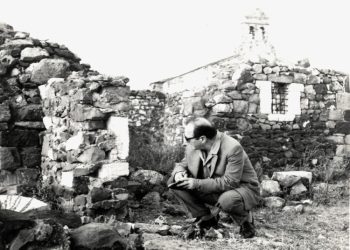
Silence became his second nature, while he began to “converse” more with books, which accompanied him even during rehearsals. He had just started his own family when Gjergj Bushi found work at the Tobacco-Cigarette enterprise. It was 1964, and until he retired, he worked as a mechanic in the Harman department – one of the most difficult and polluted areas of the factory. But this did not prevent him from dedicating every afternoon to teaching and performing.
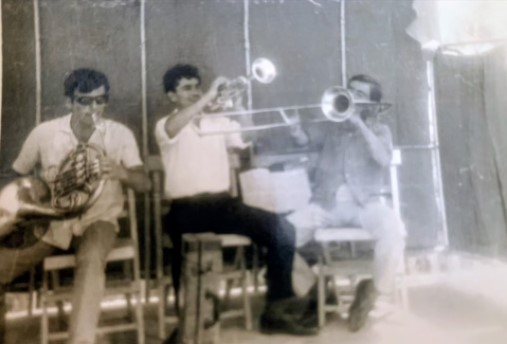
In the city’s Philharmonic Orchestra, conducted by Ermir Dizdari, which in 1967-’68 gathered professional and amateur artists not only from Durrës, Gjergj Bushi played the French horn, a challenging instrument he had long been familiar with. Musicians, singers, and instrumentalists brought to life the opera “Bijtë e Skënderbeut” (Sons of Skanderbeg), by composer Abdulla Grimci and librettist Matish Gjeluci – one of the greatest artistic undertakings in the city’s life. In one of the photos provided to us by Edmond Ziu, another violinist in the philharmonic formation, Gjergj Bushi is seen during a concert in Shkodër, standing between two of his horn students.
Meanwhile, he was a permanent member of the Durrës Musical Band, a formation with a tradition dating back to 1908. Rehearsals were held in the “Fatih” Mosque building, which had changed its purpose, and later in one of the halls of the Pioneers’ House. But the passionate man did not stop there. Every afternoon, children and young people gathered around him to attend the brass courses he led.
Generations of youth, meeting in one of the halls on the first floor of the “Aleksandër Moisiu” Palace of Culture, made way for one another, while the adults joined the orchestral formations of the city and the country. The best among them even pursued studies at the Higher Institute of Arts (today the University of Arts). Gjergj Bushi was by then a “professor without a title,” unconcerned by the small salary, but focused on the knowledge the young people were gaining.
He had only one day off per week, but even that was dedicated to preparing future artists in the town of Shijak. Gjergj Bushi’s life was very intense, yet his silence grew ever deeper. It seemed as if he replaced the words missing due to persecution with the deep sounds of the French horn, which were present in the musical background of the orchestras where he played. He read a lot, even in foreign languages, in silence, even when other musicians were resting.
“We didn’t have a library because the house was too small, and father kept his books in suitcases,” Nikolin said of his father, his voice carrying the regret that they had not preserved his scores and numerous musical and non-musical books. “He had a close friendship with Professor Vangjel Toçi, the famous archaeologist, with whom he was also related by marriage,” his son shared. Nikolin recalled that his father, through Vangjel, had donated several historical books in Italian to the library.
With the same passion as his brother, Pashku – who had played for years on the organ of the “St. Lucia” church and was one of the best masters at the Railway Goods Park – Gjergj also took care to protect his children from the danger that excessive words could bring. Unfortunately, he did not fully succeed, even though his family of six lived thanks to his labor.
“We were in our 20s. As soon as dad died in 1981, my brother Albert and I were sent word to hand in our fanfare costumes and not to show up at the Musical Band’s concerts anymore,” Nikolin recounted with pain, describing the family drama that continued even after the death of Gjergj Bushi, who passed away at the age of 59. The family’s persecution would continue even after his passing.
Gjergj Bushi is one of the forgotten figures in the history of the musical culture of Durrës. Today, thanks to his instrumentalist friends, we are bringing a part of his contribution to light, along with a group of photos provided by the family. I am sure that this article will be an incentive to further research the life and creativity of Gjergj Bushi, as part of the group of artists who gave life to important musical formations in the coastal city during the years 1960-1980.
Testimonies:
Pirro Dollani (USA), former member of the Durrës Symphony Orchestra (violin):
“Gjergj Bushi has done so much for the artistic life in Durrës, and the city should be indebted to him. Fortunately, some musicians remain who have passed through ‘Gjergj Bushi’s artistic academy’! Gjergj Bushi worked in the Industrial Cigarette Enterprise, in the Harman sector, one of the ‘terrible’ departments of the enterprise; it was impossible even to walk through that department, let alone work 8 hours, as you were suffocated by the steam and the stench of the processed tobacco. In the artistic life of Durrës, Gjergj Bushi made a very large contribution and was an extremely modest man. Just as we wouldn’t have had the string instrumentalists without a teacher like Stathi Qehaef in the 1960s-1970s, we would not have had the group of wind instrumentalists in Durrës without Gjergj Bushi.”
Ermir Dizdari, former conductor of the Durrës Symphony Orchestra:
“Gjergj Bushi, a member of the Durrës Musical Band on the French horn. He was simultaneously for many years the head of the wind instrument course, from which many instrumentalists emerged who periodically filled the ranks of the Musical Band, and played or led many musical activities in the city of Durrës.” (Taken from the book “Enver Mara, life and activity”)
Edmond Ziu, former member of the Durrës Symphony Orchestra (violin):
“I knew him before 1972, when I started playing as a violinist in the Symphony Orchestra alongside Vladimir Caku and Pirro Dollani. Gjergj Bushi spoke little and tried not to stand out; as he feared he might be followed or surveilled. He was an extremely correct, wise, and humble man. When the conductor worked with the violin section, he would read, trying to keep his foreign language books hidden from sight. I remember that in the orchestra, he sat between two young instrumentalists, Fatmir Muzhaqi and Dilaver Barushi, all three horn players. He appears the same way in the photo I keep from the Symphony Orchestras’ concert in Shkodër in 1968.”
Sandër Bonati (Italy), former conductor of the Brass Band; former member of the Durrës Symphony Orchestra (clarinet):
“Gjergj Bushi was a gentle and loving man, quiet and polite; he loved music, and that was the reason he worked with such passion. He played the horn, but had very good knowledge of brass; he had a special contribution to the Durrës Brass Band. In the late 1960s, when I conducted this formation, I had the chance to understand more of his silent and wordless nature. I don’t know what his formal education was, but he knew the theory of solfège very well indeed. The students who attended his lectures at the Palace of Culture loved him because he didn’t get angry; he was kind and quite cultured.”
Fatmir Muzhaqi (Canada), former instrumentalist in the Durrës Symphony Orchestra (horn):
“Gjergji, a good man and a devoted Catholic, who kept alive the art of amateur music in our city in the wind instrument branch. I don’t remember who suggested we attend the wind instrument courses at the House of Culture. I emphasize this moment because it was this person, and especially Professor Gjergj Bushi, who decided the fate of my future, even though I was 13-14 years old. I didn’t have the chance to have much contact, but I remember a wise, smiling man, a man who appeared as an intellectual. I have the impression he had such virtues because he was educated in Catholic colleges and transmitted such a gentle and very welcoming upbringing. Gjergj Bushi was very passionate about what he did and he transmitted this. He was a man very dedicated to family care. From his care in training students, the city’s wind orchestra had many instrumentalists who emerged from the work of this wise and always smiling man.”/Memorie.al