By Shkëlqim Abazi
Part sixty-four
S P A Ç I
The Graveyard of the Living
Tirana, 2018
(My memories and those of others)
Memorie.al / Now in old age, I feel obliged to confess my truth, just as I lived it. To speak of the modest men who never boasted of their deeds, and of others whose mouths the regime shut and buried in unmarked graves. In no case do I presume to usurp the monopoly on truth or to claim laurels for an event where I was only accidentally present, even though I desperately tried to help my friends, who tactfully and kindly avoided me: “Brother, open your eyes… don’t get involved… you only have two months and a little left!” A worry that clung to me like an amulet from the morning of May 21, 22, and 23, 1974, and even followed me in the following months until I was released. Nevertheless, everything I saw and heard those three days, I would not want to take to the grave.
Ever since August 11, 1968, my future took a tumbling turn toward Dantesque blind alleys, accompanied by the threatening curse of the “patriot” prosecutor: “You got away with it today, but next time, we’ll put you away for good!” My naive rebuttal – “How can you sentence me a second time when you haven’t even convicted me yet?!” – was followed by a cynical smirk and a devilish prophecy: “Why, you think we’ll just let you do as you please? We know what’s brewing in that enemy skull of yours, and we’ll cut the bridges before the fire even starts! We’ll give you ten years, then another ten, and another, until you leave your bones in some gallery crag!”
“If he thought like that then, why should he change now?” With these thoughts, I headed toward the entrance: “Better in prison with my comrades than facing a second interrogation!” But I bumped into the others coming from the opposite direction.
“Couldn’t you wait just five more minutes, man?” Caci rebuked me, adding: “The air has been pumping for two hours; the face of the tunnel should be cleared by now!”
“Strange: I had spent two hours in the dark, submerged in gloomy thoughts!” I followed my colleagues without uttering a word.
As the valve spat out air mixed with rust at the end of the gallery, a stain lay there like blood. We shoveled the little remaining ore into the wagon, then put up new supports and reinforced the old ones – which were moldy beyond belief – while Ymeri filled the holes Mexhiti had left unfinished five days prior. Then we went out. In the sunlight, we noticed each other splattered in red like butchers and put our hands to our heads. In those five days, the sulfuric acid had corroded the pipes, and the air pressure had turned them into springs of blood.
The rain had stopped and the weather had cleared up beautifully. Faint-hearted, we approached two policemen basking in the sun and chatting indifferently; they didn’t even flinch. I went behind the shack and peered stealthily through the cracks in the planks, but saw no one. Strange – we expected to face their fury, yet they had vanished! We looked at each other, then at the policemen, but saw nothing suspicious in their behavior; they continued their chat as if we didn’t exist.
We handed over our tools at the depot and joined the comrades waiting at the inclined plane winch until the policemen blew their whistles and we headed up the hill. No sign of the morning’s hatred was visible; only the gloom and silence that were part of the moment’s “normality.” We greeted our fellow sufferers of the second shift as usual and continued down the slope of our Calvary, as if returning from a funeral. Even at the entrance gate, we passed without issues, except for the strict search and the threat: “This is where all the enemies of the Party and Comrade Enver will leave their bones!” – a refrain we had faced for years.
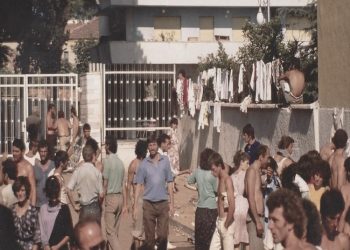
In the camp, there was a heavy military presence; they moved in and out of the barracks shouting, casting us crooked glances, but stopped at that. Meanwhile, at the door of the collective kitchen, two policemen stopped anyone trying to leave with their bowl of soup: “The party’s over, boys. You’ve had it your way long enough, but from now on, you’ll eat only in the canteen,” one of them sneered as I headed for the exit.
Like it or not, I sat in a corner and sipped the soup directly from the bowl because I had left my spoon on the shelf. When I returned to the room, I ate my bread dry. Before I could even settle, a swarm of policemen stormed in, screaming: “Everyone out!” This havoc gave me the shivers: “Your turn has come, boy; courage,” I tried to hearten myself as I followed the others. From the second and third floors, the crowd pushed one another under the screams of the police: “To the square! To the square!”
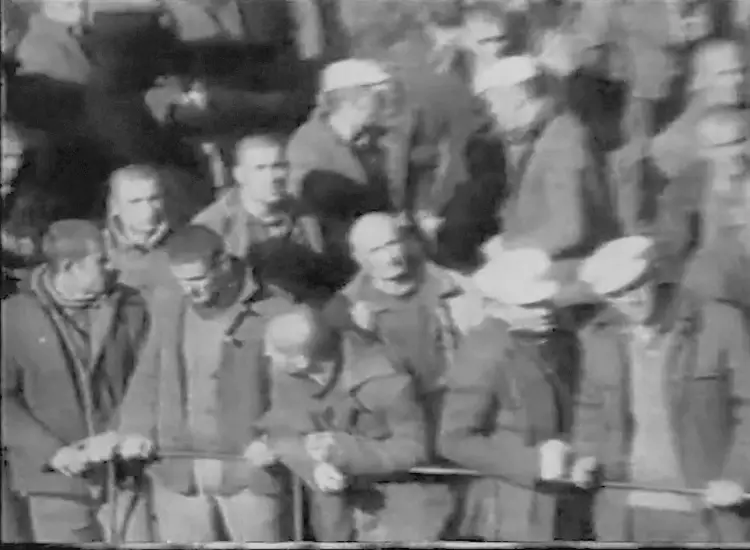
The volleyball court was packed; I squeezed onto some debris in the corner where the revolt had begun and watched, feeling like a guilty man. The appearance of the commissar on the upper level, followed by two unknown officers and the prisoner-clerk, Nasho Theodhoraqi, carrying a leather bag, raised the tension. “Wait until he flips through our files to pave the way for a re-arrest; ‘in the name of the people’!”
“Convicts!” Shahini broke the silence. “The developments of recent days showed that despite the excellent work of the Party and the Command for your political clarification, much remains to be done. It seems bourgeois ideas are so deeply rotted in your enemy heads that even deep plowing will have to tear them out by force. Certain stubborn types and so-called ideologues seek to muddy the waters and hinder others on the path to rehabilitation. But we are determined and will not give up until we bring you to your senses – by force if necessary. Therefore, from today on, you will practice two hours of politics. To ensure your effort isn’t wasted and you gain the maximum benefit, we will schedule the hours according to your shifts.”
Communist madness had reached its peak! Indeed, they had annoyed us from time to time with some proclamation or regulation, some law, or the stale speeches of “The Great One” during holidays, but such a “gem” had never been seen or heard in political prisons! To drill Marxist drivel into the heads of the enemies of Marxism, or to read them the humiliating works of Enver Hoxha, is a torture above all tortures, designed to drive the regime’s opponents to their breaking point! Only in socialist Albania could such ideological “jewels” occur!
“Today we will work through two articles from Zëri i Popullit. One is about foreign agencies and international diversion aiming to weaken the power through political unrest in coordination with internal enemies, along with Comrade Enver’s firm response in defense of Marxist-Leninist doctrine. The other speaks of the prosperity and impressive achievements of the socialist economy, which, with the brotherly help of the People’s Republic of China and Chairman Mao, has reached record results. From tomorrow on, we will plan other materials.”
Shahini turned his back, while Nasho took the newspapers out of his bag – the ones that would consume our lives from that day forward. Although the press was one of the few links to the world outside the wire, political prisoners usually read only page four and interpreted it through their own lens.
“Apparently, things aren’t going as smoothly for them as the commissar portrays! Otherwise, why would they turn a blind eye to the events in the third zone?” the clever man from Kolonja whispered in my ear after the commissar left.
“You think so?” I replied uncertainly.
“Man, do you have eyes in your head or not? Why else would they let it pass without a word and without punishing anyone?! Or do they suddenly feel sorry for us?! It seems they’re just saving their own skins, brother!” Caci figured it out.
Neither more nor less, they left the event in silence, or consciously avoided it – I won’t call it forgetting, because they never forgot! But we received the true message the next morning when they sent us to work: we never saw the “firebrand” policeman again. In all likelihood, he paid dearly for his excessive zeal. Heaven knows if they suspended him for incompetence or for violating service rules! After all, what drove the authorities to remain silent about the organized defiance, or the “extension of the Revolt,” as the police called it?
The strange behavior noticed during the following days and months became a phenomenon. When the authorities conducted inspections – which became frequent then – the subordinates turned into beasts and struck everyone: young, old, disabled, even the spies. As soon as the team left, the wolves mimicked rabbits and trembled with fear. Perhaps they feared our reaction, so they would huddle in groups of two or more when forced to come, or they would avoid the galleries and the dark corners altogether.
Our observers reached a very interesting conclusion: the local leaders were terrified of losing their jobs, or worse, they were haunted by the idea that they might end up alongside the victims as “opportunists” or “deviationists”; thus, they didn’t report everything that happened to their superiors. Sunday’s rest gave us a brief respite from the daily tension, but it didn’t last long – over a hundred policemen soon stormed the camp. So, it hadn’t been an act of indulgence, but a grander purpose: a frontal search and selective arrests.
Half of the policemen surrounded the square, while the other half fanned out through the dormitories and warehouses. They searched thoroughly, piling up everything they laid hands on – food, books, notebooks, pencils, tools, some civilian clothes – and set them on fire like barbarians. Before they had even finished, Prosecutor Zef Deda entered, accompanied by Shaban Domi, an investigator from the Rrëshen Internal Affairs Branch, and Haxhi Gora. I didn’t know what omen this visit carried four days after the revolt, but our hearts trembled, especially those of us in the third brigade who had confronted the police.
Within two minutes, the purpose of their arrival became clear when the crier called out Neim Pashai, Feti Kumaraku, Mersin Vlashi, Murat Marta, and Vladimir Prifti – the five masterminds and designers of the “Starless Flag.” Apparently, the informants had worked feverishly those days. While we expected them to add names from our May 25th group to the list, the escort left with only the five arrested. With this selective abduction, Enver’s Cerberuses sent the message that the atmosphere of the 23rd would linger long, leaving massive sorrow in its wake.
After the suppression of the Revolt, daily life changed. Besides previous hardships, verbal and physical violence increased, but above all, the mandatory reading of the press and Marxist works became a torture upon tortures, accompanied by extreme measures. Any lapse during the “political hour” was paid for dearly; many unfortunate souls would end up tied to the posts and then in solitary cells, simply because they dozed off from exhaustion, or dared to cough from a cold, sneeze from the gallery dust, or clear their throats from the congestion caused by TNT gases and other trivialities.
The policemen were successfully credited for filling the four posts at the corners of the volleyball court, each with one prisoner tied at the base, often even two. But when they filled the fifth post in front of the collective kitchen, they were rewarded with promotions. Depending on the fulfillment of this unwritten quota, they distributed medals, decorations, and even money. These incentives fueled a macabre race and incited the “revolutionary pride” of the officers; the more they punished, the higher their standing grew in the eyes of their superiors.
Thus, they began a competition among themselves to see who could devise new means of torture. A typical example remains a flagrant case: when they forcibly stuffed a dead mouse into the mouth of the elderly Arif Muja from Kukës! I believe there is no need to add more color to the beastly traits that fueled the rivalry between them. The police terror and selective arrests continued throughout the week.
Meanwhile, visits from family members were completely cut off. (I am referring to the people of Mirdita and those from Puka, Fushë-Arrëz, Lura, and the villages of Mat, Lezha, and Kukës, who came on foot or by animal), because the others could not cross the Milot Bridge – police checkpoints stopped them and turned them back without explanation.
This undeclared “state of siege” lasted until the first week of June. However, the news spread with the wind. People flocked to Spaç from every corner of the country; surprisingly, even the families of those we thought had been abandoned arrived. Concern for the lives and the aftermath of the Revolt pushed them to set aside old grudges and rush to inquire about the fate and health of their relatives.
One day in early June, the crier called me for a meeting and added: “Don’t bring any bags!”
Impossible! What could have happened for them to come empty-handed? In five years, this had never happened to me; in fact, I had often taken food along with their bags because my own weren’t enough! From the terrace, I scanned the main gate, but my view was obstructed by two cars stopped in front of it and several officers busy with a group of civilians, though none of them looked like my people. Partly from the heat, partly from anxiety, I was drenched in sweat.
“What are you waiting for? Do you want a formal invitation, your Excellency?” Malo teased from the corrugated iron gate.
An inexplicable fear made my knees weak. I stopped to catch my breath on the slope between the first barracks and the collective kitchen. My blood ran cold when I suddenly found myself face-to-face with two civilians in white coats and a local policeman. I don’t know what color my face turned, but they froze and turned to the escort:
“This one walks on his own feet? You brought us all this way for nothing?!”
“Brother, he’s a goner; it’s a miracle we found him alive!” the guard replied as he headed down the stairs.
“They are doctors, they have nothing to do with me,” I sighed in relief and followed Malo to the upper level.
“Pick up the pace, man, your parents are waiting!” but when he saw my face, he widened his eyes: “Why do you look like a lemon, man?”
I ignored Malo’s chatter; even the plural “parents” didn’t strike me, as an ignorant man like him talked nonsense all day. Besides, my “parents” had never come together because doctors had strictly forbidden my father from long trips and emotional outbursts due to a pre-infarction and blood pressure fluctuations. I went thinking only my father was waiting, but the dilemma of why he had come empty-handed still tormented me.
“Stop, or I’ll shoot!” the soldier screamed, and I halted. My father stepped out from under the eaves of the duty officer’s office and positioned himself to the right of the gate; five years of experience had taught him to act quickly and precisely.
When the policeman intervened, “Let him through,” and I approached, a woman darted out from the shadow of a car, running and screaming: “My son!” She threw herself against the wire fence, unconcerned about the blood she might draw.
“Mother!” the dilemma vanished. I reached my arm through the barbed wire and caught her fingertips, but in our haste and carelessness, we were torn by the barbs. I ignored the scratches; I just watched the tears streaming over her fingertips, mixing with the blood and dripping onto the scorched dust, where they formed a dark red stain.
As the minutes ticked away, we remained mute. Even my father stood silent, his pupils dilated, until the white coats and the guard I had passed earlier appeared from below the stairs, followed by four prisoners carrying a stretcher. They lowered it at my feet and shouted: “Duty officer, open the gate quickly, he’s dying in our hands!”
“The meeting is over, friend!” the policeman said to my father.
“Mr. Officer, we traveled all this way to see our son!” my mother pleaded, squeezing my fingers.
“Sister, instead of saying ‘thank you’ for letting you sees him, you’re trying to tell me my job!” the policeman cut her off.
“The food stayed in Milot, your brother will bring it!” my father hurried to say as he was pulled back.
“He shouldn’t bother, I have plenty, enough to last me two months!” In reality, I was down to the prison soup, but I didn’t want my brother to struggle all the way to Spaç and beg the police. Two months later, I would learn how my parents managed to “trick” the police checkpoint. A woman’s intuition far surpasses even the brightest minds and solves the dilemmas of the moment!
At the insistence of my mother—who had suffered a pre-infarction and blood pressure issues when I was first arrested—against medical advice, my parents attempted to reach Spaç for the second time in the first week of June. Fortunately, this time they “broke through” the Milot checkpoint, thanks to feminine intuition. The meeting happened, though at a distance and without an embrace; at least they saw me and I saw them, especially my mother, whom I was seeing after five years. When the car coming from Laç turned toward Mirdita, they were stopped right at the end of the “Zog Bridge,” where a chubby policeman approached the vehicle.
“Where are you going, you? And you? And you?” he asked everyone in turn, including my father.
“And you, friend, where are you going?”
“To Spaç,” my father replied.
“Get down, it’s prohibited!” the fool ordered.
“We have a son serving as a soldier there!” my mother jumped in, and her intervention changed everything.
“At the Spaç prison, eh?” the policeman softened, looking at them differently.
“Yes,” my mother affirmed.
“May God protect him, mother. It’s been a massacre these days in Spaç! People were even killed!”
“What are you saying, Mr. Officer?” she pretended to be ignorant.
“Yes, by my faith, some four or five convicts! The others they took away in irons to Tirana to sentence them again!” the chubby policeman explained and added: “May your journey be easy, mother, and may you find your son in good health!”
When he saw my brother with the bags at his feet, he turned: “And you?!” “To Spaç,” he replied. “It’s prohibited, friend, get out of the car!” After my father winked at him, my brother took the bags and joined the other travelers sharing the same plight. Thus, my parents “broke through” the checkpoint of the idiot policemen and arrived in Spaç.
“What date is you released, my son?” my mother asked, adding: “Your brothers will bring your clothes and accompany you to Berat?”/Memorie.al