From Dom Zef Simoni
Part fifteen
Memorie.al publishes an unknown study by Dom Zef Simoni, titled “The Persecution of the Catholic Church in Albania from 1944 to 1990,” in which the Catholic cleric, originally from the city of Shkodra, who suffered for years in the prisons of Enver Hoxha’s communist regime and was consecrated Bishop by the head of the Holy See, Pope John Paul II, on April 25, 1993, after describing a brief history of the Catholic Clergy in Albania, dwells extensively on the persecution suffered by the Catholic Church under the communist regime, from 1944 to 1990. Dom Zef Simoni’s full study begins with the attempts by the communist government in Tirana immediately after the end of the War to detach the Catholic Church from the Vatican, first by preventing the Apostolic Delegate, Monsignor Leone G.B. Nigris, from returning to Albania after his visit to the Pope in the Vatican in 1945, and then with pressures and threats against Monsignor Frano Gjini, Gaspër Thaçi, and Vinçens Prenushti, who sharply rejected Enver Hoxha’s “offer” and were consequently executed by him, as well as the tragic fate of many other clerics who were arrested, tortured, and sentenced to imprisonment, such as: Dom Ndoc Nikaj, Dom Mikel Koliqi, Father Mark Harapi, Father Agustin Ashiku, Father Marjan Prela, Father1 Rrok Gurashi, Dom Jak Zekaj, Dom Nikollë Lasku, Dom Rrok Frisku, Dom Ndue Soku, Dom Vlash Muçaj, Dom Pal Gjini, Fra Zef Pllumi, Dom Zef Shtufi, Dom Prenkë Qefalija, Dom Nikoll Shelqeti, Dom Ndré Lufi, Dom Mark Bicaj, Dom Ndoc Sahatçija, Dom Ejëll Deda, Father Karlo Serreqi, Dom Tomë Laca, Dom Loro Nodaj, Dom Pashko Muzhani, etc.
By Xhelal Koprencka
In the group of Fadil and Vangjel, there was also Xhelal Koprencka, a man with a political horizon, and although his bones had protruded from the suffering and illnesses, after twenty years in prison, he maintained the energy of his word and spirit – a man with Western democratic views. The three of them were executed by firing squad, and many others, after going through a very severe history, were sentenced to new years of imprisonment. Xhelali left his mother and sister behind. A rumor spread about Dom Koleci, I, and Nikollë Prenga, a good man, tested in prisons, that we were going to be arrested because we had allegedly formed a kind of Christian Democratic Party in collaboration with the Mirdita and Highlander groups.
Later, only Nikollë Prenga was arrested. We were saved by a chief camp spy; he had testified against more than eighty people. The Ministry of Internal Affairs did not rush this matter. It summoned its ready “tool” and asked him about us. But he had told them, “These two priests, they hardly ever greet me in the camp. I have nothing against them. If I were to tell the truth, I wouldn’t testify.” He had expressed that: “I am ready to testify against anyone the command asks me to, but not against the priests.” This person had a relationship with God and the devil, an enemy of the regime himself and his large tribe, from whom the regime had executed nine people, besides the other prisoners.
How will these things be resolved inside and outside the prison? A difficult task. Work in Albania. All sorts of words entered. They have broken up with China. With Great China. Literature entered the camp. We had a kind of library. We also had the radio. Only the Tirana station, which turned on at 5 in the morning. The television also entered, which was a moral aid in the camp. Only the Tirana station. We broke up with Great China. We broke up with all the great ones. They communicated it to us. But I was in prison, we were in prison, everyone was in prison, even for China. Who could say; release us now?!
The Great Pain
What? 8:00 PM on December 18, 1981, the television announces a death. Mehmet [Shehu], the Prime Minister, killed himself. What? Being a good friend, a comrade in war. What? He killed himself. A mystery! He died. Kadri [Hazbiu] and Feçor [Shehu] were quickly arrested. Kadri Hazbiu and Feçor Shehu were executed by firing squad. “It turned out to be a current: an anti-party group. Evil wolves. An old wolf in the party. The wolf among the innocent sheep.” With these lies, the source, nor the stream in Albania, were not clean. A kind of joy enters the prison. Now this matter is coming out somewhere. A little time passes. Almost a year. Enver is seen on television, aged by time, troubles, and illness. He proudly announces amnesty. He calls it widespread. For them, it is so. “There will be others,” they used to say.
Compared to the previous life, a slight change was visible in prison. Mainly, there were no arrests inside the prison. “Mehmetists” entered the prison from outside. But inside there was isolation, transfers. Transfers to Burrel prison, after being badly beaten. Beatings to knock out your brains and leave you for dead. Two people died from torture, without trial. They died secretly, evaporated from the cauldron of proletarian democracy. Another who survived the tortures is worth nothing. They have eyes, ears, nose, and mouth. They show no sign, but they cannot procreate. Beatings at this stage were frequent and severe, and the beaten prisoner was brought into the camp by squads inside the special command rooms like a corpse, for others to see and to frighten us.
Gjergj Comes to Spaç, the Mother’s Death
In these circumstances, I was saddened that Gjergj was transferred from the Ballsh section and sent to Qafë e Barit, in the Pukë district. There Gjergj became severely ill with his heart and spent almost three months with many crises in the prison infirmary. But I was happy that after those years away from each other, they brought him to Spaç, where I was. It was like a half-release for both of us. But this joy was short-lived, just a few weeks. The union was a providential act. We would experience great pain. We received the telegram indirectly from our sister, indirectly because it had been sent to our cousin, Bep Sheldia, who had been imprisoned and was with us, in which it was religiously formulated: “Mother changed life.”
It had been Wednesday, after nine in the evening, on a sweet April day, the 13th, when she went to rest in Tenzonë. She had a special devotion to Saint Joseph and had closed her eyes on the day dedicated to the Saint. Surrounded and confined where we were, this death contained the grief and affection, so heartfelt, that a human heart has for its mother. My sister would not delay coming to see us, within the month. Dressed in black, she did not shed a tear. She had cried a lot. Before us, she was a strong person, even when we could no longer endure before her. Tears prevented us from speaking, and a kind of consideration was shown even by the guard, extending our meeting by a few minutes longer.
In such a beautiful, simple letter that we received a few days later, coming from her heart, we were consoled, and she made us forget that we were in prison. Faith made us detach from earthly reality, and after those bitter first ones, a sweetness fell, tranquility entered our soul, and deep memories prevailed, of the one who rested in peace in those days of April dew and days of prayer, so that the spiritual connection would never be forgotten. The letter indicated that Mother had died of bronchopneumonia. Until the last day, she had not let go of the rosary from her hand. Towards the afternoon, she had worsened slightly more, but later she had fallen into a light sleep, and thus had given her pure spirit. At the painful burial, our sister was there for herself and for us, and many people had expressed their feelings and, in honor of her two sons who did not know in that place of long suffering, who was being buried at 4:00 PM on Thursday, April 14th. We remained three.
To the successive sorrow and sacrifices of our sister, another kind of prison is added at home, the life of solitude, leaving her as a legendary sister, of tales burdened with suffering. Next to my sister, in our house, lived a respected woman in one room, named Marika. Mrs. Marika, the wife of Gaqo Goga, a sports professor at the state high school in Shkodra, had fled before the communists entered, and Mrs. Marika, together with her daughter, Tatjana, had suffered heavy years of internment. A room was given to her, since the time when mother was alive. This woman with high qualities was a consolation and protection for my mother and sister, until I was released from prison.
But my sister will fight, and we have nothing left but the fight, the waves and the rowing in this open sea of our life. And we marched, and as time passed, we saw new events.
A face was seen on television. Tirana television showed that a former German Prime Minister for the state of Bavaria had come for a friendly visit to the homeland. It’s Strauss. Is this new politics? Western air?! Dealings with West Germany?! “Comrade Enver, what is this business”?! It is a highly civilized state. Strauss goes to church. With Germany, there are no games. The first thing they ask for is freedom of belief, the opening of churches. And this meeting happened before Enver died. “But you aren’t you going to live as long as the mountains”?! It seems that some comparisons are useless. “The mountain has no life. The mountain does not die. The mountain is buried. Those who have life, die. You have life. You are dying. You died.”
The Death of Enver Hoxha (April 11, 1985)
It is April 11, 1985, the day of your death. Mourning. National sadness. Class mourning. Those who cry for you are yours. For others, we are not saying anything, because nothing shows joy. Day of mourning, day of freedom. They ask for a telegram of condolence from the prisoners. Most do not sign it. They have not gone mad to sign it, because you separated them from their parents, wives, and children. You ruined prosperity and made everything burdensome. Leave what you did not do. You completely demonized it! You completely leave yourself in history. Generation after generation, you will be remembered for your evil deeds. A nation that was turned into black history. But I, as soon as I learned the news of his death, immediately said a deep prayer. I could not tell anyone.
Gjergj’s Release
And then life in the camp. Hopes revived. I also thought that we would be released, but my brother would come out first. I had great joy. Those three duties I had set for myself in life, they would be life for me even in prison, which became this important part of my life. Especially for the younger ones in the camp, I gave catechism, always individually, without one knowing about the other. I was the only priest left in the Spaç camp, because Dom Kolec Toni was also transferred because he was sick. I performed religious services, for people who asked to confess.
In the twelve years of prison, I dealt with writing. Together with the piece ‘The Virgin,’ which I worked on in the investigation, I made a total of thirty, forming three books with them, which would be ‘The Awakening,’ containing twelve pieces, ‘Our Homeland,’ with six pieces, with national content, and ‘Lights in the Darkness’ (The Persecution of the Church in Albania), with twelve pieces, which also contain some stories. I did these writings without using a pencil or paper, for fear that the police might discover me and the spies, who were ready to control every movement, might denounce me. And indeed, this happened to me. While I was at rest, writing down a non-compromising part of the piece ‘The School,’ which I kept in my wallet, to read in peace, as I was going up to get lunch bread, in line at the counter, the internal guard notified me to go up to the command.
As soon as I went up, the guard asked me if I had anything forbidden and put his hands in my pockets and took out the wallet, and told me: “I’m looking for this letter.” He took the letter and sent it to the command. Since it contained nothing conflicting, otherwise they would have arrested me on the spot, the internal guard returned it to me after two days. I worked on four-five lines a day in my mind, which I memorized, and so I continued and repeated the pieces every day in sequence, which were deeply rooted in my head. I took them all out computerized in my brain. The writings tired me a lot, but also made me very happy, because I thought that these long years of prison, twelve, day by day, did not pass without me doing anything.
These works were a help for me, to pass the years and also like a prayer, because my mind and heart dwelt on the high subjects of religion and social ideals. My days passed combined: with suffering and with help, with efforts and resistance, with battles and with victories. Providence worked in me. Throughout my entire prison life, God had given me great moral strength. Amid the sad, frightening days and nights, I never experienced or fell into the feelings of pain and a life with memories that burden my soul.
To Zejmen and Saranda
One day I was also transferred. My comrades felt sorry. They wanted to have a priest. They sent me to the Zejmen camp in Lezha. The journey lasted more than two hours, with a completely closed prison bus, only with a small grate with some holes, in that heat of July 30, 1986. There were twenty-seven of us inside, besides me, almost all laid up to die, throwing up what they had and what they did not have in their stomachs, all sick, and unable to communicate with the policeman who was in the car, in front. A real hell. But when we arrived, I rejoiced, because I met many priests. But this flat field camp, of Shënkollit on the bank of the Mati River, was completely different from the mountainous and wild Spaç.
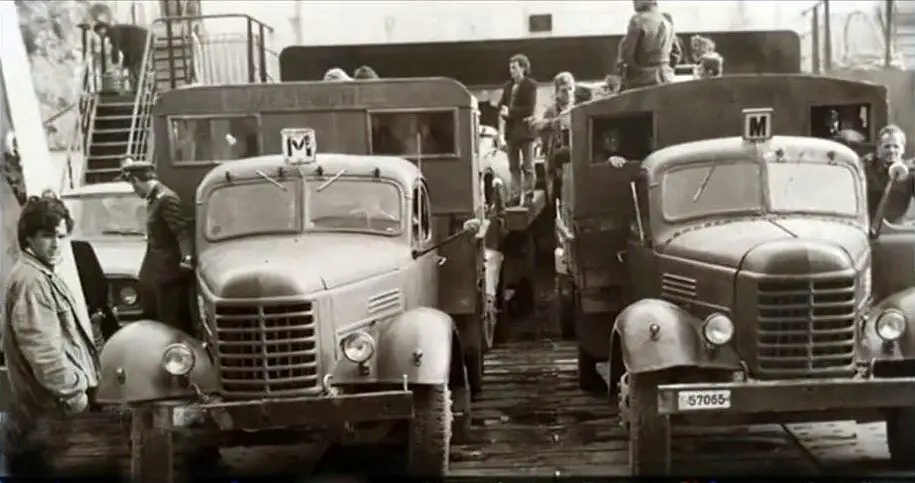
We would not stay more than eight and a half months. We would be transferred on that Friday. It was Good Friday. They woke us up at 4 AM quickly and furiously, to prepare the bundles that would leave before us, to where it was said, in Saranda. Then the roll call was made for us, the check, the arrangement in the cars, according to the lists. A total of nine large cars. They had brought in new police among them, coming from the ministry. They were sambists. Sambists who held a black whip in their hand. A very long single column, besides our cars, also fifteen others with military officers and high officials of the Ministry of Internal Affairs.
Shën Vasili Camp
A single column running at high speed towards the village of Shën Vasil, which they had named “Përparim,” near Saranda. The day was indeed beautiful, on that sunny April. But we were tied with iron handcuffs, two by two, one with the other, for almost ten hours, exhausted to the point of collapse. On this difficult journey, I had something to remember in memory of the death of Christ. It was the first time that I saw people on the road towards the back of the car, citizens and villagers, in the fields. Although I had only fourteen months left to get out of prison, in this camp, my boredom was greater, and it was combined with pain. The days of my release were truly approaching, but on the other hand, I thought that we were leaving people in their suffering. Many were old, sick, there was also someone completely paralyzed, who could not put anything in his mouth with his own hands. There was also a man blind in both eyes, whom a heartless guard hit in the face with a slap for no reason. I was used to the lively camp of Spaç, but here I had weakness and internal fatigue. Before I fell into prison, despite the difficult conditions, secret religious services were held. Now Monsignor Ernest Çoba had died, in the Tirana prison hospital. Dom Injac Gjoka was no more. Some priests were old and were not capable of services. I thought that the thread of religious life had been lost. The years, I thought, had done their work. I am also leaving. I thought that everything had deviated, had cooled down, a youth that had no interest in religion, a youth that did not know. Life seemed to me like a candle that was going out, and I, and everyone, would try to keep it burning somehow.
Exit from the Wires
It was Thursday, July 14, 1988, when I was leaving the official prison, to enter the great prison, of twenty-eight thousand square kilometers, of socialist Albania. I was leaving so many people inside those wires. Many people came and greeted me as usual, also with me. They shook hands and we hugged. They wish you a good journey and show more courage than you, stronger, while you maintain composure, a painful state, for those you leave inside. In their presence, you have a hesitant joy. There were people who, when they were released, did not wear good clothes, but came out clean, in those they had had in prison. I also came out like that. I dressed, when I came out, behind a bush, with new clothes, everything new, which my brother had brought with him.
When the guard escorted me, after him and the officer of the guard, who on this day was the command doctor, checked me and gave me the release slip, I didn’t know, so to speak, how to walk. A moment of freedom that passes quickly is abstract and concrete, and you have the concreteness of your being, the moment of your ego. There would be no freedom, because there is none. It was more something subjective, personal, accidental, and you feel a change that you moved from darkness to a force of light. With a car, we set off, passing in front of the square of the village of Shën Vasil, and took the direction through asphalted roads everywhere, making a turn for a short rest, a visit in this summer full of sea freshness, towards the beautiful terraced city of Saranda, which I was seeing for the first time.
I had the impression, just in passing, that people were moving aimlessly in the streets, and entering the shops like us, to see what was in the haberdashery, in the kitchen utensils, in the clothing and food stores. I also saw many people leaving the blue and clear water of the Ionian Sea, in this beach season. Nature was very beautiful, and it was even more beautiful for me, who was used to seeing for several years a place with little sky, some bare mountain cliffs around the camp, surrounded by wires and military guards. I now had no time to think about life, about problems. I had a celebration. My brother and sister had a celebration. I had a difficulty, because I thought that when I arrived home, I would not find my mother. This was hard for me.
Leaving that place, those wires, every inch of land, every bush, field, house seemed new to me. The low houses looked like palaces to me, and they seemed to form a large city. The car that was speeding, after we left Saranda, gave me pleasure as I saw the very beautiful fields of Dropull, which seemed to move and escape like large green, yellow, brown carpets, and the ribbons of the canals flew, in that natural background that is far from pride and noise. We marched, starting from the south of the homeland, crossing beautiful Toskëri, beside Gjirokastra, the castle where the ill-fated man was born and raised; we saw the castle of Ali Pasha Tepelena, Ballsh where Gjergji had spent years in prison, who was now in the car, towards Fier and Lushnja.
Along the way we stopped to eat lunch, at “Uji i Ftohtë” (Cold Water), an attractive place in Tepelenë. Tourist spot. Self-service restaurant. There were no drinks. Confusion in supply. Movements of young men, young women, children with plates. Meat with bones and turli (mixed vegetables), with sauce. But I was not looking for trouble. I had no business with criticism. This system is not criticized. To criticize means to point out some flaws. Here everything is bad. The evil is at the root. It is the bad seed. I saw with my eyes, but what I saw, I ground in my mind. The day passed and the sun set, everywhere the panorama, squares, hills where there was effort and blood, under the blue sky of the coast and our terrorized land. Beautiful places, steep mountains, which have made many writers describe the beauty of the flock, the joy that livestock brings to a life of peace. Memorie.al