
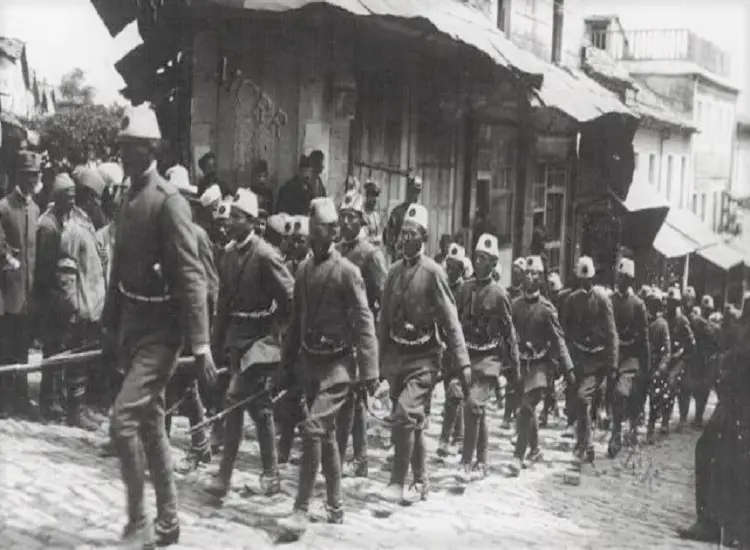
Memorie.al / The nationalism of the Alishani family, like many other families in Prizren, originated and were inspired by the defense of Albanian lands, starting from the wars for the protection of the Sanjak of Niš. Since the Balkan Wars, Albanian land was once again scorched by the Slavic armies. The sons of this family constantly lined up among those who stood up for the Arbër land, believing in the future and working for the reconstitution of Ymer Prizreni’s national state. In early April 1941, with the departure of the Yugoslav Kingdom’s military forces from Prizren towards Kukës and Gjakova, numerous patriots from Prizren and the surrounding area, aided by the Alishani family, raised the Albanian national flag on the city hall building on April 10, 1941.
This action caused clashes between the gathered crowd and Serbian phalanxes that arrived from Kukës. A bloody skirmish ensued, resulting in casualties and injuries. It was precisely through this patriotic and national activity that the bravery of the men of this family was highlighted.
From the establishment of the Albanian government in Prizren in April 1941 until November 17, 1944, the men of the Alishani family participated in the fighting for the defense of the ethnic border on the front along the border with Montenegro. Nijazi Alishani served as an escort to the city’s leaders as a bodyguard for numerous commanders, while Ferit was also in the “SS” formation.
The Alishanis were members of the nationalist organization “Balli Kombëtar” (National Front), led at that time in Prizren by the General Secretary Sali Zhuri. Nijazi, as a secretariat member, had relinquished the floor of his cafe in Tabahane to serve as the organization’s headquarters.
In the Alishani family’s house, their property in Grazhdanik, in November 1944, Reshat Karjagdiu held a meeting with members of this family and other patriots, where it was decided to resist the Slav-communist units with weapons in hand.
After World War II, Albanian nationalists who remained in the ethnic Albanian territories in former Yugoslavia clashed with the communist partisan forces in many unequal battles.
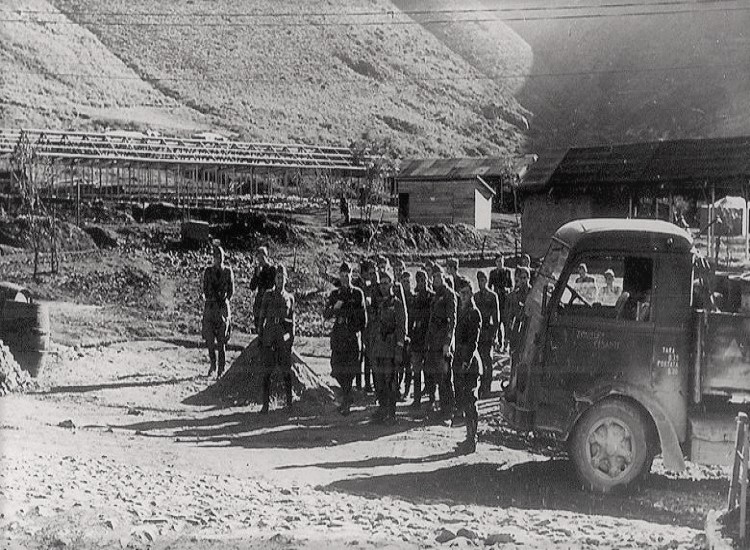
Nijazi, Llutfullah (Lluta), and Sadik were treacherously arrested and imprisoned by the Yugoslav and Albanian communist partisan forces. After a few days, Sadik managed to escape from Prizren prison. Nijazi and Llutfullah were sentenced to death by firing squad. One night, they were transported by truck with several other prisoners to be executed somewhere in Landovica.
The furious brave man, Nijazi Alishani, tested in such difficult situations, jumped from the truck and escaped the criminals’ grasp. The partisans shot bursts of fire in Nijazi’s direction, but only wounded him slightly. Llutfullah was executed along with the others.
Under these circumstances, Nijazi Alishani formed his own group, consisting of family members and like-minded individuals. In the Prizren region at this time, active nationalist groups were also operating, led by Captain Ali Rizai, Muharrem Bajraktari, Hysen Kabashi, Sefë Sadiku of Has, Qazim Bajraktari (Astrazubi), etc.
The Alishanis maintained permanent ties with the Committee of the Albanian National Democratic Organization, headquartered in Prizren. Nijazi and other Balli forces, led by Captain Ali Rizai, stayed in the Sharr Mountains in Opojë and Vërri. In early October 1944, they fought against a partisan brigade in Rudina of Kosava, which had just entered Dragash-Sharr.
In the battle fought at Guri i Zi (Black Stone) in Sharr (May 1945), besides the groups of Nijazi and Ali Rizai, Qazim Bajraktari also participated. Nationalist forces clashed with partisan-Chetniks in the Brrut mountain and near the village of Billushë (March 1945).
Rexhep and Ferit Alishani, on the night of Fitër Bajram (July 30, 1945), set out from the village of Peqan of Syreka for Drenica, intending to establish contact with any nationalist groups operating in those areas. However, along the way, near the village of Semetisht, after several hours of fighting with Yugoslav pursuit forces, father and son were killed.
Other members of this family, undeterred, continued the fight for liberation.
Nijazi Alishani and his fighters were among the 19 armed groups of Albanian resistance that participated in the “National Pledge” (Besa Kombëtare) meeting in the Dobërdol Mountains in August 1945. He was appointed political leader of the staff for the Prizren sector.
In the letter dated October 22, 1945, sent by the Council of the National Pledge to Brigadier General Hodgson, chief of the British military mission in Albania, Nijazi Alishani’s name is mentioned among the names of nationalist group leaders who distinguished themselves on the battle fronts for bravery.
When the area for the further resistance and combat operations of the nationalist forces in the Prizren sector narrowed, a part of these nationalist forces from the Prizren region, led by Muharrem Bajraktari, Reshat Karjagdiu, and Ejup Binaku, undertook the traveling odyssey towards Greece (August 25, 1946).
Nijazi Alishani and his supporters had decided to stay and continue operating in the homeland. They continued to collaborate closely with all nationalist groups and individuals who had remained in the country to fulfill the national mission. Nijazi Alishani, even though he lacked a completed academy education, distinguished himself as a strategist and fierce fighter in numerous battlefields.
The Alishanis often clashed with the pursuit forces of the OZN (Yugoslav secret police) and the Yugoslav partisan brigades. They bravely withstood all the attacks of these units. Meanwhile, the communist government, by decision of the Zhur Municipal People’s Council, no. 2062 of 24.07.1945, registered and valued the Alishanis’ property in the villages of Atmaxhe and Grazhdanik.
On 26.07.1945, all the movable property of this family in these two villages was confiscated by the communal militia and handed over to the Prizren District People’s Council.
Furthermore, the District Court in Prizren, on February 1, 1946, issued decision no. 160/45 “in the name of the people,” that the movable and immovable property of the “enemies of the people and fugitives,” the Alishani brothers, should be confiscated: the house with all the land, the inn with all the restaurant in Prizren, all the land with the hayloft and house in the villages of Grazhdanik and Atmaxhe, several hundred heads of livestock, etc.
The fighters of the Alishani Band actively operated in the Prizren area during 1946. As winter approached, they settled in safe houses (jatakë). The pursuit organs were informed by spies that Sadik was at home. On this occasion, the occupying forces arrested Sadik.
Nijazi, Shemsidin (Shema), and Gani stayed with the sisters Hilmije and Nezije Puna for the final period, where they were detected by the OZN. To avoid extensive damage by the occupying forces, the OZN agents (UDB agents) began sending emissaries for negotiations.
Among others, they sent a respected sheikh in the area. Nijazi told him: “I know in whose hands I am falling, but for the sake of the daughters of this house who sheltered us as if we were their parents, and so the residents of the neighborhood do not suffer, we surrender…”!
The occupying organs sent Nijazi to Pristina prison, where he was later executed by firing squad. Sadik, Shemsidin, Gani, and Selim Alishani were sent to Požarevac prison. All four were sentenced to harsh imprisonment. In August 1948, three of them escaped from Požarevac prison and reached Prizren in early September. Here, they secretly met their mother.
Following this act of bravery by the brothers who had escaped from prison, the communist government kept the entire remaining Alishani family under surveillance, on the condition that the brothers surrender. The three brothers crossed into the state part of the homeland (Albania) and the local government settled them in Lezhë.
Tito’s regime in Yugoslavia forcibly sent the remaining family of 18 members (mostly women and children) to the Zemun-Polje internment camp in September 1948. They were held there until September 1950, while Xhavit was kept in internment for five years (1948–’53). In this camp, the family experienced inhumane violence and repression.
The remaining part of the Alishani family did not emigrate despite continuous persecution. In the arms collection campaign in 1955–’56, Selim and Xhavit were brutally mistreated. The example of this family of martyrs demonstrates how sacred the protection of a guest is to Albanians. Ferit Alishani and his superior, Ali Aliqi from the village of Çitlluk of Priboj i Lim, became sworn brothers (vëllamër) while Ferit was in the “SS” Skanderbeg Division.
With the re-occupation of Kosovo, Ali stayed with the Alishani family. He became like a member of this family. He had also participated in several actions together with Nijazi Alishani’s fighters, even though the entire Alishani family would suffer later. They kept their house guest hidden for several years and managed to save him alive. Ali lived until 1997 in Bosnia.
From the Alishani family, two men were executed by firing squad: Llutfullah (Lluta) and Nijazi. Rexhep and Ferit were killed with weapons in hand. Sadik, Gani, Selim, and Shemsidin were imprisoned (Shemsidin was killed in Lezhë in 1963 under unclear circumstances). 18 family members suffered internment, while their shelter providers were sentenced to imprisonment, such as Isak Selimi from Peqan and the sisters Hilmije and Nezije Puna from Prizren. Memorie.al