

From Dom Zef Simoni
Part twelve
Memorie.al publishes an unknown study by Dom Zef Simoni, titled “The Persecution of the Catholic Church in Albania from 1944 to 1990,” in which the Catholic cleric, originally from the city of Shkodra, who suffered for years in the prisons of Enver Hoxha’s communist regime and was consecrated Bishop by the head of the Holy See, Pope John Paul II, on April 25, 1993, after describing a brief history of the Catholic Clergy in Albania, dwells extensively on the persecution suffered by the Catholic Church under the communist regime, from 1944 to 1990. Dom Zef Simoni’s full study begins with the attempts by the communist government in Tirana immediately after the end of the War to detach the Catholic Church from the Vatican, first by preventing the Apostolic Delegate, Monsignor Leone G.B. Nigris, from returning to Albania after his visit to the Pope in the Vatican in 1945, and then with pressures and threats against Monsignor Frano Gjini, Gaspër Thaçi, and Vinçens Prenushti, who sharply rejected Enver Hoxha’s “offer” and were consequently executed by him, as well as the tragic fate of many other clerics who were arrested, tortured, and sentenced to imprisonment, such as: Dom Ndoc Nikaj, Dom Mikel Koliqi, Father Mark Harapi, Father Agustin Ashiku, Father Marjan Prela, Father1 Rrok Gurashi, Dom Jak Zekaj, Dom Nikollë Lasku, Dom Rrok Frisku, Dom Ndue Soku, Dom Vlash Muçaj, Dom Pal Gjini, Fra Zef Pllumi, Dom Zef Shtufi, Dom Prenkë Qefalija, Dom Nikoll Shelqeti, Dom Ndré Lufi, Dom Mark Bicaj, Dom Ndoc Sahatçija, Dom Ejëll Deda, Father Karlo Serreqi, Dom Tomë Laca, Dom Loro Nodaj, Dom Pashko Muzhani, etc.
These horrific scenes in the interrogation room, terror and poison, were commanded, programmed, and controlled by the investigation branch. This one was an ordinary prisoner, whom they had brought from prison to carry out this mission in my room. Whenever they summoned him to interrogation, especially after the first month, he would receive the information, the prepared words, and the time when he was to start the attack against me. At that time, the police would stay ready to listen to the progress, because even though he was their guaranteed spy for doing such things, the Security also monitored him in the task assigned.
Nothing new. Life had become like this. “Trust, but verify”; this vile principle was the essence of the dictatorship. This was life. The bad people were fighting. Here, in the interrogation room, I felt no sentimentality, and I did not weep over our downfall, calling this condition a misfortune, but rather a trial. I was living in a fight and asked God for courage. I had a resistance for defense. I was at war, and in war, you focus on its work.
After the three months ended, they left me alone. It was better, obviously. But the days there become heavy, and a length of time is formed that never ends. You face a very serious front, that of an investigation. It is not child’s play. This is not about class warfare. There is no class warfare. Here there is torture, machinations, pressures that seek to destroy.
Here you are cut off from all people. Your only relationship is with the investigators who swell up like beasts to attack, with the stern police, with the duty officer who, at 6 AM, opens the room’s hatch and stares at you intently for a minute, with the deep eye of revolutionary vigilance. And when he closes the hatch, he slams it hard. You are an enemy. A furious enemy against the “people’s power”: “you must be severely punished, you must be severely punished, you must be crushed, annihilated. For them, you are the bed of centuries-old pus. You are the black veil. You are the agent of the Vatican, the center of global obscurantism, the representative of Anglo-American imperialism. You are the world of oppression.”
In solitude, I remembered my father who had died a few months earlier, my mother, my sister, and my behavior towards them. And I would say; “Why haven’t I done more!” I remembered many of my behaviors toward people. Every word spoken wrongly, even a thought, anger. I was doing a strong self-analysis, a self-work, a decision, a transformation. I sought to fight all my harshness and every lack of good behavior.
It seemed to me that in those ten months, I advanced greatly in virtues. I had thought I had moved forward, and I truly had, but I saw the path taken by my great shortcomings. I sought to overthrow one self, two, to form another. Here I could see who I was. People in free conditions progress little, because very few know themselves and can be free in good circumstances.
In these difficult circumstances where I found myself, I discovered a lot. Perhaps you never know yourself, but in this room of penance, with yourself, I reached a conclusion that: for almost everyone, such a harsh room is necessary, even a year in prison, to be purified, to have your conscience put in order, and to enrich your knowledge. “O people, be humble, because those who are humble suffer less than the proud.”
A ray of sunshine would enter the cell around 8:00 AM, changing according to the season. I valued the need to see a ray of sunshine. A blade of grass was all you saw around when they took us out for a few minutes for fresh air. The room was not very dark, because it had a small window up high, but when they took me to the interrogation room, I came out as if into the light and distinguished what is light and what is darkness, when I returned after one or two hours of suffering.
I did not think about what I would say according to the word of Christ, but rather dealt with myself and heaven. Since I happened to live there for approximately one liturgical year, I remembered all the feasts of Christ, Our Lady, and the Saints with joy and longing. When the feast of Our Lady of Lourdes approached, which falls on February 11th twice (the text mentions this twice), and which, this year, was the sixteenth anniversary of the celebration of my first Mass, I wrote a work which I dedicated to Our Lady of Lourdes and my mother. I titled it “The Virgin.”
I had no pencil, no paper. Even if I did, I could not write it. I formed sentences every day for about ten days and memorized them. I made that day a special feast and entrusted myself and my family to Our Lady, in these difficult struggles. I would say prayers, but not very long ones during the day and life, only those that were essential to me. And many short ejaculatory prayers. For every cross that God sent me; I tried to endure every suffering out of love for Him. This expression, “to endure out of love for Him,” means to sanctify the suffering, to accept with pleasure, with joy “for the redemption of our sins and for the need of the Holy Church.”
Thus, hunger, cold, sickness, and for all these, I thought that God does not send us more than we can bear, and I remembered the words of the Our Father: “Thy will be done!” So I accepted the imposed penances. The severe interrogation continued its work. Great disturbances came over me. They wanted to know with whom I had discussed things against the government. I told them I had not spoken to anyone. They asked me about various and numerous people with whom I had conversed. And this work went on for several sessions. But I denied it. They wanted to know to whom I had given the writings to read, to whom?
Some had read my writings, and one of them was Professor Gaspër Ugashi, my mother’s first cousin. But I denied it. They attacked me even more to find out where I had taken my writings to keep them, and they asked the questions in a way as if they had truly discovered them. Here I was very afraid. For a time, I had taken the writings to my uncle’s son, Simon Moni, for safekeeping, but later to the family of Ndok Kiri. The questions and attacks were constant, but God’s help strongly protected me from this great danger. Another major problem was that I had actually had contacts with thousands of people to whom I had rendered religious services.
The Security knew that I had performed many such services, as they brought up how the Vatican Radio station, in the Albanian language, on May 8, had mentioned Dom Martin Trushi and me for numerous services. Regarding this problem, as I told you, on June 8, 1973, I was summoned to the office of the Branch of Internal Affairs, in the presence of the Republic’s investigator, and I do not know more about this news.
At that time, the raging Women’s Congress was beginning in the Great Church, converted into a gym, and the Republic’s investigator, who would later also end up in prison, and we would both be in the same camp, in that of Zejmen, Lezhë, and Përparim, Sarandë, told me not to meet with clerics and sent word home that, during the time of the Congress, I should not leave the house. But they did not prolong the issue of my services. Another day they declared to me: “You were appointed Vicar General of the Diocese of Shkodër, and that: you have formed a diocesan council.”
For all these problems, the investigation branch, repeatedly, always made records (of the proceedings). This was done with the intention of seeing if they could find discrepancies in my statements. This is a scientific method of interrogation. During the interrogation, I struggled to maintain calm and a certain tact, and when they asked me questions, I would not answer, but would turn and ask the investigators a question myself. But they would get very angry, telling me whether it was us who asked you, or you who asked us. My goal was that with some of my indirect questions, I could truly discover something, to see where I stood.
They would take me out of the interrogation and put me in the room. Then thoughts boiled over me. I had great freedom of speech in the interrogation. Nowhere else was I freer. I spoke as I thought, I told it to them to their face. This happened when, in a very fierce session, they unexpectedly told me that I had commented very negatively on the Albanian-Chinese relations. It was a fabricated question of theirs, as they wanted to know the people with whom I had spoken. “I have not commented on anything,” I told them. And then I bravely asked them myself, wanting to know: “Creative people, a challenge: please explain to me how you maintain relations with China, while it is initiating a meeting with the United States of America.” It was the ping-pong diplomacy. They even let me speak. “You maintain friendship with a state that connects with your enemy. No clarification has been made by you.”
And these people called us out for engaging in agitation and propaganda, while they officially broke with China shortly after, because the rupture had begun. This is why we were convicted. It was time for them to deal with the writings I had made. They had taken all of them: The Life of Christ, The Life of Our Lady, Saint Joseph, A Boat in History (unfinished), and several others. All were religious in content, and at the same time social. They were calm that they had discovered them, but were angry at their hostile content, because it was against the class struggle and the proletariat.
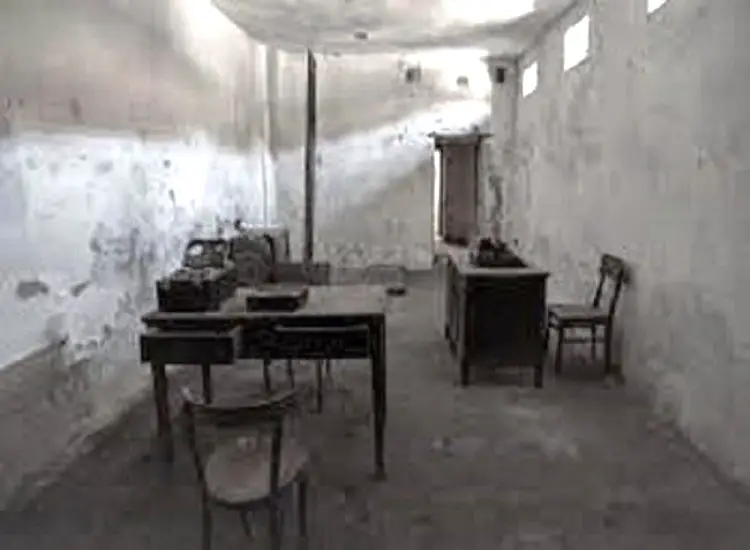
They dealt with me several times regarding these matters. One day in December, the 17th, they took me not to the room where I was being interrogated, but to the investigators’ office, which was furnished. A warm room where I stayed for four hours. There were also photographs there. They told me to underline the lines where I had written directly against them. I skipped the lines that wrote against Enver, Stalin, and their figures, without underlining them.
From time to time, they summoned me for questioning to discuss the contents of the writings: “You have written greatly against us, very bitterly against us,” they told me.
At one point, I broke my arm. Not through torture. They had not touched me physically. I was tortured by the conditions and the medications, which were wearing out my organism. I couldn’t avoid taking these medications because they put them in my lunch meal, which came out bitter. I broke my arm in the bathroom. It was the afternoon designated for bathing. The room was filled with steam and soap residue on the cement floor. It was September 23rd. My father’s death anniversary. Many memories. I also had high blood pressure. The upper part of my arm was dislocated. They were alarmed. The police immediately came, telling me; “Since you have high blood pressure, why didn’t you notify us beforehand, so you wouldn’t take the bath.” Care. If I had told them beforehand that I was not able to take a bath, they would have ordered me to do it.
The responsible policeman was afraid. They wanted to bring me out healthy for the trial. They took me to the room, supporting me by the arms. It didn’t take long for Mihajli, the military doctor of the Branch, a representative of impartial science, to arrive. He quickly set my arm. He notified me to get ready to go to the hospital quickly. Six police officers accompanied me in an ambulance. Terrible! I couldn’t move from the spot. And they, like an army, surrounded me, all armed. Tragic comedy.
The Surgeon Dr. Sula
The surgeon at the Civil Hospital, Dr. Sula, a competent doctor, fixed it very well for me. This is warmth. I felt nothing because he worked under difficult anesthesia. As I was slowly coming to, as the anesthesia was wearing off, I greeted everyone and said: “Do you see that we are all brothers? Not brothers in Lenin, but in Christ.” They were angered and disturbed. They sent me to the isolation room. And after a day or so, the severity began. Always severity. Just the sight of these faces was continuous torture.
Fantasy and Reality
In the interrogation room, I had plenty of time to deal with the earthly globe, to fantasize. I had time to do some analysis. Politics, according to my mind, came and went like baking bread. I wished I had a globe, a map. Then my fantasy began its work. I decided to arrange the geographical map in my mind. Imagination upon imagination. I had also been a geography teacher. Where should I put it? Scientists created maps. They put them on paper. Where should I put it? I put the world in the room. Europe on the floor. The United States on the ceiling. On the two large side curtains, sorrowful Africa, and Asia in some sympathetic state. Australia of the large plateaus, on the wall opposite the door. I had no business with the poles, because in winter I didn’t turn my mind there because of the ice, brrr…!
I walked on the floor for a long time. I walked in Europe. “Now I am free,” I would say. Realities are transcended through fantasy. The medications were doing their work. I would thus come out into beautiful Italy, like a saint. To France with the logic of Bossuet, Spain, still aristocratic. I would cross into West Germany, the strong woman of nations. When I went to sleep, my head happened to rest on the Soviet Union. Moscow would land on my neck. The top of my head looked towards Siberia.
I told myself, very well, that I remembered those who died in those torments. Oh, our brothers! A meditation around them and a political alliance with them. When it once seemed to me that my little toe moved under the blanket, like a tickle, I said, England, the restless one, does this. It does this work.
I had another movement of the little toe, but not here, much later, after I got out of prison. I had gone to a house for an afternoon rest. I was very tired from the road and the service. Three of us were resting: the owner of the house, Ndoc Preluca, Ndrekë Hanxhari of Rragam, and I. The day was cold, with snow falling ceaselessly, covering the mountains and forests in Qafë Mali, when someone touched my little toe and woke me up. My mind went to England. Is it England? I raised my head. No. Near the stove, at my feet, sat a little four-year-old girl with golden hair, beautiful as a mountain fairy. It was Martina. She smiled. She told me: “Say a prayer.” “England, a lady, like a politician. Martina, a very small young lady, like an idealist.”
I, certainly, have no business with the whole world. I am not the UN. But I have had business with some states. These states are: the Soviet Union with the Warsaw Pact. It is a superpower. The United States is a superpower. Tito’s Yugoslavia emerged, because they mentioned Dom Ivo Buzići and his relations with Dom Dedë Mala, who was executed. “You didn’t denounce this either,” they told me. Italy also emerged, because we had dealings with its Legation in Albania. “What was the name of its official with whom we had the connection,” they asked me. “I don’t know,” I told them. “What were the relations with the Vatican?”
They had our indictment proven, but they wanted clarifications, as they started making accusations again, saying that: “we also had relations for economic and military matters. Woe to them here. Relations only for religious issues,” I told them – “and Monsignor had the duty of conscience to inform the Holy See about the problems of the Church. This is entirely a right of the Church and its moral responsibility.” But that’s how their work was. They put the law against treason in the constitution, while violating the rights of the Church, of the individual, of institutions, and of the state itself in principle and of conscience. They defended a proletarian democracy, while trampling on spiritual justice and human rights.
They had the other audacity to ask me who had closed the churches. Two options emerged: Enver and the party or the people and the youth. A fight. A fight of facts. “Enver! The Party! Never the people. The youth are the sons and daughters of fathers, mothers, and human freedoms. The most intelligent people no longer ask about Marx, Engels. Nor Lenin and Stalin. The free world has produced the scientists. We implement the technology that they gave us. We do well. But let’s not boast. Let’s not curse the states from which we take everything.” I did not tell them these thoughts in this form, because of the consequences of the stake and the rope. But a reply had to be given, and it was this: “The churches were closed,” I told them, “by the Party and the State, not by the people, or merchants.”
“In Pukë,” I offered the argument, “the churches in the city, villages, and mountains were filled with people, despite the ideological and tactical warfare you waged against them up to the last moments of their closure.” “Yes,” the investigator told me, “we carried out the closure of institutions with popular assemblies. And the people there also decided about the Churches.” I was not cornered, because my reply was that: “you put your people there, who shouted and clapped.” Then, delighted, the investigator told me: “You will sign in the court record that you are against dialectical materialism-Leninism and the proletarian dictatorship. And we will underline it.” – “Agreed,” I told them calmly. “I will sign it.” They underlined it, and so it was done.
This session concluded, and I returned accompanied by the policeman. He was called to escort me to the cell, which became the room of my work, prayer, and thoughts. As soon as I returned, after a few minutes, I immediately thought to count with steps how long and wide the room was. I measured it. It was 5 by 3. By making the steps smaller on purpose, I produced the number 7. This is what I wanted: 7 by 3. Church numbers. I am a priest, and I pray. And the room now seemed like a church to me. “I go out and walk in Europe. There I find the filled churches, the cathedrals, the rooms, as they were filled nine years ago in Albania. Is there room for me?” I ask them. “With more desire,” they answer. “Of course.” “They tell us that the place where you are is terrible. Oh, what has befallen you? You know,” I tell them. “You have maps; you have books, knowledge, experience, and news. You know everything. It is a pity how you have your homeland, your families, and your people, because of the horrors.”
This is how I was fantasizing. And I continued how beautiful it would have been for me to have escaped at the difficult moment of arrest, before getting into the car, into the historical “Gaz” (vehicles) of the Security. To have a belt with a spring at the waist, so that as soon as I pulled it, it would open up like a large cloth, which would quickly ascend high and, like a cloud, cover me like Christ, to pass unseen towards the free world.
This work would be wonderful, because this escape would not have any consequences for my mother, brother, and sister. They would not be interned, because the escape happened in their hands. When I wanted to rise spiritually in the room, I would raise my head upwards. Above the ceiling, above the roof, is God’s heaven. On the ceiling, the armed heaven: the United States. I would say how beautiful it would be if a helicopter came through the ceiling of my room. Above the roof were the checkpoint and the guard, whose footsteps I heard during the night. The policeman would be immediately frightened. Both the police and the city.
I was becoming a broad-minded person in the isolation room. During the day, I slept for several hours, not dealing with matters of the heart, feelings, pains, and love. Both the mind and fantasy had to work. And I dealt with my map. Where? Now towards Asia. There is China. Oh, China, you want to change and we are put in prison because of you. And what a prison! You did well to us. History is playful. Only one thread remains constant, and that is Providence. You did well to us, China. Zhou Enlai must be in deep thought. Mao Zedong is old. Maybe he is dying. He might even be dead.
He died, because an arrested person, who had truly gone mad, was shouting: “May the Marxists have light! May Marx, Engels, Lenin, Stalin have light. May you also have light, oh Mao Zedong, oh uncle’s soul, oh yellow-skinned person.” That was the only news that entered the cells. Is Enver also dying, I wonder?
I said this in my mind and not with my heart, because one must not wish death upon anyone, not even an enemy. But I couldn’t say this about Enver so easily to anyone, because an “entire world” was angry at him, and then they would hate you too. They insisted on knowing with whom I had had conversations against the government. But I said I had not conversed with anyone. They continued to console me. I was very tired, very worn out, and I reached a bad state, and to put an end to these problems, I decided to speak deliberately about two people they had set on me. The Security had released two people to follow me for some time when I was outside, people who were doing their work, refined people with very secret and sneaky ties./Memorie.al