
By Reshat KRIPA
Part Twelve
Memorie.al / Arbër were standing in his corner in the hall, waiting for the arrival of the plane that would take him to another world, and he was meditating. He meditated and dreamed of the path full of nettles and thorns, through which his life had passed. He remembered the worries that had accompanied him for years. He had many passions. He wanted to become a lawyer, journalist, doctor, engineer, artist, writer, or anything else that was possible. But fate had condemned him not to reach any of the dreamed-of peaks. He encountered disappointment at every step of his life.
Continues from the previous issue
Usually, premonitions appear to people, especially when they are in difficult conditions, keeping alive the hope for better days. Such a thing happened to Xhavit, Arbër’s friend. Mid-April was approaching. That day, he approached his friends and said:
– “Listen, a great event will happen these days. I have a premonition about it.”
– “May your mouth taste of honey!” said Arbër.
– “Someone great is going to break their neck.”
It had become a habit for them to expect such events every day. They say hope dies last. It kept them alive. Precisely in those days, at 8:00 PM, the sounds of the central news programs jingle spread. After it, the face of the announcer appeared on the screen, who, in a serious tone, announced:
– “The Central Committee of the Party of Labour of Albania announces that today at ( – she said the hour – ), after an incurable illness, our great leader, the founder of the Communist Party of Albania, the strategist of great reforms that led our country to the highest peaks, Comrade, passed away. -He also said his name – ! A portrait appeared on the television screen…! The announcer continued to speak and speak about his unattainable figure. In the following days, crowds of people headed to the headquarters of the Central Committee of the APL, hitting their heads with their fists. Many people fainted. Such a thing had not happened for any other case, not even when parents’ children had died.
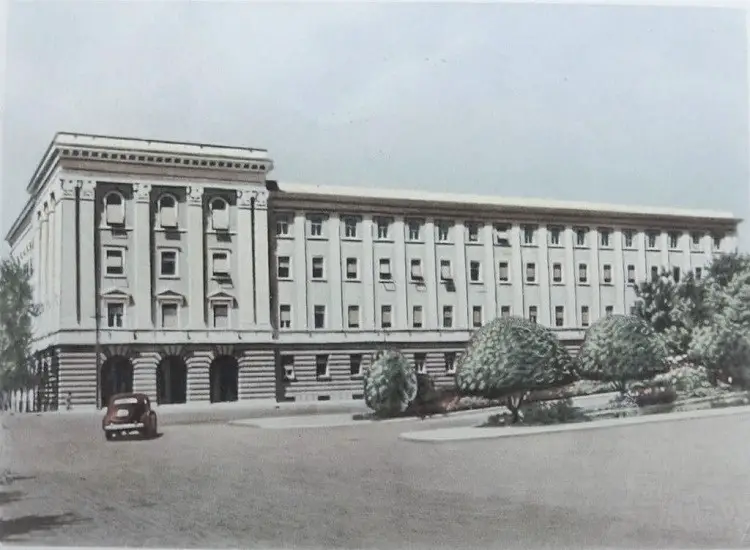
The day of the burial. The cortege from the Central Committee building heads towards the capital’s square. On both sides of the road, huge crowds, with tears in their eyes and saluting with a fist, accompanied the “great leader,” whom the country had never seen. At the head of the cortege, the claimant to the throne, accompanied by his comrades. Naturally, he gave the speech for the occasion. He spoke about the great loss the country had suffered. He spoke about the contribution of this irreplaceable man. And what he didn’t speak about. Finally, he knelt before the coffin and, saluting with a fist, cried:
– “We swear!”
The entire crowd, also kneeling, answered:
– “We swear.”
The cortege took the road to the ‘Cemetery of the Nation’s Martyrs’. The same sight. Other speeches there as well. The coffin with the body was placed in the prepared grave. Only one date was marked on the commemorative plaque of the grave, that of his birth. He had not died! For several months throughout the country, from South to North, there were no more songs and dances, no more engagements and weddings—they were canceled or postponed for another indefinite moment. A new slogan began to appear: “Let’s turn pain into strength!”
The news of the death of the “Great Leader” was also heard by the prisoners in Arbër’s camp. The joy in their ranks was extraordinary.
– “Didn’t I tell you, that I had a premonition?” said Xhavit, full of joy.
Mersini, one of those whom the prisoners called “the mice of the cells,” as they spent the entire prison period moving from cell to cell to extract some word from the prisoners and report it to their superiors, and who happened to be nearby, heard it and reported it to Officer Abazi. The officer told Xhavit:
– “Don’t rejoice, even if the American imperialists dare to step on our soil, you will be the first to disappear.”
– “You cannot destroy all of us,” Xhavit’s voice was heard.
– “Is that so?” the enraged officer asked.
He took him and, after tying him up, sentenced him to a week in solitary confinement. That month was a scene of terror for the camp. Nevertheless, many hoped that the successor would change something…! But this did not happen. That morning, Arbër woke up with a fever again. He was examined by Doctor Istrefi. His temperature was $38^{\circ}\text{C}$. The doctor decided to admit him to the infirmary. Officer Abazi was nearby. When he found out what it was about, he said:
– “You cannot admit him now. He has the strength of those who must go to work.”
The doctor insisted, but he refused. Arbër was forced to set off for work. He walked with his legs failing him. When they arrived at the canal, he had no strength left. It seemed his temperature must have risen higher. Xhavit proposed that they let him rest on the edge of the canal until evening. They also spoke with the guard who accompanied them. His comrades would work to fulfill his norm. He agreed.
Lunchtime approached. It was summer. The sun was scorching. Officer Abazi arrived. He saw that Arbër was lying down and ordered him to get up. He stood up, took the wheelbarrow, and pushed it with difficulty. When he reached the unloading spot, his strength failed him, and he fell into the pile of dirt. The other wheelbarrows coming from behind stopped.
– “What are you waiting for, unload them!” the officer ordered.
No one moved. Xhavit stepped forward and said:
– “He is our brother. We will not bury our brother!”
The lieutenant was furious. He gave the order to tie up Xhavit. Then he spoke to the others:
– “Continue!”
No one moved. Seeing that every order was futile, he turned to Mersini and a group of subservient prisoners who were among the convicts.
– “Bury him with dirt!” he ordered in a sharp tone.
They began to dump the wheelbarrows of dirt onto Arbër’s exhausted body. His muffled groans were heard. This work continued until evening. Only his head remained uncovered. When the work was over, his comrades pulled his body out of the dirt and carried him on their shoulders. It was the miracle of Doctor Istrefi and his fate that brought him back to life. The doctor, revolted, told the officer:
– “Not even the Nazis have committed such acts!”
The officer wanted to punish him, but the intervention of the camp commandant saved him, while Xhavit spent several nights in the cell, tied up with irons on his hands. When he came out of the cell, he dedicated a poem to his friend. The poem passed from hand to hand throughout most of the camp. The poem also fell into the hands of Mersini. He told Officer Abazi, who was waiting for an opportunity to punish Xhavit.
– “So you write poetry, sir,” he said. “You’re a poet, too, I see?! I’ll show you poetry now.”
He ordered him to be tied to an electric pole located in the middle of the camp. He left him there for three days without food or water. Poor Xhavit was slowly wasting away. Arbër and his comrades watched him, but they had no way to help him. Xhavit groaned and groaned, with a faint voice. At some point, the groans stopped. He had flown into the eternal world. Warm tears began to flow from Arbër’s eyes.
– “Spit on him!” the lieutenant shouted.
No one moved. Not even Mersini and some others like him dared to. They left him there all day so that everyone could see.
– “This is how anyone who violates the camp regulations will suffer,” the officer shouted.
A black shadow covered the entire camp. Arbër was the most affected. He had lost a dear friend. He had lost a man.
***
Finally, the day of his release from prison arrived. He had completed all the years of his sentence. It was September 10, 1990. On the last night, his friends gathered by his bed. Officer Abazi had been transferred to another camp. They asked permission from the internal guard to sing that evening. He allowed them. The friends sang, accompanied by a guitar that a prisoner owned. After the end of each song, a toast was raised. Custom dictated that toasts be raised with raki, but it was absent there. They substituted it with cigarettes. For every toast, one, two, or three cigarettes were thrown to the guitarist.
The Lab folk song was not missing either. The first to sing an old patriotic song, which the nationalists used to sing during the war, was Hysniu, a boy from Arbër’s region who had been convicted for creating an organization that distributed leaflets in the city:
“Open the light, oh mountains, do not stay in the clouds,
You, Father Tomorr, release a lightning bolt,
Gather, brothers, come with us,
You, Father Tomorr, release a lightning bolt.
Let us take out the weapons we have in the ground,
You, Father Tomorr, release a lightning bolt!”
When he was young, he dreamed of becoming a poet, a writer, or a theater actor. But instead of a university, he attended the school of prison, a truly hellish school that smothered him with its circles. He was surrounded by eternal hunger, by a death that stood ready at any moment to snatch him away. Add to this the tortures, about which only those who have experienced them can speak, and you will have the complete tableau of this tragic theater. But the prison also had its merits. It was a real school, a school of a special kind.
It taught him some truths that would have remained unknown if he hadn’t been there. Arbër met many rare men he hadn’t had the chance to know before. They taught him how he should act to be a human being. Now he would go out into another world. What would it be like? Would he just be exchanging the small prison for the big one called Albania? He had entered with different thoughts, and now his logic had changed. Those years of prison and the personalities he had known there had shaped his character. Since that day, he thought of nothing else but when the day of freedom would come. But would it ever come?
Nevertheless, the wind of freedom had begun to blow. In other countries of the Communist East, freedom had blossomed. Our country could not stay away. In the northern city, they had tried to tear down the monument of the Russian dictator. Two months earlier, a multitude of people had entered foreign embassies, forcing the Albanian government to allow their departure to the West. The country’s leader organized a meeting with well-known intellectuals to gain their support. But during it, many voices were heard demanding a change of the system. But the dictator did not give up. He put forward the idea of pluralism of thought, which was not supported by many participants. In a large rally held in the capital two days later, he would declare:
“We will eat grass, and we will shed blood!”
Other shouts were also heard: “Those who entered the ‘capitalist’ embassies are the excrement of the nation.” But the wolf had already lost its teeth. He could no longer bite. Arbër, now free, headed to the city’s train station. He bought a ticket. The train was leaving in two hours. He went out into the city and headed to the post office. He sent a telegram to his mother: “Arriving by the 6:30 PM train!”
At the appointed time, he was in his city. When he got off the train, he met the two people he loved most, Blerina and Petrit. They hugged and stood like that for minutes, without separating. Once the first moments passed, Arbër spoke:
– “Come, let’s go home. Now we will never be separated again.”
They set off. At home, mother Afërdita and Hektor, with Irma, were waiting for them. More hugs and wishes. Above all, the mother rejoiced. She had promised him she would wait, and she had kept her promise. Arbër, her only son, the light of her eyes, was now home. As soon as she received the telegram, she had gone to the private market, which had just resumed activity at that time, and had bought a little meat, eggs, vegetables, fruit, wine, and other things. She had prepared a dinner that she had never been able to prepare before. Among other things, a wonderful cake.
She set the table and invited them to sit down. The conversations were endless. No one mentioned the past, as if it had never existed. They drank wine and wished each other well. Only joy was visible on their faces. Especially on the mother’s face. They decided to perform the civil and wedding ceremony as soon as possible. Suddenly, in the middle of this cheer, the mother leaned back in the armchair where she was sitting. Her eyes were closed.
– “Mother,” Arbër spoke to her.
She did not answer. Arbër got up and, grabbing her by the shoulders, cried:
– “Mother, what’s wrong?!”
Again, no answer. Everyone stood up. Hektor approached and began to check her pulse.
– “She must be taken to the hospital urgently,” he said. “Petrit, go out quickly and find a car.”
Petrit rushed out. Fortunately, a passenger van was passing by on the street. He stopped it and asked for help to take the mother to the hospital. The van driver agreed immediately. After fifteen minutes, they were at the hospital. The medical staff took the mother on a stretcher and took her to the diagnostic room. Arbër and the others waited outside. After about an hour, an older doctor came out of the room.
– “Doctor, how is mother?” Arbër asked.
– “We cannot give an exact answer,” the doctor replied. “She has suffered a cardiac arrest. We are using all means to bring her back to life. You must remain calm.”
The doctor went back inside. Two more hours passed. The doctor came out of the room again.
– “Are you Arbër?” he asked the son.
– “Yes.”
– “Come inside. Mother has started whispering your name.”
He entered the room. The mother, with her eyes closed, whispered in a voice barely audible:
– “Arbër…Arbër…Arbër…”
– “I’ve come, mother, I’ve come. Open your eyes.”
Strangely, these words seemed to wake the mother. She looked at her son. With her sweet voice, a mother’s voice, she said:
– “I…promised…to wait…for you…! I kept…! My promise…! May you be…happy…son…!”
Her eyes closed, and her head dropped. Arbër screamed. The doctor grabbed him by the hand and said:
– “Courage, son, may you live long!”
The next day, the funeral ceremony took place. At the head of the cortege walked Arbër and Blerina. Behind them Hektor with Irma, as well as Andrea with Elvira and Petrit with Vojsava, followed by a large crowd of citizens that was rarely seen on such occasions. They laid her next to her mother’s grave. Death had shocked an entire city. Memorie.al