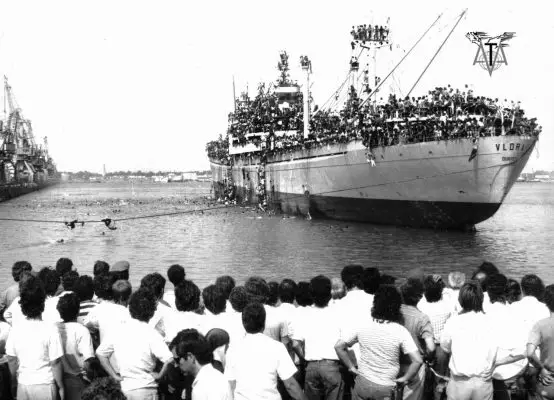
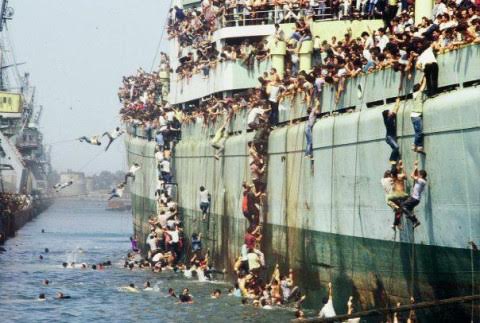
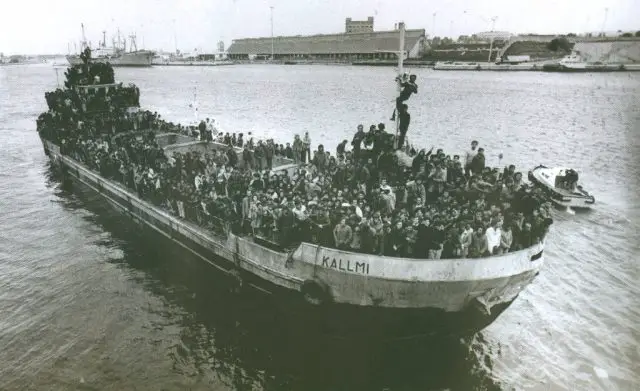
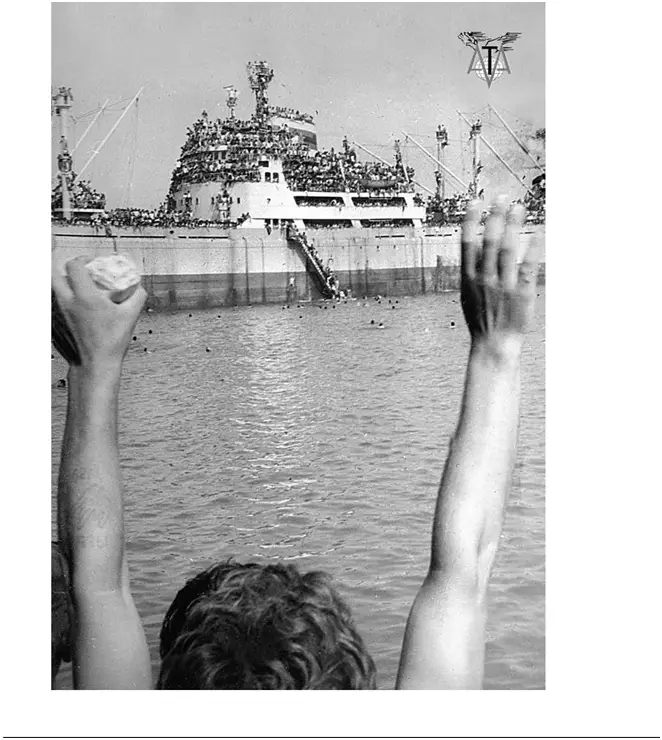
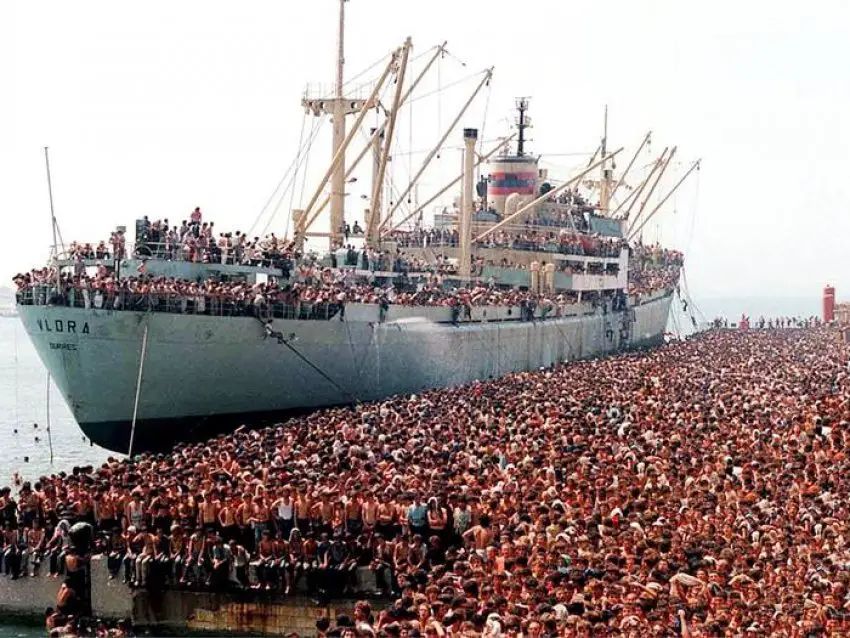
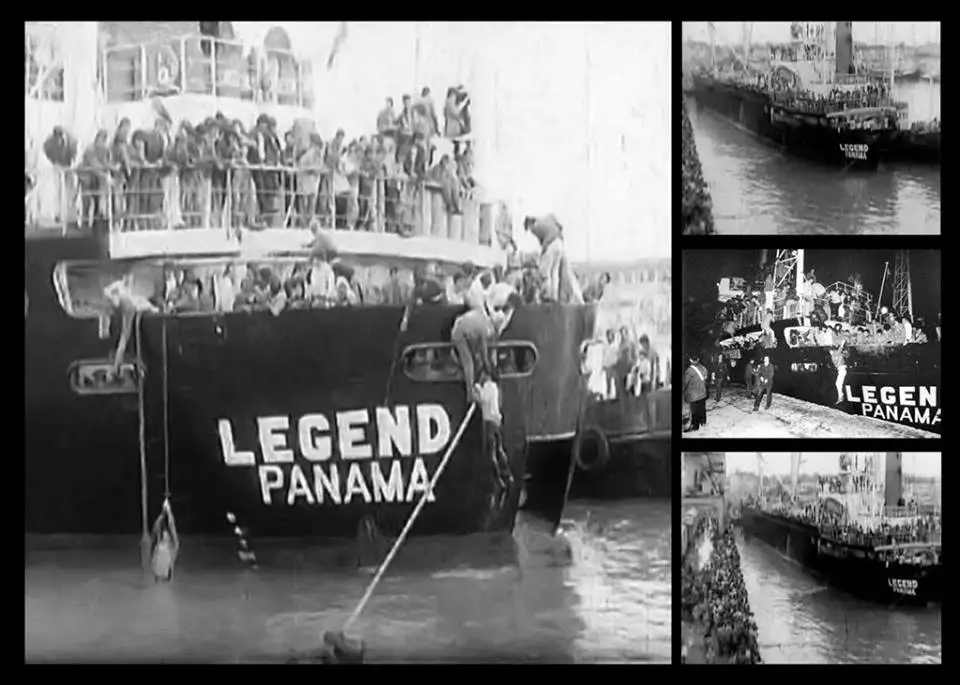

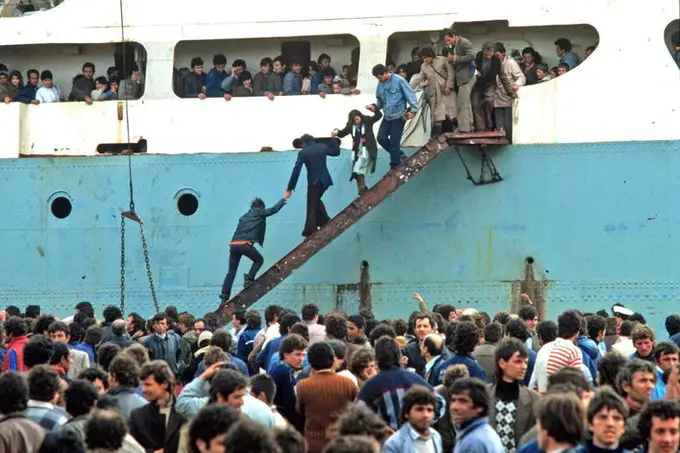
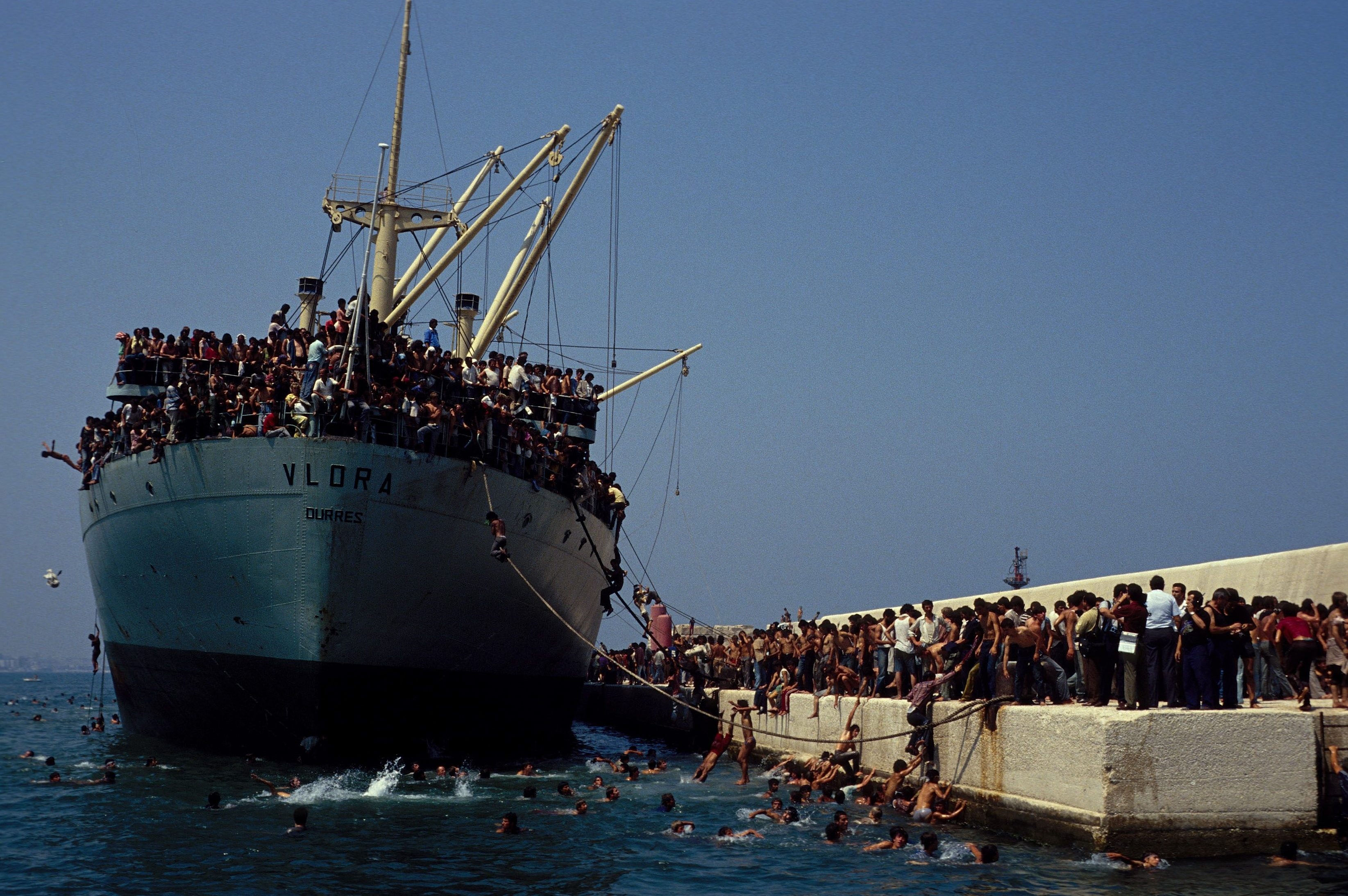
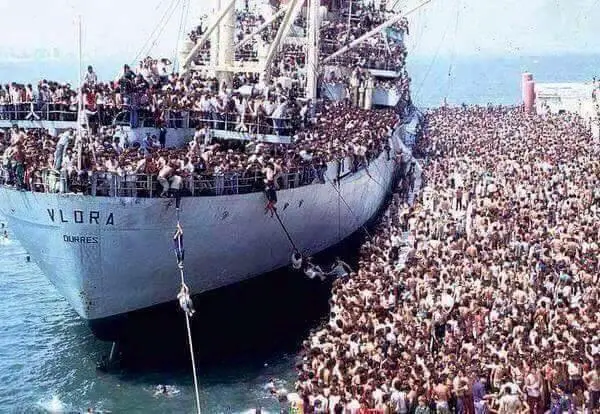

Memorie.al /publishes an unknown article by the American journalist Brenda Fowler, correspondent for the famous newspaper, the New York Times, published by her on March 9, 1991, in which her report titled “Albanian refugees, sent to shelters,” describes in detail the arrival of Albanian refugees on the Italian shores, by means of ships and fishing boats that had been hijacked in the ports of Durrës, Shëngjin and Vlorë, where on their decks about 20,000 people of various ages were overcrowded. The full report by the American journalist regarding that event which happened 31 years ago on the Italian shores, the images of which went around the world, as well as the names of the Albanians interviewed by her, regarding the reasons that had forced them to undertake that dangerous adventure, with small children in their arms.
“Worn blue trousers and jackets that seemed to come from another ideology and era are thrown away in the back alleys of Brindisi. After the Albanians discard them there, the latter receive from the local Italians new shorts or sweatshirts. In front of a school, a local Italian woman stood by the closed gate, begging a guard to let an Albanian family with a child spend the night in her house. “We want to help, but everything is so disorganized,” she said. In another corner, a group of young Albanians from the port of Durrës, from which most of the ships had departed, spoke about their 40-hour crossing, on a ship that someone had commandeered by pointing a pistol at the captain’s head, hoping to find work.”
Thus it was stated, among other things, in one of the writings dated March 9, 1991, of the famous American newspaper, the New York Times, authored by Brenda Fowler, correspondent of that newspaper for Italy, who in her report titled “Albanian refugees sent to shelters,” described in detail the drama of the 20,000 Albanian refugees who arrived on the Italian shores in the first week of March of that year, on the ships and fishing boats they had hijacked in the ports of Durrës, Shëngjin and Vlorë. For more about this, the article in question by the American journalist, Brenda Fowler, which Memorie.al publishes, informs us.
The article by the American journalist, published in the ‘New York Times’ on March 9, 1991
‘Albanian refugees, sent to shelters’
By Brenda Fowler
March 9, 1991
Fearing an epidemic among the thousands of Albanian refugees sleeping outdoors in scandalous conditions near the dock, the Italian police began to gather them this evening to move them into local schools to spend the night.
This precautionary measure seemed to be the first step in the promise made earlier during the day by the Italian Government to find temporary shelter for about 20,000 Albanians, in this region and in other Italian coastal cities, who had sailed on large and extremely rusty ships across the Adriatic.
But a spokesman for the Foreign Ministry repeated today that those who do not meet the requirements for political asylum or who do not have a visa to enter Italy, will eventually be repatriated. Complaints come from the United Nations Commission.
In a statement issued in Geneva, the United Nations High Commissioner for Refugees called on Italy to determine whether the Albanians qualify for political refugee status, before returning them back to their country.
The action to shelter the Albanians, some of whom have been here for a week, was the first decisive step taken by the authorities, in this southern port city of 92,000 inhabitants. The narrow streets of which around the port area are filled with about 16,000 Albanians, mostly young men in their 20s and 30s, but also families with children.
“During the night we will move all the Albanians into 38 local schools,” said Raffaele Belardi, the Regional Minister of Civil Protection of Brindisi, after an evening meeting with emergency and local officials. “Tomorrow morning between 8:00 and 9:00 they will have breakfast and between 12:00 and 14:00, 7,000 of them will receive a hot lunch and the rest will receive a cold lunch.”
Police said there were also about 2,000 Albanians in Monopoli, 1,200 in Bari and dozens more in other coastal towns of the Apulia region. Although officials had said earlier that no ships would be allowed to dock here, police said small ships continued to arrive today, bringing many Albanians.
But Foreign Ministry spokesman Alessandro Di Franco said the coast guard was trying to turn back ships arriving from Albania and that Italy had called on that country to stop the exodus and release 215 political prisoners.
“This would be considered a sign that would soften the great desire to leave Albania,” said Mr. Di Franco.
Emergency Aid for Albania
The Italian Government also pledged to provide about 9 million dollars in emergency aid to Tirana, in the form of food and medicine, in support of the liberalization program of the Albanian President, Ramiz Alia. Last July, Italy hosted more than 3,000 Albanians who had sought shelter in Western embassies in Tirana, but most of them went to Germany.
The scene this evening was just one of hundreds like it, of festive chaos, as traffic jams of empty ambulances, transport trucks and police convoys unfolded in the narrow streets of the port area, around groups of grim-faced Albanians and curious Italians.
Worn blue trousers and jackets, that seemed to come from another ideology and era, are thrown away in the back alleys of Brindisi. After the Albanians discard them there, the latter receive from the local Italians new shorts or sweatshirts.
In front of a school, a local Italian woman stood by the closed gate, begging a guard to let an Albanian family with a child spend the night in her house. “We want to help, but everything is so disorganized,” she said.
In another corner, a group of young Albanians from the port of Durrës, from which most of the ships had departed, spoke about their 40-hour crossing, on a ship that someone had commandeered by pointing a pistol at the captain’s head, hoping to find work.
“Just imagine, there are thousands of pistols in circulation, all over Albania and we had only 3 on this ship,” said Nini Toçi, a 27-year-old mechanic, who said he had come to Italy with some friends, because he believed it was a rich country and that there was work here.
In the middle of a group, a woman seemed shocked when told that many Albanians might have to return, if they did not qualify for political refugee status, according to the Geneva Convention.
“We are all political refugees,” said Elsa Shuka, a 33-year-old mother, who said she had spent the previous night on the open sea, with her husband and children aged 6 and 11. “I am a political and economic emigrant.”
As she spoke, a small red Fiat mounted the curb and an Italian boy got out of its doors, to give the Albanians shaving cream, a razor and some soap. The boy’s mother, Irene Cecchini, said: “I don’t think they should be allowed to stay in our country, but I and the people of Brindisi are trying to help them.”
But tension was evident in other parts of the city. Police and aid workers said hospitals were filled with Albanians who had suffered minor injuries and that the streets were almost constantly being crossed by ambulances.