

By Dashnor Kaloçi
Part Nineteen
Memorie.al / The history of parliamentary elections in our country, or more accurately, the attempts at elections, have its origins in the era of Ottoman rule when Albania was part of the Turkish Empire. One of the first Albanian deputies elected to the first Turkish Parliament, which opened its proceedings in December 1877, was Abdyl Frashëri. However, that parliament did not last long, as it was dissolved by the Sultan himself due to the outbreak of the Russo-Turkish War. Following the dissolution of Turkey’s first parliament, there were several other attempts at elections, but they all failed for various reasons. The first regular elections in Albania were held only in 1908, when the Young Turks came to power in Turkey. Those elections were not direct but were held through representation, otherwise known as the two-tier voting system (secondary electors).
The first Turkish Parliament opened on December 10, 1908, and out of 266 deputies, 27 were Albanians elected from the four vilayets of Albania. At that time, members of the “Committee of Union and Progress” in Turkey, which included many Albanians, split and grouped into three political factions. The first group was “Union and Progress” (the Turkish-Macedonian party) with 164 deputies, consisting of 130 Turks, 5 Arabs, 1 Greek, and 15 Albanians, led by Hasan Prishtina, a deputy from Kosovo.
The second group, called “Liberal Union” (the Greek-Albanian party), consisted of 45 deputies and included 12 Albanians led by Ismail Qemali. Among the other Albanian deputies in the Turkish Parliament at the time were Esad Pashë Toptani, Nexhip Draga, Rexhep Pashë Mati, etc. After 1908, there were several other elections where Albanians continued to vote for their representatives in the Turkish Parliament, a process that lasted until November 1912, when Independence was proclaimed and Ismail Qemali was elected head of the Government.
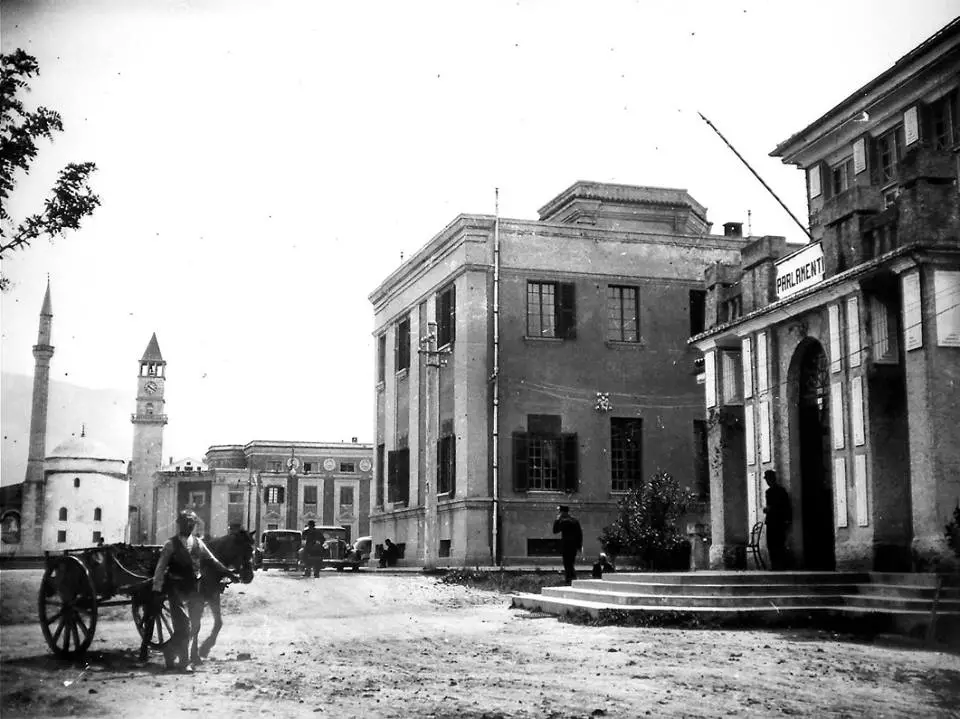
Meanwhile, the first parliamentary elections in Albania took place in the spring of 1921, as they had not been held until then due to World War I, in which Albania was also involved. The first Albanian Parliament opened on April 21 of that year; the first building of the Albanian Parliament was located where the Academy of Sciences stands today. In that parliament, 76 deputies participated, elected following a relatively regular process from the nine prefectures of the country: Berat, Durrës, Elbasan, Gjirokastra, Korça, Kosovo, Shkodra, Vlora, and the Albanian colony in the USA.
As in the past, those elections were conducted through a system of representation, or secondary electors, where based on territorial division, representatives of each province had the right to elect their deputy. The aforementioned, along with a brief history of parliamentary elections in Albania from that period until 1991, has been published by Memorie.al in previous issues. Here, we are publishing the complete Basic Statute of the Albanian Republic (the Constitution) of 1925, where a special place is held by the parliamentary election legislation of that time, as well as the Parliament’s regulations regarding the rights and duties of deputies, published by the “NIKAJ” Printing House in 1925.
Continued from the previous issue…
PENAL CODE 1928
SECOND BOOK
TITLE VII: Crimes Against Public Integrity
CHAPTER III: Abduction
ARTICLE 380. – Whoever, through violence, intimidation, or deception, removes or detains a woman over the age of 20 or an emancipated woman for the purpose of lust or marriage, shall be punished with heavy imprisonment from six months to five years.
ARTICLE 381. – Whoever, through violence, intimidation, or deception, removes or detains a person under the age of 20 for the purpose of lust or marriage, or a married woman for the purpose of lust, shall be punished with heavy imprisonment from three to seven years.
If the minor is removed or detained without intimidation, violence, or deception, but with their own consent, the punishment shall be heavy imprisonment from six months to three years.
If the abducted person has not reached the age of fifteen, the offender shall be punished with heavy imprisonment from three to seven years, even if no violence, intimidation, or deception was used.
ARTICLE 382. – If the offender of any of the crimes provided for in the preceding articles, without having committed any lustful act, voluntarily releases the abducted person, returning them to the home from which they were taken, or to their family’s home, or by placing them in a safe place at the disposal of that family, the heavy imprisonment for the case in Article 380 shall be from one month to one year; and for Article 381, depending on the case, from one month to one year or from one to five years.
ARTICLE 383. – If any of the offenses provided for in the preceding articles were committed solely for the purpose of marriage, simple imprisonment may be imposed instead of heavy imprisonment.
ARTICLE 384. – For the crimes provided for in the preceding articles, no prosecution shall be initiated except upon the request of the person entitled to file a civil suit; however, this request shall not be accepted after one year has passed from the day the crime was committed or from the day the person entitled to sue became aware of it.
The withdrawal [of the suit] has no effect once the trial of the case has begun.
CHAPTER III: Inducement to Shame or Lust
ARTICLE 385. – Whoever, to serve the lust of another, induces into prostitution (kurvëni) or pederasty a person under the age of twenty, or results in their physical demoralization, shall be punished with heavy imprisonment from three to thirty months and a heavy fine from 100 to 3,000 gold francs.
The heavy imprisonment shall be from one to six years and the heavy fine no less than 200 gold francs if the crime is committed:
- Upon a person who has not reached the age of fifteen;
- Through deceptive means;
- By an ascendant, father-in-law, mother-in-law, or their parents, by an adoptive parent, by a husband, by a guardian, or by any other person to whom the minor was entrusted for care, education, teaching, observation, or guarding, even temporarily;
- Habitually or for profit.
When two or more of the aforementioned circumstances are combined, the heavy imprisonment shall be from two to seven years and the heavy fine no less than 500 gold francs.
ARTICLE 386. – Whoever, to serve the lust of another, favors or facilitates the prostitution, pederasty, or physical demoralization of a minor under the age of twenty by the means and in the cases specified in point II of the preceding article, shall be punished with heavy imprisonment from three months to two years and a heavy fine from 100 to 5,000 gold francs; in the case of the final point of that article, the heavy imprisonment shall be from six months to three years and the heavy fine from 200 to 6,000 gold francs.
ARTICLE 387. – Whoever, to serve the lust of another, by using violence or intimidation, or by abusing authority or any other coercive means, entices (entraine) or pushes into prostitution a woman or girl over the age of twenty, shall be punished with heavy imprisonment from six months to three years and a heavy fine from 200 to 5,000 gold francs.
If the offender used only deceptive means, the punishment shall be heavy imprisonment from three months to one year and a heavy fine from 50 to 1,000 gold francs.
If the offender is a legitimate, adoptive, or legally recognized natural parent, a father-in-law, mother-in-law, or their parents, or the husband or guardian, the punishment in the first case shall be heavy imprisonment from five to ten years, and in the second case, from thirty months to five years.
ARTICLE 388. – When the offender of any of the offenses mentioned in the preceding articles is the husband, no prosecution shall be initiated except upon the request of the wife; if she has not reached the age of twenty, the person who would have had paternal or guardian authority over her as if she were unmarried also has the right to file a suit.
The conviction also results in the loss of the husband’s authority over the wife.
CHAPTER V:
ARTICLE 389. – Conviction for any of the crimes provided for in Articles 364, 365, 366, 368, 371, 385, and 387 shall result in: for ascendants, the loss of all rights granted by law by virtue of that status over the persons and property of the descendants against whom the crime was committed; and for a guardian, it results in removal from guardianship and exclusion from any other guardian office.
ARTICLE 390. – When any of the crimes provided for in Articles 364, 365, 366, 380, and 381 are committed against a public prostitute (kurve publike), the punishments specified in those articles shall be reduced by half to two-thirds.
ARTICLE 391. – When any of the offenses mentioned in Articles 364, 365, 366, 380, and 381 result in the death or bodily injury of the offended party, the punishments shall be increased by half to double in the case of death, and by one-third to half in the case of bodily injury; however, heavy imprisonment cannot be less than ten years in the first case (death) and no less than three years in the second (injury).
ARTICLE 392. – The offender of any of the crimes provided for in Articles 364, 365, 366, 368, 380, and 381 shall not be punished if, before the sentencing, they marry the offended person; in this case, prosecution ceases for all accomplices as well. Punishment applies only to other offenses, if any exist.
If the marriage takes place after the conviction, both the execution of the sentence and all penal effects thereof shall cease.
CHAPTER VI:
ARTICLE 393. – A wife who commits adultery by violating her honor with another man, or a husband who commits adultery by violating another woman, shall be punished with imprisonment from three months to three years.
Their accomplice shall face the same punishment. If the adultery is committed with a person cohabitating with or closely related to the spouse, the punishment shall be increased by one-third.
If the offense is committed while the spouses are legally separated, the punishment for each offender is imprisonment for up to six months.
ARTICLE 394. – A married man who keeps a mistress (mantenutë) in the home where his wife resides, or in a place of public notoriety, shall be punished with imprisonment from six months to three years.
The same punishment applies to the mistress if she is married; if she is legally separated or unmarried, the punishment is imprisonment from one month to one year.
ARTICLE 395. – Whoever, being unmarried, cohabitates as a spouse with a woman who is separated but not divorced, or an unmarried woman cohabitating with a separated but not divorced man, shall be punished—along with their accomplices—with imprisonment from one to eight months.
ARTICLE 396. – For the crimes provided for in the articles above, prosecution shall only be initiated upon the request of the husband or the wife. The request must necessarily include the accomplice or the mistress.
The request is not accepted if three months have passed since the day the offended party became aware of the act.
ARTICLE 397. – Withdrawal of the suit may occur even after conviction, at which point the execution and penal effects of the sentence shall cease. The death of the complaining spouse has the same effect as a withdrawal.
CHAPTER VII: Bigamy
ARTICLE 398. – Whoever, while bound by a valid marriage, enters into another marriage, and whoever, being free, marries a person bound by a valid marriage, shall be punished with heavy imprisonment or simple imprisonment from two to five years.
If the offender deceived the person they married by convincing them they were free to marry, the punishment shall be heavy imprisonment from five to ten years.
ARTICLE 399. – The statute of limitations for the penal suit of bigamy begins from the day one of the two marriages is dissolved or the second is declared void due to bigamy.
CHAPTER VIII: Crimes Against the Origin of Infants
ARTICLE 400. – Whoever, by hiding or swapping an infant, causes the loss or change of their civil status, or causes an inexistent infant to appear in the civil registries, shall be punished with heavy imprisonment from two to five years.
ARTICLE 401. – Whoever, outside the cases provided in the preceding article, abandons a legitimate or recognized natural infant in a foundling home or other charitable place, or presents them there while concealing their civil status, shall be punished with heavy imprisonment from three months to two years.
If the offender is an ascendant of the infant, the punishment is heavy imprisonment from six months to five years.
ARTICLE 402. – If the offender commits any of the crimes in the preceding articles to save their own honor, or that of their wife, mother, descendants, adopted daughter, or sister, or to avert imminent suffering, they shall be punished with imprisonment from one month to two years.
TITLE IX: Crimes Against the Person
CHAPTER I: Homicide
ARTICLE 403. – Whoever, with the intent to kill, causes the death of another, shall be punished with heavy imprisonment for no less than twenty years.
ARTICLE 404. – The punishment shall be life imprisonment if the homicide is committed:
- Against a spouse, brother, sister, adoptive father or mother, adoptive son or daughter, father-in-law or mother-in-law, son-in-law or daughter-in-law;
- Against a member of the Legislative Chambers or a State official due to their official functions;
- By using poisonous substances;
- By treachery or through asphyxiating methods;
- Against a pregnant woman.
The same punishment applies to anyone who kills two persons, whether at the same time or at different times, even if the period for the statute of limitations has passed between the two homicides.
ARTICLE 405. – The death penalty shall be imposed on anyone who commits the offense provided for in Article 403 if:
- They kill any of their legitimate ascendants or descendants, or their natural mother or father, or natural son or daughter, provided that the natural filiation is legally recognized or declared;
- They kill with premeditation;
- They kill driven solely by a barbaric or criminal spirit, or by using torture or causing severe suffering;
- They kill by means of fire, drowning, sinking, or any other means specified in Title VII of this Book (Public Integrity);
- They kill to prepare, facilitate, or execute another crime, even if the latter is not completed;
- Simultaneously with or immediately after committing a crime, they kill to secure the benefit, or because they find it impossible to achieve their intended goal;
- They kill to hide a crime, to destroy traces or evidence, or to otherwise secure impunity for themselves or others.
The same punishment applies to anyone who kills more than two persons, whether at the same time or at different times, even if the period for the statute of limitations has passed between these homicides.
ARTICLE 406. – In the cases provided for in the preceding articles, if death would not have occurred without the combination of conditions that existed before the crime but were unknown to the offender, or other causes that arose after the offender’s act and were independent of it, the punishment shall be:
- Under Article 403: heavy imprisonment from seventeen to twenty-two years;
- Under Article 404: heavy imprisonment from twenty to thirty years;
- Under Article 405: life imprisonment.
ARTICLE 407. – Whoever, with acts intended to cause bodily injury, causes the death of someone, shall be punished:
- Under Article 403: with heavy imprisonment from eight to twelve years;
- Under Article 404: with heavy imprisonment from twelve to fifteen years;
- Under Article 405: for no less than fifteen years.
If death would not have occurred without the combination of prior conditions unknown to the offender, or causes arising after the act and independent of it, the punishment shall be:
- Under Article 403: heavy imprisonment from five to ten years;
- Under Article 404: from eight to twelve years;
- Under Article 405: from ten to fifteen years. / Memorie.al
Continued in the next issue…