By Ahmet Xhavit Delvina
Part Two
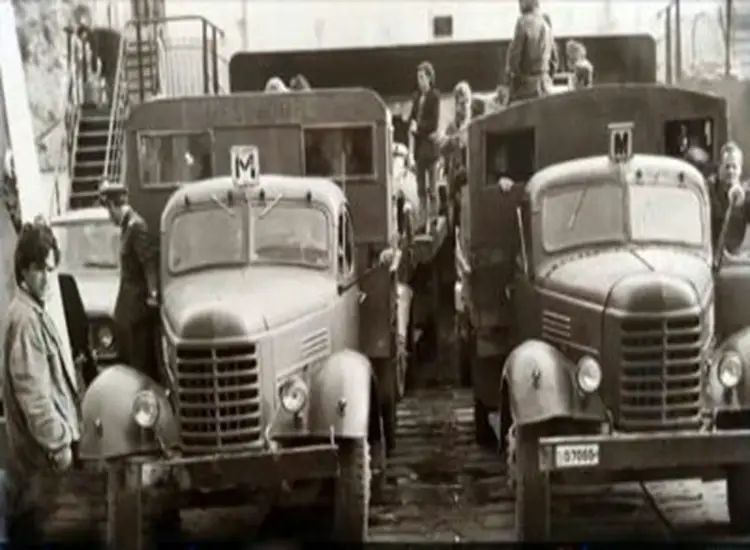
Memorie.al / I am writing about this event, which I handled as a “conductor,” and it left an unforgettable impression on me because it is a small fragment of our people’s lives during that dark period of communist rule. It was the year 1954; I set off for Tirana from Burrel at 4:00 AM. I was a soldier in Unit 7620, serving in the workshop as an auto mechanic. On this occasion, I was taking a military truck – a GMC (“James”) type, Made in USA – to the Central Army Workshop for a major overhaul. This type of war machine, I must say, was completely unsuitable for civilian transport; its design featured an open driver’s cabin with a canopy, but in this case, the canopy was missing, and the windshield did not exist due to a previous collision. The cargo bed was entirely metallic, with low sides only 25 cm high, and it too was uncovered without a canopy or any side supports. It was February, the peak of that fierce winter.
Continued from the previous issue
Back then, they smiled at me and allowed me to complete the “assigned service” given by Captain Gjoni – as they called him there – and no one bothered me again until I reached Tirana. We drivers of that era used such maneuvers to escape the difficult situations that frequently arose, and often we succeeded. Around 10:00 AM, I arrived in Tirana and let them off behind the National Bank. We bid each other a very heartfelt farewell amidst a chorus of religious blessings and superlative praise.
For a moment, I called out to the woman who had been sitting in front of me during the whole trip – the one who had called me “comrade partisan” – and told her in confidence, asking her not to tell the others, that “Inshallah (God willing), we shall meet again in a Free Albania,” without the communist criminals. Then, I revved the engine and disappeared under the waves of their salutes.
When I returned home, I told my mother and father about the journey and whom I had transported, and above all, that I had spent all the “provisions” – bread and meat – that I had taken for them. Therefore, I told my father: “Humanism based on religion leaves you without bread.”
– “Please, do not speak like that; may God make it ‘hallall’ (rightfully earned) for them and for you.”
I begged them never to tell anyone my name; I was afraid because, in the end, I had cursed communism severely, and “anyway” (as they say in Tirana), things did not go as I wished. Everything was soon revealed, and both sides, on different occasions, would recount this adventurous story of mine. They often said that blood is blood – which Xhavit, who used to stir up trouble around the “white” apartment buildings where we lived, had now turned into a true and unparalleled nobleman, sacrificing his own needs for people in misfortune. “Hallall, hallall everything to that devil!”
It was the year 1957–1958 (years when I worked as a professional driver), and I was traveling in a “Pobieda” car, which at the time was considered a luxury classic because they were Russian (like it or not). On one occasion, on the road to Tirana around 7:30 PM, while passing through the town of Mamurras, I saw an elderly couple, both completely grey-haired, waving their hands.
Their gesture meant they wanted a safe ride to Tirana. I recognized them immediately; they were friends of our family, of both my father and mother. Furthermore, we had been neighbors for a long time in the white Italian apartments, but unfortunately, we were separated after the “National Cataclysm” of November 1944. Their family suffered the same fate as ours; they experienced prison just like my father.
This was Engineer Naraçi together with his wife, entirely white-haired, a true lady in every sense of the word she had also proven to be a heroine; she was Austrian, and they had married in Austria after Mr. Naraçi completed his higher studies there. Here in Albania, he had been a Secretary General and later a Minister in the Ministry of Public Works. Unfortunately, they were childless – a quiet, kind, and noble man beyond measure – but he too, like all his peers, was consumed by the “communist plague” of imprisonment.
Naturally, I stopped the car immediately and opened the front right door, right at their feet. Automatically, as the door opened, the interior of the car was fully illuminated. Mr. Naraçi himself approached hurriedly, leaned in, and poked his head inside. The contrast between the darkness outside and the bright light inside highlighted the vivid colors of the upholstery, which apparently made him think for a moment that he had tried to stop a car he shouldn’t have. He felt guilty, stepped back, and for a moment was speechless, unable to talk.
That car belonged to the head of the Soviet specialist group at the Ulza hydroelectric plant, at the disposal of the “muzhik” Ivan Fomich. It was no longer meant for a distinguished intellectual of Western culture – especially a former high official from an old patriotic Shkodran family – to even stop it, let alone ask for a ride!
Eventually, with great effort, he composed himself and apologized for stopping me, adding that due to the brightness of my lights, he thought he was dealing with a truck with powerful headlights: “I was completely blinded, so please forgive me, and forgive me for the trouble I caused you.” He repeated this several times and turned to leave.
I then addressed him: “Why do you speak with such hesitation? You see the car is empty, and in such cases, it is our duty to serve the common people like you. Come on, get in!” Meanwhile, I opened the back door, and so they boarded the car to avoid making a second mistake.
We set off immediately, and I noticed in the rearview mirror the pleasure they felt from the scent released by a beautiful artificial rose placed somewhere in the cabin – a truly pleasant aroma that the Soviets themselves had brought me from Bulgaria. They were no less pleased by the heat inside the car. I noticed in the mirror that they began to unbutton their coats and remove their scarves.
By coincidence, it was the top of the hour, and I tuned the radio to Italy, which at that moment was broadcasting “Giornale Radio” and giving details about a “Sputnik” that the Russians had launched into space. I noticed in the mirror that Mrs. Naraçi was expressing her astonishment to her husband about what was happening, but he gestured with his hands as if to say, “I don’t understand anything either!”
I had great respect for Mrs. Naraçi, not only because she was a genuine intellectual specialized in social sciences, but also because, despite being a foreigner, during the entire period her husband was in prison, she worked and did everything – from serving in hotels to ironing clothes and tailoring – maintaining the honor of their small family with dignity and pride.
Meanwhile, I joined the conversation casually, expressing wonder at how “the thick Russian muzhiks try to lead in such expensive high science; I don’t understand their madness. All these giant expenses are carried out right on the backs of the very poor Russian people who are starving, just like us here! These over-expenditures do not justify their state budget balances; that is why poverty and misery reign in Russia. These expenses are catastrophic for those people because their technological levels are generally low, if not backward, for this kind of work. But apparently, they overspend for demagoguery; these are the political reasons driving this madness. That’s how it seems to me – I don’t know what your thoughts are on what I said?”
– “Yes, yes, exactly so,” Mr. Naraçi said instinctively from his soul, but he quickly realized he had made a very big mistake, perhaps even a fatal one for the times we lived in. He likely doubted the sincerity of my conversation and surely thought it might be a provocation – for such were the times; you were spied on everywhere and by anyone. Furthermore, in a car like that, you could be recorded, and this kind of conversation was punishable to the maximum under the infamous Article 55 – “for agitation and propaganda.”
After this incident, I saw in the rearview mirror that he had placed his hand over his mouth, surely as a self-reproach, but he had already let slip the “fatal affirmation,” revealing the enmity he felt for the Great Soviet Union.
After this “catastrophe” that befell him, the conversation continued with him asking where I was from. He was profoundly shaken when I told him we knew each other because we had been neighbors, and in fact, “our houses were face to face, Mr. Engineer Naraçi.” I noticed in the mirror that at that moment he became fully convinced he had fallen into a deliberate trap of provocation; his mouth moved as if his saliva had dried up, and with great difficulty, he managed to ask which family I belonged to.
Then, to change the situation and turn it into humor – knowing that the Lady also knew Italian well – I replied in Italian: “Sono il figlio del Consigliere della Corte di Cassazione, Neki Delvina” (I am the son of the Counselor of the Court of Cassation, Neki Delvina).
– “Si… si… si…” he said, laughing, and told his wife in German who I was. She nodded to show she understood, and we all began to laugh together.
Enthusiastically, she said to her husband: “I want to remind the boy of then, and the gentleman of today, that I have not forgotten and will never forget the favor he did me many years ago when he was still very young. He sold, without any self-interest, a tablecloth and two shirts I had sewn to sell because I was in a miserable economic state, like many of our friends, including Mr. Delvina’s family. Had I not received those funds at that time from this gentleman we are talking to, I would have been shamed by someone who had wrongly made me a debtor.”
– “Yes,” I said, “I remember it fully; let bygones be bygones, and please let us not remember those bad times anymore, for our souls are already filled with such things.”
– “There you go,” said Mr. Naraçi, “you see? You, without any bad intention, tell me your opinion, and I, instinctively or naturally due to the state we live in today, to my own misfortune, affirm that I am of one mind with you. It is quite normal, but the danger is that today’s man has become ‘without faith or soul’ and can easily send you to prison or destroy you however they wish!”
When we arrived in Tirana, he begged me to let them off wherever was most convenient for me. I, in turn, begged them to forgive my lack of tact in the conversation we had, as I had caused them distress. To make up for that mistake, I invited them for a coffee, and with great difficulty, they accepted. I took them to the “Vollga” restaurant, and we had dinner “like in the old days.”
I didn’t blink an eye at the cost, as that very day I had received a bonus for exceeding the planned usage of tires, so I had money for the house as well. There we parted with the warmest greetings, never to see each other again in this world.
The communist dictatorship was the reason that we, the children of former intellectuals or old families, through the very heavy and difficult work and conditions offered or forced upon us, grew into men and matured prematurely. Although we had been raised in privileged conditions – permitted by the level of wealth inherited from our origins or the real contribution our parents continued to give, which was valued at that time – we, their children, were not affected by any sense of laziness or disdain for hard work. Therefore, we faced this new and difficult reality imposed on us with great success and always maintained distinguished positions, regardless of how we were valued. For this, the credit undeniably belongs to our Family Upbringing.
I was 10–12 years old when I began to rack my brain to find ways to survive in that forced destruction of the family. The imprisonment of my father, being cast out of our home, the plundering of our wealth, the transformation of my father from a balanced man with high and inexhaustible spiritual strength into a physically broken man as a result of the torture inflicted on him in the dictatorship’s interrogation rooms – and especially when memories of many close people or friends who were executed, imprisoned, or severely interned passed before us at every moment – affected us deeply. But we were never demoralized, nor did they lower our spirit and pride; on the contrary, they gave us strength, hope, and increased our hatred against the murderous communism represented by the Labor Party.
We were absolutely connected to the thoughts and spiritual side of our parents, all our historical friends, and our persecuted relatives. Thus, our maturity reached the limits of an adult, even an experienced one. So, we never separated our personal lives from the collective of the family. /Memorie.al
To be continued in the next issue