
By AGRON ARANITASI
Part Ten
THE TRUTHS I BELIEVE: THE FRENCH AGENT
Introduction
Memorie.al / When I began writing the book “The Truths I Believe” (PAPIRUS Publishing House), I hadn’t intended to write about myself. The initial spark came when I encountered the State Security (Sigurimi) files regarding the surveillance of Citizen Agron Hajdar Aranitasi. Those files are further testimony to how someone could be persecuted once they were labeled an enemy of the “people’s power.” Nothing was taken into account – not how they had worked, how they had conducted themselves, or how they had lived. Not even the standing of parents, brothers, or numerous cousins was considered; they were automatically subjected to the same brutal blow and suffered the consequences without any guilt.
Continued from the previous issue
Years 1974–’75: The Sentencing and Internment of My Friends
The Bekteshis
Sadik Bekteshi was accused of being a “putschist” (1974). Enver Hoxha first mentioned his name during the 5th Plenum of the Central Committee (1976), and again during the 6th Plenum in December of that same year. He expelled him and his entire family to Berat. It seemed it might end there. It was not to be! Sadiku, the only one among the founding members of the CPA (Communist Party of Albania) who had not been previously sentenced, held the rank of Lieutenant General (two-star general). He was a Knight of the “People’s Hero” Order.
He had been decorated with many orders and medals for his activities, both during the National Liberation War and during the socialist construction of the country. He had graduated from the “Frunze” Military Academy in the Soviet Union and had begun studies at the “Voroshilov” Military Academy near the General Staff of the Soviet Army. He completed only the first year because, by Enver Hoxha’s order, he returned to Albania to assume an important post. For a long time, he served as the Director of the Political Directorate of the People’s Army.
After 1976, he worked as a Corps Commissar in a certain district. In his final years, he was the Director of the Institute of Military Research. For his work, but also for his character, he was respected within the army and beyond. A bad word was never heard about him. None of this saved him! In 1975, he and his family were expelled to Berat. He began life as a pensioner under State Security surveillance. Later, he was forced to work as a carpenter. This was the time when, by Enver’s order, his pension was slashed to 300 new leks per month. His wife, Hava – a well-known jurist – was sent to work as a laborer in a dairy factory.
His sons, Guxim and Skënder, were sent to construction. Only Zana, who was still a student, “escaped.” Enver Hoxha could not leave uncontrolled a man who, among other things, was an eyewitness (the most reliable one remaining) to who exactly formed the CPA. He could not leave free the person who knew that, upon the party’s formation, Enver Hoxha had not been elected its General Secretary. Thus, he decided to move Sadiku from Berat into internal exile (internment). He even found the “justification”:
“They tell me that Sadik Bekteshi – an anti-party element, a revisionist (!), and a traitor (!) – goes every day to the best café, dressed ‘chic’ like the bourgeois he is, sits cross-legged, drinks tobacco and coffee, eats pastries, and in this demonstrative way, provokes, wanting to say: ‘Look, I am a gentleman; I don’t give a damn about the decisions the party took against me.’ He receives 900 new leks a month, the highest pension. ‘But we have laws,’ they say. Well, laws are made by the [working] class. Let us ask the class why we should give such pensions to enemies like him. Then, where is the difference between such an element and a patriotic officer? Bureaucracy prevents that difference from being made, and when bureaucracy speaks, the class does not.”
Did the “class” speak afterward? I don’t believe so. When Enver spoke, the “enemy” fell silent, the bourgeoisie fell silent, and even the “class” fell silent. It spoke only when he gave it permission! Enver, like “Zeus,” held everyone’s fate in his hands; no one felt secure about their own future. With which “patriotic” officer did Enver want to compare Sadiku? By this time, all high-ranking army officers – those who had led partisan formations and built the People’s Army – had been sentenced and removed from the Ministry of Defense. They cut his pension, fine, but by what law did they strip him of his war veteran’s bonus? If anyone deserved it, Sadiku was at the top of the list.
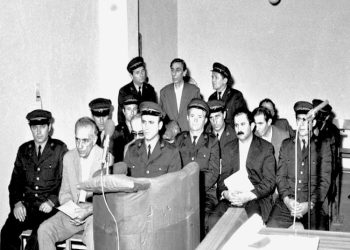
The Bekteshis were interned as a family in Sheqëz. Sadiku was arrested in 1982, when Hekuran Isai had taken over the Ministry of Internal Affairs. The interrogation could not break him. Nor could the trial. When former colleagues appeared as witnesses against him, and Aranit Çela read the indictment, Sadiku would erupt: “But this is madness, madness!” He said the word madness in his Shkodra dialect: “Marrina.” Halim Ramohito, once his deputy in the Political Directorate, prompted by my brother Gëzim, told us:
“All of us imprisoned officers surrendered before the interrogation – some more, some less. We were thinking of our families! The only one who remained proud and unyielding was Sadik Bekteshi. I have felt ashamed of my stance toward him.” Halim, an honest man, corrected the mistake made under the pressure of interrogation and asked the Bekteshi family for forgiveness. I met Sadiku after he left prison. He lived in a small space near the former Party School with his wife, four children, and grandson, Artur. He had grown a mustache. Surprisingly, he looked younger! His skin was like that of a young man.
He looked like a legendary highlander (kreshnik). Even at age 80, he stood straight, not hunching like his peers. That is how he died, after a heart crisis. I spoke with Hava for the last time in April 2009. I was in New York. I called her two sons living in America. Guxim answered. I told him we should meet, but he and his brother Skënder were leaving for a fishing trip. Hava spoke to me on the phone: “Goni, are you coming? I’ve cooked imam bayildi. I remember you like it.” It was my favorite dish, which she used to cook for me when I visited their villa in Durrës. I couldn’t meet her. Two years later, she too passed away to join her “Diku.”
Vera Bekteshi
I studied with her at the 7-year school “11 Janari” (today “Edith Durham”). Then we were students in parallel classes at the “Petro Nini Luarasi” high school. She was always a brilliant student, ranked among the best – those called “excellence” students. Every year, on the final pages of the grade registers, the names of the best students were written. Vera’s name was never missing. I remember the day we were celebrating our graduation; I saw Anastas Shuke on a bicycle, holding a large bouquet of red roses.
A few days later, I learned he would be engaged to Vera. Anastas worked at the Ministry of Foreign Affairs. He was cultured, knew several foreign languages, and the minister at the time, Nesti Nase, held him in high regard. It seemed his career would be brilliant. When Sadik Bekteshi was being targeted, Anastas was at the UN with the Albanian delegation. At that time, I learned that Nesti had asked him to separate from Vera. He told him: “We don’t want to lose you as a cadre.” Anastas refused. He changed his mind a few days later.
And he requested the separation. This was common for the time, but it must be said that the “family council” influenced his decision. The Shuke brothers, led by the eldest, Koli, had convinced him. Caci separated. He separated and… he lost his son. He lost him for life. Breaking up his family did not save him. He was transferred to Puka. Even after returning from Puka, he had no luck. He started another family but found neither joy nor peace. He died ill, nearly blind, with no one by his side. In mid-1975, Vera was removed from Tirana and sent to Berat. She was assigned to work at the Uznova farm.
She, a brilliant physicist, worked all day in the fields. They did not care that she suffered from kidney problems. Along with her family, she was interned in a village in Berat, in Sheqëz. I won’t recount her life there; she has written about it in two books. One day, my brother Gëzim brought me a book. “Here,” he said, “take it, it’s a gift; your friend Vera Bekteshi wrote it. She writes very well. I liked it.” Gëzim doesn’t give compliments lightly. If he praises something, it means he truly liked it. It was Vera’s book, “The Villa with Two Gates.” I laughed and showed him the same book. I had bought it, read it, and undoubtedly, I had liked it.
Then I bought her next book, “The Villa with Three Gates,” an expansion of the first. Years later, at the book fair, I bought her book of short stories. She has established herself as a writer. She even won the “Kadare” prize. On the internet, I have read idiotic comments about Vera, gossiping about her fashion and behavior during her university studies (1964–1969). Vera took care of herself; she was beautiful (and remains so today), she dressed well, but I never noticed any “excessive fashion” from her. The highlander Sadik Bekteshi knew how to maintain order in his family.
Perhaps I missed the instance when they put up a “lightning poster” (fletë-rrufe) against her, but at that time, inspired by the slogan “Everyone has the right to write in large letters…”, and by the Cultural Revolution in China, there were many envious people and social climbers who wrote in “large letters” about foreign influences, seeking them out even where they didn’t exist. Let me give you an example from many years later to understand how deeply the “Mao Zedong idea” had penetrated us.
In a meeting around 1973, in the basic party organization at the television station, a speech by Enver Hoxha was being discussed. Enver had said: “What meaning does a person’s family welfare have compared to the majority of Albanian families who do not have it?” More or less, that was the theme. In the meeting, party members stood up, discussing with passion and boasting that they had no refrigerator, no television, no carpets, and so on.
I listened to them and… Remained silent. I had just married and lacked none of those things. I had been on a two-to-three-month specialization in France. I had been to France once more to purchase television equipment. My family had very good economic conditions.
A colleague from the organization turned to me: “Why aren’t you discussing, Agron?” I replied: “Well, what can I say? I have all of these.” Marash Hajati, secretary of the coordinating bureau at RTSH, stood up: “Agron does well not to discuss. The rest of you haven’t understood the essence of Comrade Enver’s speech.” So, even after seven years, Albanian society and mentality had not changed.
The Chinese Cultural Revolution (begun in 1966) had ended and was no longer felt in China. Here, its echo still lingered; in fact, in the center of Tirana, a tailor shop continued to sew “Chinese-style” suits with high military collars.
Vera returned to Tirana. She returned to the position she had held before. She engaged in scientific work again. She also began to write. But for her, joy was a faded feeling. She had a tall son, with a giant frame, very handsome, who had inherited the Bekteshi features and his mother’s intelligence. He was smart. He finished studies in the same field as Vera. But he was unlucky.
The suffering in internment left its mark. Today, he is Vera’s greatest concern. I could end the writing here, but let me add one more thing. When the Bekteshis were in Berat, the State Security unleashed an informant upon them. It was the collaborator “Nerënxa,” once a classmate of Vera’s (and mine) at the 7-year school “11 Janari.” The use of “Nerënxa” would “link” her fate with the fate of the couple Aleksandër (who in 1992 would become the first democratic prime minister) and Dhurata Meksi.
She spied on them as well. “Nerënxa” reported regularly to State Security. In one of her reports, she wrote: “Vera Bekteshi, along with her two brothers, Guxim and Skënder Bekteshi, are sworn enemies of the People’s Socialist Republic of Albania.” I won’t go further. Read the books “The Villa with Two Gates” and “The Villa with Three Gates.” You will understand much about the life and treatment of internees during the communist regime.
The year 1982 “joined” me with Vera. We were “joined” by State Security, which engaged the collaborator “Nerënxa” against me. But that is another story.
The Others
The years 1974–1975 were accompanied by the targeting of many families of the country’s communist nomenclature. Fadil Paçrami and Todi Lubonja were arrested. Dashnor Mamaqi, former editor-in-chief of “Zëri i Popullit” and then secretary of the Tirana Party Committee, was arrested (under the idiotic pretext that he had been friends with Beqir Balluku). Abdyl Këllezi and Koço Theodhosi were arrested, accused of being saboteurs in the economy.
The former was the Deputy Prime Minister and Chairman of the State Planning Commission – practically the man who ran the country’s economy. The latter, once Deputy Prime Minister, was the Minister of Industry and Mines. The spark for their downfall was a letter from an oil worker accusing Theodhosi of hostile activity in that sector. That was enough for many responsible employees in central institutions in Tirana and the oil industry to be put in irons.
The arrests were accompanied by the internment of hundreds upon hundreds of their family members. I knew many of the children of the targeted families; with some, like Kozeta Mamaqi, Maksim and Leon Këllezi, Mira Theodhosi, and others, I studied at the “Petro Nini Luarasi” school. They went into internment. I cannot say that, at the time, I suffered much for their fate.
I was not in a position to understand what was happening! I knew nothing of the brutal war that had broken out over the political legacy of Enver Hoxha, who, to protect his power, began the next rounds of purges. For the rest of his life, he would implement the teachings of Mao Zedong, who dictated that every five years “stagnant water” must be stirred so it “clarifies.” By this, he “taught” that every five years, political opponents should be struck.
Being among those not touched by the wave of arrests and mistreatment, I did not understand that what was happening was not temporary. Purges had become the political line. Other events would follow, and other communist families would be targeted. And those who had brought and kept Enver Hoxha himself in power would be struck. In the paranoia that had gripped him, he was sawing off the “tree” upon which he himself sat. / Memorie.al
To be continued in the next issue