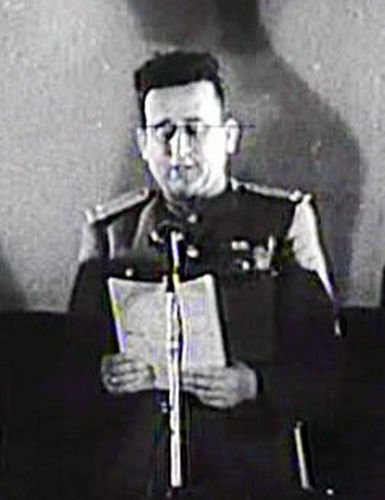
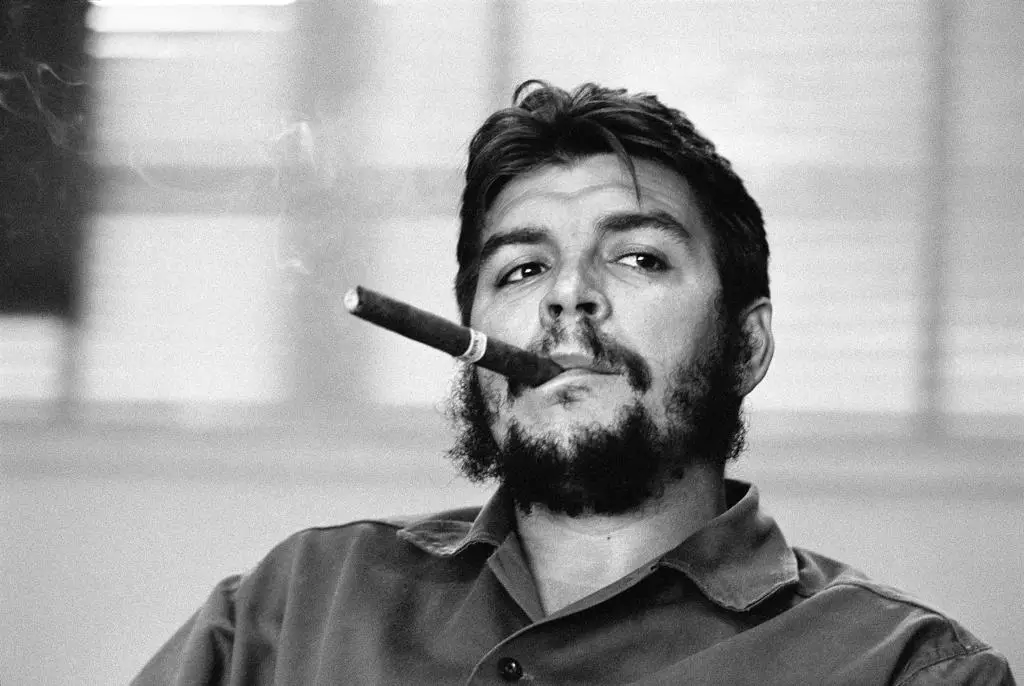
Memorie.al / More than half a century has passed since then, and he claims to be the only Albanian still alive who has met and talked with Che Guevara. Initially, it was a warm embrace with the hero of revolutionary mythology, as he was called at the time, in a small room in Havana. Then Che took the opportunity to express his considerations regarding the secret visit he had made earlier to Tirana. “The Albanians gave me the most precious gift,” he had said, recalling the “Kallashnikov” Made in Albania that Mehmet Shehu had given him. Subsequently, the discussions focused on the situation and the problems of the region. In his narrative, 90-year-old Mihallaq Gjinikasi fully brings back the story of the meeting with the legendary man in distant Havana, in the hot summer of ’64…!
Mr. Mihallaq, you were a member of the only Albanian delegation that visited Cuba. What do you remember from the meetings in Havana?
It was an official visit at the invitation of the Cuban government, to participate in the anniversary celebrations of Fidel Castro’s victory against the dictator in Santiago de Cuba. The members of the delegation were initially proposed by the political authorities and then formalized through the Ministry of Foreign Affairs, which also prepared the visit’s agenda. Due to the ideological constraints of the time, it was thought that the delegation should have a modest composition, leaning more towards the state dimension. The idea was to go to Havana not as representatives of the party line. However, for Tirana, it was a visit of interest, considering the tumultuous events starring Fidel Castro and Che Guevara.
Who were the members of the Albanian delegation that participated in Fidel Castro’s celebrations?
The delegation was led by Bilbil Klosi, the Minister of Justice at that time. It included Josif Pogaçe, our ambassador in Havana, and me. So three people in total.
What was your role during the period you were appointed to the Albanian delegation that participated in Castro’s celebrations in Cuba?
At that time, I was the First Secretary of the Party Committee in Vlorë, but I was not called to the delegation in that capacity. I went there as a deputy of the People’s Assembly, representing the electoral zone of Skela. The other two colleagues, in all official meetings, were also presented with their state functions, without ever mentioning their political positions within the forums of the Party of Labor.
This is about the early ’60s?
More precisely, July 1964. As far as I remember, it was our first, but also our last, delegation to Cuba.
Do you recall the route you traveled to Havana?
From Tirana we flew to Prague. We slept there one night. The next day, we traveled towards England. Then, with a special plane, on to Havana. A tiring journey, nonetheless, lasting two days and two nights…!
Who received you at Havana airport?
Besides the protocol officials, representatives of the Communist Party had also come out to welcome us. There were also prominent fighters, known as public figures in Cuba at that time. The entire Havana airport had taken on a festive appearance. That day, dozens of delegations from the ‘People’s Democracies’ arrived there, as well as from other neutral countries. There were also personal friends and acquaintances of Fidel Castro and Che Guevara, coming from all four corners of the globe.
What was the agenda of the Albanian delegation during its stay in Cuba?
The day after our arrival, we participated in the festive demonstration on the occasion of the anniversary of Fidel Castro’s victory against the dictator in Santiago de Cuba. It was an extraordinary rally, almost like those held in Tirana in the early post-war years. Castro and Che were the main topic of conversation for everyone. For hours, Havana was overtaken by revolutionary chants and songs. The celebrations continued until near evening.
What other activities did you attend, besides the Havana celebrations?
In fact, there was a common program for all participating delegations, which the local authorities followed rigorously. Besides that, three other activities were reserved for our delegation. A meeting with the Minister of Justice, a visit to Girón Beach, the largest beach in Cuba, and a conversation with Che Guevara.
So the meeting with Che Guevara was planned by the Cuban side?
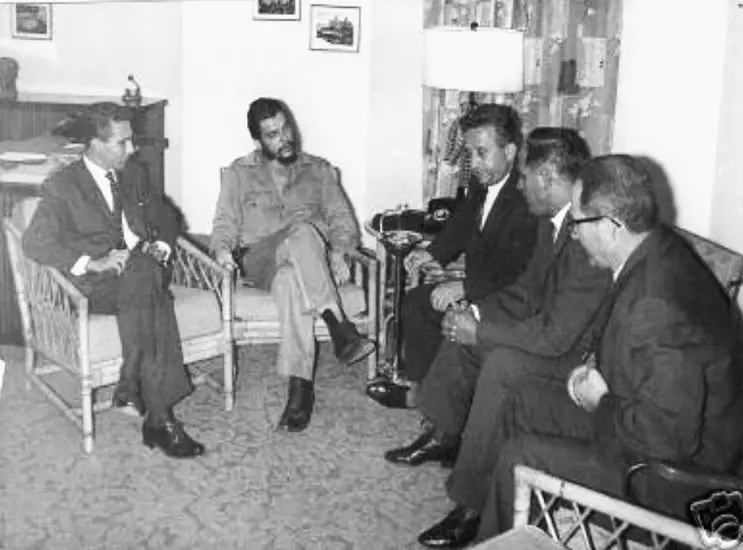
Che Guevara came personally to meet us at the hotel where we were staying in Havana. The friendly meeting took place in one of the rooms of this hotel. As we found out later, he had been interested in our delegation from the first day and had tried to create the opportunity for a confidential meeting.
Was this the first time you met Che Guevara?
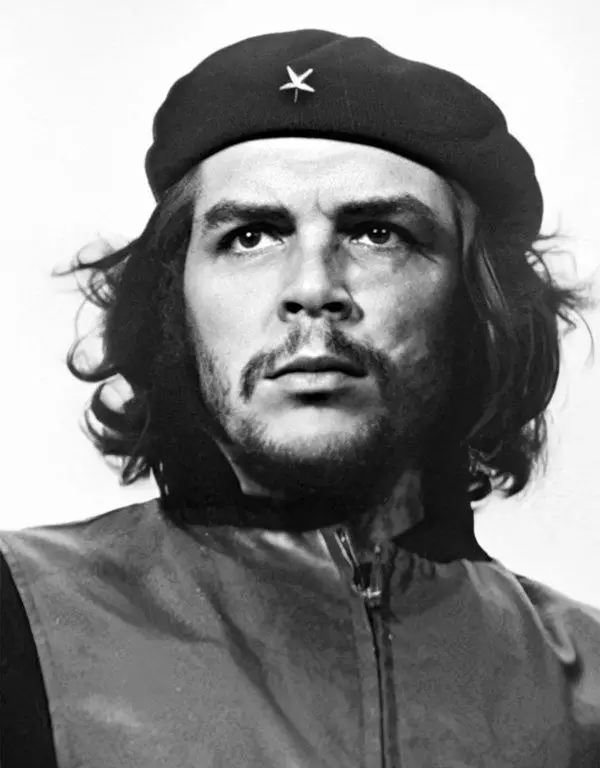
At least for me, it was the first time I met him. From what I knew at that time, I understood that Che Guevara was a revolutionary of a special kind. I had heard that he had also made a secret visit to Tirana in 1960, but among us, the echo of his name had been felt earlier. Confronting him was something impressive. Che appeared at the appointed time, dressed in his characteristic clothes, the classic beret and the military shirt with two large pockets. We embraced like old friends.
First, he asked us how we felt among the Cuban fighters, how we found Havana, its people, who we had met, and what we had talked about. Then he focused on the Cuban experience, dwelling on the victory over Batista and the economic problems faced by the Cuban revolution. Everything in his discourse referred to the terms; revolution and revolutionary overthrow, which he perceived as developments that start from the periphery and culminate in the center. “This is exactly how we acted in Cuba,” Che specified, “and the people understood us and supported us until we overthrew the dictator Batista.”
So Che Guevara promoted the revolution that is born on the periphery and erupts in the center, something that clashed with the philosophy of revolution that Enver proclaimed in Tirana?
This was one of the issues on which we did not share the same opinion with Che Guevara. However, we were not there to convince him about the Marxist-Leninist way of achieving the revolution. Che himself represented the protagonist of a revolutionary overthrow, which nonetheless had brought a promising reality to Cuba at that time.
What did you discuss with Che Guevara about the relations between our two countries?
This was the most interesting topic of the talks. Che was open and direct, stating that there had been pressures from third parties, meaning the Soviet Union, regarding bilateral relations; Albania-Cuba. Despite this, he added, we have every opportunity to deepen them in the future. In fact, at that time, the Cuban Embassy had been opened in Tirana, but the ambassador had not arrived. Meanwhile, we had accredited our ambassador in Havana. Che thought that this situation, conditioned by Moscow’s role, would be resolved very soon, but according to him, it required commitment from both sides.
He saw the institutionalization of bilateral relations as a good omen, for a favorable situation for the fate of the international revolution. He promised us that their side would quickly overcome the impasse and efforts would be made for a healthy environment of cooperation. On this point, Che envisioned joint plans with the youth of both countries. “Youth,” he expressed, “is the spirit of the revolution. Without its support, there can be no talk of triumph or victory.” This issue caused us to focus on problems of international relations. I don’t remember the details discussed there, but I have fixed in my mind Che Guevara’s interest in the events in Cyprus.
What was his opinion on the conflict in Cyprus?
Che did not express any concrete opinion, but was interested to know our assessment of the then conflict between the Greek and Turkish communities in Cyprus. “You are close to the problematic area and undoubtedly have a clearer understanding of the cause of this conflict,” he said, insisting on learning the nature of the clashes. Our reaction was not to exceed the officially declared political stance, and on the spot, we responded in standard language. “For us,” we said, “the conflict in Cyprus is an internal matter of the two communities there and must be resolved between them.”
What impression did Che Guevara make on you during the meeting?
Completely different from what I had known. There I learned that Che Guevara was a doctor and a multifaceted figure, with a calm and composed temperament. As the second figure after Fidel Castro, Che was completely opposite to his impulsiveness. At that time, the Cuban revolution was known as one of the most powerful and difficult. From what we learned there, I understood that despite the fact that Che had borne the main weight in this revolution, he was somewhat left in the shadows by Castro. However, the latter had not been able to deny Che his knowledge in organizing the new Cuban state, especially in the field of economy.
How did Che Guevara remember the visit he had made to Tirana in 1960?
That had been a secret visit, and Che explained that he could not speak about a matter archived as secret, by the will of both parties. His only impression was related to the special gift given to him by the country’s Prime Minister, Mehmet Shehu. It was about an automatic “Kallashnikov” rifle, of the ‘Made In Albania’ brand, which, as Che said, he considered the most precious souvenir in his house.
In what language did you communicate during the talks with Che Guevara?
He preferred that we communicate in French, and so it happened.
Any other impressions?
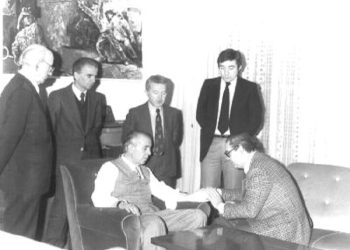
Che was a charismatic man, where his physical appearance, with the typical attire of a warrior just returned from the front, played no small role. Perhaps for this reason, he became an idol for thousands of young people everywhere in the world. From that meeting, I keep as a rare memory a photograph taken at Che’s request and many unforgettable impressions. More than half a century has passed since then, and I can say, not without pride, that I am the only Albanian, still alive, who has met and talked with Che Guevara.
Did you make other visits during your stay in Havana?
We stayed in Havana for about two weeks. Besides the meeting with Che Guevara, we also held other meetings with various officials where we discussed the issue of trade exchanges between the two countries. The Cuban side accepted without hesitation our request to import sugar and to export various canned goods there. This was a very interesting initiative, which immediately began implementation. During our stay in Havana, we had the opportunity to visit the sugar factory and the rope production factory, which were known as the most famous in Cuban industry.
Gjinikasi: “Guest in Hemingway’s House, at the Invitation of Che Guevara”
“To come to Cuba and not go to Hemingway’s house, it’s as if you haven’t been at all.” Che Guevara’s invitation to visit the home of the distinguished writer was somewhat strange, just as he himself was strange. We had been in Havana for almost a week and, distracted by the festive echo of political debates, had forgotten that we were in the birthplace of one of the giants of world literature. Che’s intervention took us by surprise. We welcomed his idea with pleasure and asked him to help us visit the great writer’s house. “World literature does not have a second Hemingway,” added Che, highlighting the explosive and proud character of his characters, faced with the misery of a lost generation.
Right there, he told us that three days earlier they had commemorated the 3rd anniversary of the poet’s death. Then he spoke for whole moments about his beloved writer. The next day, in the company of the man he entrusted to us, we went as guests to Hemingway’s home. The simple house somewhere on the outskirts of Havana, was lost in lush greenery. People entered and left incessantly. Everything inside was kept as the owner had left it. Everywhere on the walls, panoramas made from the skins of wild animals stood out. Likewise on the floor. “Hemingway never preferred any other carpet but these,” our guide explained. A sight that reminded you of a hunter’s nest, but the feeling was immediately softened when you approached the writer’s desk.
On its surface, Hemingway’s thoughtful gaze seemed to enlighten visitors. Right here, ‘The Old Man and the Sea,’ ‘A Farewell to Arms,’ ‘For Whom the Bell Tolls,’ ‘To Have and Have Not,’ ‘The Snows of Kilimanjaro,’ etc., came to life. Some of them had reached us. At least our generation was familiar with them at school. However, the moment you held in your hands the fountain pen with which they were written, was something wonderful. Especially for us who came from a distant continent.”
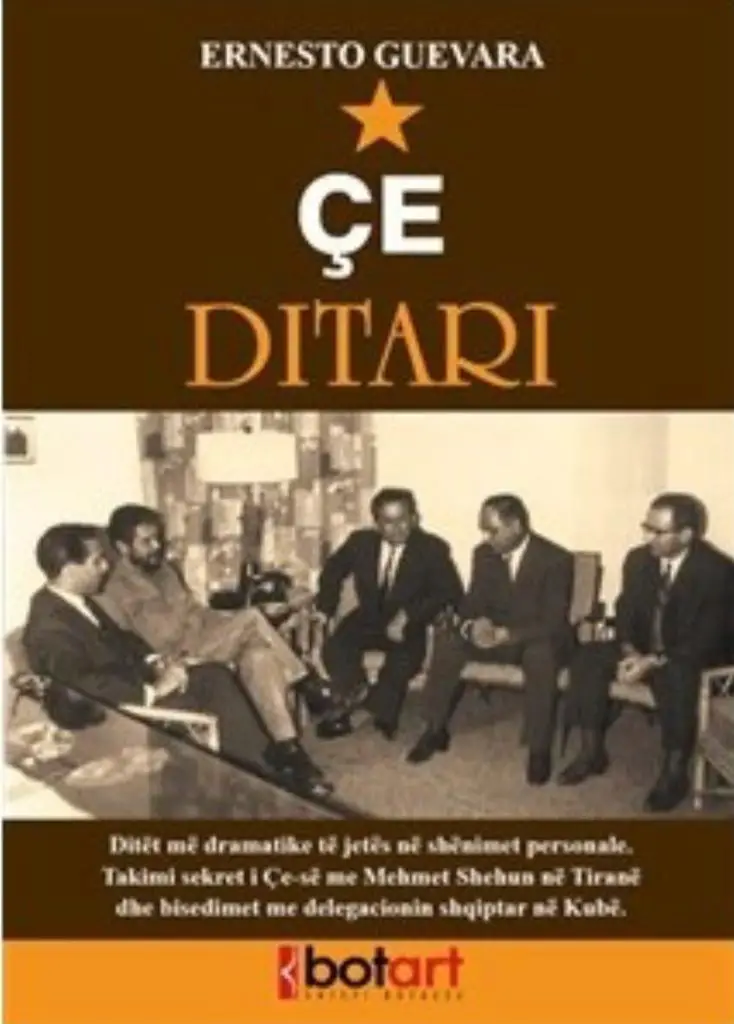
Che Guevara’s Diary, Finally in Albanian
The manuscripts of Che Guevara, the icon of the 20th century, as the prestigious magazine ‘Time’ considers him, have finally been translated into Albanian. It was the care of the Publishing House “BOTART” and the translator Piro Andoni that made the publication of the book possible. The diary with impressions from the most dramatic days of the hero of revolutionary mythology. Written in the trenches of war, where Che became famous, this diary has today become a relic of great value, especially for the younger generation, the ardent admirer of the author’s extraordinary resilience in the face of injustice, oppression, and exploitation.
The book contains assessments of numerous personalities about Che Guevara, ranging from; Benicio del Toro, Nelson Mandela, Rigoberta Menchu, Ariel Dorfman, Jean-Paul Sartre, to Fidel Castro. One of the most interesting parts of the Albanian edition are the memories from the secret meeting of Ernesto Guevara with Mehmet Shehu in Tirana in 1960 and the unknown discussions with the Albanian delegation in Cuba in July 1964. The Albanian version of “Che Guevara’s Diary,” highlighted by the publisher, is the basis for the film script by Steven Soderbergh and Benicio Del Toro. Memorie.al