By Ali Buzra
Part Thirty‑Six
LIFE UNDER PRESSURE AND SUFFERING
(ASSESSMENTS, COMMENTS, NARRATIVES)
Memorie.al / At the request and wish of the author, Ali Buzra, as his editor and first reader, I will briefly share with you what I experienced during this encounter with this book, which is his second (after the book Gizaveshi në vite) and which naturally delineates his writing style. Sincerity and frankness of narration, simple and unembellished language, accuracy and precision of episodes, or the absence of an elaborative imagination – whether deliberate afterward or its non‑exploitation – I believe have served the author positively, as he comes to the reader in his original form, inviting us at least to come to know unknown human fates and sufferings, whether by chance or not, leaving us to reflect as a beginning of awareness toward a catharsis so necessary for the Albanian conscience.
Bedri Kaza
Continued from the previous issue
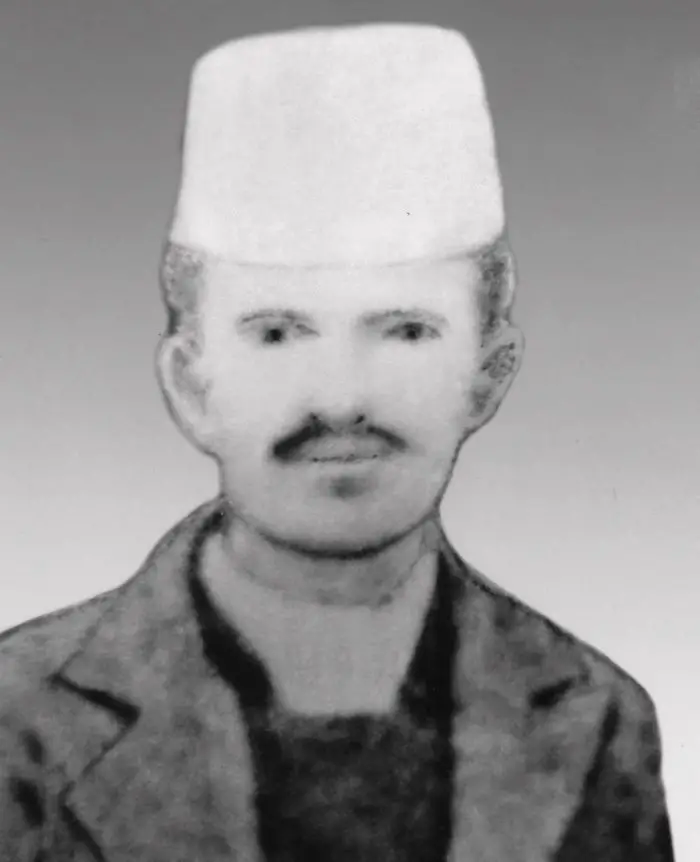
Shahini kept the family’s traditional friends, while also making new ones. He engaged his son Xheviti to the daughter of Azis Biçaku from Letmi. Those who knew him say that Shahini was a skilled orator. In gatherings and assemblies, his word was listened to with great curiosity and attention. During the war period and the tangled events the country was going through, such a prominent figure as the scion of this family, Shahin Dosku, could not remain outside of it.
As in other villages, in Dorëz too, around the beginning of 1943, a “Balli Kombëtar” (National Front) unit was formed, at the head of which was placed Shahin Dosku. His cousin Demir Dosku was its secretary. The Balli unit had about 50–60 armed men, who were called up when needed, mainly for self‑defence. What is special about him is that during the war Shahini was quite balanced toward the events of the time. From numerous testimonies of contemporaries, it appears that Shahini, regardless of the heated and conflictual situations among the political forces, never showed radical tendencies in his behaviour and actions. This is also confirmed by the fact that during the war he cooperated with the National Liberation Front as well.
His brother Maksuti, today 92 years old, recounts that in the autumn of 1944 Shahini agreed to be elected Chairman of the village’s National Liberation Front. Shahin Dosku’s house became a refuge for partisans, not just in two or three cases but in dozens of them. In their home, the brothers Maksut and Muhamet Dosku related, a table with bread was laid every night for 15–20 people. When partisans came, the bread oven was lit several times a day, cooking for them; they were served meals and given food to take with them. There were cases, they recount, when in the guest quarters upstairs were guests of Balli, while downstairs in the kitchen room the partisans stayed, among whom there were also women.
Muhameti, at that time 13–14 years old, together with Shahini’s son Xheviti, several times escorted partisans, accompanying them to the edge of the village. On the day when fighting developed between the Second Partisan Brigade and the nationalist units of Zgosht and Letmi at Qafë Drizë, Shahin Dosku with his unit positioned himself on the hill of Ortojon, while Zeq Hunçi on the hill of Hoxhoj. This was for self‑defence reasons, because the Command of the General Staff of the Partisan Army had ordered its formations to eliminate the Balli units in several areas of Librazhd. The opposite happened with the Second Brigade. Its units were almost destroyed in the self‑defence battle organized by the units of Zgosht and Letmi, led by Isak Alla and Azis Biçaku.
Nevertheless, in this specific case, the tolerant attitude maintained by Shahin Dosku and Zeq Hunçi should be noted. Since they were aware of the order to eliminate the Balli units, they could have gone to the aid of the neighbouring villages. Not only did they not do this, but they also helped some partisans who managed to escape from Rrapun and, passing through the middle of Dorëz village, reached Krastë. Zeq Hunçi sent Abdulla Dobrën, Ramadan Koxha and Abdulla Kojku there; they helped the partisans, treated their wounded and gave them food for the road. It was the two nationalist unit commanders, Zeq Hunçi and Shahin Dosku, who enabled the partisan group to pass freely, escorting them with their fighters as far as Qafë‑Shlli. During this time, they fired a burst of rifle shots into the air from their positions, in order to avoid the village being burned by the German forces that were in Babje.
The people of Dorëz were unique in their attitude toward ordinary partisans. For this reason it is said that even Maliq Dosku, who almost never got involved in war matters, stated on this occasion: “We cannot kill partisans at our own doors, even if we all burn.” It is completely clear that the group of partisans from the Second Assault Brigade could not have passed through the territories of the villages Dorëz and Gizavesh had the respective village leaders not made it possible.
On the other hand, their setting out in this direction was not spontaneous. They must surely have had information about the villages’ stance toward the war. And not only that, but Zgosht and Letmi, which were attacked by the forces of the Second Partisan Brigade, after the battle not only did not mistreat the prisoners, but released them, allowing them to go in a direction where there was no danger from the Germans. These facts speak of acts of high humanity and nobility on the part of the nationalist leaders of the area.
Alongside the National Liberation Front, the Territorial Battalion of Bilal Biçaku from Qarrishta was also active. Shahini sent several fighters from Dorëz there, among them his brother Maksuti, 16–17 years old. Regarding this, Maksuti recounts that they went as far as Shmil and up to the mountains of Tirana. He remembers that some boys from Dorëz and Gizavesh were enlisted in this battalion, such as: Rexhep Mema, Isuf Brazhda, Shefqet Dosku, Ramadan Koxha, Ibrahim Brazhda, Ramadan Vërçani, Tafil Kojku, Ramadan Dosku, etc., who after the dissolution of the Territorial Battalion joined partisan formations, mainly in Mehmet Shehu’s First Brigade. In a conversation with the late Beg Hoxha, 92 years old, in 2013, he stated that Shahin Dosku defended the village and helped the war effort and the partisans.
“In cooperation with Ram Kurti, who had been elected chairman of the National Liberation Council for the village of Dorëz,” he recounts, “Shahini sent several boys to the XV and IV partisan brigades. From all the testimonies gathered, it appears that there was no case of confrontation between the Balli unit of Dorëz, and the nationalist one of Gizavesh, with the partisans; on the contrary, there are dozens of families from these villages that hosted and escorted them, while over 20 men from the village of Dorëz joined the war formations. Gizavesh lined up 43 men in the partisan ranks, taking first place at the district level for participation in the war. The assistance of Shahin Dosku, as well as of the other nationalist leaders of the area, is also evident in the passage of Mehmet Shehu’s First Assault Brigade, whose movement toward Qarrishta was made possible and facilitated.”
After the war, at the beginning of 1945, the district party delegate Vjollca Xhufka came to the village and contacted Shahini as chairman of the Democratic Front, as well as Ram Kurti, who held the position of chairman of the National Liberation Council for Dorëzin. On their orders, Musa Dosku, who had been appointed village courier, accompanied her to Librazhd. The leaders of the village of Dorëz, as well as of Gizavesh, immediately after the liberation of the country engaged themselves and helped in taking the first measures for the reconstruction of the damaged houses in the town of Librazhd. The question arises! Despite the honourable stance maintained during the war period, could Shahin Dosku and Zeq Hunçi come to terms with the drastic reforms that the communist state would undertake after the war? Naturally, no?
Thus the state information network, spread everywhere, marked out in every village and area the persons who were to be eliminated, as obstacles in undertaking socialist reforms in Albania. Shahin Dosku, not only as a former commander of a “Balli Kombëtar” unit, but also as the head of a family with a good economic base, could not escape communist terror. Meanwhile, he was friends with Azis Biçaku, who had fled into exile. At the beginning of 1946, Shahini was arrested, but due to lack of evidence he was released. He was arrested a second time, with some witnesses being manipulated against him. At the end of 1946, Zeq Hunçi was also arrested in Gizavesh.
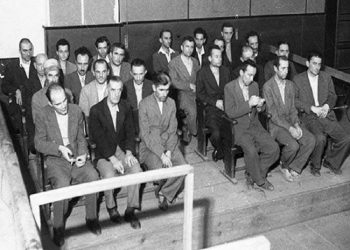
At the trial against Shahini, 27 witnesses were summoned, among them an old woman from Bërzeshta. When the old woman was asked by the judge – who, as it seemed, knew she had been prepared beforehand – whether she knew Shahin Dosku, she answered that she did not know him, but that they had told her he was an enemy and must be condemned. So, just as for hundreds of other nationalists in Albania, the trial was staged and pre‑arranged to convict them. Initially, the sentence for Shahini was death by firing squad. At the second session, 101 years, and finally it was commuted to 25 years, with the motivation of “enemy of the people.”
Shahin and Azis Dosku’s large family was expropriated, while family members were persecuted, being labelled as kulaks.
His arrest and conviction were accompanied by other harsh measures against the family. The brothers, who were still undivided, tried to sell or take the livestock to friends, but even that was difficult. Faced with the coercive measures of the state, everyone tried to save their own skin. Immediately after Shahini’s arrest, the family was confiscated 12 yoke‑oxen, 4 cows, 1 horse, a large number of small livestock – the family remembers that only black sheep numbered 110 head – as well as considerable quantities of foodstuffs, such as dairy products, pekmez (grape must), etc., leaving nearly 70 family members at the mercy of fate. The shop in the Qendër neighbourhood was seized, where later the offices of the locality would be placed. The house in Librazhd with 7 rooms was also seized, where initially schoolteachers were accommodated, and later the offices of the civil registry and district administration were placed.
Shahini, Zeq Hunçi, Maliq Dosku, Sehit Albrahimi from Lunik, Sadik Muzhaqi from Vilan, Daut Gurra and many other prisoners were sent to the Maliq swamp. The labour camp in Maliq was a cruel Albanian “Gulag.” The prisoners worked in water up to their knees, and in many cases up to their waists, without any protective equipment. With the convicts, the Maliq swamp, that of Hoxhara, etc., was drained in the first years after liberation. They were exploited to the maximum in these swamps, and when they became unfit for work, they were removed and replaced with others. Many of them fell ill and died. Later, Shahini was sent to the Elbasan prison. There too they were taken to work, most often in the construction of the Hajdares canal.
His family went to him every month, sending him food, coffee and tobacco, despite the economic hardships they faced at home. Regarding this, on March 30, 2019, while talking with Shahini’s youngest daughter Xhevrie, who is the wife of Rrahman Gjëkola from Dorëzi, we learned many details about her meetings with her father, as well as the difficulties her family went through. She recounts that several times she went to visit her father at the prison, going with her uncle Aziz, another uncle Sehit, as well as with Xheviti, her mother Mejreme, and her stepmother, the mother of Halil and Avni. To Elbasan they always went on foot. With great pain, she speaks of one instance that has remained an indelible sorrow in her heart. She went together with Azis, Menduhie and Halil, Shahini’s second son.
As on every occasion, the meeting took place from behind the bars. After they greeted him, Shahini did not recognize his son Halil and asked Azis who he was. The latter told him he was Halil. From that moment, he could not speak to any of them anymore, breaking into tears. The meeting ended without them being able to communicate further. After nearly two hours, Aziz asked the guard if they could meet again, because the children had not been able to communicate with him, but he did not allow it, saying the meeting was over. That night, they had supper at a friend’s house in Elbasan. The stepmother soaked Xhevrie’s feet in brine, because they had swollen from the journey, as they would have to walk again the next day. They set off for home, where neither Xhevria nor Halil were able to speak to their father. – “That was the last meeting,” she recounts, weeping, “and I never saw my father again.” Shahin Dosku died in Elbasan prison in 1953.
This was the reward the communist state gave to Shahin Dosku, who had sheltered and helped dozens of partisans during the war period. He was father to seven children, three sons and four daughters, who were left orphans. Shahin Dosku’s large family, like many others labelled as *kulaks*, endured great economic difficulties. In his family there were the two sisters of Mefail Biçaku from Qarrishta; one was the wife of Latifi, who had died, leaving three daughters whom Shahini married off while he was still free, and the other was the wife of his other brother, Azis. Under such circumstances, in conditions of expropriation and contempt, the brothers decided to separate in order to survive, but they never stopped helping and caring for one another.
As we have noted above, kulak families were deprived of many civil rights, so each of them tried to negotiate with the state to have the kulak label removed. The first to obtain the *Front* certificates, thereby having the kulak title removed, was Maksuti. He had fought in the war, and had married into the Gjeta family in Librazhd, a family connected to the Front during the war. His brothers‑in‑law intervened and helped him to have the *kulak* title removed. After him, Muhameti and Hamdia, who were brothers of the same mother as Maksuti, also obtained the certificates. Aziz’s family, who was a half‑brother of Shahini, went through many vicissitudes. He had five sons and two daughters. His eldest son, Mendui, was very quick‑witted and intelligent. He greatly resembled his uncle Shahini.
Knowing that being a kulak deprived them of the right to speak, to assemble, to education, etc., he would go down from time to time to Librazhd, Elbasan and even Tirana. Knocking on the doors of government officials, he sought denied human rights, often demanding to be confronted with the law. With his persistence, it was achieved that in 1956 the *kulak* title was also removed from Aziz Dosku’s family. From information gathered today from the brothers of this family, it appears that although the *kulak* label was removed, even for many years afterward they did not receive the *Front* certificates! He sent his younger brother, Pëllumb, to the Pedagogical School in Elbasan to become a teacher. He worked as a primary school teacher in various villages of the district, while for higher education it was out of the question, because he came from a former *kulak* family.
Initially, Shahini’s sons stayed together with their uncle Aziz. The eldest son, Xheviti, did not give up his engagement to the daughter of Azis Biçaku, even though she was in internment. As I have described above, they married in 1952; his bride Menduhie was released from internment after several requests made by the Dosku family. After the dissolution of the localities and after many requests, Shahini’s children were able to recover the confiscated house in Qendër. They came from Ortojon with a few pieces of furniture and a sack of corn, just enough to keep alive. The family of Shahin and Azis Dosku, with nearly 1,000 head of livestock, was now completely economically ruined.
Shahini’s son Avniu finished elementary school in the village with excellent results. He wanted to continue at the Pedagogical School in Elbasan, but this was not possible. The Executive Committee of the district did not approve his application. His former teacher, Qemal Çiftja from Elbasan, told him he would keep him in his house so that he could continue school as an external student, but this too was not made possible. Their family still bore the label “kulak”. Special interest in Shahini’s underage sons, Avniu and Halil, was shown by their other uncle, Sehit Dosku, who had moved away from the village and lived in Librazhd. Sehiti had bought land and built a house in the town.
He took Avniu and went to Tirana to meet Gogo Nushi, who held a high state position. During the war, Gogoja had taken shelter in their house and Sehiti had escorted him to Qarrishta, to Bilal Biçaku. They knew each other well. He received them in his office. – “Whose son are you?” – he asked Avniu. – “Of Shahin Dosku, my father died in prison,” Avniu said. – “How is that possible? I did not know he was in prison,” he addressed Sehiti. “Shahini helped us a lot during the war.” – “I have come to ask you to help Shahini’s children obtain the Front certificates,” Sehiti tells him. – “Go, we will send them to you there,” he finally said. / Memorie.al
To be continued in the next issue