Part Ten
Excerpts from the book: ‘ALIZOT EMIRI – The Man, a Noble Library and Newspaper’
A FEW WORDS AS AN INTRODUCTION
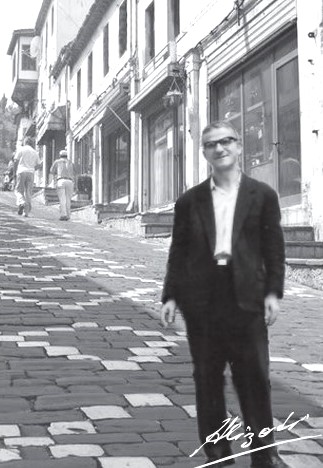
Memorie.al / Whenever we, Alizoti’s children, shared “stories” of Zotja (Alizot) in joyful social gatherings, we were often asked: “Have you written them down? No! What a shame, they will be lost…! Who should do it?” And we felt increasingly guilty. If it had to be done, we were the ones who should do it. But could we write them?! “Not everyone who knows how to read and write can write books,” Zotja used to say whenever he handled poorly written books. While we, Zotja’s children, were discussing this “obligation” – the Book – we naturally felt inadequate to fulfill it. It wasn’t a task for us! By Zotja’s “yardstick,” we were incapable of writing this book.
-IMPRESSIONS AND MEMORIES OF ALIZOT EMIRI –
ANDON LULA
THE HOUSE OF THE BOOK
In memory of the Gjirokastra bookseller Alizot Emiri
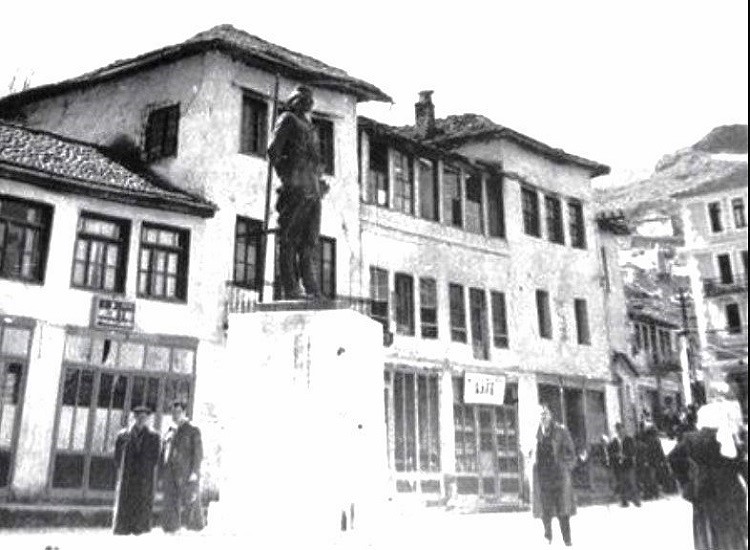
We, the residents of the “Old Bazaar” neighborhood, consider the center of the Bazaar as our home. Even today, we go back and forth in a heartbeat, just as we did in our childhood as “zabërhanë” (wanderers), as the neighborhood elders used to call us. That nickname suited me too, as I wouldn’t hesitate to go there a hundred times – mostly for no reason and rarely for a school assignment.
I particularly liked standing in the “heart” and on the stone ledges of the Bazaar shops, which traditionally remain places for staying and meeting. People talked there as if in an open-air café, regardless of the rain or the scorching sun. This was the case 50 years ago, when I used to listen to news, programs, and music broadcast by Radio-Gjirokastra through a large loudspeaker, the only one in the city. Visiting the shops also attracted me, especially the “Great Mapo,” where boys and girls went ostensibly to shop, but in fact, were looking at each other and arranging meetings. The Palace of Culture and the State Library were similar; after “chance” encounters, people would emerge from the library looking thoughtful, book in hand. Even the Polyclinic in Hazmurat wasn’t visited just for medical check-ups.
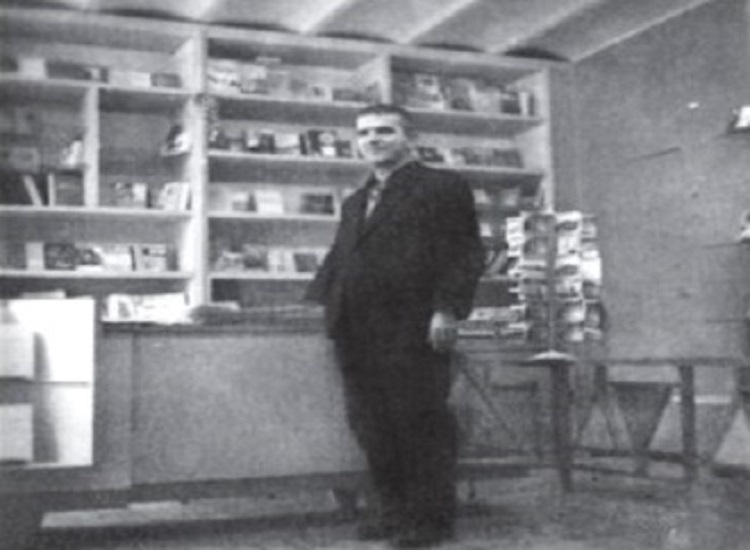
I loved these meeting places of my youth and hold many memories of them, but I most enjoyed staying at Alizot Emiri’s bookstore. For the time I am describing, from the 1960s onwards, it was a model bookstore – organized and with a relaxing, attractive appearance.
Just like the book covers and titles, Zotja’s wise words and humor radiated. He was communicative and understood by everyone, bold and very at ease with people of culture and the well-read; he was direct with the “innocent” ones who came often but rarely bought books, and serious and persistent with those who “savored” books only on their shelves in their home libraries – a category that was only interested and queued up for political books, while taking fiction just for show, for appearances.
And Zotja knew how to measure their heads and pockets with a string. He would pick out heavy, thick books for them, which they – holding one or two in their hands – would carry while taking their evening stroll in Çerçiz Square before heading home.
The atmosphere in the House of the Book, with Zotja, was different from the one moving outside in the streets, shops, cafés, and the barbershop across the way, where his primary friend for humor was the barber Gaqe Kekezi. There, every client felt warm and friendly; they entered calm and left thoughtful, almost tempted, because Zotja would change their minds and move the money from their pockets for the new books they had to buy. His words and soul were tied to books, authors, and characters that he kept under the counter for true friends of literature. Most clients, whom he categorized as well-read, were his first friends.
These people would save their money for the books he offered. I belonged to this category, gathering a handful of coins for the books and literary newspapers of the time. As a regular reader, he would often tell me: “Take a copy of ‘Rinia’ (Zëri i Rinisë); the literary page has stories by authors you like.” The truth is that after the 1970s, besides some foreign authors, I eagerly read the first books and warm stories of Nasho Jorgaqi, Vath Koreshi, Koço Kosta, Bedri Myftari, Alfred Kanini, etc.
I am grateful to him for the spirit of thrift and the desire for books; meanwhile, if I wanted a new book, I had it in my pocket, because Zotja valued the bookstore’s favorites not just as regular buyers and readers, but also distinguished them as lovers of books and culture. He knew the friends of the book by name and respected them one by one, just as he knew the characters in the books he published, which “quickly” fell into the readers’ hands.
This was due to his professional skills and culture in handling them, the atmosphere he created at work, and his characteristic humor with a Gjirokastra color – where irony and mockery were absent, replaced simply by kindness, friendly understanding, and a pleasant sense of folk humor.
I remember many intellectuals who considered the bookstore, as they put it, a meeting point to exchange thoughts on books, plays, or concerts. Closely tied to literary works, I remember the charming couple Skënder and Ardita Bulku; the intellectuals who came from Tirana to work in Gjirokastra: Feti Gjilani, Trim Gjata, Pjerin Radovani, Vaso Bezhani, etc. Others, locals from Gjirokastra like Isak Babaramo and Shehap Braja, would order books in foreign languages and receive them by mail.
He showed care and seriousness with every client. If he told you: “Take it, this is a book for you!” – it was hard to disagree. He read the books himself first, then recommended them. He kept me close and cheered me up when I entered with a friend who wasn’t connected to books. In such cases, to make them a friend of books too, he would ask if I had liked book X or Y.
Thanks to Zotja, in the Gjirokastra of those years – to some extent a closed city – the thirst for reading grew. Both old and young frequented the bookstore. Gjirokastrians preferred fiction for adults and children. They took political books out of necessity, by obligation. They loved and read Kadare a lot, but also showed interest in every book by local authors, which Zotja placed at the front of the shelves: Bekim Harxhi, Agim Shehu, Pano Çuka, Tasim Gjokuta, Koço Kosta, Dhimo Dhima, etc.
He joked a lot with Dhimo and the variety show actors, as Qimo Papadhopulli, one of his best friends, told me: “We, the youth of that time – Sokrat Kalivopulli, Aleko Pano, Rusto Asqeri, Izet Mato, etc. – when we performed a show, hurried to get his impressions, which he gave with sharp and humorous words. In one instance, as soon as we asked for his feedback, he told us: ‘Listen: for your sake, last night we paid 25 lek, but for your sake, we lost 2-3 hours of sleep; now, for our sake, don’t go on stage anymore.’”
When I published my first book of children’s stories, “Bileta e Cirkut” (The Circus Ticket), Zotja was happy; he congratulated me sincerely and placed the book in a prominent, visible spot, but I never dared to ask if it was selling or not. I was afraid it might be taken as bragging, and I had heard about his humor regarding what happened with two famous writers, Fatmir Gjata and Llazar Siliqi. When they came from Tirana and asked – the first about the novel “Këneta” (The Swamp) if it was selling, Zotja answered positively; but the second asked about the poem “Mësuesi” (The Teacher), to whom he humorously said: “I give that one away instead of small change!”
So, in the “House of the Book,” amidst Zotja’s books, words, and humor, I felt grown up compared to my peers, lucky to be a favorite and accepted in the great bookstore where I could stay even without “business,” just looking at the rows of books on the shelves without feeling the owner’s gaze – a gaze that might sadly fall on someone entering just to pass the time or escape the rain. For those people, he found words to “hit” them subtly and sweetly with his humor.
I loved and respected the kind man of books and, in a way, was waiting for the chance to repay his care and appreciation. I found the courage when I started working at Radio Gjirokastra, initially as a news bulletin editor and later as a creator of programs and segments on youth, culture, and Gjirokastra’s traditions over the years. As I recall, in the 1970s, the Enterprise for Book and Film Promotion reported once or twice a month on the fulfillment of targets.
Despite being an outstanding bookstore, exceeding targets every month and year, Zotja’s name was never mentioned in the news; it only said: “The city bookstore is distinguished…”! The problem stemmed from his past, from a “flaw” in his political biography. This happened even though he was respected, inside and outside Gjirokastra, by the country’s prominent intellectuals and writers, and without a single remark from financial audits, with books registered title by title, in and out, as Ylli Shehu and Pano Tana, who worked in State Audit back then, told me.
“In the new books segment,” I told him one day, “we will talk together about some of the books in circulation. I also need your opinion on them…” Zotja looked at me with surprise. He thought for a while and then, patting my shoulders, said: “No, Kane’s boy, no – our voices don’t sound good on the radio!” I insisted, but he didn’t continue for long. “Stop by the bookstore tomorrow; I have a good book, you’ll like it,” he said, gently pushing the microphone away.
In the next day’s news bulletin, the announcer, Violeta Muço, in the report on the book enterprise’s results, read with emotion – among other things – the praise for the exemplary work of the distinguished bookseller Alizot Emiri. When the radio operator, Ali Shehu, heard the report, he told me: “Careful boy, slow down, or a brick might fall on your head!” For a few days, I didn’t go to Zotja’s bookstore. But I learned from others that he had received the news well, and people were telling him: “We heard your name on the Radio.”
Later, I strengthened my friendship with him even more; I stayed longer in the bookstore, listening with curiosity to conversations with readers and his old friends: Great Doctor Vasili, Doctor Zhusti, Thoma Papapano, Lefter Dilo and Vaso Cico, journalists Spiro Kufo, Kristo Ndrico, and Foti Dode, etc. I felt just as good from the atmosphere created when high personalities of literature and art, Zotja’s friends, came there. From their presence, the “House of the Book” took on another light, covered in enthusiasm, anecdotes, and jokes.
“Books know how to speak when they fall into the hands of true readers,” he would say. “As soon as you open the first page, the second, and so on, you begin to learn their language…” At my current age, I recall such advice whenever I pass by the former “bookstore” below the middle of the Bazaar, once Zotja’s “House of the Book.” I feel saddened by the missing great friend of books, but I am also filled with gratitude for the good memory he left in the great book of our city. / Memorie.al
Gjirokastër, December 2010