By Ali Buzra
Part Twenty-Four
LIFE UNDER PRESSURE AND SUFFERING
(ASSESSMENTS, COMMENTS, NARRATIVES)
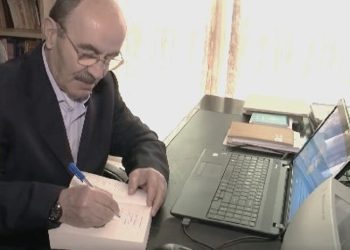
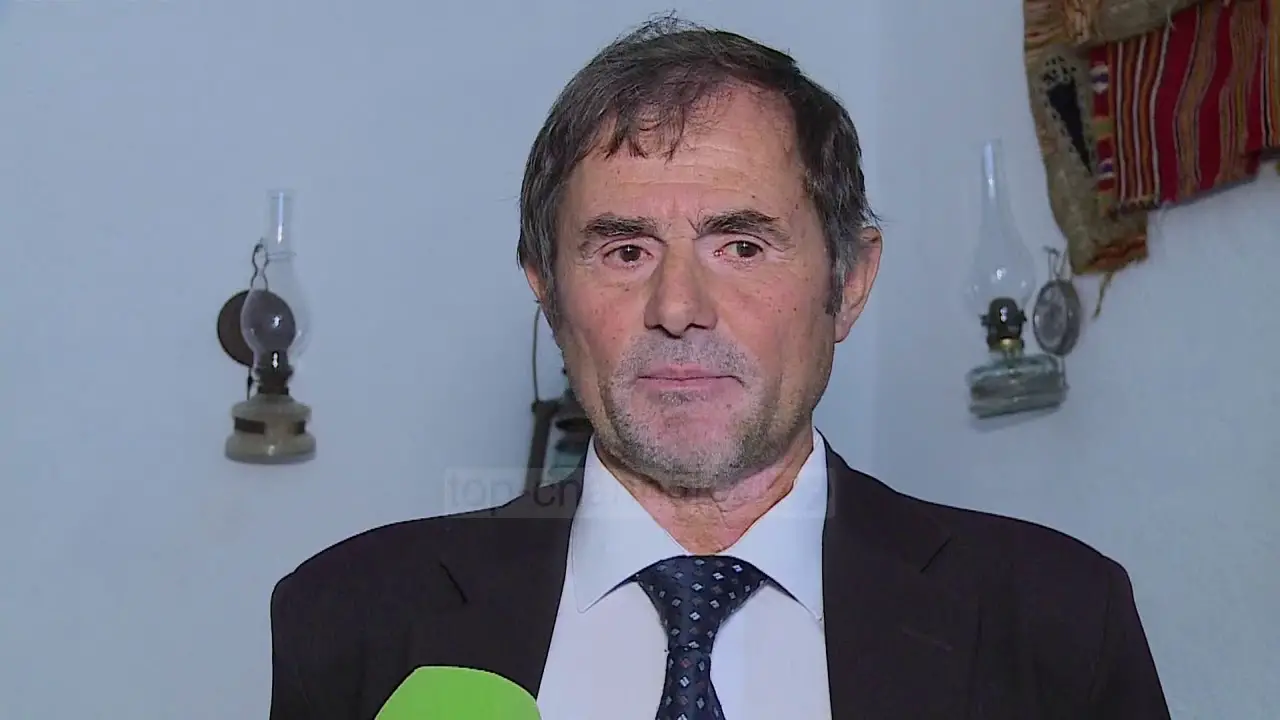
Memorie.al / At the request and wish of the author, Ali Buzra – as his editor and first reader – I will briefly share with you what I experienced during my encounter with this book. This is his second work (following the book “Gizaveshi through the Years”) and it naturally continues his established writing style. The sincerity and openness of the narration, the simple and unrefined language, the accuracy and precision of the episodes, and the absence of intentional, later-processed fantasy or its exploitation, have, in my opinion, served the author positively. He reaches the reader in his original form, inviting us to at least get to know unknown human fates and pain – whether by chance or not – leaving us to reflect as a beginning of awareness toward a catharsis so necessary for the Albanian conscience.
– Bedri Kaza
Continued from the previous issue
MUHARREM SALLAKU: A VICTIM OF REGIME PERSECUTION
The mistreatment and persecution of individuals and families who were, or were suspected of being, opponents of the regime, was an objective of the party-state’s activity in almost every village and residential center. Since it is impossible to describe them all in this book, we are providing only one example: the Sallaku family in Dranovicë (Kostenjë).
I mention this case because during the War, Kostenja was almost entirely connected to the National Liberation Movement, serving as an important base for it. Unfortunately, even this village did not escape harrasment and persecution. In the “Dranovicë” neighborhood of Kostenjë – now a separate village – lived two families of the Sallaku clan. Traditionally, the men of the Sallaku family were hardworking people, distinguished for their word of honor (besa) and bravery.
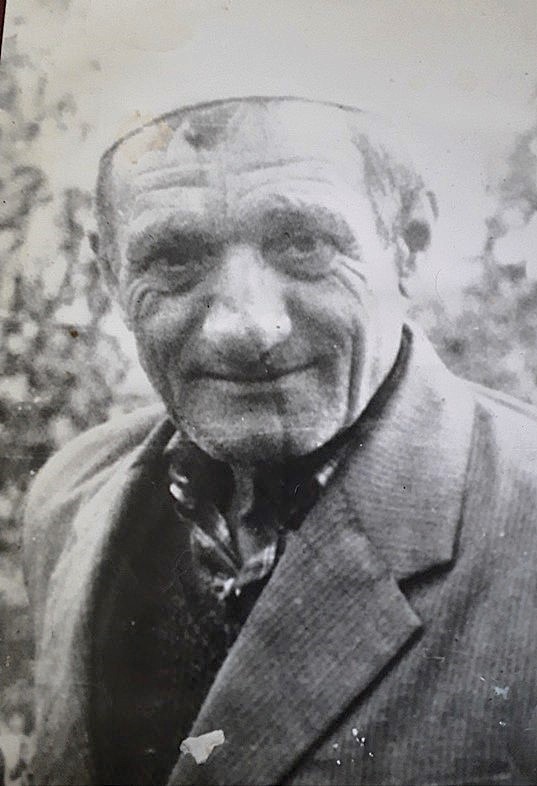
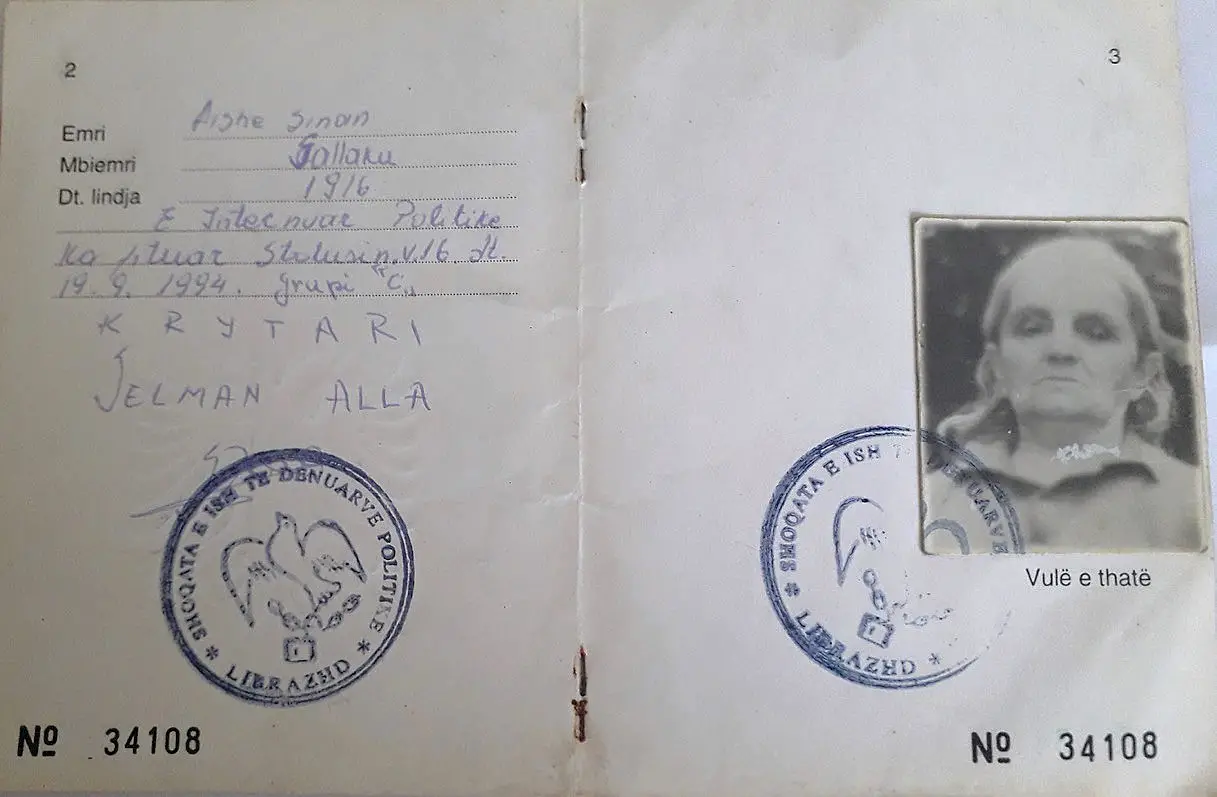
Muharrem was the son of Liman Sallaku. Their family was small, with few members. They were engaged in agriculture and livestock. They were simple people who, through hard work, had achieved a middle-class standard of living. Liman passed away at a young age, while his son, Muharrem, strengthened the family economy by increasing the livestock. He married Aishe, the daughter of Sinan Meta, who was from the same village.
During the war, with the formation of the Martanesh Detachment (Çeta e Martaneshit), he, like many of his fellow villagers, joined the struggle for the country’s liberation. He was then 27 years old. Following the massacre carried out in Martanesh in March 1944 by the 1st Partisan Assault Brigade (led by Mehmet Shehu), where over 20 innocent men were killed without trial, Muharrem was left disillusioned.
He knew some of them personally, as the people of Kostenjë had friends in the Martanesh area. He often disagreed with the orders given by the command, which expressed harshness toward opponents. Muharrem, though uneducated, possessed an intelligence to be admired.
Meanwhile, he contacted friends who provided him with information regarding the reforms the communists intended to undertake after the country’s liberation. Now convinced that the liberation war was not leading to a true victory for the Albanian people and after a debate with the leaders, he left the Martanesh Battalion and returned to his family.
Muharrem did not join any other nationalist group, yet the partisan command decided to arrest him. After the country’s liberation, the partisan unit that arrived in the village surrounded his house while he was a fugitive (në arrati). They demanded and threatened his family members to reveal his location, but in vain.
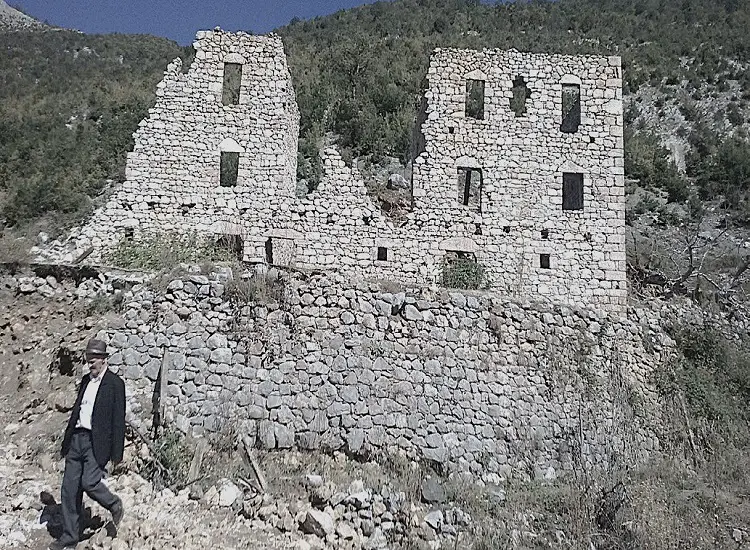
His mother and his loyal wife, despite extraordinary pressure, did not utter a word, even though he was in the forest directly across, not far from the house. The partisans opened the doors of the first floor where the livestock were kept, while his mother and wife, with his small son, two-year-old Fadil, were forced outside without being allowed to take a single possession. The partisans set fire to the Sallaku family’s three-story stone tower (kulla), while Muharrem watched the flames rise into the sky and the wooden roof collapse within its magnificent walls.
The partisans seized and took all the livestock: two cows with calves, a heifer, the plowing oxen, the horse, 80 goats, and over 20 sheep. That same night, Muharrem’s elderly mother, Mereme, his wife, and the young son were taken on foot to Elbasan. There, along with many other “reactionary” families, they were held for several months.
Aishe recounted that they were given only one ration of moldy cornmeal bread per day and nothing else. Muharrem’s mother could not survive. She fell ill and passed away inside the camp without being given any medical assistance. Like many other internees, to this day, she does not have a grave where her family can find solace.
After Elbasan, the group of internees was sent to Berat, where they stayed for nearly two years. Under these circumstances, Muharrem decided to surrender. He had committed no crime other than leaving the Battalion. Despite the harsh conditions of the established regime, many of his fellow villagers and fellow detachment members consciously vouched for him.
Thus, he was not sentenced, but for several years he held the title of kulak, while his family was released from internment. Muharrem built new houses in the place called “Krushë” in Dranovicë. He lived and worked there, where three other children were born and raised. Generally, his family was no longer hounded, though certain individuals caused them trouble at specific moments.
In 1982, his youngest son, Belul, was appointed as a salesman in the village shop by a decision of the local authorities. His father, Muharrem, was uneasy about this. He told his son that they would not leave him in peace there.
He continued to work in the trade sector until 1984, but an anonymous letter sent to the Central Committee of the Labor Party led a team from the District Party Committee to come to the village to “analyze” the “great” problem that had arisen. Finally, it was concluded that the son of a former kulak should not be in that job position. Thus, he was dismissed from this sector without any other motive.
I wish to share with the reader some personal memories of the Sallaku family. At the end of January 1976, after being discharged from military service, I was appointed as a teacher at the subordinate school with collective classes in the village of Dranovicë. The school had two teaching rooms and a small room for the teacher, separated by wooden planks. There was a wooden cot, a small table, and two portable chairs.
I cooked on a simple electric stove. I taught on a 6-hour schedule with the 4 classes of the elementary cycle. One afternoon after school, a dark-haired young man with a sturdy build came to the school and greeted me. “I heard a new teacher has arrived,” he said, “so I came to meet you and get acquainted.”
It was Belul Sallaku. He too had been discharged from the army in those days. At first glance, he seemed a bit stern, but in reality, he was quite warm and cheerful. Days passed, he visited often, and we became close friends. He invited me to his house, which was situated on the opposite mountain slope and could be seen from the school. I gladly accepted, and late one afternoon, we set off for his home.
When we arrived, I noticed the house was a three-story tower (kulla), where you entered the second floor directly without stairs, as the slope was very steep. Around it were several small plots of land, and beyond them lay a dense oak forest. We climbed the stairs to the third floor, where his father was.
Upon entering, I noticed the room was large and covered with rag and wool carpets, and several white and black sheepskins were placed over them. The fireplace, filled with oak wood, roared with flames and embers. In the corner sat Belul’s father, Muharrem Sallaku, cross-legged. It was the first time I had seen him.
He immediately stood up, saying, “Bujrum” (Welcome). He shook my hand and also placed his other hand on my arm. He was taller and larger in build than his son. Now at the age of 60, he was well-preserved. We stayed late talking. Belul hardly spoke again; he listened to and respected his father.
Muharrem spoke calmly and fluently. He intrigued you, as for every event he recounted, he had a purpose, arguing the point in question. I visited Muharrem several times, always in the evening. When he saw me off the next morning, he would say: “I expect you to come back.” He was very generous and hospitable.
Some time passed, and it seems my friendship with them was noticed. On one occasion, one of the cooperative cadres told me to be careful and not get too close to that family, as they had been labeled kulaks and Muharrem himself had been a fugitive for some time. To be honest, despite my great respect for them, I felt shaken.
At that time, the State Security (Sigurimi) and its tools thought nothing of preparing “papers” for you, which meant not only could you be permanently dismissed from work, but you could also face long years in prison as a “collaborator with the enemy.”
That night, I stayed up late in the small room, lighting several cigarettes one after another, as I was a smoker at the time. But this anxiety about my fate did not last long. The next afternoon, I went to the sector office, where three guards of the weapons depot – located on a small hill facing the school – served in shifts.
There was also a telephone. I went there often after school. The two older guards were Hamza Peshku and Selaudin Meta. I found only Hamza there. Usually, the sector’s norm-setter worked in the office while cooperativists also came by for various problems, but in this specific instance, no one else was there.
I asked Hamza, saying: “I hang out with Belul and have been to his house; is this problem?” “No,” he replied. “But… I heard he was declared a kulak?” “That was for nothing; it was a misunderstanding. Muharrem Sallaku is a good man and has nothing against the authorities. We go to his house.” I was completely relieved of the anxiety that had gripped me. Hamza was the brother of Qazim Peshku, who had been a unit commander in the Martanesh battalion, and I was aware of this. As a family, they were closely connected to the authorities.
Another day, in conversation with Selaudin, I said: “I’ve become friends with Belul and have been to his house. It seems like a good family!” The latter, with his sharp and defiant gaze, understanding the purpose of the conversation, told me: “I’m waiting to change shifts now; let’s go together to Muharrem’s tonight.” And so we did.
Selaudin might have been over 55. His family had also participated in the war. His brother, Ibrahim, a serious, measured, and very balanced man, worked in the government organs of the time. I spent a wonderful night with the two elders. They told stories of the zone and the region. They mostly talked about the Martanesh region, about famous men in that area with whom the people of Kostenjë maintained friendly ties.
Thus, with the courage Hamza and Selaudin gave me, I maintained and kept my friendship with the Sallaku family, which became so dear to me during the time I stayed there – a friendship I still cherish today with Belul, as Muharrem passed away in 1986.
Closure
By highlighting and describing the harrasment, persecution, and suffering of some of the families in the villages of the area I have included in this book, I hope to have contributed somewhat to lightening the heavy burden of insult, contempt, and discrimination placed upon these families by the communist regime of the time.
Executions with or without trial from the end of 1944 onwards, heavy political imprisonments of many prominent men in the Librazhd regions, and the countless sufferings of their families, constitute part of the terrifying scenarios of grave crimes committed by the dictatorial state, which was established by force in Albania after the country’s liberation.
The entire Albanian people felt and experienced the weight of the dictatorship of the proletariat. The collapse of the dictatorship and its symbol, the bust of Enver Hoxha, was a turning point for suffering Albania./ Memorie.al