
By Nos Xhuvani & Pavli Haxhillazi
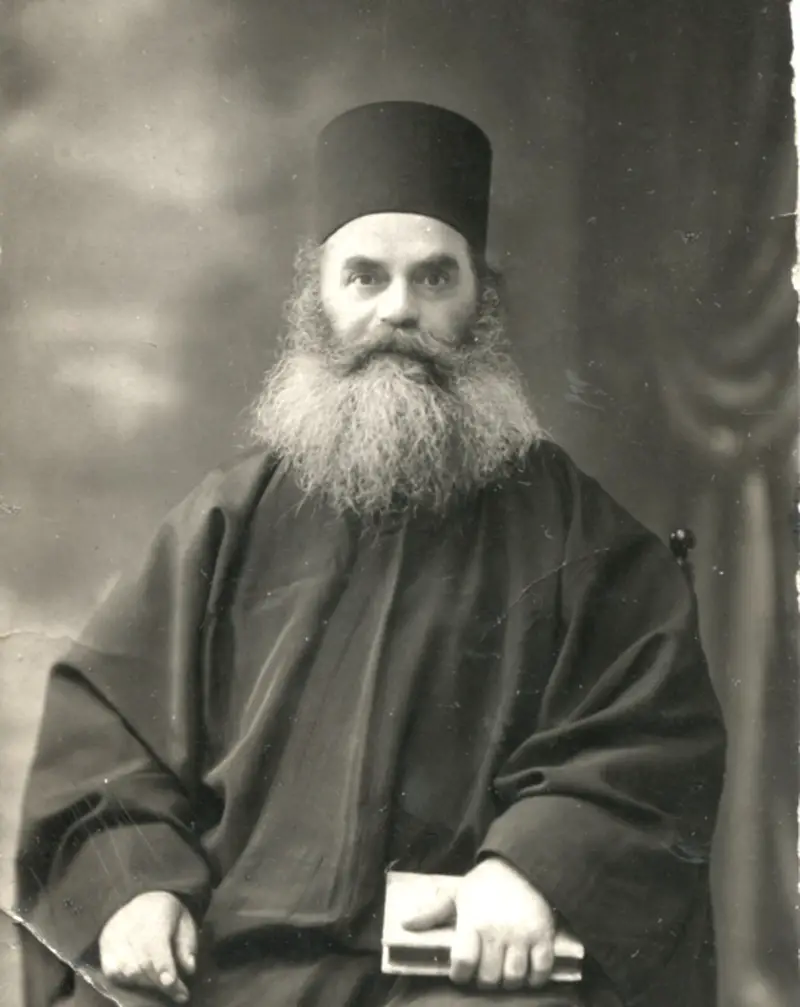
-The role of Monsignor Visarion Xhuvan, in the recognition of the Autocephalous Albanian Orthodox Church and the great support he gave to Ahmet Zogu-
Memorie.al / The desire of the Albanian Orthodox to have an independent Church is early. It was taken with them by those who emigrated outside the homeland, to America, Romania, Bulgaria, Egypt, where they found suitable land and signs of revival. With the declaration of independence (1912) and with the formation and consolidation of the independent Albanian state in 1920 (the Congress of Lushnja), this desire came alive, strengthened and took more concrete forms. Albanian Orthodox, led by the main canon; “Free church in a free state”, demand that all religious rituals be done in the Albanian language, in the mother tongue. The spiritual organization based on the holy canons, its formalization and approval, must be done by the state in the first place.
This initiative was taken by Kostë Paftali, prefect of Durrës. He telegraphed the prefectures in 1922, about the necessity of organizing a gathering, for this important purpose. Each prefecture would choose two delegates, among them there were very well-known clergymen, such as; Archimandrite Visarion Xhuvani, Archimandrite Agathangjel Çamçja, Iconom Vasil Marku, Pope Harallambi, Pope Joseph, etc. The Albanian government was very interested in the spiritual and religious affairs of its people. She sent a circular to the prefectures and sub-prefectures, to support the election of patriotic people, who would support the idea of an Albanian autocephalous church.
Opponents of the autocephaly of the Albanian Orthodox Church spread lies, as if the government was the organizer of the meeting of the First Church Congress of Berat. Ahmet Zogu, then Minister of the Interior, rejected these slanders. The Orthodox Ecclesiastical Congress declared the autocephaly of the Albanian Orthodox Church, relying on the apostolic canons and synods connected spiritually, dogmatically and apostolically with the great Church of Christ, with the Patriarchate of Istanbul.
This Congress fulfilled the aspirations of the Albanian Orthodox, because it finally established the legal right of the Orthodox Albanians to use the Albanian language in the church. With the decision No. 807, dated 18.09.1922, the Council of Ministers made the official state recognition of the decisions of the Congress of Berat and fully approved them, because they were based on the principle of independence of the Albanian state (A.Q.Sh. fund 251, file 1254, year 1922).
Istanbul does not recognize the Albanian church!
The Nalte Council, elected at the Congress, notified all patriarchates and requested the approval of the Ecumenical Patriarchate of Istanbul, which did not approve the autocephaly of the Albanian Autocephalous Orthodox Church. Two delegations, one after the other, went to Istanbul and met with the Patriarch. In the second delegation, MPs, prominent clergy, well-known personalities of the country participated, such as; Father Vasil Marko, Dhosi Havjari, Vasil Avrami, deputy Thoma Orollogai, Father Harallamb Torka, Dhimitër Kacimbra, Simon Shuteriqi and Kristo Kirka. Despite the convincingly argued request, the Patriarch did not withdraw from his previous position, acting with diplomacy, for the recognition of the independence of the Church and not for the recognition of autocephaly.
For the recognition of independence, so we emphasize not of autocephaly, the Patriarch of Istanbul set the following conditions:
– The bishops who will be elected by the Albanian people must have been approved by them beforehand.
– The Patriarchate has the right of veto, in the approval of the Archbishop.
-The desirable old language of the church, Greek, to occupy the first place in the Church.
These demands of the Patriarchate of Istanbul rejected the main decisions of the Church Congress of Berat and the patriotic opinion did not agree with these demands. Meanwhile, the discussions became fierce and the contradictions between those who were in favor of autocephaly and those who called the proposals of the Istanbul Patriarch sufficient, deepened. The implementation of the decisions of the Congress of Berat was done slowly, because even the main dioceses were without their own holders. Also, the financial situation of the churches was very weak. In order to create a more favorable situation, Visarion Xhuvani, in 1923, since then he was a deputy and a member of the Supreme Council, asked the Parliament for financial assistance of 50,000 gold francs.
He addressed the Parliament with these words: “So once again, this Parliament should take into account all the needs and the delicate situation of the National Autocephalous Church and not spare a small gift, which has the advantage of uniting and Albanianizing the Orthodox, work which has so much value for the highest interest of the state in the future, that I cannot explain it with the little time we have”. (Conversations of the National Council, page 221, year 1923***)
After some discussions, Ahmet Zogu said: “You know that these aids will be given outside the budget and an amount of 50,000 gold francs is not a big deal. The government therefore gladly accepts the wish of the finance committee, that this much to be donated to the High Council of the National Church”. In this case, Ahmet Zogu expressed for the second time, the good will to help the Albanian Autocephalous Orthodox Church. He maintained this position in support of the Albanian Autocephalous Orthodox Church in other cases as well, which we will see below.
The aid approved in the Parliament led to the solution of the urgent problems of our Church, but the absence of the Holy Synod with canonical despots, who would lead the church activity, to implement the decisions of the Congress of Berat, was an obstacle great. The metropolitans were: Jerotheu in Korça, Kristofori in Berat and Noli in Durrës. With their actions, these incumbents showed themselves to be arrogant and did not fulfill the request of the Congress of Berat, to submit the two possible candidacies, since then they were Visarion Xhuvani and Agathangjel Çamçja.
Three years have passed since the Church Congress of Berat and the solution seemed somewhat distant. Meanwhile, the diocese of Durrës remained without the Metropolitan. In order to fill this important ecclesiastical post and to implement the decisions of the Congress of Berat, the High Council of the Albanian Autocephalous Orthodox Church commissioned Visarion Xhuvan to lead the Metropolis of Durrës, according to decree No. 686 dated 28.3.1925. Vissarion asked his clergy and associates to preserve and fully implement the holy canons, for the honor of the church and for the good of the people. Completing this task required the Metropolitan of Durrës to have episcopal rank. Vissarion could not wait until the anger of the Istanbul Patriarchate subsided, and he did not agree with the indolence, patience and humility of any other despot.
He was convinced that the Patriarchate wanted the Albanian Church to remain forever dependent on it. It was time to act with courage and sacrifice. Then, without the support of the Supreme Council, Visarion Xhuvani went to Montenegro and on May 3, 1925, he surrendered to the episcopal rank. The act of Visarion’s surrender had a double echo. Some thought that things would be accelerated for the formation of the Synod; others called it a disciplinary violation. Among them, there were members of the High Council, who did not recognize him as Metropolitan and forbade him to celebrate the Episcopal Mass.
They even managed to demand that disciplinary measures be taken against him. The conflict between the new Bishop and the Supreme Council was resolved by the Minister of Internal Affairs, Abdurrahman Dibra, who, in response to the letter sent by the Prefecture of Elbasan, on 24.2.1927, wrote: “Since the Holy Synod , is in the process of being formed, the status quo should be maintained and the problem resolved by the Synod”.
Xhuvan is not defeated
In 1926, the Patriarchate of Istanbul took another diplomatic action, to overcome the resistance of the Albanian patriots and to convince the Government and the King of the Albanians. She sent to Albania, Exarch Krisanthos, and Metropolitan of Trebizond and lay P. Kotoko. The Greek missionaries insisted again on maintaining the privileges of the Istanbul Patriarchate. The Albanian Orthodox was then divided into two groups: supporters of the idea of autocephaly and supporters of the demands of the Patriarchate.
Meanwhile, the Orthodox of Vlora, headed by Tol Arap, sent this telegram to Father Vasil Markos on June 10, 1926: “Krisanthi is coming to Korça, have patriotic courage and don’t fall victim to the Phanariot foxes. We were born Albanians, we live and we will die Albanians. The Statute of Berat, for which we have sworn, is not violated by us”.
Visarion came to the forefront of the efforts that opposed the prohibition of the Albanian language in the religious liturgy. He did not call the introduction of the Greek language logical for philological reasons, because most of the liturgical books were translated and adapted into the Albanian language by people with professional competence. The contradictions between the intellectuals, on this important issue of the Albanian Orthodox Church, were resolved by King Zogu i Parë, who firmly declared: “I don’t care what the Patriarchate thinks. In Albania, I am the lord myself and I command.” (70 years of the Autocephalous Orthodox Church, Tirana 1993, page 71).
On November 13, 1929, the Prime Minister of the Albanian State, Koço Kota, addressed two letters to the Metropolitans; Jerotheu and Kristofor Kisi, who were both in Korça, and showed the desire that the two candidates for bishops (Çamçe and Ambrosi) would surrender as soon as possible and in this way, the conditions for the formation of the Holy Synod of the Autocephalous Orthodox Church would be met Albanian. Four months passed without anything being done. The government asked for an internal solution of the synod, while those who did not support this idea, asked for another solution. Their requests, not only were not canonical, but were also impossible for the national interests, of the Albanian Orthodox and for the state principles.
The High Council of the Autocephalous Orthodox Church was particularly interested in the formation of the Synod, which relied on the decisions of the Congress of Berat, the holy canons and the Albanian government of the time. In February 1929, the President of the Supreme Council of the Autocephalous Orthodox Church of Albania announced Visarion Xhuvanin. The new task assigned to Visarion was immediately approved by the Albanian Government.
Any further waiting would severely damage the autocephaly of the Albanian Orthodox Church, therefore in the extraordinary meeting of the Council of Ministers, chaired by His Highness, King Zog I, in which they participated; Koço Kota, Pandeli Evangjeli, Hiqmet Delvina, while from the Nalte Church Council, Father Vasil Marko and Monsignor Visarioni. The latter was tasked with choosing two foreign canonical bishops, who would deliver the Albanian candidates.
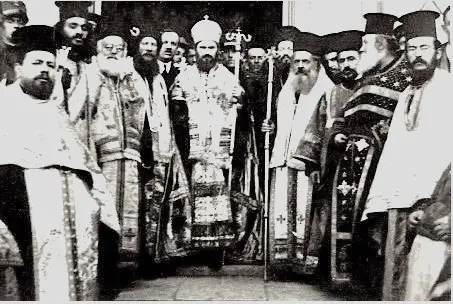
From February 11 to February 17, 1929, the ordinations of bishops took place and on February 18, the Synod would be formed. These were festive days for Orthodox and Albanian Muslims. The masses that were held then were events marked in the history of the Albanian Autocephalous Orthodox Church. The King was represented by Colonel Zef Sereqi, the Prime Minister Koço Kota, the Minister of Justice, Hiqmet Delvina, Xhafer Vila, Yzedin Beshiri, Abdurrahman Kroi, Dr. Basho, Tefik Mborja, etc. The seven-year long discussions for the election of the Holy Synod came to an end. “Gazeta e Re”, then wrote: “Finally, the national idea prevailed as always, because it originates from the soul of the nation and is believed in strong patriotic hands.”
Congress of Korca
After the formation of the Synod, the anger of the Istanbul Patriarchate and the Greek Patriarchate increased greatly. Both together and separately, they increased the pressure and increased the attacks on the Synod and especially on Archbishop Visarion, on King Zog and the Albanian Government. In order to cope with these defamations, which could reach the League of Nations in the form of a complaint, the Council of Ministers, with decision No. 218 dated 21.3.1929, decided to form a commission, composed of the Minister Plenipotentiary, Mehdi Frashëri and Dhimitër Pogë, political director at this Ministry, to follow the possible actions and to protect the interests of the Albanians, to be facing situations in the event that the Greek Government would raise the issue of the Autocephaly of the Orthodox Church in the League of Nations. (AQSh. fund 251, file 850, year 1929)
Without yielding to internal pressures and external slanders, the Synod, with Visarion at the head, worked intensively to prepare the second Congress of the Albanian Autocephalous Orthodox Church, in Korça. Even for this activity, the care of the Government and His Majesty, King Zogu I, was at the appropriate level, bearing a part of the financial expenses.
The Congress would approve the definitive Statute and the internal regulation of the administration of the Church. On June 19, 1929, all 46 delegates representing the clergy and people of Albania gathered in Korça for the proceedings of the Second Pan-Orthodox Congress. The historical Congress of Korça unanimously approved the basic documents of the Church and many other decisions, placing the Albanian Church alongside other Balkan, European and world Orthodox churches.
Recognition of Albanian autocephaly
In 1935, His Highness, King Zog, requested recognition of autocephaly from the Patriarchate, sending Koço Kota and Josif Kedhi, at the head of a delegation to the Patriarch, to give Tomus to the Albanian Orthodox Church. Another condition was added to the demands of the Patriarchate: the removal of Visarion from the post of Archbishop. Vissarion, who gave so much for our church, decided to sacrifice himself and at the VII Synod, he agreed to resign. After May 27, 1936, the day Vissarion resigned, until April 12, 1937; there was intense diplomatic activity to convince the Patriarch of Istanbul to approve Tomus.
He did not budge from his demands, he only softened them and adapted them to the diplomacy of the time, he approved Tomus and Monsignor Kristofor Kisi came to head the Albanian Church. Even later His Eminence, Ahmet Zogu, showed special attention to the progress of the Albanian Orthodox Church. The donation of the Tomus by the Istanbul Patriarchate, to the Albanian Autocephalous Orthodox Church, was made on April 12, 1937. This came after the persistent work done by the Albanian clergy, with the Congress of Berat, Korça and after they formed their Synod.
The Greeks blocked the trip of the Albanian archbishop, but King Zog ordered a plane to Italy for Monsignor Xhuvan
For the realization of the religious-national mission, Visarion Xhuvan was supported by His Highness, the First Bird. When Vissarion was imprisoned by the communist regime (from 1948 to 1962), one of his co-sufferers, Beqir Ajazi, for the unsparing help that His Eminence, the First Bird, gave to the book; “From the scythe with the crown, to the sickle with the hammer”, he writes: “Patrick of Bucharest and all of Romania had died.
As the canons want, his burial would take place with a grand ceremony, where there would be not only the high clergy of the country, but also the official representatives from the churches of other countries, among which Albania was also a part, coming out for first time as autocephalous. Since Patrick’s death had been unexpected and when the representative of the Albanian church, Vissarion, had to be there, His Highness, the First Bird, had ordered a ceremonial table for the mass, woven and embroidered entirely of gold. The heavy chamillaf (womb) and the scepter alone had cost more than 400 gold napoleons.
The airline to Bucharest then passed; Tirana-Athens-Sofia-Bucharest. So, in addition to the Bulgarian transit visa, the Greek government visa was also needed. The latter had refused to grant a visa to Visarion, because Monsignor was “persona non grata” there and convicted, due to the activity he had carried out in the case of autocephaly. It seemed to the public that the Greek authorities were doing their best to prevent our Church from appearing in a world ceremony, such as that of the burial of Patrick of Romania. In order to blow up their sabotage plan, His Majesty, the First Bird, had ordered a special plane, passing Visarion to Italy and then to Romania.
According to the rules of protocol, you had asked Visarion to be the first to preside over this ceremony. The other parts, appearance, clothing and ecclesiastical abilities, were owned by Visarion himself, who had reaped a great sympathy there, for our Church, for himself and for Albania. Regarding this activity, Gjergj Bubani told me that; during the ceremony, thousands of Albanian women from Bucharest interrupted the procession from time to time to appear in front of Visarion, chanting with devotion: “Long lives our Sovereign”./Memorie.al