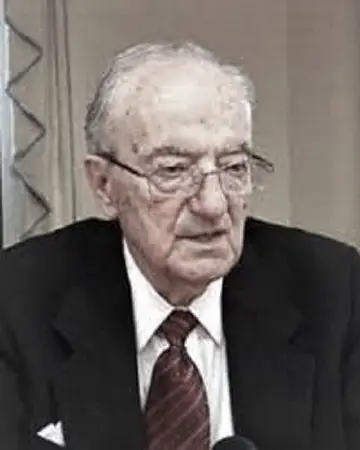
By SAMI REPISHTI
Part Nine
UNDER THE SHADOW OF ROZAFA
Sami Repishti: “In Albania, the communist crimes of the past have been neither documented nor punished; there has been no ‘spiritual cleansing,’ no conscious confession, and no denunciation of ordinary communist criminals!”
Memorie.al / During the ’30s and ’40s of the last century, as the unstoppable fascist and communist storm descended upon Europe, and eventually the entire world, “fate” seized the Albanian nation by the throat. Like all young people, I found myself at a crossroads where a stand had to be taken, even at the risk of one’s life. I said “no” to the dictatorship and took a path that had no end – a sailor in a vast, shoreless sea. The rebel act that almost killed me simultaneously liberated me. I am an eyewitness to life in the fascist and communist hell of Albania – not as a “politician” or a “personality” of Albanian macro-politics, but as a student, a youth who became conscious of his role in that time and place, driven by love for the fatherland and the desire for freedom; simply, as a youth with profound sensibility, faithful to himself and to a life of dignity.
Continued from the previous issue
I did not expect such an expression from him. For my part, I had long nurtured these doubts, and developments in the country were confirming them. Our country was descending from the platform of an occupied nation awaiting liberation into the vast and unknown arena of ideological clashes of global proportions. The “Anglo-Soviet-American Coalition” had been “transformed” into the “brotherly struggle of the Yugoslav peoples” or the “Soviet” struggle, under the “genial leadership of Comrade Tito and Stalin.”
Albania was badly caught in the trap of this development, and it was clear that my cousin had also begun to understand this. I left, unwilling to leave him alone; yet hoping I would meet him again. When we embraced, he said in a low voice: “Between us!” and smiled. “Undoubtedly!” I replied. As summer passed, the situation worsened further. German troops were retreating from Greece. Clashes with Albanian guerrillas were daily.
In the city, ordinary murders increased, and in the resulting chaos, the communists executed “enemy” elements. Their military capabilities created an unshakable confidence in the forces the “Movement” had given them. By now, there was no force capable of stopping their march. The question of what kind of “state” and “society” would be born from such methods was not raised at all. It was clear that “Victory at any cost” meant victory without any moral scruples…! On their part, the Nazis began new arrests and hostage-taking.
Among them were my cousin’s parents – his father and two uncles. They were married, with nine children. The Nazis demanded the surrender of the “son,” threatening the hostages with execution. An extraordinarily difficult moral dilemma was placed before the “underground” cousin. I tried to meet him, but without success. Faced with the risk of the execution of his father and two uncles, and leaving two widows with nine orphaned children, the nineteen-year-old cousin bravely faced certain death and surrendered to the pro-Nazi police authorities.
His self-sacrificing act shook the city! For me, as perhaps his closest friend who knew him intimately, it was a death blow, though not unexpected. This manifestation of his manly character was part of his personality as I knew it. He remained faithful to himself until the end, even before certain death, even before the firing squad in the Nazi extermination camp…! A day later, loaded onto a German military truck along with a Jewish family from Shkodra, he left and never returned.
Those who saw him said that along the way, he raised his handcuffed hands as if wishing to say there was no salvation. Later, we were informed that the caravan had passed through Pristina and Belgrade, ending up in the Mauthausen Nazi camp in Austria, where the group from Shkodra was shot. Devastated by his disappearance and submerged in a river of memories that followed one another naturally and uncontrollably, like the flow of water, I spent many days shut inside my house, not knowing what to do, unable to find an explanation for such a banal turn of fate that cost the life of a nineteen-year-old idealist.
I had neither the courage nor the desire to meet his parents, who were driven mad by the loss of their son. I could find no words to say. But most difficult was a kind of accusatory, unfair spirit I began to harbor against them. The idea that he had surrendered to save three parents from certain death and nine orphans from misery further strengthened my conviction in the strength of his character and the quality of the idealism that had accepted the supreme sacrifice for the cause he served. I often thought that a being as kind and sensitive as he was could find him in such a difficult position, facing the eventuality of sacrificing his life.
Nevertheless, something inside told me that his conviction in the justice of the cause he had embraced was dearer to him than life. There was something more sublime in his act; his gesture of surrendering “voluntarily” to save innocent lives being sacrificed for him – by force, not by conscience – took on an extraordinary brilliance of martyrdom, a courage of superhuman proportions, and was clothed in the semi-divine meaning we give to legendary heroes…!
The daily events made it harder for me to understand the price demanded of everyone in the name of the national cause, which was valued more than the lives of the youth – the unconditional commitment to social “reforms” that demanded the destruction of the old order and the building of a new one, marching over the bodies of martyrs, especially the young people falling every day across our country. It was difficult to understand that the sanctity of human life took second place to an “idea” that spiritually elevated and morally guided, but also “accepted” physical annihilation.
What idea could be so high, so noble and just, that in its immanent nobility, it demanded human sacrifices, and specifically the sacrifice of youthful lives?! Such “ideas” now seemed to me like man-eating monsters that devour their own children for food. Do we today, in modern language, repeat the legends of antiquity – the sacrifices and offerings on the altar of angry gods for their appeasement? Is this how the freedom of the innocent population is gained from the curse of one deity or another, who always despise the mortality of earthly beings?! How much has the cause of the “proletarian revolution” been advanced by the heroic and lonely act of my noble cousin, who will never return? And how much more useful will this “revolution” be after his death…? The greatness of such a superhuman act transcended the boundaries of the natural, transcended the limitless and banal force of vengeful gods who demand sacrifice, transcended the importance of any cause nourished by human blood, especially that of a youth not yet fully grown.
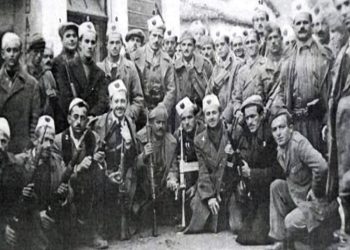
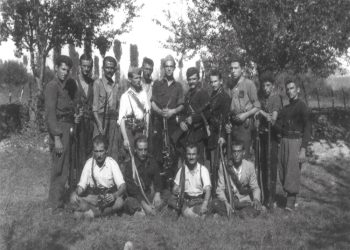
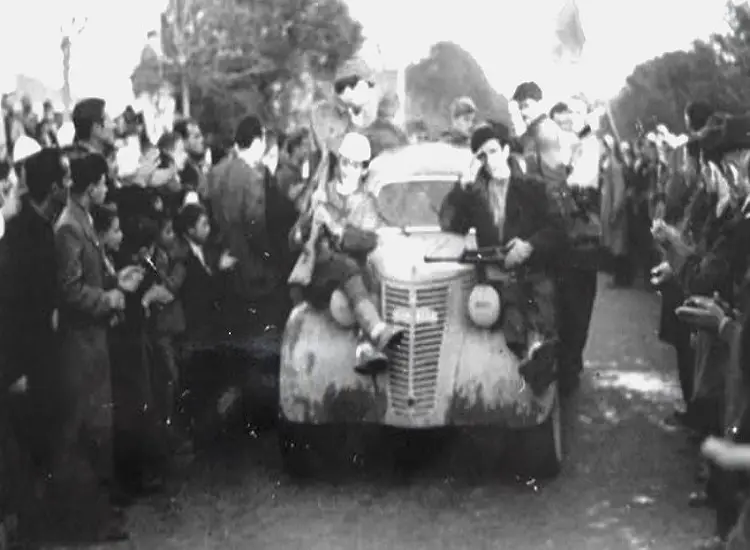
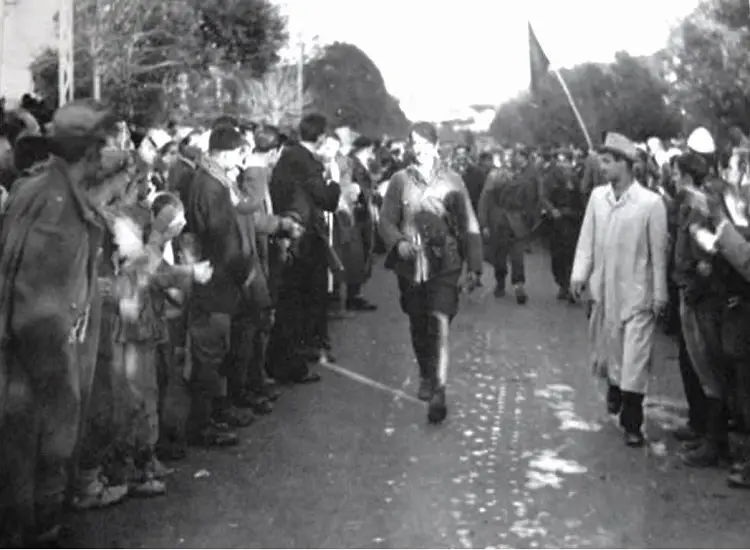
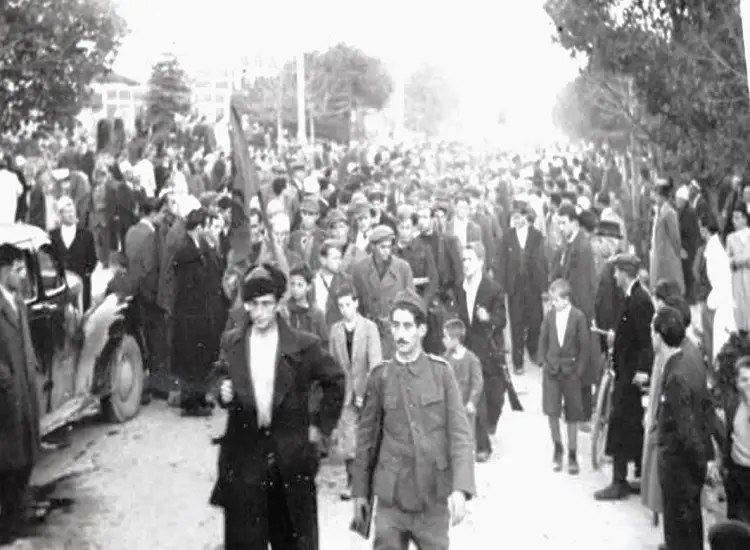
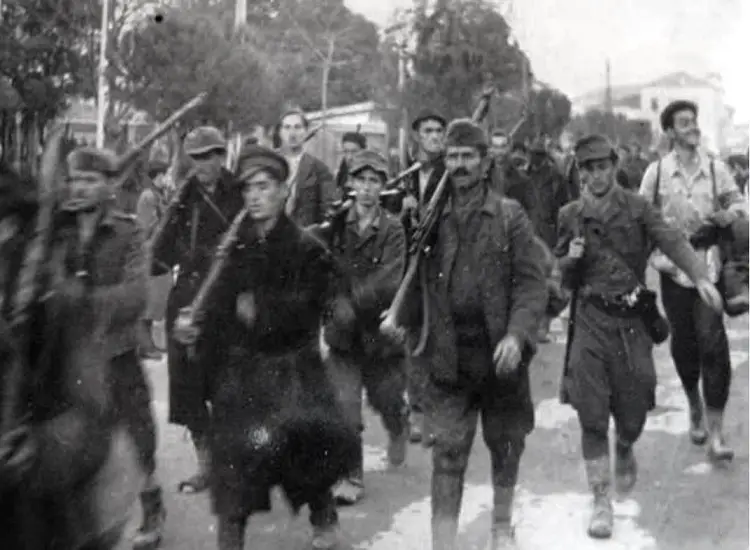
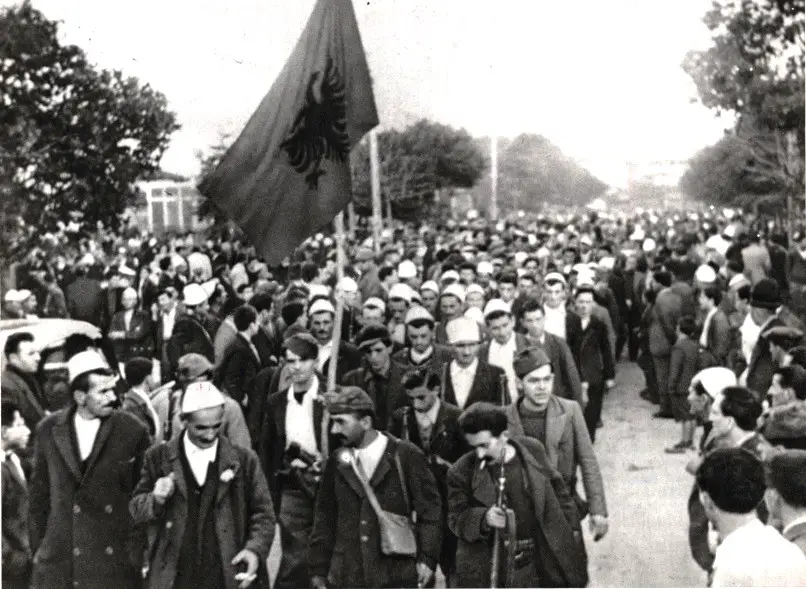
My cousin’s act was of a special quality, incomparable – a Promethean act! November 28, 1944. A beautiful autumn day! During the previous night, scattered rifle shots were heard. It seemed the citizens were celebrating the day of the German occupiers’ departure from the city of Shkodra. In the morning, an entire people began to fill the main streets. The crowd headed toward the city center. Here and there, young people in partisan clothes and arms were seen, greeting with a clenched fist: “Death to Fascism!”
A spirit of freedom was in the air, and everyone, spurred by the importance of the moment and curiosity to see the “undergrounds,” spoke heatedly. Some recounted war episodes, others were proud of the shelter given to the “illegals”; parents and relatives of partisans embraced and congratulated one another on the victory of their sons and daughters. It was the first time in our city’s history that girls left their homes and engaged in independent political activity – moreover, “underground” and of a military nature.
The concept of the Albanian woman’s role, confined to the home within the family, which for centuries had been one of the most stable pillars of conservative Albanian society, especially in Shkodra, was overturned by the wave of political-social revolution brought by the partisans. “Comrades” (male and female) were for the first time placed on an equal pedestal, with major consequences for the future of the country and Albanian society.
In the attitude of the majority, this extraordinary event was accompanied by the fear of the unknown. Who are the “victors,” the partisans, the uncontested leaders of the promised but unknown new order?! Their numbers were small, their past unclear and in some cases worrying, their revolutionary program and the methods used thus far harsh and dictatorial. Freed from the world of two hated regimes, Albanian society waited impatiently for a period of peace and security to enjoy newly-won freedom.
An instinctive feeling, unexplainable yet present everywhere and in everyone – the fear that we were entering a tunnel whose light we could not see – was in the minds and hearts of most of those walking, running, and gathering in the city’s central square. The psychology of the masses in a city like Shkodra, which had suffered successive invasions from northern neighbors, did not allow for the unconditional acceptance of close cooperation with “our Yugoslav brothers,” and even less the presence of Serbian and Montenegrin “instructors” in all sectors of the country’s state life.
Outdated mindsets for a new era? Perhaps. But they were powerful enough not to allow their acceptance without passing through the bench of deep… and historically justified suspicion. In the city center, armed civilians kept the road open for the “parade of guerrilla units and liberation battalions.” Everyone was talking; no one was listening. The crowd grew every minute. From the city’s outskirts and especially from the northern zones bordering Montenegro, armed highlanders or unarmed groups joined the urban crowd.
From them, we understood that German forces had retreated and crossed the border at Hani i Hotit, and partisan forces – Albanians and Montenegrins – controlled the main road up to the small town of Tuzi in Yugoslavia. Various reports, mostly unverified, circulated from mouth to mouth and ear to ear. At the city entrance, combat units prepared to arrive in military formations. A brass band that of the municipality, played marches selected for the parade.
I took a suitable spot in front of the central garden, from where I would be able to see the parade closely and possibly some of my partisan friends. Through my experience during the war, I had become quite cynical; it felt as if I were trying to convince myself that the “promising tomorrows” we had hoped for were nothing but a boyish dream evaporating like dew before the sun. Within me, a serious, deep debate had been unfolding for some time. The voice of conscience would not leave me in peace: “Is this your role in these decisive moments, your place on this historic day, and your contribution to the cause of national freedom?!” Silence…!
The changes brought by the war were predicted to be revolutionary, and the upheaval a cataclysm. Now, there were “activists” and “enemies,” with no hope for mutual understanding. The voice of my heart comforted me with the idea that my stance had been taken with the utmost sincerity, without ulterior motives to please or upset anyone, and that at the conclusion of this internal dialogue, my conscience was clear. This reached clarity had turned into a true fortress within which I felt safe. I had the impression that my generation was the first in the country’s history to face such a dilemma.
The sounds of the brass band were heard. Applause! From afar came the tones of new partisan songs. Without delay, the first groups of “guerrilla units” entered the city square, led by the red-and-black national flag, which this time bore the sickle and hammer, or the red five-pointed star…! It was a disappointment! In the ranks of the uniformed partisans, I saw some of my school friends. They looked tired, and suffering was clearly visible on their faces. But all were exalted. They walked with pride, rifles on their shoulders, gazes forward full of confidence. Some smiled at me when I waved; others did not react at all.
But their presence in this mass of volunteers made them greater than the sum of their individual parts. They were part of a social group that represented them, that had emerged victorious, and that was committed to building a new life and fulfilling desires. Speeches, more speeches. When the ceremony ended, I returned home. In this festive atmosphere, I felt alone. I was not part of a historical process of my country and my people on the day of liberation from the foreigner; I had not caught one of the brightest hours in history, the hours we face only once in our lives. I had lost this privileged moment…!
The “seizure of power” was not done by force, because it was not contested. The country’s administration, which until that day had served the “collaborators of the occupier,” placed itself at the service of the “partisan authority.” In Shkodra, with the exception of the power outage, municipal services continued almost undisturbed. The city streets began to fill with partisans from brigades arriving from the south of the country. For lack of space and organization, thousands were placed in the homes of citizens, who also fed them. In my house too, we had eleven soldiers.
It was cold! Tired from marches, exhausted by hunger, these young people – almost all under twenty years old – huddled under military blankets in every corner of the room, trying to sleep as much and as deeply as possible. It was a sight that touched my heart. In conversations with these partisans, I found no enthusiasm. On the contrary! A new world unfolded from their stories. Almost all had been “mobilized” in their villages. They were wary of the “commander” and the “commissar.” They all had “stories” to tell, especially about mass executions in the mountain villages.
An ugly event in the city center fell like the first bomb that woke the citizens – the first signal of what was to come later. A group of “collaborators” with the occupier was publicly executed in the main square. The news spread like lightning and was received with profound disbelief. At the scene, I saw the bloody corpses lined up one after another. All were in civilian clothes. Around them, groups of partisans danced to a rhythm accompanied by a song, new to me: “Lule Sofo, lule djalë!”
A crowd of silent citizens watched this massacre in horror: public executions, modeled after the Nazi style – without process, without trial, without legal defense, without the right to appeal. It was the first taste of the new society…! The new state organization was raising its head, supported by the force of iron and fire, just as I had suspected for the past two years. Endless speeches, repeated slogans, mass arrests, the “demonization” of the opponent – who was presented and treated as an “enemy” – and the revolutionary demand for merciless war. The public execution was the logical conclusion! It was not just the act of executing “collaborators” that shook the city.
It was the manner of this execution that showed a disregard for the rule of law and, practically, a disregard for the feelings of the citizens. Everything was calculated to create an atmosphere of fear and to prepare the psychological ground for the mass terror being planned. The continuous resistance faced by the “new power,” especially in the mountain areas, along with a cooling of the urban population toward public manifestations organized by the new rulers, was enough to convince the central leadership in Tirana to declare a “state of emergency” for the city and districts of Shkodra.
Every day, on telephone poles and shop windows, long lists were posted with the names of highlanders executed or sentenced to long years in prison for “collaboration” with the “enemies of the people”! The division into two camps grew deeper and more complete each day. From the start, it became clear that the battle for the minds and hearts of the citizens was not a priority for the new “power,” and consequently, it was lost. What interested the “power” was its reinforcement by any means and its retention at any cost. In the list of “collaborators,” there were also truly tragic elements: well-intentioned and brave attempts to face “fate” – the development of events in our country and beyond our country’s control.
It was the internal forces, supported by a centuries-old tradition, that were being defeated by new movements without history in that place, directed by forces located outside the country. The end of these victims of a fate that maneuvered without asking or caring was, in essence, an indicator of the setting of the old system – the inevitable sunset of a world that still concerned itself only with preserving inherited privileges, with no perspective for the future! A Shkodran social class, once privileged and powerful, later crushed by economic crisis, social changes, and the cataclysms of war, was evaporating without leaving heirs for replacement.
The remaining void was large and frightening at that decisive phase. Every day a public “show” was prepared to discredit the “enemies of the people.” One January day, a group of highlanders passed noisily, bound with handcuffs and ropes side by side, while around them, groups of young people and hysterical women repeated in chorus: “A bullet to the forehead! A bullet to the forehead! Death to traitors! Death to traitors!” The arrested – tall men, worthy representatives of the Illyrian race preserved for centuries in the heights of the Northern Alps – watched this funereal comedy with surprise, and the crowds gathered on both sides of the boulevard remained silent, astonished, terrified.
The fear exercised by the partisans was bearing its first fruits: an entire population was being stripped of its traditional civic courage! The serenity on the faces of the victims, bound and despised, heading toward certain death, could not be the reflection of a guilty conscience…! On the contrary! In their hearts, they must have felt themselves victims of an unjust punishment. Only the idea of victimization, of innocence, allows for such serenity. During their existence, these highlanders of Kelmend had accepted as their life’s purpose, like their ancestors, the role of guarding the borders of Vermosh from Montenegrin attacks for centuries. History was a witness!
Every political movement and activity had been viewed and defined in terms of this unquestionable patriotic stance. This was the only explanation for their armed opposition to the Albanian-Montenegrin “partisan brigades” in 1944–’45. This was the only explanation for why they “surrendered to our brothers,” the Albanian military authorities, as well as the naivety of their answers before the Military Court, which did not understand and, as a result, treated them as “traitors”! Why had they not helped the “National Liberation Movement?” Because it was linked to the Serbs and Montenegrins, our centuries-old enemies.
Why had they taken up arms against “our brigades?” Because they collaborated with Serbian and Montenegrin brigades, and we did not trust them. Why did they submit to the influence of the Catholic Clergy? Because they have always been with us, through good and bad…! The greatness of the sincere Albanian highlander rose before the Court like a monument testifying to the pettiness of the arrogant communists in the position of judges. The moral superiority of the victim’s stance was clear even before the tragedy shamelessly prepared by a leadership servile to foreign interests; a leadership degenerated by the lust for absolute power.
The entire court session, especially with those of advanced age, was permeated by a national, principled, and just line of the simple highlanders, in clash with the political line of the internationalist movement imposed by blood upon a population that despised it. The harsh and threatening questions received the simple and human answers of the highlanders, convinced of the justice of their cause. Even when the death penalty was pronounced, they were not shaken, though they could not understand how a Shkodran could be sentenced by an Albanian – an Albanian who has protected Albanian land generation after generation! They looked around as if expecting the “People of Shkodra” to say something for them, for their past, for their innocence.
Shkodrans, who knew their history well, were stunned by the hysterical screams in the hall from the selected public, who erupted, as if on command, against the “criminals,” insistently demanding their execution as soon as possible. The people of Shkodra had been distorted… or were huddled at home, terrified to the bone. “The clock had died for Shkodra!” It was the reflection of a complete political upheaval, a result of the slow moral ossification that Albanian society had suffered, especially during the war years…! Executions, with or without trial, along with the victim, also killed the very idea of the “liberation revolution,” the idea of freedom, and the promise of a better world that the revolution would bring.
The executions stained the “revolution,” blackened its image, and annihilated it. Because the hearts and souls of the silent majority began to rot, along with the corpses lying lifeless in the village streets, in city squares, on military firing ranges and execution grounds. Everywhere the eye saw corpses, covered and uncovered, always there before everyone’s eyes, like stubborn monuments for those who still lived, showing how heavy the price of crime was and how empty was the concept of a revolution without mercy and without magnanimity! / Memorie.al
Continued in the next issue
![“After the ’90s, when I was Chief of Personnel at the Berat Police Station, my colleague I.S. told me how they had once eavesdropped on me at the Malinati spring, where I had said about Enver [Hoxha]…”/ The testimony of the former political prisoner.](https://memorie.al/wp-content/uploads/2024/09/admin-ajax-4-350x250.jpg)