By Ali Buzra
Part Twenty-Five
– LIFE UNDER PRESSURE AND SUFFERING –
(ASSESSMENTS, COMMENTS, NARRATIVES)
Memorie.al / At the request and wish of the author, Ali Buzra, as his first editor and reader, I will briefly share with you what I experienced in this encounter with this book, which is his second (after the book “Gizaveshi in the years”) and which naturally continues his writing style. The sincerity and frankness of the narrative, the simple, unmodified language, the accuracy and precision of the episodes or the lack of a subsequent, intentional, refining imagination or its non-utilization, I think have served the author positively, who comes to the reader in his original form, inviting us to at least get to know unknown human fates and pains, whether coincidentally or not, leaving us to reflect as a starting point for raising awareness towards a catharsis so necessary for the Albanian conscience.
Bedri Kaza
Continued from the previous issue
In Qafë Shapkë, they descend down to Loma e Belegut and go along the canal towards Rina, without entering the village, as the soldiers of the border post, who were still in their winter post, were located there. They walk, passing through Rranishta, Fushë Zezë, Përroi i Pishës, walk through Zall i Rrinës, near Boka e Kuqe, near Gurra that emerges in the plain, near Zharrat, in Tumen e Zezë, and finally end up in Qafë Kryq. They cross the peak at daybreak, with the land of Macedonia in front of them. Kadriu knew the territory they crossed very well. Along the way, on difficult trails, with snow sometimes frozen and sometimes melted, where in many cases they had to crawl on all fours, they crossed the border, the motherland, with their lives hanging by a thread. And why? Because death awaited them in Albania.
They crossed the border, descending into Ligatat e Belicës, with the Macedonian state post in front of them. It was a wooden shack, and they didn’t know it was a border post. Extremely tired and exhausted to the bone, it seemed to them as if in front of the shack there was an old woman; in fact, it was the Macedonian guard soldier. “Stoi,” the soldier shouted at them and pointed his automatic rifle. The other soldiers came out, and the shack seemed to move. For the moment, they tied them hand in hand and put them in the kitchen. As soon as they stretched their feet towards the stove to warm them, those feet, as blackened as they were, immediately began to swell.
They untied them and gave them food to eat, but they couldn’t eat. After they rested, they were sent to Struga, escorted by two soldiers. But now they couldn’t stand on their feet. With the help of the soldiers, who held them by the arm, they reached a hill where two officers were waiting, while down on the main road, a car was waiting. Kadriu, thinking they might even send them back to the border, addressed the officer: “Kill me here, let me die, but I’m not going back to Albania!” But they, Kadriu recounts, helped them get to the car, and from there they were sent to the Directorate of Internal Affairs in Struga.
After questioning them and taking their statements, they gave them medical treatment and brought them food. That night they were placed to sleep in a materials warehouse. There, around one o’clock at night, they were woken by a call: “Kadri Biçaku, come to the door,” in Slavic. “Here I am, and would that I weren’t,” he replied in Albanian. They gave them bread and canned goods to take with them and, with an escorting policeman, sent them by bus to Skopje. In a place called Dorzanë, before reaching Skopje, there was a prison where they would be left. The Prison Director came out, Kadriu recounts, greeted them with a nod, and told them: “You are Enverists.” Kadriu, who was fed up and completely exhausted, replied, “I am anything but an Enverist, just as I wish you weren’t one either!”
He asked for tobacco, and they gave him two packets each. He was placed in a cell where there were two Macedonians and one Greek, while Ferit was placed in another cell. Then the others left, and he remained alone. In the morning, they brought him macaroni to eat, in an army mess tin. By now, his health condition was very serious. He couldn’t stand on his swollen feet. The pain became unbearable. He tried to get up, but in vain. He tried to explain himself to the policeman, but they couldn’t understand each other. The latter brought the mess tin with macaroni closer, while Kadriu threw it away against the wall.
From the noise and the bang against the wall, two other policemen immediately came to see what had happened. He took off his socks and showed them his swollen feet; even his nails had fallen off. In this state, they took him and sent him to the prison doctor. The doctor urged them to take him urgently to the hospital, telling them his condition was serious. “When they took me to the hospital,” Kadriu recounts, “I fainted in the bathroom. I came to,” he says, “when I was in the bed.”
The next day, several doctors came; including the doctor they called “Professor,” who said his legs needed to be amputated. They communicated this to Kadriu. “I ask for death,” he told them, “but I will not have my legs cut off.” He remained like this for three months in the military hospital of Skopje, receiving treatment every day. Ferit, who was in better health, stayed in prison. After leaving the hospital, he and Ferit, who was brought out of prison, were sent to a neighborhood in Skopje called “Sillovoda”. They were both placed in a residential house, given a room that was furnished. He was free, and even went to Struga to visit family friends who had helped him financially.
They stayed there for two years. In 1967, he requested from the Macedonian state authorities to be given a tourist visa for Sweden. There, there was work and good pay; meanwhile, his brother Nexhip’s son, Adil, who had escaped years earlier, was also there. And so it was done. Kadriu went to Sweden, where he got settled with work and everything, while Ferit went to America, as he had requested, where he remains today.
After Kadriu’s escape, the Librazhd Directorate of Internal Affairs was put on alert. The Eminaj family in Qarrishtë was defying them. According to them, the family had to be removed. On the evening of May 15, 1965, the Eminaj tower was again surrounded by police and border forces. Emin’s brother, Kapo, now over 70 years old, was not at home that night. He had gone as a guest to his in-law, Riza Hasa, there in the village, together with his son’s wife, Shadia, who was 19 years old, and his little grandson, Dashamir, who was a 5-month-old baby.
Riza had invited them because he was hosting a dinner for the men returning from the winter pastures. The people of Qarrishtë would take their small livestock to the lowland areas for the winter months, and in the spring, after keeping them in the village for a few days; they would take them to the mountains where they had their summer sheepfolds. In the mountainous areas, collectivization had not yet been completed. That night, Nexhip’s son, Besim, 18 years old, who had spent the winter months on the hills of Peqin with the herd of goats they raised there, had also come home. Despite the difficulties created by the state regarding tax collection, their family was still doing well.
At that time, Besim recounts, their families had again increased the number of livestock and managed nearly 300 sheep, 100 goats, 10 head of cattle, and pack animals. The policemen, accompanied by the chairman of the village People’s Council, whom they took with them formally, knocked on the door and demanded that the family members come outside. Havaja, Kapo’s wife, a courageous woman, sister of Latif Musta from Borova, did not open the tower door for them. They kicked the door, threatening her, but she replied curtly that she would not open the door until morning. The house remained surrounded all night, amid the shouting and furious rage of the policemen.
This was the “people’s power,” which arrested and punished the men of the house without cause, one after another: Emin, Kapo, Nexhip, Rrahim, and most recently kept Veliu in prison, with ridiculous and unprincipled justifications. This was the state that had unjustly crippled the Eminaj family, having faced the challenge of its capable men, and now took revenge in the most despicable and inhuman way, against women, the elderly, and children, keeping them under terror all night. On the morning of May 16th, a village resident went to Riza Hasa’s house and told Kapo to go to his house because they were looking for him.
Kapo told his daughter-in-law to get the child ready and come later, while he himself left immediately, feeling that something might have happened. When he got to the house, what did he see?! The tower was surrounded by police who were demanding that the family members come out. “Why are you forcing people out?!” he said to the policemen. “We’re going to remove you from here,” they told him, “Kadriu has fled.” Soon after, his daughter-in-law Shadia arrived, with the child loaded in the cradle. “I was very scared and sad,” she recounted, “when I saw my father-in-law just smoking, while my mother-in-law was crying silently, choked with tears.”
Kapo’s only son, Ilmi, her husband, was a soldier. An officer from the border post seemed like a restrained and humane man. He told them: “Take all your belongings, you’ll need them.” He took a blanket and spread it on the ground, and told the neighbors who were following the events to help the family members take out the belongings from the house, so they could take as much as they could. Thus, some of the neighbors tied up the belongings and furniture in blankets and sacks because the family members’ hands wouldn’t work.
“They were forced to pour out the dairy products to take the containers, while they took the pastërma (cured meat),” recounted Shadia, today a living witness of that sad day for the families of Emin and Kapo Biçaku. Their cousin, Pasho Biçaku, who lived in the “Qytezë” neighborhood, took care of the livestock—sheep, goats, and cows—sheltering and caring for them. In 1967, Qarrishta also became a cooperative; most village families sold what they had above the allowed quota, while some were forced to hand theirs over to the cooperative, forming the cooperative’s herds.
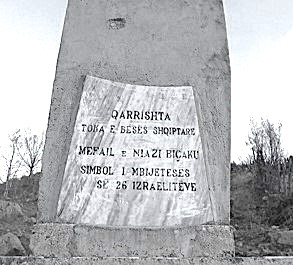
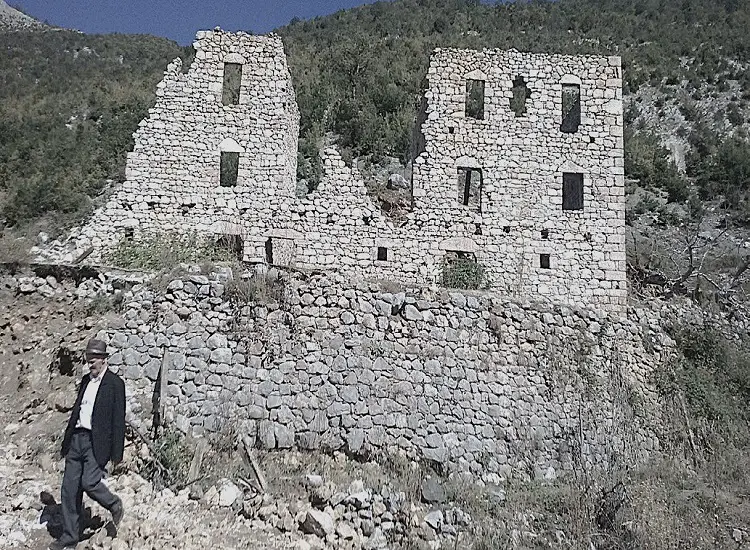
On that day, May 16, 1965, the Eminaj tower was emptied, never to be lived in again. Thus, 9 families from one lineage set off, not knowing where they were being taken. These were the families of the old man Kapo, Veliu, Shukriu, Isai, Hakiu, Eshrefi, Saipi, Kadriu’s wife (the escapee), Mejtja with her two minor children, and Nexhip’s sons with their mother. Only Saipi was unmarried; the others were married with children. The latter would marry during internment, a girl from Borova. With children and belongings in their arms, loaded onto two mules, they walked on foot for about four hours, escorted by police, to the “Kopal” neighborhood of Librazhd-Katund.
There, two “Zis” type trucks were waiting; the belongings were placed in one, while the family members were placed on top of the other’s flatbed. Genocide, practiced at different times by Serbs and Greeks against the Kosovo and Cham populations, while in this specific case, carried out by the Albanian state against its own people. They traveled to Rrogozhinë. There they were stopped, staying for about 4-5 hours. Apparently, they were planned to be sent to the internment camps in Lushnjë, where there were internees brought from the Tepelenë prison camp, but a second order changed their destination.
They turned them back and sent them to Belsh (Fierzë, Sector III). After arriving there, they were housed in an open tobacco barn, covered with rye straw. The covering was merely to keep the sun out, as rain fell entirely inside. “The height of the barn was no more than 1.5 meters,” recounted Nexhip’s son, Besim. The men of the families partitioned it, using wood and mud bricks in between, separating each family individually. They repaired the roof better, still with rye straw. They lived in this barn for two years. Out of the 9 families, 5 of them lacked working hands, having small children, or parents who had escaped or were in prison.
Nevertheless, the collectivity and harmony among the members of the family lineage was admirable. They helped each other to secure the means of survival. Not only the men, but also the women went to work in the cooperative after 2-3 days. In Qarrishtë, they had lived well. They had an abundance of dairy products, meat, beans, potatoes, pastërma, etc., but they couldn’t take anything except cooking utensils and bedding. Kapo’s family was worse off because he and his wife were elderly, while his daughter-in-law had a small child, about 5 months old, but as I emphasized above, help from the able-bodied members of other families was not lacking.
However, this didn’t last long, because after a month, Ilmi, Kapo’s only son, was discharged from the army. He was doing his military service in a labor unit, in Çermë of Lushnjë. The law on military service stipulated in one of its articles 1 year of service for those boys whose parents were elderly and had small children. Ilmi, being aware of this, had requested this from the command, and based on the law, he benefited from discharge from the army. He was discharged on June 16, 1965, knowing nothing about his family’s internment. He set off from Lushnjë, and according to procedure, stopped at the Military Directorate in Librazhd to complete the legal formalities. As soon as he arrived and signed the relevant document, they referred him to the Directorate of Internal Affairs.
“You will not go to Qarrishtë,” they told him, “because your family has been interned.” Thus, escorted by police, they took him to the Belsh area, to his family. Regarding this, Ilmi recounts: “When I arrived in Belsh, I found there my father, mother, and wife with the little boy Dashamir, in a shack, a tobacco barn. My cousins had partitioned off two small rooms, measuring three by two meters, as much as the space allowed, where they had placed all our families. The rooms were plastered with mud and covered with rye straw. There were no windows. Cooking was done outside because inside there was a fire risk. The whole village fetched water from one well. We stayed in this dwelling for three years. True, the situation was worrying. ‘In Qarrishtë, we truly left behind property and livestock, but we brought our working hands with us. We worked until our backs ached to raise the children,’ he expresses. Ilmi, although young, was a master builder.
He started work in the construction brigade, as they needed builders. The locals did not have this skill. His wife, Shadia, worked in the greenhouses. Both worked hard and accumulated many workdays. After three years, he built a new house, three rooms, still with wattle and daub (lit. with fence and stone in between). He plastered it inside and out, protecting it from the cold. They stayed in this house for 10 years, and then he built another house with 4 brick rooms, covered with tiles. The other families did the same, improving their housing conditions through work. Kapo passed away in 1975, while his wife, Ilmi’s mother, in 1989. They were buried there in internment, only with the participation of fellow internees. The peasants of Fierzë did not attend, nor did anyone from Qarrishtë.
Naturally, there were many people who wanted to attend and console the family, but it wasn’t possible due to the surveillance of families classified as *kulaks* (rich peasants). From 1965 to 1970, their punishment was “full internment.” They had no right to leave the residence. After 1970, this measure was lifted, and they could move only with permission from the Directorate of Internal Affairs. The daily roll call, however, continued. The contempt and differentiation shown towards persecuted families was constant. “Only our work wasn’t taken away; every other right was denied or restricted,” express brothers Fatmir and Reif Biçaku. Despite these conditions, Fatmir enrolled in night high school and finished it, while working during the day.
His brother Reif did the same, but couldn’t finish it. In his second year, he was suspended from school, and later mobilized into the army. Like many other boys from persecuted families, he was assigned to a labor unit, in Peshkëpi of Vlorë. They worked on manually excavating tunnels, outside minimum technical safety conditions. In those tunnels, several soldiers had been injured, and some had even died from cave-ins. Such a thing happened to Reif. In October 1977, a large mass of earth fell and struck him in the spine. He was sent to a hospital in Tirana, where he stayed for 6 months, but he remained paralyzed from the waist down. Even there, Reif felt social differentiation.
“I was in a very serious condition. Initially, they put a sponge under me, but later they took it away, telling me, ‘We don’t have any, we can’t do anything!’ They must have found out I’m from a family of *kulaks*, I thought to myself,” he recounted. After six months, he left the hospital and returned to his family. He was given a disability pension of 380 old lek, but the worst part was that he had to appear before the medical-legal commission in Elbasan every year. At that time, transportation was a problem, and in that health condition, moving was very difficult. Only his brother Fatmir and he himself know what they went through every year to appear before the commission in Elbasan.
In 1976, Veliu was released from prison. During his time in prison, he appealed and his sentence was reduced from 25 to 20 years. He served 14 years and was released, as 6 years were counted as work credit. He returned to his family there in Belsh. The boys were grown up by now. Fatmir worked in construction, where he was paid well, while Reif worked in agriculture, but he also met and exceeded the daily norm. Veliu himself was past 60 when he got out of prison. Although elderly and suffering, he was still physically fit. His sons didn’t let him go out to work. In 1980, together with Fatmir, they built a new house with stone walls and a tiled roof.
Fatmir married the daughter of Hamdi Gurra from Dragostunja, who came from a *kulak* family. The State Security at that time tried to penetrate persecuted families, co-opting individuals within their ranks, aiming to pit them against each other. They did this not only with adults, but also with the young, 15-16 years old, by promising them favors. The weapon of the State Security could not penetrate any member of the Eminaj family. They were prepared for this, remaining vigilant and unyielding to any possible provocation. For the communist state, Veliu remained a “dangerous” person. / Memorie.al
To be continued in the next issue