

By AGRON ARANITASI
Part One
THE TRUTHS I BELIEVE
– THE FRENCH AGENT –
Introduction
Memorie.al / When I began writing the book, “The Truths I Believe,” I had not intended to write about myself. The first impulse arose when I encountered the State Security (Sigurimi) files regarding the surveillance of the citizen Agron Hajdar Aranitasi. Those files are yet more evidence of how someone could be persecuted if, at a given moment, they were placed in the ranks of the enemies of the “People’s Power.” Nothing was taken into account – not how they had worked, how they had behaved, or how they had lived. Not even the stance of parents, brothers, and numerous cousins was considered; they automatically became subjects of brutal strikes and suffered consequences despite being entirely blameless.
Chapter One
Family Origins
My parents were officials of the People’s Power. My mother came from a middle-class urban family from Vlora. Her father, Tol Stavre Arapi, was a determined supporter of Ismail Qemali’s government. That government appointed him as the commissioner of the municipal police of the city of Vlora. He remained in this position for a quarter of a century, until the occupation of Albania by Fascist Italy.
Toli had participated in the war against the Greek andartes (1913). He had fought against the Italian army (1920). For this, he was decorated by the Presidium of the People’s Assembly. After the fall of the communist regime, he was honored with the title “Honor of the Vlora Region.” A rare photograph has appeared in the Albanian press, showing five men raising the national flag over the grave of Ismail Qemali in Kanina on September 3, 1920. They were Shtjefën Gjeçovi, Dom Mark Vasa, Osman Haxhiu, Qazim Koculi, Ahmet Lepenica, and Tol Arapi.
Tol Arapi was a staunch supporter of Fan Noli’s government. Thus, in the book “Six Months as Prime Minister, 1924,” (in Fan Noli, the Rebel) by the author… it is written: “In 1913, when he was in Vlora, Noli resided in the house of Tol Arapi, located next to the Church of ‘Saint Todhri’.” In the spring of 1921, Fan Noli would perform a great historical act. Followed by a group of young Orthodox men, he opened the gates of the Church of “Saint Vllas” and held the mass in the Albanian language. This was happening for the first time in Albania…! The Orthodox Church of Albania was declared Autocephalous at the Congress of Berat in September 1922. The High Church Council, which would lead the church, was elected at the Congress. One of the four members of this council was Tol Arapi from Vlora, a long-time patriot since the Declaration of Independence, the National War of Vlora in 1920, and a contributor to the creation of the Albanian police.
After the fall of Noli’s government, Toli’s name was placed on the lists of persons considered opponents of the government of Prime Minister Ahmet Zogu. As is known, Zogu followed a pragmatic policy toward some of his opponents, offering them positions in the state administration. Toli accepted and continued to serve as the municipal police commissioner. Tol Arapi had been educated in Turkey and was a member of the “Bashkimi” (Union) society in Istanbul. Being of the Orthodox faith, in 1922, he was among the most active members in building the Autocephalous Orthodox Church of Albania (KOASH). There are numerous documents on this in the Central State Archive, some of which were once published in the newspaper “Republika,” the organ of the Republican Party of Albania.
After 1936, many believers from Vlora were called Uniate Orthodox. They did not accept that the (independent) Autocephalous Orthodox Church of Albania should be under the jurisdiction of the Greek Church. They performed religious rites according to the Orthodox faith but recognized the Pope of Rome as the head of Christianity. For his activity, Tol Arapi was decorated (on June 1, 1939) by Pope Pius XII (Eugenio Pacelli) with the “Cross PRO ECCLESIA ET PONTIFICE” (“For the Church and the Pope”), authorizing him to “decorate his chest according to the set rules.” I do not know of any other case like this in Albania.
The decoration by the Pope placed Tol Arapi under the surveillance of the State Security. In the book “The Hostile Activity of the Albanian Catholic Clergy,” written by one of the main leaders of the State Security (Rakip Beqja), Tol Arapi is described as a Vatican agent. The author of the book did not write that the “agent’s” house was, during the National Liberation War, one of the main bases of the Communist Party (PKSH) in Vlora. He did not write a single word that it was burned by the Italian occupiers and the gangs of Halil Alia and Selim Kaloshi (1943). He did not write a single word that three of Tol Arapi’s children were active members of the partisan brigades (Vllasi, Liria, and Fatos Arapi). Throughout his life, Toli maintained active religious activity. His grave, according to his last will, is located in the courtyard of the Orthodox Church of Zvërnec. Fatos, in a poem, writes about the day of his funeral:
“Everyone is throwing
a handful of earth.
But I throw over him
two or three pieces of sky,
two or three Laberia songs
and splashes from the lake,
when the wave crashes
through the olive roots.
These were loved dearly
by my poor father,
My good father.”
Toli’s wife, Katina Arapi (Kona), was originally from Berat. In Vlora, they called her “Mama Katina,” or for short, Mamatina. She was always proud of having been a student of Babë Dudë Karbunara. Mamatina was one of the staunch supporters of the National Liberation War. She raised and educated nine children, most of who worked as teachers (Liria, Pirro, Shqiponja, Bubulina, and Tefta). Even Fatos worked as a teacher for a long time. The exceptions were Petrit (a well-known player and coach of the “Flamurtari” football team), who chose the profession of economist, and Astrit (a player for the “Flamurtari” volleyball team), who chose the profession of engineer.
Today, the most famous among them remains Fatos, who powerfully entered Albanian poetry. Highly evaluated in Albania, Kosovo, and Macedonia, he remains the only Albanian to have been honored with the “Golden Wreath” of Struga. This recognition has been received by some of the best poets of all time, some of whom (such as Pablo Neruda) also won the Nobel Prize! Do not seek any honors from post-communist governments for Fatos Arapi! He is neither a “Grand Master” nor “Honor of the Nation.” Strange, when in our country, even a restaurant has been honored with the “Honor of the Nation” award!
It is a unique case, perhaps the only one to have occurred in ceremonies held at the U.S. State Department, when American Ambassador John L. Withers, during his swearing-in ceremony, recited Fatos Arapi’s poem, “Sultan Murad and the Albanian.” This carried great significance! Only after receiving the “Golden Wreath” of Struga and Ambassador Withers’ gesture at the U.S. State Department did the Municipality of Vlora remember to honor Fatos Arapi with the title “Honor of the Vlora Region”…!
A few more words about Fatos. He was involved in the National Liberation War when he was only 14 years old. After the liberation, he left the army and continued school. He was given a scholarship to study abroad and was sent to Bulgaria. Although he was assigned to study mathematics, he managed to change his major and studied economics. At a young age, he began writing and soon distinguished himself as a poet. He did not join the Labour Party (the Communist Party). He maintained an outward appearance of indifference toward official politics, but in his close circles, he criticized the policies followed by the party in power. He never appeared as a dissident.
One day, the State Security learned of Fatos’s thoughts. I remember an event from 1979. I was walking near the “Bllok” (the Leadership residential area) with the director of the Tirana Internal Affairs Directorate, Nusret Dautaj. Nusret was a second cousin to Kadri Hazbiu. I saw Fatos coming toward us. We greeted each other. “How are you, Fatos?” Nusret asked. “Fine, thank you…” Fatos didn’t get to finish his sentence because Nusret interrupted him: “What do you mean fine! Do you know where your place is?! Right where Trim Gjata is!” Trimi, a well-known literary critic, was a close friend of Fatos. He had just been arrested. Surely they had been “blabbing” together. It seems Trimi had “broken” during the investigation and had spoken about the conversations held with his friends. Fatos turned pale. He didn’t speak. We parted ways.
I turned to Nusret: “How dare you speak to him like that?! He is my uncle!” Nusret cut me short: “I have been ordered to speak to him like that. He must be careful and stop blabbing!” I fell silent; I understood who had ordered it. After some time, again by order, Nusret called Fatos again. He told him: “Be careful of a certain journalist (the journalist worked at Zëri i Popullit). He has spoken about the conversations you had together. If they call you, say you don’t know him at all.” That journalist had also been arrested, and he too had mentioned Fatos’s name.
Fortunately, at this time, Mehmet Shehu had softened toward the Aranitasi family. Likewise, Hysni (Kapo) and Manush (Myftiu) continued to be kind and supportive of the Arapi and Aranitasi families. I have nothing to write about my grandfather and grandmother on my father’s side. My grandfather died very young. His name was Bektash Yzeiraj. Even my father did not remember him, as he had left him when he was very small. I only saw my grandmother once, a year before we went to Moscow. Her name was Xhemile. She passed away at the age of 76. As a faint memory, I have the hug and kiss she gave me when she once came to Korça. My father had three brothers and three sisters.
The eldest brother, Bajram Yzeiraj, practically led the family. In fact, everyone addressed him as “Father.” He had authority among the residents of the village of Aranitas. He was a supporter of the National Liberation War, as was the entire Yzeiraj family. The second uncle, Xhaferri, was a non-commissioned officer in King Zog’s army. He was paid in gold napoleons. Regardless of the fact that the family had sheep and goats and a fair amount of land, his salary was their greatest support. It is redundant to say that Xhafo was a supporter of the National Liberation War. He took an active part in the partisan ranks. He was a deputy battalion commander in the Mallakastra “Group.”
The third uncle, Tofiku, lived his whole life in the village. My aunts were housewives. They married, took care of the housework, and gave birth to and raised many children. The Yzeiraj house was among the first houses burned by the Nazis during the “Winter Operation.” The Ballists (members of the National Front) of the village had denounced that Xhafo and Hajdar held command positions in the National Liberation Army. Can a sane mind believe that Hajdar Aranitasi’s brothers had been with “Balli Kombëtar,” as they were later accused?!
The ancestors of the Yzeiraj family were known as fighters for the country’s freedom. Here is what Mr. Bujar Muçaj, author of the book “The Aranitasi People and Mallakastra, Between Legend and Truth,” writes: “Hajdar Aranitasi was the great-great-grandson of Zenel Xhafo. Zenel Xhafo Aranitasi, born in Aranitas, was one of the main commanders, alongside Zenel Gjoleka and Rrapo Hekali, who participated in the anti-Ottoman uprising of 1847, where he fell heroically.”
Liri Arapi (Aranitasi)
I searched for Liri’s files for a long time. There should have been two of them: the work file and the file as a member of the Labour Party of Albania (PPSH). The work file cannot be found. It seems as if Liri Aranitasi, a well-known official during the communist regime, never existed, while in the Central State Archive, there are dozens upon dozens of documents regarding her activity in Vlora during the Italian occupation. Her party file is found in the archive of the former Central Committee of the PPSH, Fund 14. In it, data is found about her activity from 1945 until the first months of 1960. Afterward… a void, not a single document. Why? Surely, there was a reason for this!
Documents of the years 1945-1960
Here is what Liri Aranitasi wrote in 1952, recounting her autobiography (CV): “I was born in Vlora on July 17, 1923, to a middle-class official family (my father was the commissioner of the Vlora municipal police). I finished primary school with excellence in Vlora (1929-1934). In 1934, I was awarded a scholarship to continue my studies at the ‘Queen Mother’ Women’s Institute in Tirana. I finished my studies at the institute in 1938 with excellence, completing the 4 lower classes of the ‘Normal’ school. Thus, I completed my semi-matura. In that same year, I was given a scholarship by the Vatican (through the intervention of Uniate Orthodox priests) to continue my studies in Italy, at the ‘Margherita di Savoia’ school. I finished this school in 1941, thus completing my full matura. I graduated with an average grade of 8, which was the highest evaluation for a student at that time (the grade 9 was called the teacher’s grade, while the grade 10 belonged only to God – my note). I graduated in teaching. That same year, I returned to Albania.
Upon returning to the motherland, I became part of a network of friends from the ‘Youth Group.’ My brother, Vllas Arapi, who was himself part of this group, introduced me to them. They often met at our house and involved me as well. When Qemal Stafa came in April 1942, he organized a meeting with the most active female comrades. I also participated in that meeting. After this, I became part of an educational group and worked hard. This caught the eye of the spies who denounced me. In June 1942, I was arrested and taken to the Tirana Prison (she was arrested along with the well-known Vlora activist, Sulltana Çakërri – my note).
They held me there for a month and, for lack of evidence, gave me a provisional release (I had to report back when notified). After returning to Vlora, I went underground because they wanted to arrest me again. I stayed in the city until September 1942 and then became a partisan in the region of Dukat, in the village of Tragjas. Toward the end of 1942, the mercenaries of Halil Alia and Selim Kaloshi, together with the Italians, burned our house (it is one of the first three houses burned by the Italian fascists and their collaborators – my note). During the time I was a partisan, I worked in the regions of Dukat, Mesaplik, Himara, and Mallakastra.
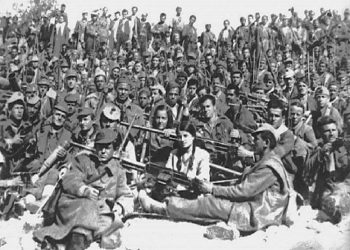
In March 1943, Liri Gega informed me that I had been accepted as a party member. My brother, Vllas Arapi, became part of the 1st Brigade upon its formation. Later, he deserted…! I condemned his action. After this event, no member of our family joined the Balli or the occupier. Furthermore, my brother, Fatos Arapi, became a partisan although he was only 14 years old. He stayed in the ranks of the army until 1945 when the Command released him from the army so that he could continue his studies.
During the National Liberation War, I was part of the 5th Brigade from November 1943 (this is the month this brigade was formed, while its inauguration took place on January 20, 1944 – my note) until February 1944, and from May 1944 until November 1944. From March until May 1944, I worked in the field by order of the Party. In the Brigade, I was a deputy commissar of the 3rd company in the 4th battalion. After the country’s liberation, my brother, Vllas Arapi, stayed in Albania as a fugitive and, in 1946 (April), it was said that he was killed.” / Memorie.al
To be continued in the next issue