

BY DASHNOR KALOÇI
Part Three
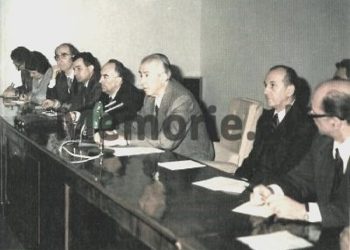
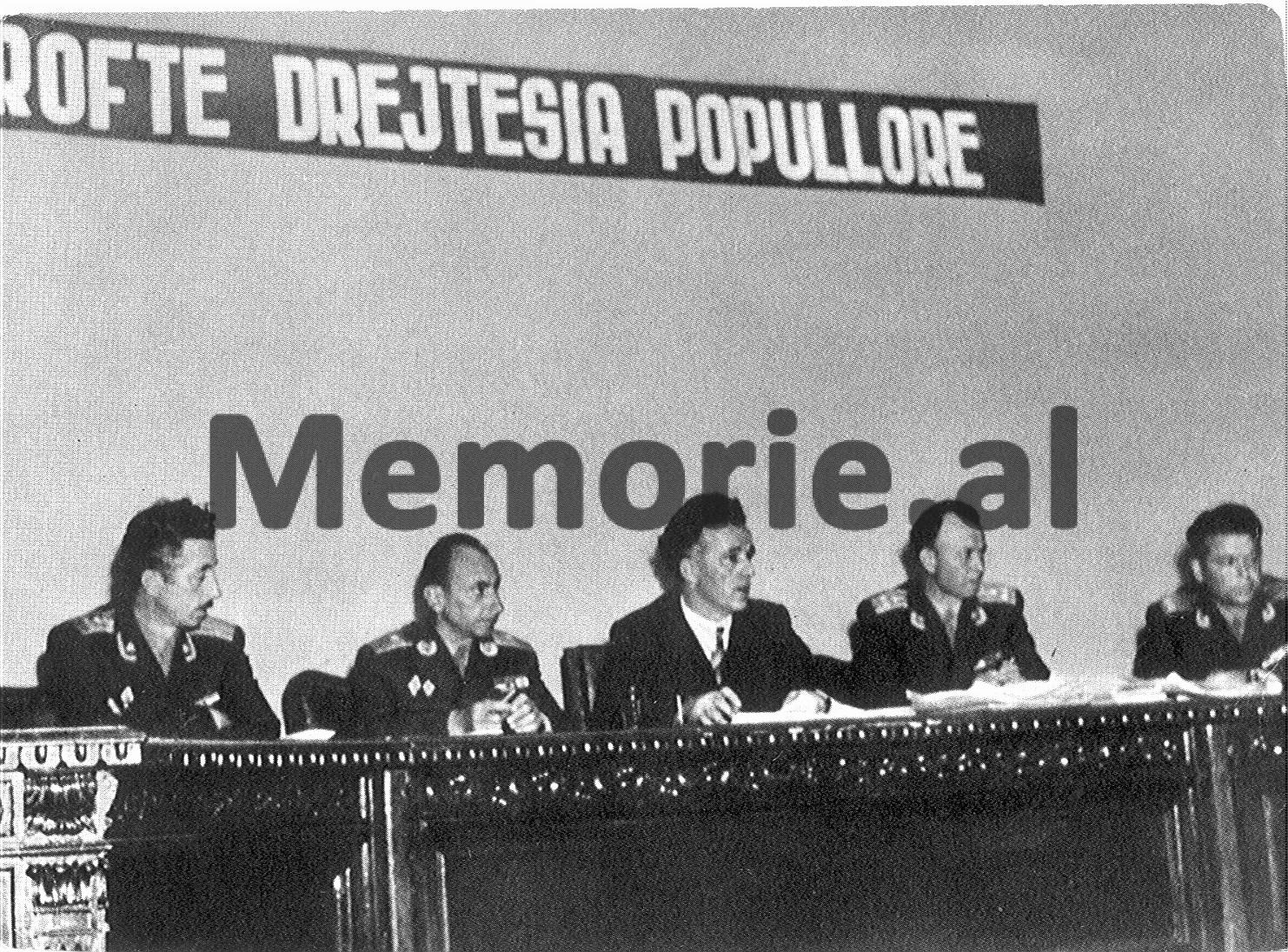
Memorie.al / At the end of May 1961, the trial against the so-called “Hostile Group” of Teme Sejko (former Rear Admiral of the Naval Fleet) concluded in Tirana. He, along with Tahir Demi (former Chairman of the Executive Committee of the Elbasan district), Taho Sejko (former journalist for “Zëri i Popullit” and later director of the Shkodër Automotive Park), Avdyl Resuli (Lieutenant Colonel in the Tirana Recruitment Branch), Hajri Mane, Nasho Gërxho, Hajri Purizi, Ali Xhelo, Sami Murati, Izet Osmani, Shaban Ademi, etc., were accused of: “having entered the service of foreign intelligence agencies, such as the Yugoslav UDB, the Soviet KGB, the American CIA, and the Greek Asphaleia, with the aim of overthrowing the people’s power in Albania.”
Consequently, after the sentencing on May 28, 1961, by the judicial body headed by Shuaip Panariti (Chairman of the High Court, with Major General Muharrem Kokomani, Colonel Sotir Spiro, Colonel Bejto Isufi, Lieutenant Colonel Hilmi Telegrafi as assistants, and Murat Deliallisi as session secretary), eight of the defendants in this “Hostile Group” would be sentenced to death by firing squad and executed on May 31 (two had died during the investigation), while the rest of the defendants would receive heavy sentences, up to 25 years.
All the above are now well-known, as dozens of articles with various testimonies or archival documents, as well as television documentaries, books, etc., have been published since the early 90s until today. However, what has remained somewhat undisclosed (at least with archival documents) is who the main agents used by the State Security (Sigurimi i Shtetit) were at that time to strike the “Teme Sejko Group” – or as it was otherwise known, the “Cham Group,” due to their origin from the Chameria region!
And how and how much were those State Security agents rewarded, who “sank” their fellow Cham patriots, who were not brought to trial as witnesses to avoid de-conspiring them, even though their role was somewhat known? As we said, it was never made public in newspapers, books, or magazines, as was the case at the time with other “Silent Heroes” of the Ministry of Internal Affairs.
Paradoxically, even today, almost 35 years after the collapse of the communist regime of Enver Hoxha and his successor, Ramiz Alia, no archival document has been published about the three main State Security agents who sank the “Teme Sejko Group,” nor the rewards and other favors they received from the ruling communist regime for “their contribution to the discovery and strike against that hostile group.”
Based on this, in this article, we are publishing several archival documents (along with the respective facsimiles) that have been extracted from the Archive of the Ministry of Internal Affairs, which see the light of publication for the first time. But as we will see in this article and the respective facsimiles, only agents “Gjoksi” and “Trimi” are given with their full names: Braho Beqo Emini and Skënder Hoxha, respectively, while “Besniku” is not de-conspired?! At least not in these documents we have available.
Perhaps this is also due to the State Security Platform, which categorically forbade such a thing, something that Minister Kadri Hazbiu himself should have been the first to implement. However, both “Gjoksi” and “Trimi,” as well as “Besniku,” were well known in the city of Shkodër, where they were sent to work and live, with the aim of “protecting them from the enemies of the people or the Greek intelligence,” against which they had worked since 1951, when they were sent on a secret mission to Greece—something we will see in this second and third part of this article, where they affirm with their own mouths all the intelligence activity in the neighboring state.
ARCHIVAL DOCUMENT WITH THE MINUTES OF THE INTERROGATION OF THE STATE SECURITY AGENT BRAHO BEQO EMINI, WITH THE PSEUDONYM “GJOKSI”, BY FIRST CAPTAIN KRISTO… OF THE FOREIGN INTELLIGENCE DIRECTORATE
MINUTES
Held today, August 11, 1953, by First Captain, Kristo…. regarding the depositions of our agent “BRAHO EMINI,” with the pseudonym “GJOKSI.”
QUESTION: Tell us in detail, from when you went to Greece last year until you returned to Albania, where you stayed, and which intelligence agencies had you in their service?
ANSWER: Besides what I told the Major, I said that you here also keep some leaders of the emigration, such as HAKI RRUSHITI and MUHARREM BAJRAKTARI, who were collaborators of fascism against Greece in the Italo-Greek war. When they were in Albania, they killed many elements who were nationalists and not communists; therefore, they are hated by the Albanians, and when someone considers coming to Greece and falling into their hands, he decides not to come.
Afterwards, the Major told me that these things are true, but some Albanians come here sent by MEHMETI, and those who are not sent by MEHMETI have the same fate here. Finally, the Major told me that the Americans do not allow us to strike Albania. The Major did not tell me anything else. Leaving his office, he told me that he had announced that people would come from Athens to pick us up, but since the weather was bad, the airplane turned back, so it will come tomorrow.
And on the 26th, the airplane came as far as Ioannina, but since there were clouds over the mountains of Ioannina, it did not land; it turned back and landed in the mountains of Agrinio, and after 5-6 hours, when the clouds dispersed, it came to Ioannina.
During the 4 days we stayed in Ioannina, we did not leave the office of DHIMO DUKA, nor did we see anyone familiar. Besides the Major I mentioned above, DHIMO DUKA, the soldier who was in DHIMO DUKA’s office, I also saw another Captain who came and went, but I don’t know his name or what job he did. In these offices, 8 soldiers also served, who brought us bread.
On October 23, 1953, XHORXHI, whom we have spoken about other times, arrived by plane. He came to the office where we were staying, asked us how we had been, and I told him what had happened to us, always based on the legend we had prepared here in Albania.
Finally, XHORXHI told me that the order from his Command was for SKËNDER and me to return to Albania, to meet with our bases and to organize the work so that once a month throughout the winter, we would come and meet our bases. Now, he said, the weather is better, and you can go and come, while later, when there will be rivers and it will be winter, we will take you and pick you up with motorboats from the side of Nivicë.
I refused such a thing, telling him that we had been in a clash and that now we were afraid to go back; besides that, our bases there would not accept us, because after the clash that happened, I fear they might be exposed.
XHORXHI insisted, telling me to study it again, think and decide. Then I told him that I had decided right now, that I will not return to Albania for the reasons I mentioned, because I am afraid they might kill me. Then XHORXHI told me; get ready, because in an hour or two, we will leave for Athens.
That same day at 3 p.m., we went to the Ioannina airport in a “Daçë” car, with us, a soldier, and the driver inside. XHORXHI was waiting for us there. We two and XHORXHI boarded the plane and left for Athens. The plane was twin-engined and, in addition to passengers, was also used for cargo; it was 6 tons, was white and had American flags, and had two pilots, a radio operator, and an airplane attendant.
I do not know their names. We arrived in Athens at 4:30 and landed at Faliro airport outside Athens. No one was waiting for us there, but XHORXHI left us inside the plane, went to the side of the airport, and took a closed sedan-type car shaped like an ambulance that holds up to 10 people, a “General Motor Troç” brand. XHORXHI drove it himself and took us to Voula, below Faliro, by the sea, where he parked the car outside.
After entering the prison and meeting Ali, he told me that he was innocent, as he had killed the communists. He was tied up, and after I stayed for a while, I got up and left. Although I acted this way, the Agrarian Party did not remove the suspicion from me; I understood this after a day when Mehmet Kuçi told me: come on Braho, we will sort out the enjoyment, and Gaqo Mike from Korça also told me these words.
I reported the enemy of the Albanian people, Mehmet Kuçi from Vlora, who, when he came to Greece and was questioned by the Greeks, had not, confessed, only saying that he had fled Albania due to the great hatred he felt for the communists of Tirana. Later, when he was questioned by the Americans, he told them that General Kadri Hazbiu had put a revolver to his head and told him to enter Greece as a friend and connect with the Greeks or the Americans, and that “you, as a high family – the General had told him – the Greeks and the Americans will receive you well, and in this way, we can strike the Americans and the Greeks well at sea, and so they escorted me to Greece.”
Then I gave a report to the Greeks, stating that Kuçi’s words were not true – “General Kadri,” I told them, “in order to send him here, must have imprisoned many nationalists.” On the other hand, the report says, General Kadri told him to come here, tell the Greeks and Americans, and show them that he was sent, and then the Americans will be convinced that he told the truth and will send him to Albania.
Then our report says – why did Mehmet Kuçi not tell the Greeks when he crossed the border that he was sent by General Kadri, since he was ordered by General Kadri not to tell the Greeks, because the Greeks do not fall for these things, these only work on the Americans? In the report, we say that Mehmet Kuçi and his brother are agents of the communists of Tirana. Then a Greek Colonel comes, along with a Greek Lieutenant who was his secretary, and they call Mehmet again, after six months in prison, and the Colonel tells him that “we know you and your family, but why didn’t you tell us the truth when you crossed the border?!”
Mehmet told them he was afraid. Mehmet had told Fetah these things when he came to Greece. Why did Fetah not tell the Greeks? Then Mehmet Kuçi went and told Fetah to tell the truth, and then Fetah told the truth, saying that when Mehmet came, he told me that we were sent, that we had come here to Greece.
After a short time, I reported again about Mehmet, that he maintains ties with the English, and at this time, Captain Trandafillua calls me and tells me to surveil him. In May 1954-1955, Gani Hamiti constantly came with an English small-wheeled motor-bicycle. Then we reported to the Captain that Gani Hamiti was coming. The Captain then called him to the office and asked if he had a license, and he showed him the license.
From the minutes dated 23.3.1951
In this case, the Espionage Office, since we would stay for a period of four months in Albania, instructed us as a task to organize work among the communists, i.e., to buy off communists, especially people in the Security. We were to do this with people who had some dissatisfaction, or were affected, or had friends who were elements we could use.
They also advised us to use money without reservation to buy such people. At the same time, we were to promise them that their lives would be spared. They recommended as elements we could work on to bring over: Tahir Demi, Rexhep Mevlani, Memoçen (I don’t remember the name anymore), Fejzo Zeqo, a comrade Nurfo (I don’t know the last name), Ali Xhelo from Konispol, etc. / Memorie.al