BY SAMI REPISHTI
Part Ten
Sami Repishti: “In Albania, the communist crime of the past has not been documented or punished; the ‘spiritual cleansing,’ the conscious confession, and the denunciation of ordinary communist criminals has not taken place!”
‘Under the Shadow of Rozafa’
Memorie.al / During the ’30s and ’40s of the past century, as the unstoppable fascist and communist storm descended upon Europe, and sooner or later upon the entire world, “fate” seized the Albanian nation by the throat. Like all youth, I found myself at a crossroads where a stand had to be taken, even at the risk of one’s life. Back then, I said “no” to the dictatorship and embarked on a path that had no end – a sailor in a vast, shoreless sea. The rebellious act that nearly killed me simultaneously set me free. I am an eyewitness to life in the fascist and communist hell in Albania – not as a “politician” or a “personality” of Albanian macro-politics, but as a student, as a young man who became conscious of his role in that time and place out of love for the fatherland and a desire for freedom; simply as a youth with heightened sensibility, loyal to himself, and to a life of dignity.
Continued from the previous issue
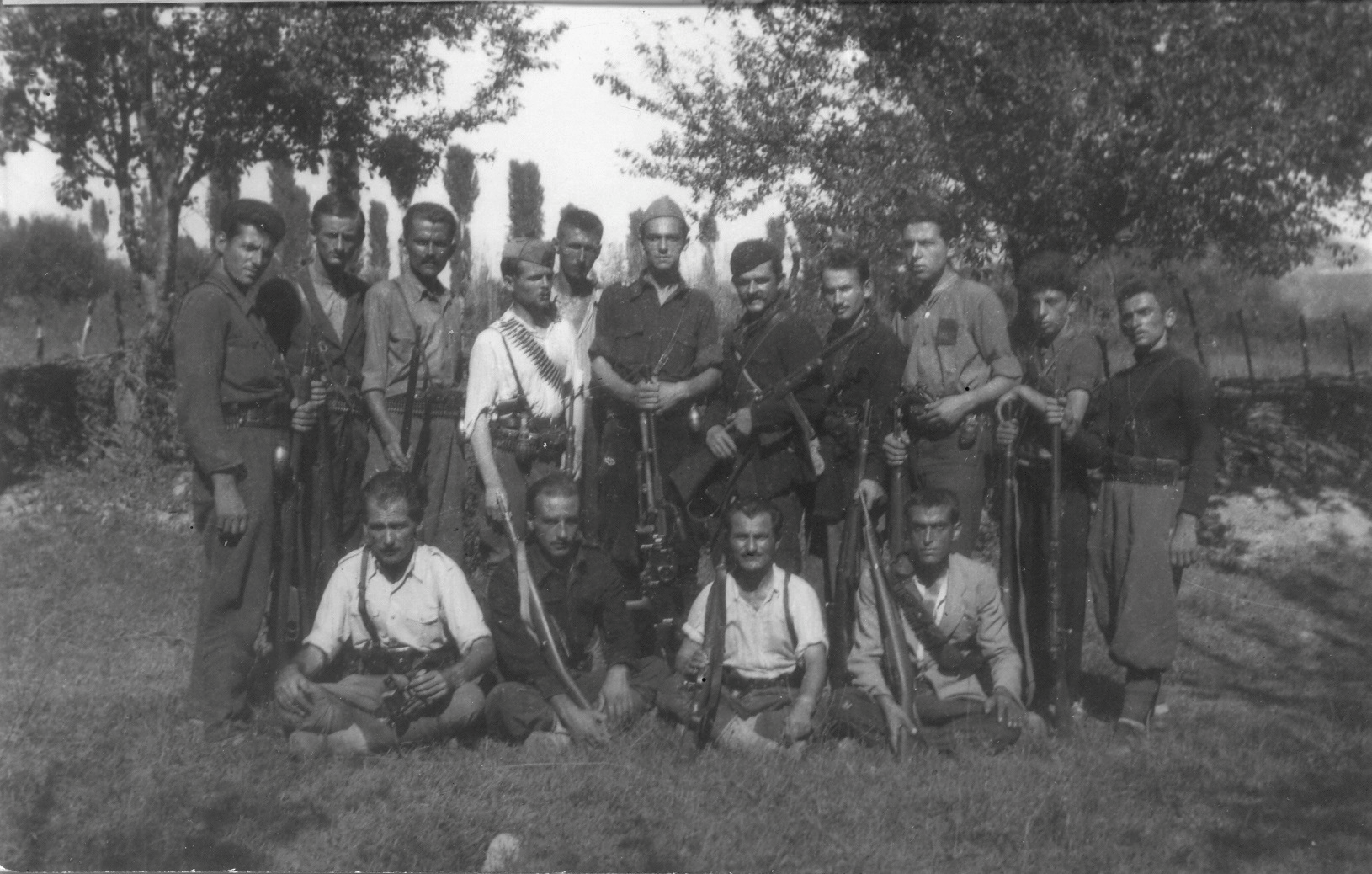
During this wave of terror, I met one of my comrades from the anti-fascist groups of my high school days, a man from Vlora. He was the youth leader of the battalion. I was glad to see him. He was exhausted from continuous marches, yet satisfied and enthusiastic. We embraced. I took him home for dinner so he would have a chance to clean up and rest properly for a night. He accepted. After dinner, alone in my small room, we began a conversation that turned into a heated, yet humane, debate. I told him about the events in the city. He wasn’t surprised at all. He told me that; “we have problems with the north” and that; “Shkodra is the head of the reaction.”
When I asked how they intended to hold power this way – through force and blood – and how he thought “the world would endure all this,” he replied: “We only need two months with a free hand in power…! We need two months to execute the plans we have prepared…! You spoke of ‘the world’…! If the Anglo-Americans do not land on the Albanian coast today for the purpose of ‘pursuing the Germans’ from the south, then, I assure you, victory is ours, definitively!”
And, persisting before my expression of astonishment, he added: “I am not speaking into the wind, believe me! During these days, we have developed concrete plans that we will implement from the very first minute. The first drastic measures: arrest, execution, disarmament, mobilization, and organization of the country according to the model of the ‘liberated zones,’ are all integral parts of our strategic plan. We will not deviate… even if we err!” Anticipating a possible objection, he continued: “We even have lists – lists of those who will be liquidated, but… there is no need to say more…! I am having this conversation only with you…!”
He smiled slightly, as if savoring the pleasure of the confidence he was showing an old friend. Then, he lit a cigarette, inhaled deeply with full relish, and while exhaling smoke in plumes from his mouth and nose simultaneously, he added: “Prepare yourself for the decisive days of Albania’s history. We have a mission to fulfill: to give the history of our people what it demands…! For now, it is the cleansing of the terrain from active obstacles…”, and, looking me straight in the eye, he pronounced the final word in emphasized syllables: “fu-ture…!” – “Like, for example, me and my friends,” – I completed in a half-whisper.
His expression changed: – “I don’t believe so!” – he told me. – “Let’s change the subject…!” I asked him about life in the mountains and the difficulties faced. He welcomed my curiosity with pleasure and began a monologue that, from time to time, became dramatic, with undeniable elements of exaggeration. But I did not see them as excessive. He was young, enthusiastic, idealistic, and clearly indoctrinated. He had found the necessary courage to take up the rifle and serve the ideal that inspired him. This was essential. The rest? They carried no weight, I thought, especially given the fact that he, my schoolmate, had always been a sociable person with others.
Indoctrination had deformed his logic. The tendency that made him repeats – as if by command – words and phraseology taken from Agit-Prop meetings, often made the story long, almost unbearable. When he spoke about the international situation, he referred to the Anglo-Soviet-American coalition as an “opportunistic alliance” from the start, one that lacked “sincerity” and would eventually end in a confrontation, “especially with England.” – “So, you expect a third world war?” – I said. – “Yes!” – he replied with conviction. “But we will provoke it when we are ready…! For now, the alliance continues…!” That’s what my cousin had told me a year ago, too! I listened to him attentively. For me, these were new ideas to which I had not been exposed before.
I asked how he had reached this conclusion today, when the war had not yet ended and the alliance continued to function successfully. He told me that, “The entire blame falls on Churchill’s back!” I couldn’t believe my ears. – “How can you speak this way!” – I interrupted. – “Throughout all these years, we have all adored Churchill, especially after England’s heroic resistance in the year 1940…! Do you remember London, Coventry?” – “Churchill is a fascist!” – he said in a cutting manner. – “He is the main obstacle to the victory of the international proletariat. He has been known for his anti-communist stance since the years of the Great October Revolution of 1917…!”
I did not know these facts. But, offended by the term “fascist,” I asked why he accused Churchill as such! – “Anyone who becomes an obstacle in our struggle for the final victory of communism in the world is, for us, a fascist.” The dialogue turned into a confrontation. I heatedly defended the Anglo-American contribution to the war against Germany and Japan, moved more by the revolt sparked by his definitions. He accepted America’s role and had a certain respect for the figure of President Roosevelt, but he had formed a pathological hatred for Churchill and the “diabolical policy of Great Britain.”
“It is the English who insist on landing in Albania,” – he told me, “just as they did in Greece…! But here with us, the partisan rifle awaits them…!” No room was left for further discussion. It was clear that I too, perhaps semi-consciously, found myself in the camp of the “opponents” of the new regime being imposed on our country. Contrary to my friend, the framework of my thoughts – formed outside the persistent communist propaganda for nearly two years since the day of our parting – had gained a new, independent dimension; incomplete, certainly, but nonetheless capable of giving me an inner satisfaction as well as the logical strength to defend my views before the “outside world” and especially before opposing interlocutors.
Step by step, I was building my world where current events, local and international, were viewed through a defined lens supported by principles I had freely accepted as the basis of my mental and intellectual structure. Step by step, I was moving past the period of youthful enthusiasm and entering the measured world of maturity.
That evening, I understood it well! The history of my days appeared as a process of decomposition of the hope sparked during the “National-Liberation War,” the denial of the democratic role of authority elected by the people as promised during the war, being replaced by a new structure – more centralized, more soulless, and more unjust than any other state form known in my country until that day. The history of my days appeared now as a history of “official” dishonesty, of general despair and fear – the absolute queen over everyone, including the rulers.
The new power “mobilized” me as a clerk in the Reconstruction Section. I began the routine work of an official without enthusiasm. Nevertheless, within a few days, I understood the importance of the function assigned to me. With the arrival of the first “allied” aid (UNRRA), the reconstruction work of the destroyed country gained momentum. In this non-stop activity, I suddenly found myself fully engaged, with a great desire for voluntary contribution. I was in the office from the early hours of the morning and left in the early hours of the night. It wasn’t imposed on me. It was my desire to be as much as possible inside the “construction site” of the rebuilding effort. Our office team consisted of elements that were “indifferent” in politics but regular “officials.”
The fruit of our work was clearly visible. Almost every week, a small bridge was rebuilt, a damaged road was paved, or a government building was improved. The enthusiasm for work around me swept me away. I was part of the general undertaking for the recovery of my ruined country. The initial fear of taking a job and starting life as a “mature” person – facing things with my own strength and interacting with new and unknown people – passed quickly. It was no longer school life with friends, full of dreams, aspirations, and the desire to live forever young. But I did not despair! Here, I felt I was someone, I was something. By mid-April 1945, a large demonstration of organized people took place in front of the prefecture building, where my office was also located.
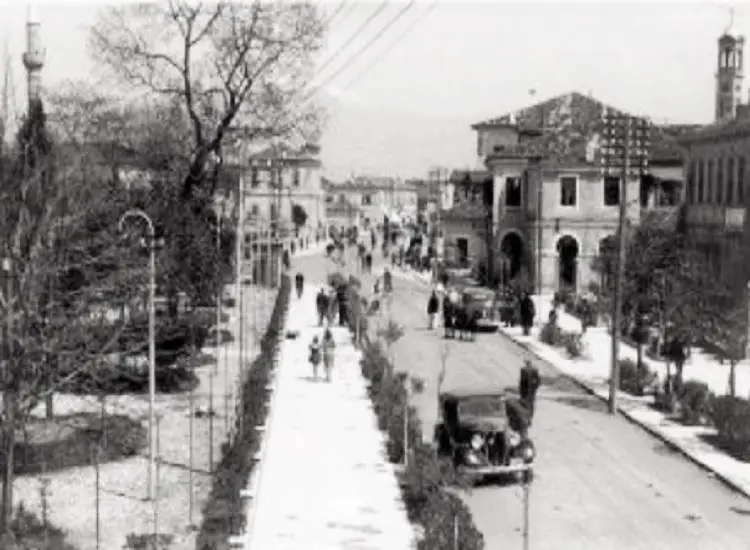
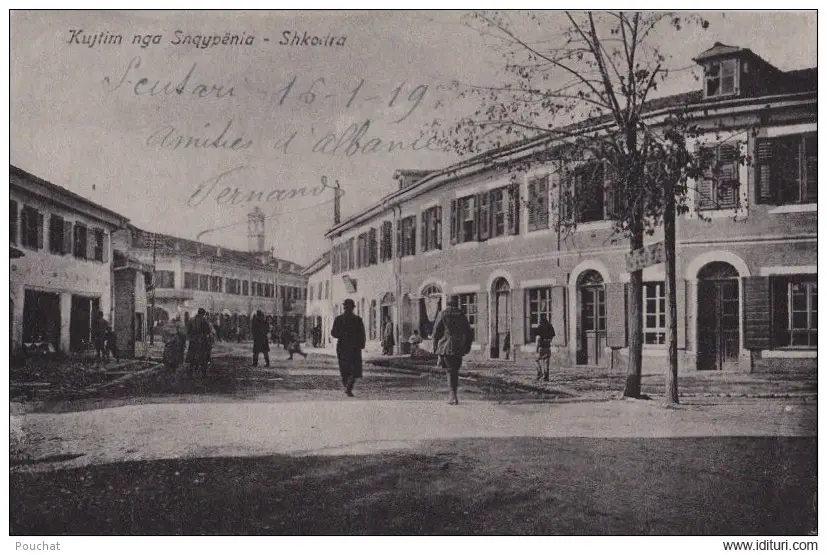
Banners with the names of Yugoslav, Soviet, and Albanian leaders filled the square. Strange writings demanding Albania’s membership in the United Nations and the annexation of Trieste by “Tito’s Yugoslavia” were read on long strips of cloth held high by the demonstrators! No one understood the purpose of this demonstration, except for the organizers who were seen amidst the crowd giving the necessary instructions. The obedient mass erupted with “Long live” or “Down with,” according to the signal given. After two hours of demonstrating, during which speakers from the balcony promised to inform the central government and the “Yugoslav authorities” of the patriotic feelings and great indignation of the population of the city of Shkodra, the demonstrators dispersed – again, by order.
The sight of thousands of citizens gathered by order, manifesting by order, and dispersing by order, made such a deep and foul impression on me that I began to look with contempt at those who were the last to withdraw from the main square. The exploitation of the word “people,” of their will, desire, and aspirations in such a banal way, shook the faith nourished in the axiom of my thought that one must think, speak, and act “in the name of the people” if moral and legal justification for our political and civic activity is sought. That day, with the treatment of the people as beasts of burden and their shameless manipulation, I saw in the light of the sun the grotesque and revealed face of the red dictatorship being imposed on us, and I hated it with intensity.
A short while earlier, long lines of Kosovars, mobilized by “Tito’s Yugoslavia,” had passed through the streets of our city. I saw them in endless columns, tired and broken, under armed Yugoslav supervision… on Albanian soil! Only three days later, those who escaped “punishment” entered Shkodra stealthily and told of the Tivar Massacre. Meanwhile, the people of Shkodra – who for centuries had been linked to the struggle of Kosovo against Serbian and Montenegrin expansionism – were now forced to demonstrate publicly with the demand that Trieste be passed to Yugoslavia! But to whom did Kosovo belong? No one answered! The massacred Kosovars were turned into “Kosovars pigs”! Every day, more and more, “the people’s power” strengthened its foundations and support upon a rational organization of its repressive apparatus and upon an uncompromising policy of the physical elimination of opponents, already labeled as “enemies of the people”!
Mass executions, with or without trial, especially in the northern mountainous areas of the country, became daily scenes. Every official action was one more signal that the direction taken by the new “state” led to dictatorship. The country’s press was governmental, opposition was not allowed, debate was dangerous, and dialogue was becoming a curiosity – gradually replaced by long speeches and monotonous monologues. How far away that day was the atmosphere of an anti-despotic vitality that was born in young souls, nourished by superhuman dreams and a readiness to leap into the infinite, like the maniacs of the race of self-destruction!
How far we were those days from that vitality brought by the ideal of building a new work, a new and free world, which was slipping from our hands every day! In the new society being born, a people wandered without direction – without a pulse of life, without a readiness to leap boldly into a world different from the banal everyday one that promised neither pleasure nor desire…!
Hope – the only god that still maintains friendship with man that pierces the darkness and allows sailing in shoreless seas – was on the brink of death! “Communist” propaganda in Albania during the war had something of the poet’s imagination, like an “invitation to travel” toward a better and promising world. “Bread and peace, and freedom!” Who among us is not moved by such a call? No more poor! No more oppressed! We are all free! The mockery of the cynics – matured by age and difficult experience – carried no weight. They were the final gasps of a society on its deathbed. The new was being born bright, full of life, full of promise, and it would be ours – entirely ours! This was enough!
But today, it was not ours! Here was the difficulty – convincing the masses, confused by the iron fist over their heads, that the value and utility of what was being lived those days, the banal every day, was stifling and hopeless. Collective madness, individual monstrosities, governmental hysteria; a society in full transformation, a new and unacceptable social order was emerging on the stage. We, between the Scylla that was dying and the Charybdis that threatened death – a population tossed by events here and there – sailed without a compass, walked without a fixed direction, and entered without understanding into the dark tunnel where the exit light was not visible. The storm that covered the land promised nothing but destruction.
A passion for opposition and activity against the “power” grew every day with a speed I was unable to stop. It felt as if time was crushing me, as if “there was no time” to wait. Youth sparked a sense of urgency to attempt the impossible, and it had become the master of my mind – an absolute ruler over every other desire, strengthening the will for action.
In those days of revolt, the ideal revealed to me a vast field of action, an infinite, limitless space, not allowing daily life to take the form of a limited, small, partial unit. Revolt ignited an unrestrained desire to expand, to stretch out, to conquer the infinite with arms and mind, thus giving life manifold proportions and an incomparable sense of joy, satisfaction, and inspiration born from the light air of the ideal that lifts high – and ever higher.
Before me, every day larger, higher, more threatening, rose the “building” that blocked my view, hindered my step, and prepared for me an eternal immurement – my fatal cell, like the grave of the victim Rozafa! Within me, I also felt an unstoppable growth of inspiration for struggle, confrontation, and freedom. The call for dangerous action simultaneously liberated me from the shackles that were tearing me apart…! The twenty-year-old I was in those days called for me to stand up, and instead of the stifling heat brought by the newly established order, to seek the storm if necessary – in its sweeping rush to cool my burning chest and to die satisfied in the vortex of air stirred by the force of my searching passion. O magic of the infinite! Just one kiss from you upon my forehead justifies an entire life, and clothes with robes of glory the unavoidable death ensured by your daring flight! Because sweet is the very destruction of the body that touches the sky…!
This sweeping rush made confrontation with simple people very difficult – their faces still showed hope for a new life, their words expressed this, and their gestures were the concrete view of a faith in promises. They did not see the sea of crime, oppression, injustice, and hatred in which the country was submerged. I did not have the courage to face them openly and sincerely – to speak as brother to brother, to point out with my finger the daily horrors and the heads rolling rapidly, to wake them from their slumber, to shake them by the arm with force, to shout that the “liberation” of one brother could not be achieved with the blood of another innocent brother – that the new laws and the words that rang like bells of liberty would not bring the promised freedom if the change was not also made in the conscience of the “victor.”
This change had not been made, nor did it promise such a turn for the future; this was the tragedy of my country. When despair and fear forced me to huddle in my small room, unable to speak and with the lost desire for reading, for hours I tried to understand the meaning of this historical process that unfolded before my eyes like a river flowing without end.
I remembered my school days, the nourishment of which allowed me to stretch my arms into the sky of mental flight: the period of Greek and Roman antiquity, the European Renaissance, the mental awakening of the continent and its phenomena, the Enlightenment, the social ideas of the past century – they brought to mind something more fundamental than the names of ruling kings, something less noisy, less sung in songs and cheered in public. Something more personal came to mind, deeper, springing like the awakening of conscience in every human – like freedom emerging from within, like the powerful feeling of each person’s need to be a free being, a human! / Memorie.al
To be continued in the next issue