
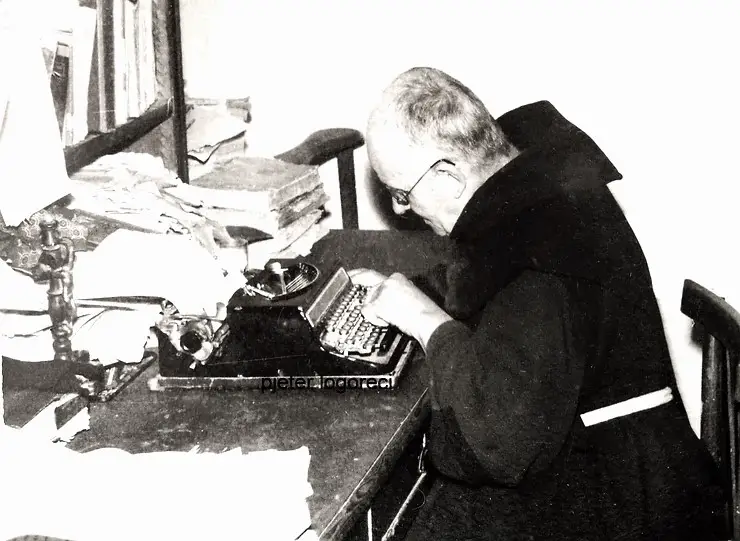
By Dom Zef Simoni
Part five
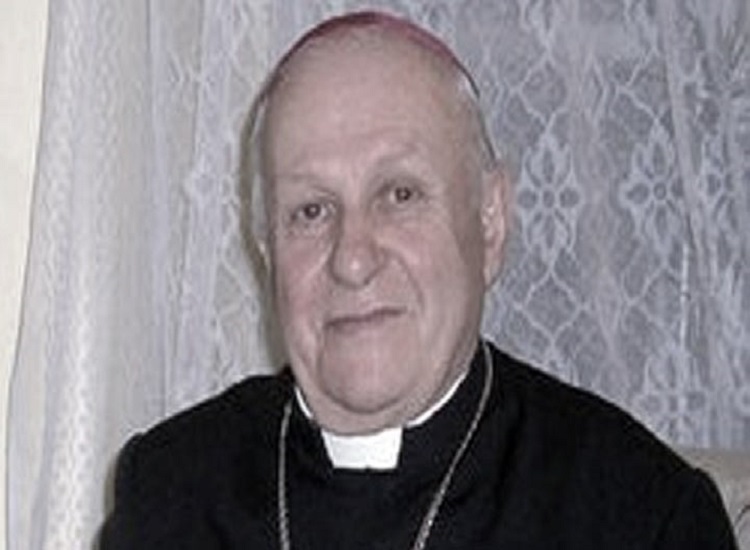
Memorie.al publishes an unknown study by Dom Zef Simoni, entitled “The Persecution of the Catholic Church in Albania from 1944 to 1990”, where the Catholic cleric, originally from the city of Shkodër, who suffered for years in the prisons of Enver Hoxha’s communist regime and was consecrated as Bishop by the head of the Holy See, Pope John Paul II, on April 25, 1993, after describing a brief history of the Catholic Clergy in Albania, dwells extensively on the persecution suffered by the Catholic Church under the communist regime, from 1944 to 1990. Dom Zef Simoni’s full study, starting from the attempts by the communist government in Tirana immediately after the end of the War to separate the Catholic Church from the Vatican, initially by preventing the return to Albania of the Apostolic Delegate, Archbishop Leone G.B. Nigris, after his visit to the Pope in the Vatican in 1945, and subsequently with pressures and threats against Monsignor Frano Gjini, Gaspër Thaçi, and Vinçens Prenushi, who firmly opposed Enver Hoxha’s “offer” and were consequently executed by him, as well as the tragic fate of many other clerics who were arrested, tortured, and sentenced to imprisonment, such as: Dom Ndoc Nikaj, Dom Mikel Koliqi, Father Mark Harapi, Father Agustin Ashiku, Father Marjan Prela, Father1 Rrok Gurashi, Dom Jak Zekaj, Dom Nikollë Lasku, Dom Rrok Frisku, Dom Ndue Soku, Dom Vlash Muçaj, Dom Pal Gjini, Fra Zef Pllumi, Dom Zef Shtufi, Dom Prenkë Qefalija, Dom Nikoll Shelqeti, Dom Ndré Lufi, Dom Mark Bicaj, Dom Ndoc Sahatçija, Dom Ejëll Deda, Father Karlo Serreqi, Dom Tomë Laca, Dom Loro Nodaj, Dom Pashko Muzhani, etc.
Continued from the previous issue
At Zef Pllumi
A friend of mine, Father Zef Pllumi, who was destined for the clergy, was released from prison. He had studied philosophy and knew theology. One day he came to the library. I took him into the private book room. After we stayed a while, I told him: “I have a great desire to learn theology. I do not want to die without knowing it. I need it very much. I see,” I continued, “that I might find my satisfaction, and the certainty of the truths, for which I have great need.” He received this conversation with pleasure. And, as I was speaking, a fleeting, rapid, distant, and discarded aerial thought unexpectedly crossed my mind, in passage, seeming to emerge from a center and open up inside my soul and this with a centrifugal force: how good it would be to become a priest!
Ah, was this a spark that ignited and spun before and around myself?! This happened late in the afternoon of that day, shortly before the evening, and as the night of nature approached, a secret, immaterial light appeared and dawned within me, a thought manifested in time, which introduced a substance of eternity into me. To become a priest, and not to become a priest, is a struggle. To become a priest is to die and be born, to be crucified and to rise, to fall low and to climb very high. What is this force, this spiritual movement and energy?! I woke up in the morning after an interesting sleep, and for some time, without getting up, and as if still asleep, without that true sleep leaving me, I needed it to live and to make my superhuman decision.
Priest
Every time he would take a seat on a bench with me in the Franciscan church of Gjuhadol, during the Sacrament of the month of May, Koleci, a little younger than me, the son of Gaspër i Kolë Toni. We mentioned their house, because his mother had spent a part of her girlhood in that building, when Gaspër’s family was not in Shkodra and they had rented out the house. We became friends when we left the church. We started visiting each other’s houses too. My mother would sometimes go too, to relieve the longing for her girlhood. We both had very good parents. In the terminology of the time, their family was called reactionary. Koleci’s two brothers, Injac and Luigj Toni, two outstanding young men for their seriousness and culture, had been prominent members of the “Youth” of the National Front (Balli Kombëtar) in Shkodra.
Injac, after his life had been spared, was in prison. Luigj was also imprisoned. The whole family maintained a resolute stance, always being united, against the regime. None of them had jobs, they didn’t have ration cards, they lived with great difficulty, selling what they owned, but they refused to change their good ideas or ideals. When they were called to go to the meetings held frequently in the neighborhoods, they refused to go, especially not listening to the mother herself, a courageous woman. In conversations with Koleci, he one day expressed to me his strong intention to become a priest. God had called me too. And to this holy calling, to work for His flock, as one called, I was spurred by the love that grew in me for this ideal and a holy hatred, which the rare salvation in this part of the earth caused me.
The sleep to make my decision had left me, and I, who would gain clarity, was in orbit. My parents’ blessing was ready. The Ordinary Bishop’s consent was needed. This duty is truly a mystery. You are on earth, and you must be completely immersed in heaven. You will wear other clothes, you will take another position. Your life will be a path, work, struggle, peace. You will not curse, you will not offend, you will not kill them, you will not steal, you will not get angry, you will not hold a grudge, you will not commit adultery, you will not think I’ll of anyone, you will not speak ill, but you will forgive and love your enemy, you will be generous-hearted, kind-hearted – is this the priest? No. These are everyone’s duties. Will he be cursed, will he be offended, will he be trampled upon, will he be crucified and say: “Forgive them, O Father, for they do not know what they are doing”? Is this the priest?!
No. These are duties required of every Christian. The priest will have all of them, but the special thing is that he will receive the priestly power of Christ, he will receive His priestly office, he will celebrate the Mass as He did in the Cenacle, in the name of Christ he will absolve the sins of the faithful and administer other sacraments, he will be the official intermediary between heaven and earth, he will preach the Gospel, the good news, for the transformation of the world, of the Crucified and the Risen One, he will be the example, the light and the salt of the dish. He will say to everyone with his own sacrifices: “Follow me, and I will show you Christ.”
Before Monsignor Ernest Çoba (1953)
And one evening, a cold night with stars in the sky, January 1, 1953, Koleci and I, I at the age of 24, the year in which priests are ordained according to the Church code, found ourselves before Monsignor Ernest Çoba, in a room downstairs in the Archbishop’s Palace, which had been vacated and handed over to the church after the statute was established. This palace near the Cathedral had a good appearance and a serious atmosphere. The four-story tower had been added during the time of Archbishop Imzot Jak Serreqi and looked out from the top over the city, the surrounding mountains, and this whole building demonstrated a blessed and historical power.
The Monsignor Bishop, as soon as he heard of this desire of ours, embraced us with pastoral warmth, a sign of approval and joy. This event took place around seven o’clock that evening, which became so beautiful for us, as it was also amidst the Christmas and New Year greetings. Our families rejoiced too, and for some time, even five years, it remained hidden. I continued to go to church. After a spiritual flight that I would take to cross the sky, amidst my heavy years, I would also find myself often amidst black clouds and the tremors of the space of time.
The days passed one after the other. “These people” are noisy days, meaning this state carries out great works. These years were closed to me and with some phenomena of nervousness, which was thought to have been caused by smoking as well, this poisonous narcotic, so harmful to my nature. This gave me fatigue, a disorder, before starting the new life, with successful struggles. I never abandoned the church, the sacraments, and conversations with the Monsignor. Every two weeks I would go to the Monsignor. I was waiting. I had made my decision and was firm when I declared something. I prolonged it to find the opportune moment. And, when the ordination of a priest began, and this year after year, the path was open for me too, but my request to announce and ask to become a priest would cause a sensation in the city and the surrounding area.
Faith and Science
Life had taken a form. We shall call it a form, even though it had no life. Factories, plants, roads, railways, houses built in a style without style were being constructed. Nothing was uniform, only their style of tastelessness. Schools continued to be built, some parks were beautified, memorial plaques and busts of war martyrs were placed. Also of old patriots, to convey patriotism. Roads were named after clerics too. Even Buzuku, Budi, Bogdani, Gjeçovi, Mjeda. Mjeda was given the title of a school in Shkodra, and a bust. All without the words Monsignor (Imzot), Father (Padër), Dom, a confusion of ideas, a dispute of thoughts, malicious and mediocre actions. Everything will be distorted and incomplete. Professional theaters and variety shows were formed everywhere in Albania and great dramas were bravely performed; even Hamlet.
It was order and disorder. Both under the direction of the dictatorship. We cannot give a scholastic definition of Marxism. “Disorder is the substance. Order is the accident.” One day the news came that rationing was being abolished: bread, food, clothes without ration cards. The time came to abandon the chestnuts we ate in the evening instead of bread. A kind of improvement in living standards, a powerless socialist improvement. Terror had seeped into the bloodstream and the Sigurimi’s tools were more numerous than its official employees. It seemed there was calmer and fewer political arrests truly occurred, but time accumulated filth that easily surfaced. The “pit-city” of Shkodra, which had possessed seriousness and merriment, greatly spoiled its substance and form. Every city has its own life. The City was killing itself. The era of city suicides began.
“They” shouted, especially in schools, that we had emerged from the middle Ages, from the clerical middle Ages, from clerical obscurantism. This war had been declared by the Encyclopedists and adopted by all revolutionaries. But making distinctions, I found that the middle Ages were dark for the masses, while the intellectual power was great. It is highly distinguished by Albertus Magnus, by Aquinas, Duns Scotus, Roger Bacon, Ramon Llull, by Dante’s Divine Comedy, by the cathedrals of engineering and art, by the great orders of Saint Francis, Saint Clare, and Saint Deda, by the first universities of Europe and the Renaissance, which draws its strength from classicism and the Testament. And since faith and science are not opposites, modern times have strong connections with the Middle Ages; it draws nectar from it.
The Internal Occupation
And our city, like the entire homeland in reality, was being impoverished. The dawn appeared as a day of death. The difference between day and night was only made by changes in nature, because the 24 hours were connected only with terror, with evil. There was only night, meaning darkness, black nights, long, deceitful nights. A malice, a very filthy fanaticism, because those faces with swollen and distorted eyes gave the city and the nation the life of internal occupation. The Castle had the permanent function of being a witness to sorrows. It was useless for those who had not yet been arrested to say that we do not pass by the Branch of Internal Affairs, so as not to be noticed by its personnel. Hiding was nowhere to be done. There is no nook. Within the dictatorship, the fierce class struggle, bells were heard, Masses were said, and sermons were given. This means that in this territory, God, Christianity, was spoken of.
A great vitality occurred on the occasion of the consecration of the Shkodra Cathedral Church, with a gathering of villagers, religious and civil authorities, and a very large crowd from the city and villages. This happened on April 19, 1958, a Sunday. The church was built during the time of Sultan Hamid, the time of the Turk, and was being consecrated in the time of Enver, the time of the undead. Afterwards, arrests, terrible trials of priests, and executions began. The state was ready for revenge. If this work of mine to become a priest was ever to be accomplished, the day should not be delayed. The days were equally bitter. The revolution continued with plans. Enver stayed in the office. He moved his eyes everywhere and prepared his face at every moment, even when he wanted to be, sometimes, shameless. He had gestures that expressed everything about him, and to make them, he needed to be trained and like a cordial uncle.
He himself caused, created, manipulated, prolonged, shortened, choked, and resuscitated events, this perfect idol of this time, of his time: a great man whose only stature and mind had grown. One must be against him. I declare before everyone that I want to become a priest. The Church addressed my prayer to the Prime Ministry. Imzot Ernest Çoba handed it over to the Prime Ministry. They received it. The clerk received it. “He is an educator,” the Monsignor told him. He put it in a locked drawer. I immediately requested, the next day, my resignation from education. At 9:00 AM, when Gjergji, my brother, had delivered the petition to the Committee, I spoke with the school director, Zef Doda. “I have something private to tell you,” I told him. “It is June 21, 1958, St. Aloysius’ Day. We stay in a separate room.” The news he received from me, that I wanted to become a priest, made him congratulate me like a priest, and two tears rolled down his cheeks, as he was deeply Catholic. Finally, he told me: “It’s a difficult problem. They will go mad.”
Ilmi Seiti, Sadik Bocaj and Gac Mazi
And indeed they were angry. They went mad. A teacher becoming a priest!? They provoked meeting after meeting, in the Executive Committee, in the Party Committee, in the Branch of Internal Affairs. They summoned me to the education section. The Head of the Branch, Ilmi Seiti, called the relevant officials “clumsy” (mlysha – a local term for slow or ineffective people). He told them fiercely: “Where have you been? How did you not understand anything? What are you guarding?”! They dealt with me for a short time, with wisdom, with tact. The state does its job. They told me to think, to change my mind. They summoned me to the office of the Party Committee Bureau. All the members of the Bureau were present. The First Secretary of the Party, Sadik Bocaj, who had just returned from Czechoslovakia, a socialist country, the first task he took under consideration was to analyze this issue with me.
God was with me everywhere. During the conversation, a full hour, from 9:00 AM to 10:00 AM on July 1st, he finally called me stubborn. Now I spoke with my own terminology, with the terminology of distance and separation. I would not say “Comrade Secretary,” but “Mr. Secretary.” I felt saved, free. “I am determined to carry out this work,” were my words. And with a secret irony of my own, I told them: “I am confirming the democratic nature of the Constitution, which speaks of freedom of belief and conscience. I must be free to carry out this work.” And I said this to end the conversation. And they did not deal with me anymore. I had decided to become a priest, with entirely holy intentions for this office. In an annual analysis of all educators, of course, without me being there, this issue was strongly mentioned again.
The Second Secretary of the Party, Gac Mazi, was present. He said about me that I had entered a society and would end up in prison. A sure Communist prophecy. Truly a state for prisons. A prison state. A great number of people looked at me strangely when I walked on the street. Also with great admiration. There was someone who said: “How did he do this?”! “Does he know where we are?”! They did not deal with me directly or indirectly anymore. They have other ways. Gjergj was dismissed from his job. He worked as a props master in the “Migjeni” theater in the city. They left him unemployed. Unemployed for a year. A serious economic hardship began. Sometimes we didn’t have money to buy even bread. The family endured it without any complaint. We were all united in this endeavor. The Monsignor helped us. Providence helped us.
At the Archbishopric
After some time, the Episcopacy brought me into the Archbishopric. Until the approval came, which never did? The Church brought me closer by giving me a job, that of an employee, an accountant. It was the account of the Church Presidency, the subsidy given by the state. This subsidy did not remain the same: it decreased year by year. I entered the Archbishopric. Another atmosphere. Another environment. Another person. Peace. I felt that I had gained freedom. In the room where my office was, I also had the library. I continued my studies. The professor of morality for three years, Father Justin Rrota, the Franciscan distinguished in great virtues and knowledge, advised me to quit smoking. He told me these words: “If you are able to quit smoking, the consumption of which is a sin, you will find it very easy to face forbidden things.”
I liked this moral expression very much. I quit it. My self-regulation began in a short time. I would begin the duty with the regulation of myself, because to be a priest means to live externally and internally as such. Form without substance is hypocrisy.
No hypocrisy could have a worse kind than that of the priest. Those who are strong, formed, have the examples of Christ, Our Lady, the saints, the doctrine. But those who are weak need daily examples; they need the priest of sacrifice, of prayer, to see his soul, mind, behavior. And this every day, hour, moment, circumstance. How can a priest live with vices that would not let him carry out his duty?
How can he have even a slight sympathy or antipathy that would confuse his conscience and disturb others? The shortcomings of a good priest would not cause so much trouble, because we are human, but any kindness of an unworthy priest would always bind him to the world, forgetting the altar and the hut, to savor the sins of the palaces. I can never say that I have been a person who turned back. I have always been a believer, I have gone to church, I have wanted to be a good person. I have never been against you, O God. I could not think of the existence of the world, or human existence, or myself without you.
Doubt in God (1961)
The Doubt
But an unexpected event occurred in me. A doubt in God came to me, which, as I am writing it, and whenever I read it, my body trembles; for any sin I might have committed, and for what I have done, I would not be as ashamed to confess as this. And to write this, I make a very great sacrifice. This lasted for a few days, no more than 23 days, under the force of strong temptations. And this happened to me a few days before I was ordained a priest. And I found myself heavily wounded and troubled. And I would say to myself: not a single moment can be lived with this doubt. And I looked further into the books of some great authors for the scholarly arguments of the proofs of God. I told Monsignor Çoba about this spiritual state. He, with delicacy and tact, told me: “Pray to Our Lady of Lourdes, since you will also say your first Mass on that day.” And indeed, it immediately passed definitively, and it was like a dream to me, but a sad one.
So, I cannot say that I turned back, but I have been far from you, O God, and against you, whenever I sinned. But I couldn’t end the day, and let the night catch me, without confessing. These confessions, which were weaknesses until a day before I became a priest, I said: “You saved me, O God. You have given me an extraordinary strength in the inner and outer struggles of life, and to judge that the problem of every sin is separation from God. If we have God in our soul, if we make Him live in us, we would not sin.” And once, the priest told me in confession: “Do not let God depart from you. And God never departs from you, only when you do not pray.” Later I would remember this, and this would happen when the bondage passed and freedom came, the efforts the Church would make through catechesis and its distinguished methods of organizing with people, with youth, with nations, to instill the Christian life in everyone’s soul.
The Calling
“Know yourself, O man!” I was on the path. My self was on the path. I leave. I turn my back on something. I lose rights to gain higher rights. I am silent. I die. Even the ideal love of the earth, which is connected to that of heaven through the seventh sacrament. I want the sixth (meaning the Sacrament of Holy Orders). To go from home to the Archbishopric, with the step of a man over 33 years old, precisely the years of Christ, with the step of a secret and completely internal enthusiasm, truly victorious, I would take no more than five minutes, walking and still living the time of arrival, I was going towards the moment when Christ would give me a part of His power. And it seemed to me that I heard a voice that said: “Be good, speak well, act well! Do not shame me! Through your mouth and your deeds, I will appear, I will spread, I will be known, I will triumph. And one of my offices, the priestly office, I have left to you.”
For this, all the gates of evil will be closed. I die. Kolec Toni and I will go secretly near the shepherd (the Bishop).
It is a slightly cold, but bright afternoon, with beautiful sunshine.
I have embraced my parents, kissed their hands. Few people will know. Among them, Father Pjetër Meshkalla. And I would be ordained a priest, on the 9th of February 1961, at 3 o’clock in the afternoon, on the occasion of the 25th anniversary of the priestly ordination of Monsignor Ernest Maria Çoba. And it would take place in the small room of his apartment. The doors would be locked. A very secret affair. Only one is left open, that of Heaven. And the words of the ordination fell upon me. The sublime space is seen. It is not simply a new life. A transformation has taken place, a mystical substance, an alter ego, an alter Christus has emerged. The power of the priesthood has been introduced. The angels are recording.
I am registered in Heaven and also in the Church. In the Catholic Church.
The 11th of February is another great day for us. It is also the day of Our Lady of Lourdes. Our Lady carried Christ in her bosom. We too shall transform the substance of bread and wine into the Body, Blood, Soul, and Divinity of Christ. Transubstantiation. Only the accidents (appearances) of the bread and wine remain. The first Mass was said in another room upstairs, in the addition of the Archbishopric, in its tower. No one would see it: neither father, nor mother, nor brothers, nor sister, nor relatives, nor the people, nor the participation of the clergy. No participation. Only the angels were there. Very similar to the cave of Bethlehem. And you, O people, guard this man, pray for this man, even if you do not know it yet, pray because he has difficult work, he has double responsibility, he has accepted a heavy burden, and Heaven, while giving him help, only asks for accountability.
Secret Joys
What a person feels in the first days, in the first times of the priesthood, is a mystery. Mystery and loftiness. You are an exalted self and you are satisfied that you have dedicated yourself to God. If you were to die in those hours, you are ready to go immediately to Paradise. And you can say to yourself in terms of time, before you and after you, as before Christ and after Him. You might live only one hour after the priesthood, but this is an epoch. Your self has united with that of Christ. And you guard Christ. You are bound to Him, for Him. You have introduced into your life a joy, goodness, strength, an ideal. In those first days, you feel only congratulations, joys, you see only smiles, you expect visitors, and suddenly everyone leaves you in peace and waits.
People come to church and see your Mass, the Mass of the new priest. We, who were secretly ordained, did not have these external joys. But others, the people, were waiting for when we would be ordained priests. They were waiting for our time to come, and this time had come for us. The time had come to resemble Christ a little, who had remained hidden before His public life. We too were destined to make a sacrifice. But in this ordeal of ours, we had special consolations because my inner world delved deeper into the depths of the supernatural. And the days passed for me in an inner life, with a mission within myself. I had time to contemplate, to meditate. I had time to give value to this eternal power./Memorie.al