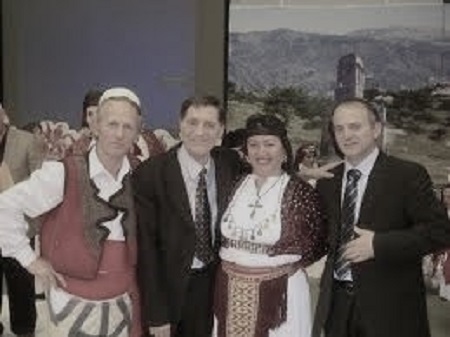
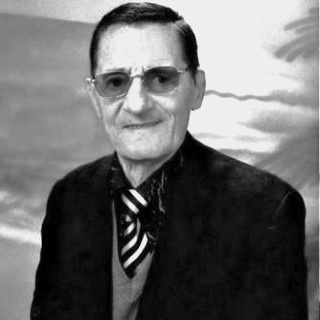
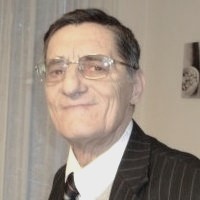
Memorie.al / The desire for literature began with his first steps. That small desire that grows every day, especially when he reads the works of great authors such as Serembe, Frashëri, Ali Asllani, Çajupi. These and others enlightened the mind of the highlander Gjokë Beci and awakened in him such a beautiful feeling for poetry. Like any child, with his bursting desire, he strives to read and study meticulously what seems most interesting to him, what “disturbs” him in a good way, to understand more about his dream. A dream that follows him even into adolescence with determination, to give it the right direction. Thus, at an age neither too young nor yet adult, Gjokë Beci’s journey toward realizing his passion for writing began.
Even though his father left him at the age of four, his figure remained an inspiration for the artist. Gjokë Beci was born in the village of Zajsë, in the Selitë region, in the Highlands of Mirdita. This is the beautiful village where he wrote his first verses for his beloved homeland. And from that day until the end of his life, he continued to write with the greatest love: poetry that was recitative and melodious, as the artist Beci himself calls it.
Not only was he the only brother among the Beci sisters, but because he was different from the other children – the way he spoke, expressed him, behaved with his peers and adults – set him apart from everyone, certainly in a good way. He began writing poetry and prose as early as his seven‑year compulsory education. This passion grew stronger when Gjoka moved to the capital to study at the “Ndrec Ndue Gjoka” high school, under the guidance of esteemed professors such as Petro Marko, Gjergj Zheji, and Gazmend Biba.
“They had an extraordinary pedagogical vitality and a positive influence on every student,” Gjoka recalled. He continued his passion for literature, now delving deeper into it, and wrote his first verses in his second year of high school. It was the beginning of his journey in the field of art, in the world of creativity.
Like any writer who remembers the first moments of inspiration to write, like any poet who recalls the time he picked up the pen to put black ink on white paper with innocent, lively youthful ideas, he said longingly:
“In high school, my interest in literature awakened for two reasons: first, because I read together with my classmates – reading leaves its own impressions, it forces you to explore particular themes; of course, the themes at that time were uniform.
It was difficult to break away from the uniformity of creativity and step into that field that a creator truly longs for: distinctive creation, leaving a mark. I think that a part of my folkloric creations have mirrored their lives in my work,” Beci recounted.
Everything was going well: poetry, studies, family, and health – until the moment of graduation, which he completed successfully, of course! But there was something else that hindered Gjoka’s dream. His great desire to continue higher education was cut off precisely at the moment he was awaiting it with so much joy. “They were political reasons – if I tell them, they are certainly very ridiculous – but they stopped me from studying”!
He remembers with pain the day he found out he could not study at university, but he did not give up. Even though from 1965 until ’86 he was forced to do other work instead of sitting in the lecture halls of the University of Tirana with his peers, his high‑school friends. Still, this period of pause did not serve him badly.
He returned to his birthplace and engaged with music, never leaving the field of art, and there he made a special contribution to the folklore of Mirdita, which at that time was going through its worst period. It was there that Gjokë Beci’s career flourished, beginning with awards at the Gjirokastër Festival in 1978, where the song “Xhamadan i trimërisë” (The Fustanella of Valor) won first prize.
And not only that – Gjoka had a particular way of writing; he never parted from his ideas, and if he liked what he had put down in his notebook, he would not change so much as a comma. But if just one phrase seemed unsuitable to him, he would change it a hundred times until it sounded so beautiful that it needed no further touching.
He continued with “Një zambak i bardhë mbi gur” (A White Lily upon the Stone) and “Dy gëzime në një ditë” (Two Joys in One Day), both of which won first prizes at the 1990 Festival – exactly four years after Gjoka began his higher education in Language and Literature at the University of Tirana, in 1986.
Even at the age of forty‑seven, he sat in university lecture halls to attend lectures and seminars with his fellow students, where his figure stood out – not only because of his age, but because he now came with a different “profile”: a mature man, a personality equal to the professors, who commanded the same respect as he did among the board of writers.
Gjoka is the author of ten books. His first poetry collection bearing Gjokë Beci’s imprint was published in 1970, titled “Kur zgjohen bjeshkët” (When the Highlands Awaken). But after a long pause of twenty years, he published the book “Zambaku im” (My Lily) in 1990. He then continued with several other poetic volumes, such as: “Qiell e dhe” (Sky and Earth), “Antologjia e shpirtit” (Anthology of the Soul) (1, 2), “Thuj vetes ec” (Tell Yourself to Walk), and “Plis në Luvër” (A Plis in the Louvre).
Verses for Music
Gjokë Beci made a name for him in Albanian music and gave a special contribution to folk music. He collaborated with distinguished Albanian artists, both within and outside Albanian lands, who entrusted his pen and gave voice to what he had animated and brought to life.
Singers from the diaspora, those of the folk tradition, showed particular interest in the songs written by Gjoka, such as: Shkurte Fejza, Ismet Rexhepi (North Macedonia), Ilir Shaqiri, Nikollë Nikprelaj, Myfarete Laze, Kastriot Tusha, Gëzim Nika, Arif Vladi, Manjola Nallbani, Artiola Toska, and many others.
In the period when Gjoka was doing exactly the second part – that is, writing song lyrics – his approach was different. At that time, it was not like today’s covers, where a singer comes and orders a song, takes the money, and that’s the end of it.
For Gjoka and the authors and composers of that era, things were different: the song was created first; the product was not sold but given away. In fact, Gjoka mentions the case of the song “Xhamadani i trimërisë”: “I received 180 old lek – 18 new lek today – and it was considered that I had received a large reward. My lyrics were paid for by the state through royalties; I did not sell them.”
Apart from the fact that we were not paid, I recall that, certainly very different from today, to write a song lyric you had to keep certain points in mind that you could not violate. There were thin lines you had to watch carefully so as not to cross any of them; otherwise, the snake would bite you,” Gjoka recalled.
Inspiration is a key element in a lyricist’s creativity. For the master Beci, inspiration is an inseparable part of his cultural and folkloric treasure. He wrote when he felt the necessity to write. “Twenty singers may come and not write a single lyric; none may come, and I may have written four,” he asserted.
Furthermore, he cites the great Kadare: “I am a writer and I will die as one. I am simply an Albanian writer, and I have no written contract with my people on how to write; I am sovereign over myself.” In 2009, the artist Gjokë Beci was honored with the “Great Master of Work” award by the then President of the Republic, Bamir Topi. / Memorie.al