By Shkëlqim Abazi
Part sixty-three
S P A Ç I
The Graveyard of the Living
Tirana, 2018
(My memories and those of others)
Memorie.al / Now in old age, I feel obliged to confess my truth, just as I lived it. To speak of the modest men who never boasted of their deeds, and of others whose mouths the regime shut and buried in unmarked graves. In no case do I presume to usurp the monopoly on truth or to claim laurels for an event where I was only accidentally present, even though I desperately tried to help my friends, who tactfully and kindly avoided me: “Brother, open your eyes… don’t get involved… you only have two months and a little left!” A worry that clung to me like an amulet from the morning of May 21, 22, and 23, 1974, and even followed me in the following months until I was released. Nevertheless, everything I saw and heard those three days, I would not want to take to the grave.
The deployment of police checkpoints, which turned people back without explanation, plus the stories of drivers who traversed the roads of Mirdita and embellished tales according to their own judgment, in addition to the convoys of vehicles transporting soldiers and armaments towards the northeast, fueled the mystery and increased curiosity. Police repression on one hand, and the bond of blood on the other, pushed family members to flock to the few hotels in Laç-Milot, to knock on the doors of friends or strangers, even to sleep under the open sky while waiting for the road to be cleared. As the hours passed, their presence doubled the number of inhabitants in the minor towns and attracted the attention of the police, who violently drove them out of the area perimeter, by car or by train.
Simultaneously, it also raised the interest of diplomatic representations, which informed their centers and, through them, spread the news across the globe. Late in the afternoon, they lined us up again to communicate the division into brigades and work fronts. This time, the card-filer came with a representative of the technical office because the head, Mediu, was missing. We hadn’t seen him since the morning of the 21st, when he took Pal’s club to the back. Apparently, they had sent him for treatment to a secret clinic, to reward his services offered over the years, especially to save his life from the many enemies he had made among us.
“Convicts, in front of the technical office, we will post the lists with the names of those affected by the new movements,” the card-filer announced, waited for the crier to repeat it, and left. On a plywood board, they lined up several dozens of names, contained within a handwritten notebook where red pencil marks stood out. As it seemed, names had been added in ink to the lists drafted since the last reorganization, differing from the original. The absence of the head had restrained the servile subordinates, who surely had left the definitive lists to be made after Mediu’s return from the “Convalescence.”
I approached, but was blocked by the heads of the others; I stood on tiptoes and read: Nominal list according to the respective areas and brigades:
-Zone 1,
-Zone 2,
-Zone 3, Brigade 2:
Group 1: 1 -…, 2 -…, 3 -…
Group 2: 1 -…, 2 -…, 3 -…
Group 3, in the upper gallery: 1 – Ymer Kadria, 2 – Anastas Lapi, 3 – Shkëlqim Abazi.
There is my group! Indeed, they hadn’t moved me from the gallery and the front, but they had changed the “oxen of the plow.” Ymer, the Dibran-Swede, was the miner, while the “pen” consisted of me and Caci, from Kolonja. I met Caci in September 1970, the day I started working in the mine, when Arshin Laraku asked him for his leather coat so I could wear it. Later, we were in the same area again, and now fate brought us to work at the same front. As for Ymer, as a new prisoner, I hardly knew him; he had returned from Sweden nearly a year ago, and now work was linking us for the first time.
“Where have they sent you, boy?” Mexhiti Capa spoke from the top of the stairs, but I was startled.
“You’ve lost it, boy; I asked you where they sent you?” Mexhiti repeated.
“They haven’t moved me from the brigade,” I replied through the smoke.
“While me, they have transferred to the second zone,” he paused for a few seconds and added: “Who did they bring into your group, man?” The question encapsulated the friend’s concern.
“Ymer Kadria and Anastas Lapi,” I replied briefly.
“Ymer ‘the Swede’ from Maqellarë, man?”
“I don’t know where he is from because I don’t know him at all.” I replied, but the qualifier “the Swede” increased my curiosity: “Why do they call him the Swede and what kind of man is he?”
“Listen, boy, as for the designation, he will tell you now, but as for the character, I can speak, as he is from my area. So he is a gentleman and from a good family, but he was foolish to return from abroad. Woe, woe, now you are an old prisoner, friend, and you will find out for yourself!” Mexhiti concluded the presentation, but as soon as he took two steps, he turned back to me: “Boy, why do you need new acquaintances, keep your eyes open, you only have a little time left in prison, do this, dear friend!” He greeted me and left.
Secrecy and mystery had no place in prison. No one escaped its sieve; if not one, the other would know, because you would find either a villager or a friend, or a comrade, and in the end, the personality emerged naked. “Fri-fiu-friuu,” the whistles blew, “Everyone to the square,” Malo yelled. A group of military men broke the silence with their presence. Before we even settled down, we returned to the terrace, as a bunch descended from the upper platform, and Haxhi Gora broke the silence with the aid of the loudspeaker:
“Last night, among other things, I spoke to you about the requests for life pardon for the four prisoners sentenced to death, addressed to the Presidium of the People’s Assembly. The answer just arrived,” he accompanied the words with pauses to emphasize them more, but at the last one, he stopped for a long time and examined us from top to bottom with his wide-open eyes. Our breath was cut short, as if poison had been injected into us. It was about the lives of our friends, aged 21 to 30, who did not deserve death. After all, they neither killed nor cut, but demanded freedom and rights like everyone else! But the murderous and ignorant communists were ready to kill even their own offspring to prolong their rule…!
Nevertheless, we hoped and believed in life, because hope dies last! The Presidium of the People’s Assembly decided in complete unanimity to implement the court’s decision point by point, which means it rejected the four requests for life pardon. “Tonight at midnight, the firing squad will execute the decision, and tomorrow we will present you with the photographic evidence.”
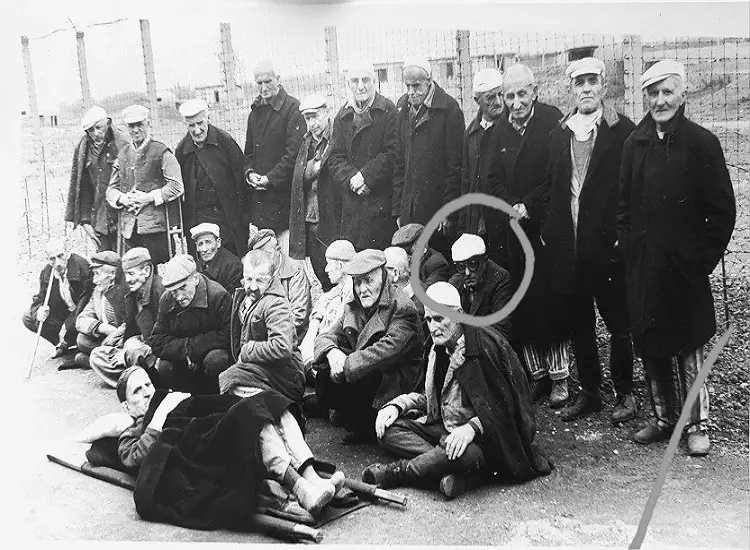
Haxhi Gora continued his speech, while we were stunned. After a few seconds, wails and moans covered the square, and some old men lost consciousness and collapsed onto the cement. Meanwhile, an elderly man from Mati or Dibra, with the surname Doda and the name Beqir (if my memory serves me right), took off his skullcap as a sign of respect and shouted in a loud voice: “You have killed the young boys; may Allah curse you, and may not a stone remain upon a stone for you. May God extinguish your seed, O Lord?” Before he even finished speaking, the police rushed him and seized the poor old man, dragging him quickly to the base of the loudspeaker pole, where they hung him like butcher’s meat.
“Here is where all the enemies of the Party and Comrade Enver will end up,” he yelled, and the massacre continued on the others; sticks and sand-filled whips lashed dozens of backs, until the whistles blew: “fri-fiu-friuu” and Malo yelled: “Disperse, comrades.” The inflammation of this brainwashed race, which had tied its future to the Party and Enver, would reach its peak, while extreme violence would be the message reserved for us from now on. The night passed amidst terrifying nightmares. We mourned the fate of our friends who awaited the firing squad and the terror that would accompany us afterward.
Whenever I find myself in such situations in prison or in free life, the tortures in Shkodra’s isolation cells reappear to me. That evening of mourning, when we awaited the execution of our friends, the chief investigator Llambi Gegeni, the prosecutor Thoma Tutulani, and the veteran investigator, Shyqyri Çoku, flashed before me, acting like hyenas with jagged teeth, while I fluttered on the concrete chair, as they insulted and threatened me, until a stick hit me on the right side of my forehead, knocking the breath out of me.
What a terrifying pain! Then oblivion and oblivion! And then, again, piercing pain and blood! Lots and lots of blood, a river, a sea, a sky! In moments of consciousness, I pleaded: “Take me, O God, what good is this worthless life,” but as soon as I was lost in the abyss, another world, full of colors, lured and tempted me! Suddenly, I returned to reality, and the pain multiplied, courage failed, and again I pleaded: “Take me, O God, I am no longer interested in this life!”
But He protected me from the claws of the sadistic trio of the vampire regime because He had planned my future differently! Why hadn’t He planned such a future for my friends? “Protect them, O God, they are innocent,” I prayed and hoped for divine miracle.
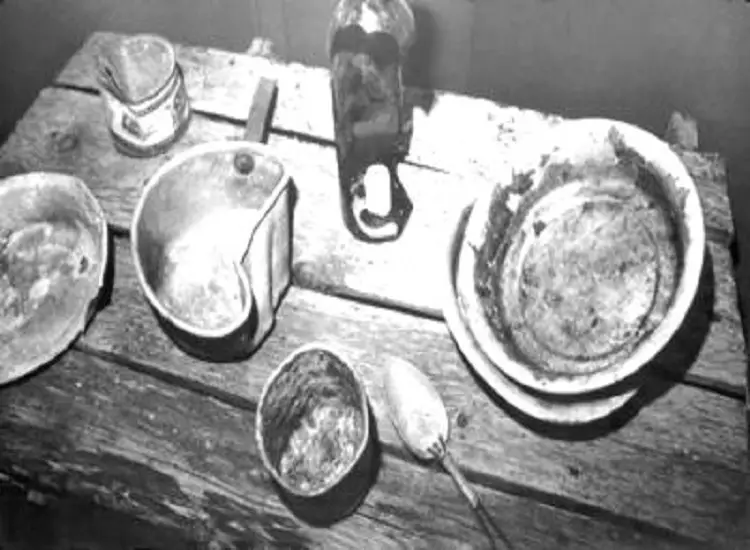
“Fri-fiu-friuu, fri-fiu-friuu” – “first shift wake up!” Malo yelled, followed by the whistles of dozens of policemen, who attacked the rooms, swinging their sticks. Their rattling dispelled my dream. The morning met us with tears; it seemed nature also joined our weeping! We returned to the perennial ritual: latrine, faucets, soup cauldron, and this time under the sticks that struck the backs that protruded sharply and under the rain that poured from the clouds clinging to the earth. We slurped the thin soup, almost standing, and rushed to the beginning of the ordeal, where we hadn’t stepped for five days.
The rain intensified. We put our leather coats over our heads to protect ourselves somehow and took the slope towards the exit gate.
“Who are you hiding from like that, you lot?” a scream followed me.
“The rain!” As I turned back, a pole struck me between the neck and shoulder, blinding my sight, making me loses my balance, and I slipped in the mud.
“Get up, you lot, or I’ll kill you completely!” The labor policeman, Pjetër Koka, rushed at me, but the corners of his tarpaulin got tangled in his feet, and he fell horribly. “Hurry up, or I swear by the ideal, we will shoot all of you!” I was already far from the trajectory of the stick.
“Forty-six, forty-seven, forty-eight… you’ve exhausted us, you lot! You’re stuck, worse than a pig in a sty!” The policeman at the gate counted me and pushed me with the tip of his boot. At the tuff stairs, “greetings” came from across the stream: “We dug your grave, enemies! Die in the mines!” which we hadn’t heard for five days, but this time from a minor chorus. We didn’t answer them, but shuffled one after the other, so as not to slip in the mud. At the top of the ordeal, a platoon of policemen huddled under hoods, while the guards at the barrier were fourfold.
At the carbide depot, they gave us the daily ration; at the other, they equipped us with the necessary tools, and we held our breath at the gallery door, from which heavy-smelling vapor puffed out. We threw the tools into the rusty cauldron and pushed the wagon, but it got stuck at the first turntable. We tried to rotate it back and forth, but it wouldn’t move. We pulled it back and lifted the iron plate; reddish slime had solidified at the base. We cleaned it by hand and continued on, but it was exhausting, turntable after turntable, until we reached the front.
There, the flames of the lamps dwindled like fireflies; the environment resembled an abandoned ship in the middle of the sea: water, rust, and gas. From the barrow stuck in the rock, just as Mexhiti had left it, a stream of water ran, while the barrow itself, the hammer, the shovels, and the rails were red with corrosion. Toxic gas with a moldy smell, floating in the air, blocked our breathing, giving me a headache.
“It’s terrible, men!” Ymeri rushed to the wheel, but rust had blocked it. “Let’s get out, or they will take us out as corpses!” He shook the lamp, as an invitation to follow him.
“Swede, go back to an old shaft, because if you fall into their hands, they will disassemble your ribs strand by strand,” Caci advised him and hit the valve with a lever. “Damn it, the compressor is broken!” He also headed towards the exit.
At the nearby intersection, the currents alternated one another. Dizziness and toxic gases, which had invaded the gallery, overwhelmed me, giving me a headache. A moment later, lights of lamps flashed from all four directions simultaneously. We joined our colleagues, who began complaining of headaches and nausea. For a moment, the ceiling beams spun around me. I put my head in my hands and sat on some logs, but a gush of vomit burst from my throat. I felt faint, almost passing out.
“Quick, let’s take him outside!” someone said, and they lifted me by my arms and thighs.
“Lay him here to massage him!” Caci cut off their rush. “Outside, we will end up behind the poles, and who knows what the end will be, with the momentum these people have taken!” He unbuttoned my shirt. Anastas, phlegmatic and extremely careful in his relations with colleagues, especially with the police – a trait that had saved him from countless senseless punishments – sensed the danger from afar.
“We Christians have been endowed by God with the instinct of fear, but He has given us wisdom; to you Muslims, along with bravery, He has added recklessness. But, we mostly die in bed, while you, dinner won’t catch you where lunch leaves you,” he justified his excessive caution and discreet intransigence toward the military. And to take the irony to the extreme, he added: “Brother, it is better to die in feathers than to remain naked behind the thornbush!” Naturally, the clever man from Kolonja was not as cowardly as he pretended; on the contrary, when work demanded it, he was one of the others, but he avoided trouble with tact.
As they swayed my arms, two pale lights flashed about a hundred meters away at the intersection. From the way they swayed, we realized they were travelers, because experience had taught us to distinguish the lamps hung on the front of the cauldron from those swaying in the hand. Someone gave the signal: “The wolves!” – and the darkness swallowed everyone in the blink of an eye. Some hid in the nearby shafts; others extinguished their lamps and watched the approaching shadows. My knees buckled, I turned off my lamp and huddled behind some half-collapsed logs. A moment later, two people stopped on the turntable.
“Hey, how did they disappear into thin air in a second, man?” – the voice of our brigadier, the scarecrow from Korça.
“Hopefully, nothing happened to them, because it’s hard to get out alive from this stinking hole!” – Frroku, the free brigadier, who couldn’t decide which direction to take.
“They were here, man! Didn’t we see the lights?” – our Mensuri.
“Yes, man, we saw them, but who knows what happened to them!” – the free man worried and added: “We must notify someone, or I swear by the ideal, they will die inside like candlewicks!”
Concerned by what I heard, I emerged from the corner where I was huddled and faced them.
“Where are the others, man?” – the imprisoned brigadier.
“I don’t know,” I replied dryly.
“And you, here?” – the free man.
“I started to go out, my lamp went out, and I got stuck at the intersection.”
“Good, light it up, man, and go back, notify your comrades! You need to leave, or the gas will kill them!” – the strong accent implied that I needed to act fast.
“As you command!” – I turned my back.
While they turned back the way they came, those hiding emerged from the pockets where they had followed the dialogue, we waited about five minutes and headed toward the mine entrance. In front of the barracks, almost the entire brigade had gathered, while a policeman had climbed onto an overturned wagon bed and was screaming at the top of his lungs: (I was seeing this short man in military clothing for the first time; as far as I could recall, he had been a fireman in the second zone).
“The Party and the government are big-hearted, because if it were up to us, we would have extinguished all of you! With me, there’s no messing around, no friendship, no companionship; even if we exchanged a word before, forget it. Right now, I am a policeman, and woe to whoever falls into my hands! I will squeeze the sweet taste of his mother’s milk out of every enemy of the Party and Comrade Enver! You wanted to overthrow the people’s power, you miserable wretches with no pants on your backside, and now you expect to be pardoned? No, I swear by the ideal, we will send you to the spit and the bullet, just like your comrades who were killed last night at the Shpal Bridge.”
He continued his rambling, but no one was listening anymore. The news of the execution of our friends: “last night at the Shpal bridge…” hit us like a bomb, eclipsed our brains, and sealed our mouths. “Oh God,” someone groaned from the front and collapsed onto the rails. Two or three people lifted him and unbuttoned his collar to ease his breathing, while a mass of police officers rushed from inside the barracks, snatched him from their hands, and dragged him quickly to the inclined plane’s winch, where they shackled him tightly, as the short man kept hitting the fainting victim without any mercy.
The unrestrained violence increased the tension. The first people helped the victim, others followed, until a brawl erupted. Terrified to death, the police scrambled down the inclined plane, blowing their whistles: “friu-fiu-friu,” to give the signal. The bitter news and the forewarned death of our friends, as well as the torture of over eighty others in the cells of Koci prison, awoke the virus of May 21st, which was activated in the appropriate instance, even though we had not yet recovered and were devastated by the massacre of the twenty-third.
Some people freed their comrade from the wires and were treating him with makeshift means; others occupied the dominant point and surveyed the terrain to organize some form of defense in case of a sudden attack. Just as the police were blowing their whistles, two trucks and an “ACV” (Armored Car) crossed the main gate; people were visible on the cargo, who, due to the distance, could not be distinguished as police or civilians.
The rapid rush brought back the state of anxiety, but when the vehicles bypassed the uphill road to the third zone and continued under the inclined plane, stopping in front of the compressor barracks where they unloaded the cargo, we somewhat calmed down. Now the workers’ overalls were clearly visible, apparently specialists who would put the compressors back into function, since Fiqiri Muha and his colleague, a Greek minority member, were taken to the Koci cells in Tirana. Nevertheless, the danger was present, because a platoon of policemen took the ascent toward the first zone, heading towards us.
“Avoid the clash, friend!” Caci spoke softly and pulled me by the sleeve.
“Wherever we hide, we are in their hands!” I was convinced that this time, I would not escape punishment.
“Enter the gallery, you only have two months left, while we have a decade or more,” and he guided me towards the mine entrance.
I followed instinctively, although I still feared retribution. At the nearest intersection, we separated.
“Do whatever you must, but don’t take a step without me notifying you!” he advised and returned the way he came. I sat on a log in the endless darkness. The darkness evoked extreme sensations; ominous thoughts invaded the brain cells. In that moment of weakness, I asked myself: “What is the value of my friends’ sacrifices, to save me from re-sentencing, or the desire to see me outside the prison doors sooner, when I cannot imagine what life holds for me beyond the barbed wire fences after five years of slavery? Will I be able to adapt to freedom, if it truly exists?”
I tried to recall the last moments of my free life and connect the broken thread, but the result was null. “Have I perhaps lost the ability to adapt, or is the link connecting the past with the future broken forever?” I remembered friends released from prison that were brought back after a few months or a few years, without having done anything at all. “What harm could Feta Malasi cause the state or society, who was locked up for a whole year within four walls, and was re-sentenced immediately after his release, supposedly because it hurt his eyes to see the flourishing and prosperity of Socialist Albania?!
And Xhelal Bey, who is being sentenced for the third time, with the same accusation, agitation and propaganda, supposedly because he refuses to answer to the young people when they call him Comrade Xhelal, but absolutely wants the qualifier ‘Mister’?! And dozens of others who are brought back to prison, just because they are presumed sworn enemies of the communist system?!” “It’s useless; this fate has been destined for me too! After all, they didn’t gather all the dates for nothing: 11.08.1968, it hangs over my head like the Sword of Damocles and threatens me in dreams and waking life!” Memorie.al