By Shkëlqim Abazi
Part sixtieth
S P A Ç I
The Graveyard of the Living
Tirana, 2018
(My memories and those of others)
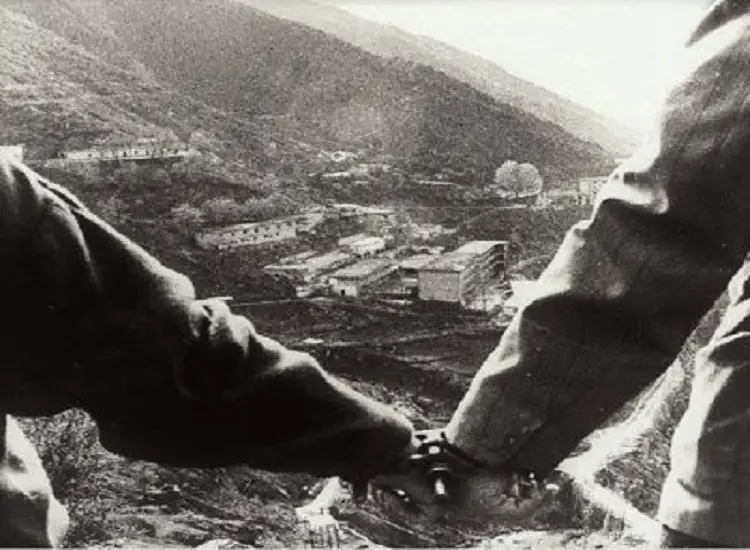
Memorie.al / Now in old age, I feel obliged to confess my truth, just as I lived it. To speak of the modest men who never boasted of their deeds, and of others whose mouths the regime shut and buried in unmarked graves. In no case do I presume to usurp the monopoly on truth or to claim laurels for an event where I was only accidentally present, even though I desperately tried to help my friends, who tactfully and kindly avoided me: “Brother, open your eyes… don’t get involved… you only have two months and a little left!” A worry that clung to me like an amulet from the morning of May 21, 22, and 23, 1974, and even followed me in the following months until I was released. Nevertheless, everything I saw and heard those three days, I would not want to take to the grave.
“Only the building of the 303 Unit Command has the right to the flag, while you were brought here by court decision for re-education,” the Deputy Minister struggled to escape the impasse.
“To whom does the right to protect the Flag belong more than us, the genetic inheritors of those men who watered it with blood and waved it freely after five hundred years of slavery?” Hajri continued his point. After the initial shock, the Deputy Minister seemed to regain some composure and addressed the topic:
“We accepted the meeting with the idea of differentiating those few rebels from the innocent and isolating them; on the contrary, any opposition will be paid with your head!”
“Stop the threats, sir, because with your irresponsible actions, you brought the situation to the brink!” Paulini retorted. “We came here on behalf of our fellow sufferers and with good will to find a solution to the problems that concern us, and to submit a package of demands that…”
“Submit the demands in writing! I want to understand the reasons that prompted those few convicts to undertake actions in violation of the law and regulations,” the Deputy Minister deliberately unified his language.
“Let’s be clear, sir, it’s not just a few, but everyone reacted as one body against the irresponsibility and repeated violence you have exerted for years,” Nuri Stepa jumped in.
“Precisely about these things, we need to talk! Because even among us, there are irresponsible officers or police who violate the directives of the Party and comrade Enver, intentionally or not, as well as the regulations for the treatment of convicts. We are ready, if the need arises, to take appropriate measures to bring every violator, both from your side and ours, back onto the rails of the law,” the Deputy Minister evaded.
“Sir, the culprit hides behind power; this is also our case!” Paulini countered and added: “Arbitrary punishments have been rampant for a long time; you isolate us in cells, tie us with wires, keep us for two shifts in the mine even when we are sick, even when the quota is not met due to your fault, you cut off our correspondence and meetings with family members, you confiscated our books and notes, you – ”
“I don’t want repetition, submit the complaints in writing! I promise you that we will examine them one by one and respond to you in optimal time. At the same time, we will take measures against every violator, be it the camp commander or the commissar,” the Deputy Minister cut him off. “But first, I advise you to distance yourselves from the rebels who incite destabilization and try to implicate the unfortunate ones as well.”
Even an owl could read the subtext of this passage. The government representative aimed for division, just as Uncle Rustem had said: “To divide us thread by thread, to subdue us more easily!” The term “rebels” in his mouth tasted like a poisoned pill. Perhaps he intended to differentiate the targeted “rebels” from the rest of the mass, to kill the second bird with the testimonies of the “unfortunate ones.” Our representatives smelled the trap and responded to the official’s insinuation fiercely:
“Sir, you have no right to consider these honorable men rebels; we are not ordinary thieves, but political prisoners, honest patriots, and good Albanians!” Hajri cut him off. “This language cannot continue much longer…”
The intervention caught the Deputy Minister off guard, who interrupted him, shaking his finger: “Leave politics, convict, and focus on the problem! The laws treat rebellion the same way for common criminals and for politicians!” – and he turned so red that his veins almost burst.
“Sir, before the meeting, we hoped that you would treat us with the respect deserved by the emissaries of the men who have been protesting for more than twenty-four hours and sent us to represent them, but the threats and conditions you are setting do not promise hope for any good agreement. Please, either changes your language and let’s reaches an understanding, or we will stop the talks and return to the previous positions!” Nuri Stepa got ready to turn away.
This diplomatic behavior enraged the Deputy Minister, whose body trembled as if he were having an epileptic seizure. But Paulini gave him no time to compose himself:
“You should not mention rebellion, sir; this phenomenon has nothing to do with this case! The forced protest is a counter-reaction to the violence and the violation of the few rights the law grants us. How else would we act when you treat us like criminals?! No, sir, we are not such, so we insist that you punish none of us and enforce the law and regulations…”
“Who are you to tell us the law and teach us how to enforce regulations?” the arrogant official interrupted. “The People’s Courts have convicted you of forced labor, and we have been charged with guarding you and requiring the strict enforcement of legality. We will tolerate no one violating legal norms, did you understand or not? We could also explain ourselves with alternative methods, but…” he raised his voice, as a sign of threat.
With “alternative method,” the official intended to break the negotiators, and consequently, the seven hundred “rebels” in the camp.
“Sir, we are confident in the justice of our demands. To have opposing ideas is more than normal, but to treat opponents as enemies is an anomaly! On the one hand, you have convicted us for our beliefs; on the other hand, you force us to work in the mines! Only you can bring about this catastrophe, because everywhere in the world, they respect this category and apply amnesty, but you have put a lock on it ever since you broke up with Russia. Therefore, as the previous speaker said, we insist on leaving the mines and returning to construction, while also demanding that the unjust sentences be reviewed; otherwise, the situation will escalate further,” Hajri burst out.
“Who are you, sir, that you merit so much respect!?” Feçor flushed with indignation.
“A compatriot of yours from Hekal!” Hajri returned fire for fire.
“Hey, are you going to shut your trap, or should we shorten that tongue of yours, which is a foot long!” again in a high tone.
“Shouting is not an argument, sir, nor is the arrogance you are applying! You can impose thirst, hunger, violence on us, but you cannot subdue us this way! Since you have convicted us for our beliefs, we have the right to appeal to you, to treat us like any politician in the world, to respect the rights and freedoms recognized by international conventions.”
“To hell with the imperialist-revisionist conventions!” The Deputy Minister raised his middle finger, but his hands trembled.
In contrast to Nuri and Paulini, two cool-headed, experienced diplomats, the artist Hajri caught fire and exploded:
“Shove that finger you took out up your ass! Even though you have the power, you have no right to trample on the dignity of seven hundred convicts who have been protesting for neither two days, nor ours as their spokesmen. I repeat: you are responsible for what is happening, so we insist on our legitimate demands:
-That none of us be punished.
-Not to work in the mines.
-To transfer us to construction (work).
-To create communication facilities with embassies and international organizations for the protection of human rights headquartered in Helsinki. At the same time, we invite a team of UN experts to become acquainted with our demands and complaints on the ground.”
This address broke the camel’s back. The statesman twisted left and right, leaned his ear toward the Commissar, who whispered something to him, and then retorted:
“You sing like a nightingale, you carnation, now tells us what else you want!?” – Irony burst from his pores. “Hey bandit, aren’t you the cub of the bandit Zenel Pashaj from Hekal?” – This rhetoric concealed sadism, insult, and primitive threat.
“As you command, O Shehaj lackey, I am the son of the man whose stirrups you held when he mounted and dismounted his horse, and whose shoes you wiped with the bottom of your jacket!” Hajri returned the fire in kind.
Lord, how freedom magnifies you; it gives you wings and raises you to the seventh heaven! The astonishment transcended the limits of reality and entered the boundaries of unreality; the good fellow I had known for five years took on gigantic dimensions! Strange how I had failed to notice the dragon beneath the delicate skin of the artist who reveled in lyrical songs and jazz drums! All this time, he talked about literature, fine arts, and naturally, music, his hobby, but never about politics, even though he was in prison precisely because of it?!
Social cataclysms give ordinary people other dimensions and turn them into heroes! The retorts provoked a state of dread across the camp, as if the universe held its breath, the plants lost their greenness, the birds stood still among the leaves, the bees froze on the flowers, the flowers wilted, the butterflies stopped mid-air, the eagles remained suspended over the crests, and even the sun hung like a red-hot iron plate behind the celestial dome, shooting scorching rays at us.
“Your father left his bones in Gjirokastra prison; you will leave yours in Spaç!” Feçorr was trembling all over.
“Scoundrels and cowards act under state authority! Be careful, you hound, because the circle is tightening around you, and soon we will switch places!”
The soul of the artist is like glass; it resists the heat of furnaces but cracks with a cube of ice!
Afterward, the two compatriots devolved into mutual insults. The Deputy Minister spat out all the vulgarities of the Albanian vocabulary, but the artist was no less eloquent. Thus, the meeting ended in a cockfight.
“You are dead! You are dead! You are dead!” the Deputy Minister shrieked hysterically.
“I thank you for the glorious end you are reserving for me, but don’t forget, it awaits you too! I am dying as a martyr and will be remembered as a hero; you will be squeezed for the last drop and cast aside like a rag!”
The unequal confrontation foreshadowed the fate of the oracle Hajri, who did not break, just like a giant oak with roots deep in the earth, while his compatriot fluttered like a leaf scattered by the wind.
The meeting ended. The state officials headed towards the command, while the missionaries of freedom returned proud and dignified, amid the applause of the crowd who touched their limbs as if they were good-luck totems.
The crowd rushed forward, everyone wanting to embrace them first, including me. I met Nuri, whom I knew less, then Paulini, my friend from the Shkodra cells, but I froze when I approached Hajri. Perhaps the sudden heroism cloaked in a veil of mystery gave him other dimensions, an illusion that follows me even to this day. But the grating noise of the megaphone cut short the melancholy:
“Attention! Attention! We warn you that the surrender deadline remains five o’clock; otherwise, you will face the consequences,” the threats of the General Director of Police, Kasëm Kaçi, tore at our ears.
“Down with Communism,” “Long live Freedom,” “Death to the criminals of the Albanian people,” “Long live Free Albania,” “We want Albania in Helsinki,” “Freedom for political prisoners!” “We will not work in the mines, neither today nor tomorrow!” “You are murderers, you have stained your hands with our blood,” etc., was the response of freedom, thus defying the government ultimatum and the grating noise of the megaphone. Following this, the stress multiplied, and one more threat was added to the violence.
The day dragged on at a snail’s pace. The lack of water and food was compounded by the scorching heat, rare in the Spaç valley, plus the psychological violence and unprecedented police repression. The lack of vital elements showed its first effects on the elderly and the sick, then on others, but thanks to the sacrifice of the stronger ones, who helped the weak, the younger ones who aided the elderly and the sick with some water or a portion of food, the consequences were somewhat mitigated. Everyone who had saved something in their sacks emptied them and shared them with friends, voluntarily giving up their own portion.
The proverbial sacrifices of those three days, the tolerance and solidarity that transcended human limits, smoothed out religious, political, and regional contradictions, while self-sacrifice proved the ancient Albanian tradition: “Brother for brother becomes a sacrifice!” When the adversaries suddenly found themselves in the arena of war, they forgot their conflicts, shared the water flask and the last piece of bread among themselves.
To grasp the majesty and sublime values of that wonderful reality, which was rarely encountered in the environment where the Albanian Lay-fen (Life) was forged, or today when humanity has declined and people chase money, you needed to be inside the circle of barbed wire, locked in the arena surrounded by thousands of armed soldiers, in the cesspool where the heroic men of all political and ethnic Albania had been dumped: from the South, the North, the East, the West, from Presheva, Bujanovac, and Novi Pazar, from Kërçova, Skopje, and Gostivar, from Ioannina, Preveza, Parga, and Filat, from Ulqin, Tivar, Plav, and Gusinje, from Mitrovica, Pristina, Prizren, Gjakova, and Peja, etc., without counting the local cities and villages.
In the first moments, almost everyone was caught by surprise, and when they found themselves in the vortex of the revolt, they lost their composure, but with the flow of hours, they became conscious and adapted to the situation. The first day was very tense, starting with violence and closing under violence, but through it, we liberated the camp. The day was followed by a night of dramatic developments that shook even the most apathetic.
The breeze of freedom gave birth to unknown orators, who raised the spirits of the revolted with pathetic speeches, exposing the Marxist-Leninist and Enverist perversions with brilliant eloquence, while the communist legacy would be consumed by fire, and the national flag, without the red star, would wave over the palace.
On the second day, mobilization increased, but the enthusiasm seemed to drop slightly after the confrontation and disagreement with the state officials. Initially, fear shook even the bravest, but the sense of responsibility and the inevitable consequences had the opposite effect, increasing resistance and solidarity for the comrade in need.
When exhaustion overcame us, we headed to our beds to gather strength to face another night of anxiety. Meanwhile, the young men, exhausted by the heat, drained by sleeplessness, weakened by the lack of water and food, and with faint hopes, continued the duty assigned by the Inter-Regional Committee, increased vigilance, and thus avoided the sly maneuvers that might catch us by surprise. As soon as sleep overcame me, two strangers spoke to Fiqo and shook me by the shoulders:
“Are you Shkëlqim Abazi?”
“Yes, sir!” I replied mechanically, without bothering to understand if I was awake or dreaming.
“We need some water for this old man!” A withered old man, pale as a ghost, and a middle-aged man holding him by the arm, blocked the light and made vague gestures.
“You wanted water?” I reached out and grabbed a flask above the shelf, but it seemed to be nearly empty, as the old man swallowed a gulp and slammed it down on the bunk.
“Estaghfirullah (God forbid), it didn’t even wet my throat!” he added something else and sat down beneath Fiqo’s bunk.
I uncorked the second flask, but it was empty, and the third had no drop either. As soon as I took Ram Tahiri’s canteen from under the bed, the middle-aged man snatched it and emptied it into the flask.
“Take the medicine and take the rest of the water along with the canteen!” and I lay down again.
“Thank you, brother, may God enlighten you!” the asthmatic old man breathed heavily, swallowed the pills with several gulps, and cursed: “They condemned us to thirst, may no communist remain, jahrabi (O Lord)!” He capped the flask and shuffled away behind the other man.
At the threshold, he turned back to me once more:
“Greetings from Tomor, he sent us!” – and they left.
“From what I saw, you didn’t recognize them at all!” Fiqiriu jumped up, as soon as the bizarre pair disappeared from sight.
“No, who were they?” I turned onto my back.
“A dervish from my area, who served at the Rabia Teqe (Dervish lodge). In his youth he was strong as a wolf, but prison reduced him to an asthmatic. And the other, a history professor from Libohova,” he added without being asked.
My eyes were swollen from sleeplessness and lying faces down. I splashed a handful of water on my face and neck to cool down somewhat.
“Friend, conserve the water, who knows how long this issue will last!” Fiqo chided me.
“What do you think, should I not have given them any? Water is life, my dear!” I philosophized.
“You did well to give them, but don’t waste it!”
By now, I was wide awake. I poured the canteen water into a flask, gathered a crust and a crumb of cheese in a paper, and headed to the eastern section of Barrack “L,” where Tomor slept. I was convinced I would find him thirsty; his type would rather fast than take from others’ share.
At the bottom of the stairs, I ran into the other Tomor, Balliu, with a bowl covered with a cloth.
“Where are you off to with this gift?” he asked, seeing the bundled package.
“To Allajbeu, to bring him something to eat.”
“Have you eaten yourself?”
“I wasn’t hungry, I’m still sleepy.”
“I brought kaçamak to Tomor; you take this bowl and go back to the room” – he lifted the cloth and handed it to me.
“Perhaps he needs water, because he sent a thirsty old man to me a few minutes ago.”
“Who, Dervish Bey? I sent him, because he had to take his medicine! I’m leaving!” – but he returned again after two steps: “Brother, don’t wander around the camp; you only have a little time left!”
“Fine then, take this flask, drink yourself, and take it to Allajbeu!” I handed him the drawstring and turned towards the stairs.
“No need, I just filled some for myself and for Tomor.”
“Thank God they brought water!” This news indicated that something was moving on the Command’s side.
“No, man, no, Ylber Merdani opened the shower reservoir! It’s stagnant water, but it’ll soothe the throat!” He entered his room without saying goodbye.
While I was sleeping, Ylberi had notified his comrades who rushed with empty containers and burst open the shower reservoir. News in prison, however, travels with the speed of light: the first informed the second, these told the others, and after five minutes, the reservoir was empty. Nevertheless, that water was enough to quench the thirst for a few more hours. The soldiers were replaced by Special Forces police since Sunday evening, and the bodyguards’ actions were extremely chaotic.
Waiting the sunset behind the neck of Spaç-village, our eyes were fixed on the Command square, above the central gate, where several platoons of soldiers marched in formation, singing hymns to the Party and Enver, as well as dithyrambs to the triumph of socialism.
Cars, tanks, and armored vehicles rushed beyond the funnel of Gurth-Spaçi, where the road was lost to sight. Smoke rose in thick clouds, giving the panorama an ochre color. Meanwhile, two “Mig” fighter jets made several elliptical circles above our well, and a few dive-bombs up and down left two trails of smoke suspended, and they flew away the way they came.
Even after sunset, the heat continued with the same intensity; the heat did not drop even when the contours of the stones dissolved into the reddish stream and grayness blanketed the hills, blending them with the horizon. The ultimatum proved false, as the hour had passed five o’clock on time, but we still feared an attack or incapacitation with chemical agents, because the treachery of the night and the communists overlap.
After midnight, the black curtain covered the surrounding hills, contrasting with the camp territory, which shone brightly enough to find a needle. Thousands of lamps and dozens of searchlights, aided by the headlights of tanks and trucks, cast light over the secret hideouts, while the engines roared like hellish demons.
When I returned to the room, I found about ten old men huddled under blankets. Thirsty and weary from over forty hours of suffering, someone groaned, another snored, while the bed boards creaked mournfully as they turned from one side to the other. I lay down like them and imagined the violence that would follow the disaster.
“How many hours separate us from being tied to the poles, from torture in the cells, from working overtime underground?” Oh God, I lost my mind. The thought dug through the dark corners of my brain and awakened childhood memories: Memorie.al
Continues in the next issue