Part Seventeen
Excerpts from the book: ‘ALIZOT EMIRI – The Man, a Bookstore, and Noble Wit’
A FEW WORDS AS AN INTRODUCTION
Memorie.al / Whenever we, Alizot’s children, shared “Zote’s” (Alizot’s) stories in joyful social gatherings, we were often asked: “Have you written them down? No? What a shame, they will be lost… Who should do it?” We felt increasingly guilty. If it had to be done, we were the ones to do it. But could we write them?! “Not everyone who knows how to read and write can write books,” Zote used to say whenever he handled poorly written books. When we, his children, discussed this “obligation” – this Book – we naturally felt our inability to fulfill it. It wasn’t a job for us! By Zote’s “yardstick,” we were incapable of writing this book.
POLITICS IN THE BOOKSTORE
POLITICAL BOOKS
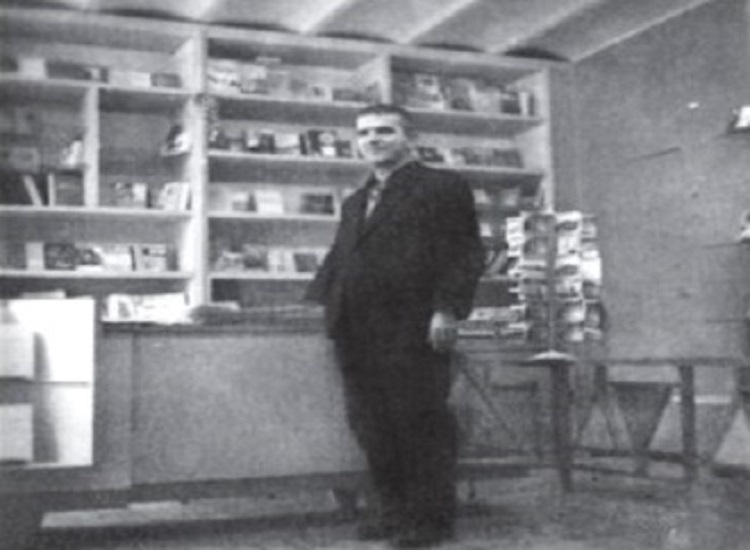
The political books were separated from the artistic ones. Upon entering the bookstore, on the right, there was a wall of shelves for political and ideological books. They stood out immediately. They were well-bound, with thick covers, mostly in shades of red and maroon. Their dimensions were standard. The shelves looked orderly.
Opposite was the counter, where the bookseller stood. Alizot stayed there, amidst the artistic books; that was his place. He felt more comfortable in that literary and artistic environment. He had placed Marx, Engels, Lenin, Stalin, and later, Mao and Enver, together further away. Nothing connected him to political literature; they were “foreign flesh” to him.
Alizot read a lot of fiction. Therefore, with special passion, he would advertise the books, quoting fragments and highlighting hidden values to the readers, making them quite attractive. Meanwhile, he said not a single word about the political books. He wasn’t required to advertise them. Thank God! But while the artistic books were being taken by readers, the political ones only increased in number. The shelves were full. New political books, arriving more frequently than before, had to be displayed in the most prominent parts of the bookstore.
A great deal of work began with transferring some works to make room for the newly arrived ones. It was also a job of great responsibility. You had to move Lenin down to the cupboards to make room for Mao on the shelves. Whom should he please and whom should he offend?! It was like using “broken scales” to find these balances. Then came questions from those who only recognized books by their covers.
– “You chose Lenin to remove?!”
– “No, no, I didn’t remove him; I just squeezed him a bit!” Zote would carefully explain. “I kept half upstairs and moved the rest down.”
And then Enver’s works were published! Fortunately, people picked up those first ones; they didn’t let them gather dust on Zote’s shelves. Not a house was left without displaying a volume on the sideboard shelf.
– “You got one too? Bravo, well done, we got…”
These were the usual conversations.
But let’s return to Zote’s predicament. How would he handle the constant relocation of the classics of Marxism? No, the way things were going, he couldn’t manage!
– “I’m racking my brain,” he told a friend in the bookstore, “we’re exhausted, carrying books in our arms all day, I’ve even exhausted my son, and they’re heavy as lead.” He didn’t know how to resolve this growing contradiction.
– “I went to the First Secretary of the Party Committee in Gjirokastra,” I heard Zote telling a friend a few days later. “I’ve come to address a concern as a bookseller – I told him.”
– “Go ahead, Alizot,” he said.
“And I truly poured my heart out…!”
– “Look, I don’t understand one thing,” I said. “Does the state publish these political and ideological books according to a plan, or just randomly? Are they published to fill the bookstore shelves, or to fill people’s heads?!”
– “Why do you frame the problem like that?” he had asked.
– “They aren’t being picked up at all,” I said. “The communists don’t read! If we continue like this for much longer, I’ll come asking for help to take the books out of the store and put them in a warehouse. As for which ones to remove, you point the finger, because I am not capable of that task.”
-“I understand, thank you Alizot. The books will be bought!” the Secretary told him, who, in Zote’s opinion, had received him very well.
“Then I find out,” Zote continued his story, “that he had mentioned me in an important meeting of the Plenum and had reprimanded all the communists who don’t read, especially the propaganda sector. They all flooded the bookstore! The beauty of it was that after buying a red-covered book, they would go for a stroll with it in their hand so everyone could see them. I was satisfied; I’d had my fill, let me tell you! They would even walk right past my display window. Some who had never stepped foot in a bookstore, not even to buy a newspaper, entered timidly as if entering another world. They didn’t know what to ask for. I felt sorry for them and helped them, knowing it wasn’t their fault. But I’ll be damned if they read more than ten pages before leaving it on the mantle to get covered in soot.”
“I enjoy the ‘tough guys’ most,” Zote wouldn’t stop recounting. “I have fun with them. They stand in front of the political book shelves with concentration, not as if they are seeing those covers for the first time, but as if they are checking if there is a book they haven’t yet studied. One from this category, who was attending ‘Party School,’ asked me for Engels’ ‘ANTI-DÜHRING.’ I gave it to him, and after he left, I told those inside: If you take ‘ANTI-DÜHRING,’ boil it well in a pot of scalding water, then take this man’s brains and boil them in another pot, join the two liquids in a third vessel, stir them well and let them cool – you’ll see the liquids will separate from each other as if cut with a knife!!! They don’t belong together at all!”
“I was impressed when someone, after buying a classic work, didn’t leave the store. He waited for a moment when I was free and said: ‘Alizot, I got it, see you later!’ Apparently, they think I send information to the Party Committee about who has taken works and who hasn’t. ‘May a bolt strike you,’ I say to myself! Truth be told, I answered them seriously: ‘Yes, yes, I saw it!’ – so word would get out and others, their comrades, would come. There was no other way! I barely escaped!” Zote concluded.
KHRUSHCHEV’S PHOTOGRAPH
In Alizot’s bookstore, the method of advertising was striking. He paid special attention to the display windows. The shop sign, “LIBRARI – KARTOLERI” (Bookstore – Stationery), from when it was private, stood out in the entire bazaar. He created a rotating advertisement using a small electric motor, the only one in Gjirokastra. Passersby would keep their heads turned toward Alizot’s window.
Later, when forced to close his private business, he started working as a state bookseller. Even there, he was distinguished, among other things, for his flair for advertising. He created something unique. He prepared at home an exhibit of three large photographs within a single frame. He placed it in the bookstore window. When looking at the window from the front, Enver’s photo appeared within the frame; when looking at the frame from the side, two different photos appeared: from one side Stalin, from the other side Lenin.
With this strange photo for that time, he ensured people’s heads remained turned toward Alizot’s bookstore. But at the same time, with this poly-photo, where he had joined the three leaders of the time in one frame, Alizot hit two birds with one stone. On one hand, he wanted to show he wasn’t yet an “enemy of the system,” and on the other, he fulfilled what was in his blood – advertising. People again turned their heads to see four men: Enver, Stalin, Lenin, and Alizot on the side.
This went on for many years. Regarding the photos he would place to the left and right of Enver, Zote consulted with those at the Party Committee so that Enver would feel as “comfortable” as possible in the frame. If Enver was “comfortable,” Zote could remain untroubled. Later, according to instructions, Stalin was removed and Khrushchev was placed in the frame.
In the 1960s, the rift between Enver and Khrushchev began. Zote listened to foreign radio at home. He listened to “Voice of America” and Italian stations, gathering information on world events, especially those related to Albania. As soon as he smelled “burning rags” – an expression Alizot used in these cases – he removed the frame with the three leaders from the window and tucked it under the counter.
One of Zote’s friends, Cike Borova, came to the bookstore. Zote felt at ease with Cike and talked without reservation, even though Cike was a military man. He didn’t guard himself against Cike. Cike was struck by the absence of the leaders’ frame in the window.
-“Why did you remove the frame with the leaders’ photos from the window?” he asked Alizot.
-“Khrushchev’s photo got a little torn,” Alizot replied, “and I removed it because it looked bad, until we find another photo.”
-“You did well,” Cike said, “but look again – it isn’t just a little torn; it’s torn a lot. Don’t look for another photo for the time being.”
They understood each other!
What Zote had heard from Western radio, Cike had learned from the briefings given separately to communists and military personnel?
MARX THE SAINT
The bookstore was at “Çerçiz Square.” The Tourism Hotel in Gjirokastra hadn’t been built yet. A very elderly woman entered the bookstore. From her attire, it was clear she was from Dropull. She was looking carefully at the shelves. The bookseller watched her with curiosity. Her persistence showed she hadn’t lost her way; otherwise, she would have left immediately, as often happened when people mistook the store for a cheese shop. She was looking for something. Zote approached her and asked in Greek:
-“What do you wish?”
-“I want something to hang on the wall,” the old woman replied.
-“I have a saint,” Alizot said in a low voice, “do you want him?” The old woman’s face lit up.
– “Come this way,” Zote said, taking her to the back of the store, near the storage area. Zote took a large color photograph of Karl Marx and held it up to the light for the woman.
– “He is a saint! Do you like him?” he asked.
The woman immediately made the sign of the cross and bowed before Marx, as if she were receiving her Communist Party membership card. Zote served with solemnity in this micro-religious ceremony. As the woman felt relieved, Zote rolled it up and warned her not to crease the “Saint” on the way. The old woman looked indignantly at the clerk who dared to advise her on how to carry the “Saint.” She crossed herself again and took it with special care. As she turned to leave, the clerk added:
-“Don’t forget to light candles for him!”
-“As soon as I get home, son, I will leave them lit day and night!”
-“Alizot, won’t ‘these people’ take offense?” a friend who happened to be in the bookstore asked with concern.
-“I don’t think so,” Zote replied, “they have no reason to. I gave him as a ‘Saint.’ Let them go and see if the candles aren’t lit. The old woman won’t let me down. She crossed herself three times in the bookstore; let alone what she’ll do at home. Besides, don’t ‘these people’ also bow before Marx?!”/Memorie.al