By Qerim Lita
Part Two
– Ukë Cami, Distinguished Albanian Military Officer and Nationalist –
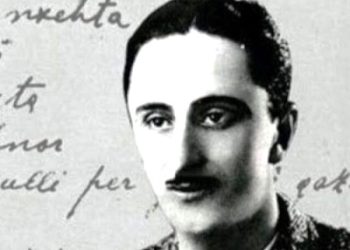
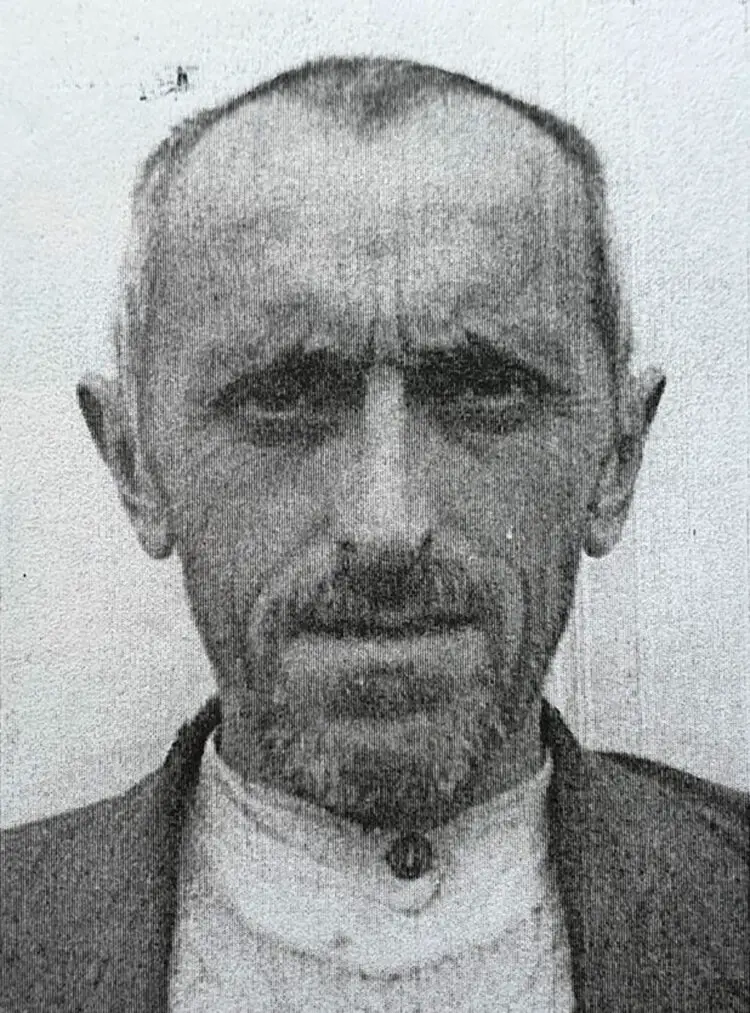
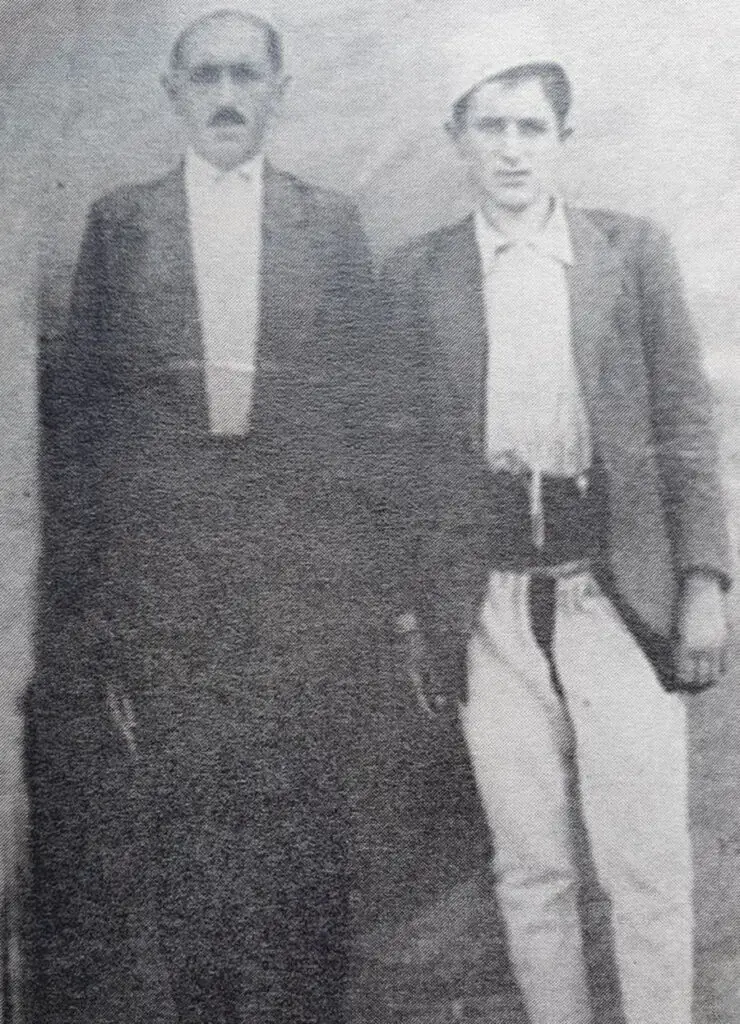
Memorie.al / Ukë Ramadan Cami were born in 1896, in Sepetovë, a neighborhood of Tërbaç, Ostren Municipality, Dibra. His home, located near the crossroads to Struga, Dibra, Golloborda, Gryka e Vogël, and Gryka e Madhe, was always open to leaders and patriots of the national movement. His father, Ramadani, was a determined fighter for the constitution and among the first fighters for the formation of the “Bashkimi” (Unity) club of Dibra. As an activist of the club, supported by Eqerem Cami, he carried out extensive propaganda activities in the city and the highlands. The Camis are a large family, part of the Dibra elite, extending across the villages of Gjorica, Viçisht, Golovisht, Sepetovë, and in Greater Dibra.
Continued from the previous issue
Immediately after the liberation of the city of Dibra, an Albanian administration was established consisting of two wings: the nationalist and the communist. This policy was unacceptable to the Yugoslav communists; therefore, on October 1, 1943, Tempo sent a letter to Haxhi Lleshi where he demanded of him: “to take strict measures against the ‘Greater-Albanian’ reaction,” because according to him: “this reaction in Dibra is also reflected in Kërçovë.” He suggested to his friend that, if possible, he should cause “division among them, by winning over (recruiting) some of them, always keeping in mind to immediately start propaganda for labeling the others.”
Tempo demanded that Haxhi Lleshi create in Dibra a “new Dibra battalion, with mixed Albanian-Macedonian soldiers, where, alongside the Albanian flag, the Yugoslav one should also fly.” All this was to be done in the spirit of “brotherhood and unity.” Tempo specified that “the new power to be established must be purely communist, the battalion led by Slavo-Macedonians and local Albanians,” and that he should strictly implement the agreement signed between the General Staff of the LNÇSH and that of the LNÇM, according to which: “all Albanian territories that had joined Albania since 1941 were considered Macedonian territories,” therefore Macedonian power should be established in those territories.
In accordance with Tempo’s request, Haxhi Lleshi organized a secret meeting with the leaders of the Ndreu family, specifically with Cen Elezi, Xhetan, and Beshir Ndreu, whom he asked to abandon the KSHpLPSHE and join the forces of the FNÇSH. Simultaneously, Haxhi Lleshi asked Cen Elezi that the gendarmerie be merged into the “National Liberation Army,” or with “his and his comrades’ bands” and to commit all forces to war, cooperating closely with the neighboring forces of the LNÇM, while the resolution of the border issue should be left to the: “Atlantic Charter and the Treaty of London.” The meeting ended without any conclusion. Cen Elezi was given 24 hours to consult with his comrades in the Committee.
The following day, Cen Elezi stated that he would enter the war as soon as the depots were handed over; he did not accept the dissolution of the carabinieri, in fact, he demanded increased security and warned that he would withdraw his own forces. Likewise, Xhetan Ndreu, who was present at the meeting, declared that “he did not wish to become a communist” and that “he does not want to be the cause of fratricide.”
For this same purpose, the Albanian communists, during August 1943, in all likelihood through Hamdi Dema, had tried to win over Ukë Cami, who at that time was staying in Vllasiq with a part of his volunteer forces. Regarding this, the Command of the “Firenze” Division in Greater Dibra, based on information from the municipality of Ballanca, on August 14, 1943, reported that “an armed communist band composed of 8-9 people has arrived in the village of Prapanik i Madh and entered the house of Xhemo Hajredini, later together with Xhemo they departed in the direction of the village of Vllasiq.
The leader of the band could not be identified.” Although the information does not specify the leader of the band, it was almost certainly Hamdi Dema, who some time ago had settled in the village of Galiçnik. However, this attempt also failed, because, as we will see in the following, Ukë Cami would align himself with the nationalist forces. Unlike Cen and Ukë, the divisive policy initiated by the Yugoslav missionaries and their tools Haxhi Lleshi, Esat Ndreu, Hamdi Dema, etc., was joined by several leaders such as Faik Shehu, Hilmi Karahasani, Xhevdet Kumbaraxhia, Ali Ndreu, and naturally all the Lleshis.
The campaign to smear the Albanian nationalist elite in Dibra, as stated in the proclamation issued by the Albanian Committee for the Freedom and Independence of Ethnic Albania, began immediately after the formation of this committee, within which the most influential leaders and the vast majority of the forces of Dibra were aligned, among whom undoubtedly Ukë Cami was distinguished. This reality, the proclamation states, “infuriated the communists, who hoped they could gradually incorporate the forces of Dibra into their own party, which was a vain and mistaken hope. They thus began to attack the new Committee with all their might to destroy it, attacking from the outside, but this was not possible, and then a new maneuver began: the attempt to destroy it from within.”
Meanwhile, the nationalist leaders, to avoid fratricide, withdrew their forces from Greater Dibra, whereby this city fell into the hands of Macedonian communists. But as if this were not enough, Tempo ordered an Albanian partisan unit to travel to Kërçovë to assist the LNÇM Staff in taking the city. In the report of Sotir Vullkani sent to the General Staff, it was stated that 200 partisans were sent to Kërçovë under the command of Esat Ndreu. This force encountered great resistance from Albanian volunteer forces commanded by Xhemë Gostivari and was forced to return to Dibra with heavy losses. According to Vullkani, Xhemë Gostivari had mobilized more than 700 people, almost all armed with German automatic weapons, and Xhemë had been aided by Muharem Bajraktari, Selim Noka, Zenel Kotarja, and Hamza Rexhepi.
The fall of Dibra into the hands of communist forces caused dissatisfaction among the Albanians of this city because the administration was now governed not by Albanians but by Macedonians. Tempo delivered a speech in Kërçovë where he asserted that “soon the Macedonian flag will be raised and, in case the reactionaries oppose it, it will be protected by the Albanian National Liberation Army.” Haxhi Lleshi considered this statement “very appropriate,” but expressed concern that “the reactionaries found the opportunity to conduct propaganda against us as communists who unite with other nations.”
At the time when fierce fighting was taking place in the vicinity of Kërçovë, in Peshkopi, with the help of Faik Shehu, partisan units had entered. The majority of the partisans were Montenegrins and Italians. On October 9, 1943, the leaders of the KpLPSHE demanded of Faik Shehu that “the communists leave the city by the early hours of the morning; otherwise the Albanian forces will enter the city.” This ultimatum was ignored. The leaders of the Committee entered Peshkopi with their forces on October 13. That same day, they formed the National Committee under the leadership of Fiqiri Dine, Riza Drini, and Selim Jegeni. On this occasion, Riza Drini delivered a speech where, among other things, he declared: “We will fight against Germany. We are friends with the Great Allies, England and America, who will give freedom to the oppressed peoples and peace and justice to the world.”
Subsequently, the organs of the prefecture were elected: the prefect, the mayor, the regional and district commanders, and the gathering of the gendarmerie took place. The partisan forces were aided by the band of Esat Ndreu and a battalion of the Macedonian-Kosovar Brigade composed of Serbian and Montenegrin partisans. The stationing of Serbian-Montenegrin forces in Peshkopi further strained relations between the two Albanian political wings. The nationalist leaders demanded of Faik Shehu, who sided with the FNÇSH, that the Serbian-Montenegrin forces be urgently withdrawn from the Peshkopi district. He promised these forces would leave, but this withdrawal did not occur. Thus, the District Commander of the Dibra Prefecture, Miftar Kaloshi, ordered the mobilization of the entire population of Dibra to expel the enemy forces from this Albanian region.
In this highly dramatic situation, the representative of the British military mission intervened and gave an ultimatum to the Albanian communists to remove foreign partisans from this region. However, the Albanian communist leaders once again failed to keep their word. As a result, on October 18, war broke out between Albanian nationalist forces and Albanian-Yugoslav communist forces. On October 19, the British captain intervened again, asking Esat Ndreu to immediately stop the fratricidal war, surrender the cannons and barracks, and remove the foreigners from Peshkopi. He warned Esat that if this request was not implemented, “the responsibility for the war would rest with him (Esat) and that he would inform London of this.”
His intervention helped achieve a ceasefire. Furthermore, the British captain mediated in the negotiations between the two parties. The Albanian Committee was represented by Abaz Kupi and Fiqiri Dine, while the FNÇSH was represented by Esat Ndreu. Ultimately, an agreement was reached that on October 21 the partisan forces would vacate Peshkopi, while nationalist forces would enter in their place. That same day, the Albanian Committee for the Freedom and Independence of Ethnic Albania issued a communiqué, the content of which was as follows:
“The Committee with all its members has today entered Peshkopi and has commenced operations. We inform you that the Committee and all the leadership sworn to the realization of its high aim, which is the salvation of the Nation and the Homeland, is today more determined than ever to continue in the effort and in struggle with an unyielding will and ever more severe energy, to fulfill our sacred mission. We thus invite you to keep the fighting spirit ever higher in your souls and to instill this spirit also in your people by holding high the flag of Nationalism and of the Homeland, of Albanian and Dibran patriotism. On this occasion, we communicate to you the provisions noted below, with the order that they be respected point by point and fully:
- The bloodshed in Peshkopi has been entirely political in character and therefore there is no place for personal blood feuds (revenge).
This struggle being fought for a sacred National purpose cannot be soiled with blood and small, base personal revenges – this point you must explain to your people and convince them.
Nevertheless, if any special case has occurred that deserves consideration, the Committee is ready to study and consider it. But in any case and in a firm manner, it is forbidden for people who depend on the Committee to fire guns for personal revenge for blood caused in Peshkopi. On this point you must act with all your power and ensure its respect;
- Send us and complete for us the name list of the martyrs who have fallen in the battle of Peshkopi as well as the wounded, noting name and surname, the village they are from, whether married or not with children and how many children or not.”
According to the agreement reached with the British missionaries, the partisan forces settled in Greater Dibra. Here stayed Svetozar Vukmanović-Tempo and Haxhi Lleshi. Before the Battalion staff in Dibra, Haxhi Lleshi, Tempo, and Faik Shehu delivered speeches. According to a report by Sotir Vullkani, “in these speeches which were greatly applauded, cooperation and brotherhood in the struggle with neighboring Yugoslav, Greek, and Bulgarian peoples was especially emphasized, the Elite was openly unmasked, and the National Liberation struggle was popularized…”
Since the situation in Dibra was becoming tense, at the request of the Albanian Committee, Xhemë Gostivari, Mefail Zajazi, and Aqif Reçani, with their forces, went to the aid of the people of Dibra. On the other hand, on October 27, Aqif Lleshi, with his forces, set out for Radastush and demanded that the Albanian gendarmerie withdraw from this municipality so that the Yugoslav-Macedonian communist power could be established there. After the Albanian gendarmerie refused to withdraw, war broke out which lasted about 8 hours. At its conclusion, Radastush fell into the hands of the communists.
As soon as they were informed of the taking of Radastush by Aqif Lleshi, the Albanian nationalist forces, led by Xhemë Gostivari, Mefail Zajazi, Shahin Cami, and Fik Maliqi, on October 28 attacked Radastush and, after a short battle, this municipality again fell into the hands of the Albanian nationalist elite. At the moment when the Albanian forces were concentrated in Dibra, Svetozar Vukmanović-Tempo, with two partisan battalions and Hamdi Dema’s Albanian band, entered Kërçovë again.
For the attack he would make on Kërçovë, Tempo informed Haxhi Lleshi, from whom he requested that his forces also participate in this attack. In the report of the Dibra battalion staff sent to the General Staff of the UNÇSH, it was stated that: “Haxhi had prepared with 120 partisans to go to the aid of the Macedonian comrades who wanted to attack Kërçovë, but following this situation, he departs for Radastush and, that same evening, with 80 partisans commanded by him, they begin the battle that lasted all night and the next day until around 4 in the afternoon. Many partisans tired and exhausted from the fighting and without food, withdrew to Dibra where they arrived on the morning of the 31st.”
Nationalist forces had achieved consecutive successes in the battles fought in Radastush. Fierce fighting was also taking place in the city of Dibra. According to the same report, the Albanian nationalist forces, “encouraged by the successes there (Radastush), attack with all their strength and quite by surprise (as we did not expect such a fast attack), almost without resistance, entered the eastern part of the city, where they entered through houses and, from there, continue to fight. The attack was fierce and lasted all night in this part; on the other hand, i.e., from the N.W. (North-west) Sabri Bej Maqellara attacks; while from the south Ukë Cami attacks.”
At the time when fierce war was being waged in the city of Dibra, news reached Xhemë Gostivari of the fall of Kërçovë into the hands of Yugoslav communist forces. He, together with Mefail and Aqif Reçani, left Dibra and set out for Kërçovë. Xhema and Mefail entered Kërçovë from the Gostivar side, while Aqif Reçani positioned himself on the lower side, coming up behind the partisans. The fighting lasted until the evening hours and ended with the defeat of the partisan forces, which withdrew in the direction of Poreç, leaving several dozen soldiers dead, among them the commander of the Macedonian-Kosovar battalion, a Montenegrin.
With the re-establishment of Albanian power in Kërçovë and Peshkopi, the positions of the Yugoslav-Albanian communist forces were greatly weakened, as they now held in their hands only the city of Dibra. This situation lasted until November 16, 1943, when the volunteer forces of the Albanian Committee for the Freedom and Independence of Ethnic Albania triumphantly entered this city, expelling the partisans in the direction of Karaorman. A day after Greater Dibra was liberated; the Provisional Committee of the Dibra District issued a communiqué with this content: “Yesterday, in a battle of several hours fought in Dibra against the Communists, the city was captured by the Nationalists of these regions…”
FORMATION OF THE ALBANIAN KRESHNIK FORMATIONS
After the capitulation of Italy, in the political aspect, Albania fell under the competence of the delegate for foreign affairs for the Southeast, Engineer Hermann Neubacher. He, with instructions from the Reich leadership, defended the thesis that the German administrative apparatus should not be organized in Albania, nor should Albania be treated as an occupation zone, but that its independence should be formally recognized and in their power, Albania should not have the status of an ally of the Third Reich. Consequently, with the initiative of several intellectuals and nationalists from throughout the Albanian lands, on September 14, 1943, an assembly was held in Tirana, in which the “Provisional Executive Committee” was formed, and it was decided to declare the independence of Albania. Ibrahim Biçaku was elected chairman of the Committee, while members included Eqrem Telhaj, Vehbi Frashëri, Bedri Pejani, Mihal Zallari, and Xhafer Deva.
Two days after this, the Congress of the “Second League of Prizren” began its work in Prizren, in which Dibra was represented by Shahin Cami, the cousin and close collaborator of Ukë Cami. Among the most important decisions of the Congress were: “…The request for permanent and indissoluble union of all provinces inhabited for thousands of years by Albanian populations. The general voice of all delegates raises the will of the entire population of these provinces, which takes the place of a popular plebiscite for this union.
Therefore, we demand the public declaration of this sacred will of the inhabitants of Kosovo, Dibra, and Struga with Albania; the formation of the Central Committee with its seat in Prizren. The Central Committee shall open its branches in all prefectures, sub-prefectures, and municipalities of the regions of Kosovo, Dibra, and Struga, which will undertake the military and political organization of Kosovo; the gathering of all historical, political, and diplomatic documents that strengthen the Albanian existence of the Liberated Lands, as well as the events and endless sufferings of the inhabitants of these regions during the time of Yugoslav rule as documentation in the event of a future peace… etc.”
On October 16, 1943, the first session of the National Assembly was held, in which Lef Nosi was elected chairman, while Xhelal Mitrovica was elected secretary of the Assembly. On October 21, the National Assembly elected the High Council of Regency, composed of: Mehdi Frashëri, Fuad Dibra, Lef Nosi, and Father Anton Harapi. Two days later, namely on October 23, the National Assembly met again, at which occasion it unanimously approved the declaration “Besa e Fisit Arbnor” (The Oath of the Albanian Tribe).
Meanwhile, on November 8, 1943, the Government of Rexhep Mitrovica received a vote of confidence from the National Assembly. In the cabinet of the Mitrovica Government, the following ministers were elected: Dr. Rrok Kolaj as Minister of Justice, Mehmet Konica as Minister of Foreign Affairs, Xhafer Deva as Minister of Internal Affairs, Dr. Sokrat Dodbiba as Minister of Finance, Agr. Ago Agaj as Minister of National Economy, Musa Gjylbegaj as Minister of Public Works, Dr. Eqerem Çabej as Minister of Education, Qazim Bllaca as Deputy Minister of National Economy, and Vehbi Frashëri as Deputy Minister of Foreign Affairs.
The main point of the program, as Rexhep Mitrovica emphasized before the deputies, was; “the protection of full independence and Albanian territorial integrity as well as the insistence on being the master of the Albanian places over which we demand respect for the ethnic and vital rights of our Nation.” He went on to say that the Albanian Government would “follow a neutral policy with all States,” hoping that other states would also respect the sovereign rights of the Albanian nation, whose borders would be protected by a reorganized army and gendarmerie.
“It is our conviction,” Rexhep Mitrovica further emphasizes, “that in this shaking period of our national life, instead of quarrels over ideologies or political principles, we must save the people from eventual massacres that may come to them from others, such as those of Bihor; and to protect with every sacrifice our ethnic borders which are watered with the blood of our grandfathers and great-grandfathers. This sacred mission will be fulfilled by our reorganized army which will not be allowed, under any circumstances, to drown in the puddles of politics, since its high duty is the guarding of the Albanian borders and any other action of a political color could be called treason against the Homeland…” Memorie.al