Part Three
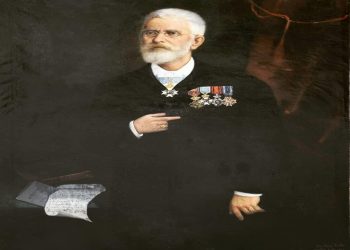
Memorie.al / The second son of Ismail Qemali, the Elder of Vlora and Albania, who served simultaneously as his personal secretary and chief of staff, lived in Struga from 1936 until his death in late December 1953. Living witnesses speak with respect about this figure, this “forgotten” personality in Struga! His adopted children also show special respect. The house where Qazim Bey Qemal Vlora lived and passed away remains functional to this day, in the same condition as it was when Qazim Bey Vlora lived there, but without any proper inscription or sign. His grave was also unmarked until November 27, 1997 – (because it was unknown, forgotten by the people of Struga) – when, thanks to the understanding of the Association of Albanian Historians, Struga Branch, it was symbolically marked.
Continued from the previous issue
WHAT HAPPENED TO THE DOCUMENTATION OF THE CREATION OF THE ALBANIAN STATE?
Unfortunately, even his grave was not marked with any sign or symbol (until November 27, 1997); in fact, most citizens and others in Struga did not know of it and did not remember the location of the grave, even though the year 1953 does not belong to the early middle Ages!!!
To partially repay the debt to this prominent personality of national history, as well as to November 28th itself – Albania’s Independence Day and the Flag Day of 1912 – with the help of the Association of Albanian Historians in Macedonia, Struga Branch, and particularly with the unreserved assistance of the chairman of this Association, Prof. Dr. Nebi Dervishi, along with the local television station “Kaltrina” from Struga, we did everything possible within very complicated circumstances so that on this occasion, on the eve of November 28th, the identification and marking of Qazim Bey Qemali’s grave could finally take place, marking it with a modest stone.
This activity was supported in various forms by many other citizens from Struga and its surroundings, ensuring his grave was marked, albeit with a modest marble stone and an equally modest inscription with the following content: “QAZIM BEY VLORA, 1870-1953… November, 1997, ‘Association of Albanian Historians’ – Struga”.
Regarding the identification, verification, and exposure of Qazim Bey Qemali’s grave, in addition to the knowledge I had from the initiator of this research, Shaban Tateshi, as well as many citizens of Struga and Ohrid who were able to help in identifying and locating the grave, a special contribution and thanks goes to everyone, and particularly to Remzi Qoku (son-in-law of Belul Efendi Kadiu), to whom Belul Efendi Kadiu himself had left a final wish (amanet) to know whose grave it was, who rested there, and to protect and care for it.
On November 27, 1997, finally, the grave of Qazim Bey Qemal Vlora was exposed and marked in the city cemetery of Struga. Present at this event were Prof. Dr. Nebi Dervishi and Zejnulla Qyra from the Association of Albanian Historians, Struga Branch; Prof. Nexhat Mustafa and Dr. Shefqet Pollozhani from the Union of the Albanian Intelligentsia in Macedonia – Struga Branch (U.I.SH.M); Fevail Çorba and Asllan Shate, representatives of the Council of the Jemat from the Muftiate of Struga; and of course, the author of the research and these lines. All of this was recorded on the celluloid film of the local television “Kaltrina” from Struga.
Regarding this modest activity, we also notified the family members of Qazim Bey Qemali in Tirana and the entire kinship of Ismail Qemali. However, on the day this modest activity took place in Struga, activities marking November 28th in Tirana and Vlora reached their peak; therefore, the possibility for the family members of Ismail Qemali and Qazim Bey Qemali to participate was very small, and they were absent. Although they were not present, during the day and evening of November 27, 1997, we communicated with Qazim Bey Qemali’s family members, who were very grateful for this, as they expressed, “deeply humane and patriotic act by the Albanians.”
That evening, in the studio of Radio Television “Kaltrina,” we held a studio discussion with historian Zejnulla Qyra and Remzi Qoku, who greatly assisted in verifying Qazim Bey Qemali’s grave, during which we informed all citizens of Struga and all viewers and listeners that the grave of Qazim Bey Qemali in the city cemetery had been verified, exposed, and marked, showing footage from the activity of placing the modest stone with the equally modest inscription.
We had planned to communicate with Edip Ohri, the eldest adopted son of Qazim Bey Qemali, and Darling Vlora, the great-grandson of Ismail Qemali. The conversation with Edip Ohri took place, while unfortunately; we were unable to establish communication with Darling Vlora due to his involvement in the central manifestation for November 28th in the city of Vlora.
THE WORDS OF EDIP OHRI DURING HIS TELEPHONE APPEARANCE
After we delivered the news regarding the exposure and marking of the grave of his stepfather, the son of Ismail Qemali, Qazim Bey Qemali, on November 27, 1997, via a telephone line during the live broadcast of RTV “Kaltrina,” retired Colonel Edip Ohri, the eldest adopted son of Qazim Bey Qemali, visibly moved, stated: “First of all, I thank you for the phone call, where you informed me and made me happy with this news.
I want to express my gratitude and that of my family and the entire lineage of Ismail Qemali’s family living in Albania, for this deeply humane gesture of yours, of the Association of Albanian Historians, Struga Branch, and the wonderful and patriotic people of Struga. With this action, you have touched us deeply, not only us family members but all Albanians wherever they are, because in this way you have honored the great figure of the patriot and National Hero, Ismail Qemal Vlora. May you be blessed, and we will be forever grateful to you.”
When asked about the figure and personality of Qazim Bey Qemal Vlora, Edip Ohri stated: “Regarding the figure of Qazim Bey Vlora, the son of Ismail Qemali, as you know, Qazim Bey is a personality of special importance in the patriotic and diplomatic activity of his father, the Elder of Vlora, as our Albanian people call him. Ismail Qemali had his sons as secretaries, advisors, bodyguards, and companions wherever he conducted his political activity. This means his sons were educated, knew many foreign languages, and had political and patriotic training.”
Edip Ohri, continuing his first statement, said: “Ismail Qemali had Qazim Bey as his personal secretary, who followed his father on all his diplomatic and political travels and meetings, both inside and outside the country. He was with him in England, Austria, Italy…! He was also with him during negotiations with the heads and leaders of the Patriotic Movement in Northern Albania and Kosovo, along with prominent men in Albania such as Luigj Gurakuqi, Isa Boletini, etc. Qazim Bey was by his father’s side until the last minutes of his life when he died in Perugia, Italy, from poisoning in 1919.
The fact is that Qazim Bey himself was poisoned along with his father, but he survived. He suffered the consequences of the poisoning until the end of his life. Qazim Bey Qemali was a cultured man with a high university education. He pursued his studies at the Faculty of Civil Engineering in Belgium. He mastered several languages: French, English, Italian, Turkish, and others. He was a scholar.
He had a rich library and possessed almost all the documents of the political and diplomatic activity of the Albanian cause carried out by his father, Ismail Qemal Vlora. Unfortunately, during the time of King Zog, and even more so after 1945 during the period of monism in Albania, the high state officials in Albania showed no interest in these documents so important for Albanian historiography.
Furthermore, after 1945, the descendants of the family of the nation’s prominent patriot, Ismail Qemali, were not shown the care and treatment they deserved. The fact is that they ended their lives in complete poverty. Qazim Bey was a good family man, very humane and caring, who took us under his paternal care: two sons and two daughters, my mother, and my maternal grandmother, even though he was in not-so-good material and economic conditions himself. Nevertheless, he showed special care for our schooling and education as honest people and patriots of our country.
He never interfered in our ideological and political views. For him, the primary importance was to be shaped as patriots, to love Albania and the Albanians, and to fight for the complete liberation of Albania from fascist occupiers, and he achieved this fully. Meanwhile, he himself was a democrat with Anglo-French preferences, as the culture he possessed drew him more towards that social system.
Qazim Bey Qemali lived for a long time among the people of Struga, for whom he nurtured great love and respect, as he always said that Struga, Ohrid, Dibra… stood by and remained loyal to his father Ismail Qemali for the Albanian cause at certain political moments. In fact, Qazim Bey Qemali’s brother, Et’hem Bey Vlora, was married in Ohrid to the sister of the prominent patriot Hamdi Bey Ohri – Qoku (Edip Ohri’s aunt, my note M.L.), and like many patriots from our Albanian regions in Macedonia, called by Ismail Qemali, they went to Vlora in 1912 and placed their signatures on the important document of the founding of the Albanian state during the declaration of independence.”
At the end of his appearance, retired Colonel Edip Ohri (adopted son of Qazim Bey Qemali) said: “Thank you, brothers and sisters from Struga, for giving me the opportunity to communicate directly with you, for the great pleasure of congratulating each other on the occasion of the great feast of the Declaration of Independence and our gratitude for the identification and exposure of the grave of the son of the prominent Albanian patriot, Ismail Qemali, Qazim Bey Qemal Vlora. Deep respect and gratitude to you, dear fellow citizens of Struga.”
Although they were not present at this modest activity, during the day and evening of November 27, 1997, we communicated with Qazim Bey Qemali’s family members, who were very grateful for this, as they expressed, “deeply humane and patriotic act by the Albanians.” After his death, the administration of the Municipality of Struga nationalized and expropriated the house in which Qazim Bey Qemali lived, along with the orchard with an area of 9,980 square meters, which it then gave for use and ownership to a family as a form of compensation for the taking of houses and properties for the construction needs of the “Drim” hotel.
The new owner at that time sold this house to another Albanian family, which to this day lives in that house, unchanged in its external appearance. The house is the same as it was during the time Qazim Bey Qemali lived there. Regarding the documentation Qazim Bey Qemali had with him and its disappearance along with the library, in Struga I have encountered numerous accounts and versions that circulated even back then and still circulate today. It is said that when the first owner entered after Qazim Bey Qemali’s death, he first cleared it of all items and things found inside.
It is known from witnesses that it contained a rich library, many books, and many documents. This was confirmed at the beginning of my research by witnesses who, unfortunately, are no longer alive, such as Shaban Tateshi, Remzi Qoku, etc., but it was also confirmed by living witnesses, such as Myzhgjane Qoku, the daughter of Belul Efendi Kadiu, who is one of the witnesses who knew Qazim Bey Qemali most closely. This documentation concerned the activity of Ismail Bey Qemal Vlora and the creation of the independent Albanian state – documentation for which Qazim Bey Qemal Vlora became a prisoner of himself to preserve. “The library was rich and had books in various languages,” the witnesses claim. / Memorie.al