
Part One
Memorie.al / Jusuf Gërvalla: “In the summer of 1966, when a naive portion of Albanians living in Yugoslavia had begun to believe that with the fall of Ranković all evils had vanished, the Party of Labour of Albania issued a detailed analysis proving the opposite. The article we are presenting here has lost none of its relevance today. On the contrary, it remains valid for the current situation in Kosovo and other Albanian territories occupied by Yugoslavia.” (Note: The torture of Shefqet Jashari took place in 1980, at the time when Jusuf Gërvalla was preparing this article for republication – Xh. D.)
Who is Accountable for the Crimes of Genocide in Kosovo?
Article from “Zëri i Popullit,” August 31, 1966
The executioner of the peoples of Yugoslavia, J.B. Tito, and his clique, in order to save their own skin and preserve the system of oppression, exploitation, and terror that is shaking to its foundations, “sacrificed” their closest associate, Ranković. They blamed him for all the faults and burdened him with all the failures, mistakes, crimes, and defeats of the Titist regime to date. With the dismissal of Ranković from all state and party functions in Yugoslavia, an open power struggle erupted within the Titist gang between the Croat-Slovene and Great-Serb clans, backed respectively by imperialists and Soviet revisionists.
This is a clear expression of the deep class and national contradictions that have long plagued and are now collapsing Tito’s kingdom – an expression of the rot, degeneracy, and decomposition of the Titist system. Recent events proved once again that Titist Yugoslavia stands at a crossroads. The betrayal of Marxism-Leninism by Tito’s clique, which turned Yugoslavia into a bourgeois-capitalist state with all its characteristics, inevitably brought division within its ranks, fostering nationalism and chauvinism among its members. Consequently, different national groupings in Yugoslavia attempted to strengthen their positions in the state, economy, and army, each at the expense of the other, with the strongest striking against the weakest.
The path of old national-chauvinist Serbo-Croat rivalries was revived and defined. For over twenty years, the entire national policy of Tito’s clique toward various ethnicities has been characterized by oppression, inequality, and economic and cultural discrimination. Most specifically, the Titists have implemented the most brutal, bloodiest terror, including mutilations and physical liquidation, against the Albanian population in Yugoslavia. The Albanian population’s experience under this enslaving regime and its chauvinistic de-nationalization policy serves as a powerful, undeniable indictment against the police order of Belgrade. Fascist-type persecutions, physical and spiritual torture, and the crime of genocide have been widely perpetrated upon them.
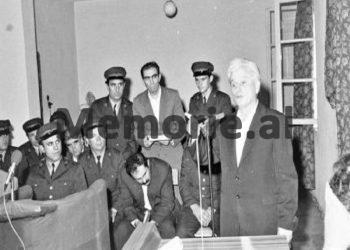
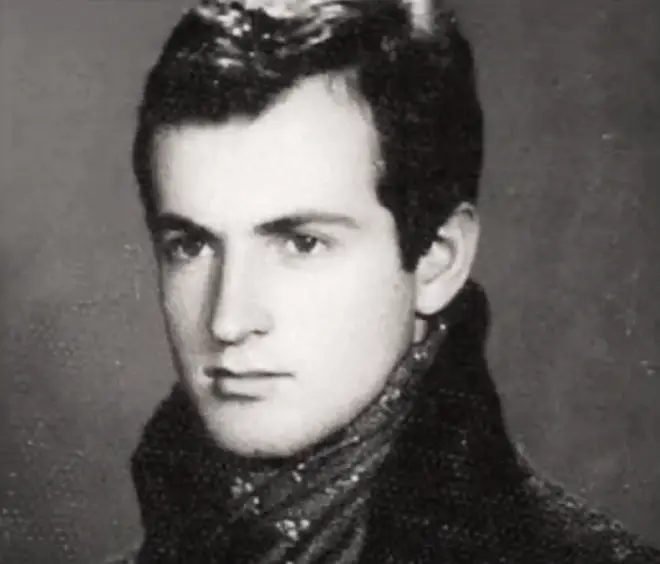
Shefqet Jashari: “The investigations lasted 7–8 months. It is difficult to name all the investigators involved in the mistreatment. Particularly heartless were Asllan Sllamniku, Slavković, and a certain Muharrem. I also had the chance to know Abdullah Prapashtica, who watched as the ruthless Asllan Sllamniku beat my feet with a baton.”
Following the 4th Plenum of the so-called League of Communists of Yugoslavia, Tito’s clique is desperately trying to save the Titist regime from the catastrophe toward which it is rapidly spiraling, attempting to shift the heavy responsibility for this dead-end situation onto the former head of the UDB, Tito’s closest collaborator, Ranković. Throughout Yugoslavia, efforts are being made to better utilize the UDB – this notorious organization of executioners – in the service of the Titist regime by removing, for appearance’s sake, a few overly compromised criminals.
Thus, by Tito’s order, several “purges within the UDB leadership hierarchy” were carried out. Ministers of Internal Affairs were removed in those republics and provinces where the chauvinist policy of national oppression and extermination had been most brutal and where the threat of popular outburst endangered the very existence of the Titist regime. This occurred in Serbia, Montenegro, Macedonia, Bosnia and Herzegovina, and elsewhere. According to Yugoslav press reports, changes were also made in the UDB leadership in the “province” of Kosovo. Those previously responsible for the UDB in Kosovo – Mića Mijušković, Stanislav Gerković, and Sh. Kajtazi – were dismissed and replaced by other UDB “specialists” such as Xhevdet Hamza and Duško Ristić. But the peoples of Yugoslavia are not deceived. Even less so are the Albanian people in Yugoslavia.
This campaign of so-called “purges” is merely a gloss to cover the indelible crimes of the Titist regime and to absolve the Tito-Kardelj-Bakarić clan, which emerged temporarily victorious from the power struggle. It is done, ultimately, to present Tito as a “savior of the situation,” supposedly caring for the re-establishment of “law and order” that was destroyed by the Titist system itself and the fascist UDB agents, who have always acted under the direction of Tito and his clique. But no maneuver can save the Titist clique. The crimes of genocide implemented against the Albanian population of Kosovo, the Dukagjin Plain, Macedonia, and Montenegro are the product of the brutal nationalist and chauvinist policy implemented by the Titist regime.
For these crimes, Tito himself must be held accountable first, along with his entire gang – from the “big sharks” like Ranković, who is stained to the throat with the blood of the Albanian people in Yugoslavia, Kardelj, Bakarić, B. Jovanović, L. Koliševski, and others, down to the smaller ones like Dušan Mugoša, Veli Deva, Xhavit Nimani, Ali Shukriu, Gjoko Pajković, Čedo Mujović, Čedo Topallović, Sinan Hasani, Xhevdet Hamza, etc. The Party of Labour of Albania, consistently grounded in correct Marxist-Leninist principles, has long denounced with the greatest resolve all the hideous crimes that Tito’s treacherous gang has continued to commit against the peoples of Yugoslavia, and particularly against the Albanian population of that state.
We have never interfered and will never interfere in the internal affairs of Yugoslavia. On the contrary, it is Tito’s revisionist clique that has institutionalized interference in the internal affairs of Albania and other countries. For more than twenty years, it has spared no effort in its struggle against the Albanian people, the PLA (Party of Labour of Albania), the PRA (People’s Republic of Albania), and the socialist state and social order established in Albania. Tito’s clique’s interference in Albania, its continuous conspiratorial and diversionary activities, and its alliances with the most rabid enemies of the Albanian people – ranging from fascists, Ballists, Zogists, to imperialists, Greek monarcho-fascists, and Khrushchevite revisionists against the PLA – are now known worldwide. Naturally, all these interferences by Tito’s clique in Albania’s internal affairs have met the resolute opposition of our people and have been shattered by the vigilance and revolutionary unity of the Albanian people, joined with their Party like flesh to the bone.
However, if Tito’s revisionist clique buries with such ceremony and provocative pomposity a known traitor of the Albanian people and the PLA like Panajot Plaku, we have all the more right to raise our voice to protect the vital interests of the Albanian population in Yugoslavia, which lives under the terror of Tito’s clique and the UDB, under the constant threat of de-nationalization and mass extermination. The crimes, murders, and physical liquidation of the Albanian population in Yugoslavia by the Titist clique, along with the policy of their de-nationalization, constitute a systematic line that began in the early days of liberation and has continued with ever-increasing horror to this day. These crimes and this genocidal policy cannot be erased from the memory of any honest person in the world, and even less from the memory of those who have suffered and continue to suffer them daily.
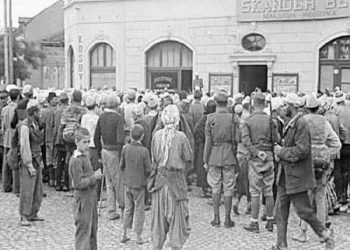
The Albanian population in Yugoslavia will never forget the bitter event of autumn 1944, when the Tito-Ranković gang arrested 10,000 Albanians in Tetovo and executed 1,200 of them without trial, to say nothing of those who died in prisons. Cynicism, brutality, and the rage to exterminate Albanians have always characterized the actions of the Titist bandits. When an Albanian patriot protested to the Titist command regarding these crimes, General Apostolski, and then commander of the First Macedonian Brigade, replied: “This is nothing; it is a cleaning we are doing. Those being killed must be cleared away.” And Vukmanović Tempo, who was present at the time, ordered: “Are you still keeping people in camps? Those you have to clean, clear them away quickly.” This order from Tito’s personal representative was executed with great zeal.
In November 1944, thousands of innocent Albanian peasants were shot on the roads of Macedonia, burned in fires, or intentionally infected and died of typhus. Generation after generation, the Albanian people of Yugoslavia will remember with unrestrained hatred against the bloody Titist clique the Drenica massacre of winter 1944, when Yugoslav divisions, under the pretext of clearing enemy elements, surrounded the liberated zone of Drenica and massacred about 30,000 Albanian men, women, elderly, and children. The Drenica event was a true slaughterhouse, a systematic and organized liquidation of the population of these regions of Albanian nationality. Why and for what purposes did the Titists fall upon the Albanian population like beasts, covering martyred Kosovo once again in Albanian blood? The only fault of this population was its Albanian nationality, and the goal of the Titists has been and remains the extermination of the Albanian population in general. They continue on this path without pause to this day.
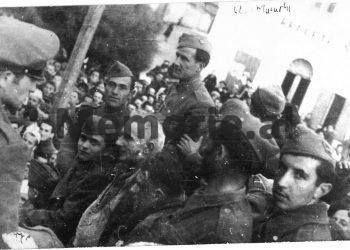
Over 2,000 Albanians in Mitrovica and more than 1,000 others in Gjilan – thousands of Albanians who joined the Yugoslav brigades as partisans to fight the fascists – were shot in the back of the head by order of the Yugoslav headquarters. Hundreds of other Albanians recruited as soldiers by the Yugoslavs were executed during the Prizren-Bar journey. 1,200 Albanian boys remaining from this tragic journey were shot in Bar. In Gorica, Trieste, more than 2,000 Albanians from Macedonia, mobilized in labor brigades, were suffocated with poisonous gases. The physical liquidation of Albanians in Kosovo, Macedonia, and Montenegro was carried out systematically. Data from witnesses and documents show that more than 40,000 people fell by bullet, bayonet, and poison during the years 1944–1948. But this exterminating terror of Tito’s clique against the Albanian people of Kosovo, the Dukagjin Plain, Macedonia, and Montenegro continued even more brutally and organized after 1948.
The Yugoslav revisionist leadership, after the issuance of the Information Bureau resolution in 1948 – which condemned Tito’s betrayal of Marxism-Leninism and the cause of socialism – increased its brutal and comprehensive oppression of the Albanian population of Yugoslavia. During the years 1948–1950, as well as the period 1951–1965, a wave of murders, arrests, and the most inhuman tortures erupted. The Titists use every means to incite fratricide among Albanians, reviving not only old blood feuds but creating new ones through various schemes. To expand these feuds, UDB officers, through their agents, organize the kidnapping and dishonoring of Kosovar girls and women and then incite killings, while the laws, intending to encourage this, provide light sentences. Thus, while in 1965, 41 murders and 74 woundings were committed in the province of Kosovo, in the first six months of this year, there were 26 murders and 46 serious woundings.
But can words express and describe the unprecedented crimes and barbarisms that Tito’s clique committed in the winter of 1955–1956 against the Albanian population during the so-called “action for arms”? To ensure the precise execution of this criminal operation and to lead the punitive operations, Tito himself appointed Ranković. He formed a headquarters assigned with individuals most experienced in barbarism – rabid chauvinists and seasoned criminals whose hands are stained with the blood of the Albanian people of Kosovo. This headquarters was led by Dušan Mugoša, Gjoko Pajković, UDB Colonel Čedo Mujović, Čedo Topallović, Xhavit Nimani, Xhevdet Hamza, etc. The first to suffer the blow of terror was the region of Rugova. The punitive expedition led by UDB officer Bogoljub Redić, under the pretext of searching for weapons, brutally tortured almost all the men of this region.
They beat them to death with batons (a weighted club with a strike force of 70 kg), tortured them with electric current, and left them naked and barefoot in the snow all night. Then they lined them up and forced them into a canal where the water had frozen due to the extreme cold, which exceeded 15 degrees below zero. In the same manner, tortures and massacres continued in Junik of Gjakova, Deçan of Peja, Suhareka of Prizren, Llap of Pristina, Vushtrri, Drenica, Mitrovica, etc. Shefqet Jashari: “The investigations lasted 7–8 months. It is difficult to name all the investigators involved in the mistreatment. Particularly heartless were Asllan Sllamniku, Slavković, and a certain Muharrem. I also had the chance to know Abdullah Prapashtica, who watched as the ruthless Asllan Sllamniku beat my feet with a baton.”
“In a single night,” recounts Kosovar emigrant Brahim Rexh Binaku from the village of Drenoc in the Gjakova district, “the UDB took 34 of us men from Drenica and gathered us in the tower of Shaban Ibishi. During the night, UDB officer Drago Kilević, with four Serbian militiamen, beat us one by one in the rooms of this tower with a rubber hose filled with metal pieces, with kicks, fists, rifle butts, and wood. After this, every three or four days, the UDB interrogated each of us, asking what we had done 20 years ago.” Emigrant Din Sadrija from Istog of Peja stated: “In the village of Dubovc, the UDB committed terrible tortures under the pretext of searching for weapons. These took place at the militia post. From the 50 houses in the village, 50 men were tortured for 5 consecutive months.” Many among them were killed or maimed as a result of the torture. / Memorie.al
(Article from the newspaper “Zëri i Popullit,” August 31, 1966. This article, under the care of Jusuf Gërvalla, was reprinted in the newspaper “Bashkimi,” Organ of the “Popular Red Front,” January 1981, page 4).
To be continued in the next issue