

Part One
-SHKREL AND ITS ROLE IN THE ANTI-COMMUNIST UPRISING OF MALËSIA E MADHE, IN 1945-
Memorie.al / As per Frederick Douglass, “The truth is uniform and beautiful in all times and places.” But unfortunately, this truth was the opposite in our Mother State and in other Albanian lands, under Greek chauvinist and Slav-communist-Yugoslav rule. Historical truth has not only been denied and left in darkness but has also been inexcusably distorted. For example, the document of the Proclamation of Albanian Independence in 1912 was falsified by the historiographers of the Academy of Sciences of the Socialist People’s Republic of Albania, covering the signatures of Mid’hat Frashëri, Lef Nosi, and Mustafa Merlika Kruja.
At the same time, those who had the courage to speak write, or act the truth were punished with imprisonment or killed with or without trial by the communist rulers. What is even more shocking is that even today; the politicization of our national historiography is being repeated. The greatest struggle that continues in the Academy of Sciences in Albania is the complete publication of the “History of the Albanian People,” because the same “historians,” who until yesterday used different epithets against distinguished figures and elevated figures like Haxhi Qamili and his comrades to the altar of the Nation, it would be a paradox for them to deal with the third part of history, covering the years 1913–1939, and the fourth part, covering the years 1939–1991.
Therefore, we have a great moral duty, before ourselves, before the nation, and before historical truth, to speak the truth. And here I use the words of Edward Schillebeeckx, when he said that; “Historical impartiality is not the reconstruction of facts of the past, but it is the truth of the past, in the light of the present time.” In this context, every person who loves and supports historical truth has the right, for the sake of truth, to express this fact as a reality without denial, exaggeration, or illustration.
For these men of the heroic mountains of Malësia e Madhe, who have united us today in this seminar for the Stoic Resistance of Mount Kelmend, led by the lion of this region, Prek Cali (Hasanaj-Vermosh), who dedicated his entire life to the pan-Albanian cause, along with the heroes; Gjergj Lul Toma (Gjeloshaj-Selce) and Gjek Marash Selca (Tinaj-Selce), distinguished for their wars against communist forces throughout all parts of Albania, and for the anti-communist uprising of Malësia e Madhe in 1945, led by Major Llesh Marashi of Shkrel – the first one in the entire Communist Bloc – we, their sons and daughters, have the responsibility to present the historical reality as it is. These men, who taught us how to live, fight, and die for the good of the Fatherland did not seek wealth, praise, songs, dinners, or various rewards.
They only answered the call of the enslaved Mother Albania, a call inherited from their ancestors! Therefore, what they sought and deserve is not their “rehabilitation”! They did not commit any sin against the fatherland; on the contrary, they took up the weapons of freedom, for the defense of Albania, generation after generation. Even though born and raised outside the mother state, and as an autodidact of Albanian, I am a son of these lands. Consequently, this communication entitled: “Shkrel and its Role in the Anti-Communist Uprising of Malësia e Madhe in 1945,” is for me like the beautiful and meaningful American phrase: “A labor of love.”
What was Shkrel? And who were the Shkrel people?
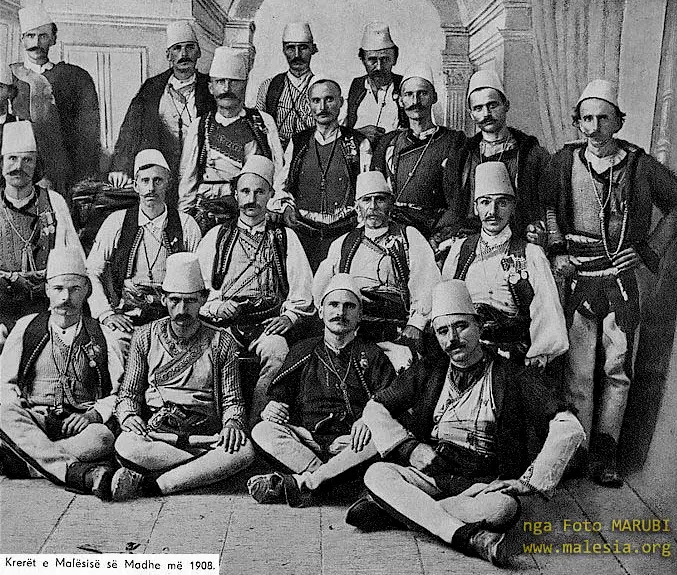
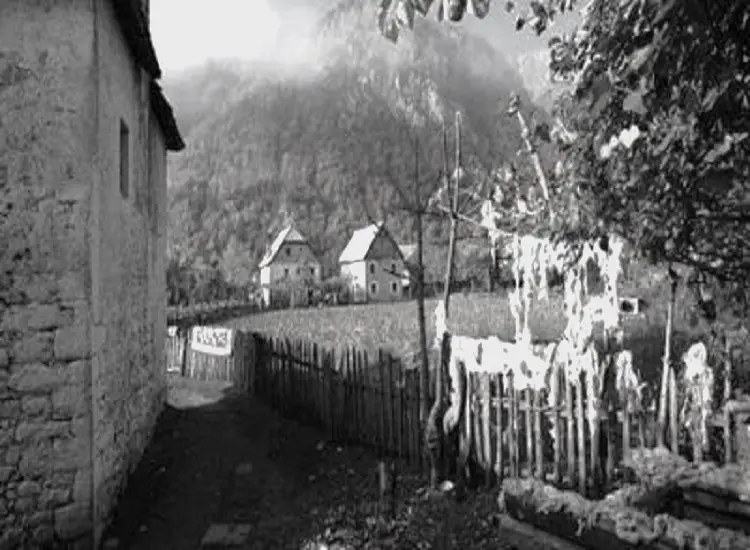
What was Shkrel? And who were the Shkrel people who, with all of Malësia e Madhe, had the courage to take up arms against the new communist ruler? Historically, Shkrel, as an ethno-geopolitical, economic, and social region, belongs to Malësia e Madhe and is ranked as the fifth mountain (tribe), after Hoti, Gruda, Kelmend, and Kastrat. These five mountains, together with the bajraqs (banners/clans) of Reç, Lohë, Koplik, Grizhë, Rrjoll, and Postribë, constitute the Malësia above Shkodra. Also, Triepshi with Koja (which the Congress of Berlin, 1878, unjustly severed from the vilayet of Shkodra and gifted to Montenegro) belongs to the Malësia above Shkodra. Geographically, Shkrel is separated by the Prroni i Thatë (Dry Stream) and borders to the north with Bogë-Kelmend, to the east with Dukagjin, to the south with Koplik, Reç, and Lohë, and to the west with Bajzë and the village of Kastrat. Thus, Shkrel stretches lengthwise from the Qafa e Grishajve of Zagora, to the tower of the Duçajs of Bzhetë.
Malësia e Madhe, in general, has a glorious history in defending the national interests of ethnic Albania against Ottoman-Turkish and Serb-Montenegrin-Yugoslav rule. As part of this mountainous region of Northern Albania, Shkrel was inseparable from these lands of Malësia e Madhe in the bloody battles against foreign occupations. For example, in 1614, Shkrel, Hoti, Kelmend, and other tribes formed an oath against the forces of Turkey. In 1621, Monsignor Pjetër Budi organized the uprising against Turkey, in which Shkrel also participated. Again, in 1645, Shkrel and Kelmend, in a joint resistance, forcefully expelled the Ottoman forces and gained a certain freedom until 1700. In 1835, Dasho Shkreli and Hamza Kazazi were the leaders of the anti-Ottoman forces of Shkodra city.
Also, in 1840, Dasho Shkreli and his çeta (band) participated in the battle of Shpuzë Castle against the predatory force of Montenegro, where Dasho Shkreli and his brother Sefa were heroically killed. In the battle of Kërnicë in 1862, the Shkrel people along with Shkodra participated against the Montenegrin forces, where Kaso Shkreli, Dasho Shkreli’s brother, was also killed. Likewise, when the Catholic part of Shkodra was persecuted by the Ottoman army, it was Shkrel that went to the aid of the Catholics, with more than 250 men. Even in the Albanian League of Prizren, 1878–1880, the standard-bearer of Shkrel, Marash Dashi, participated along with all the other leaders of Malësia e Madhe, and they signed various requests against the annexation of Albanian lands by Montenegro. During 1883, an alliance was formed between the men of the tribes of Shkrel, Kastrat, Hoti, and Gruda, to stop the bargaining of international commissions, ongoing with Montenegro, for the looting of Albanian territories.
The formation of the “Shkrel League” (“National Union” or “Secret League”) in 1893, by the parish priest of Shkrel, Dom Ndoc Nikaj, along with the Abbot of Mirdita, Monsignor Preng Doçi, Dom Mark Shllaku, Dom Zef Shkreli, Dom Jak Serreqi, Dom Dodë Koleci, and others, for our national liberation, unity, and education. In 1911, upon the initiative of Nikollë Mirash Luca and Gjelosh Gjoka, a new alliance (besëlidhje) was made between Shkrel and Kastrat, in the house of Zef Mirash Shyti, in Dedaj-Shkrel. From there, they went to Bzhetë, to Tomë Nika of Shkrel, and together with Tomë’s two sons, Nikollë Mirash Luca and Gjelosh Gjoka, they set out for Bogë, Reç, and Lohë, creating the alliance to fight the Turkish occupier. In the uprising of Malësia e Madhe, led by the legendary hero of Traboin, Dedë Gjo’Luli, the Shkrel people not only participated in the bloody battle on the peak of Bratila, but also had Tomë Nika as one of the main leaders of the uprising, and a signatory of the Memorandum of Greçë.
It would be a great historical distortion and gap not to also appreciate here the irreplaceable help of the spiritual shepherds of these heroes, meaning the Catholic Clergy, which was and continued to be always side-by-side with their faithful, such as the priest of Shkrel, Dom Nikollë Ashta, along with the parish priests of Kastrat, Hoti, Gruda, and Kelmend. After a brief resistance by Shkrel on May 25, at the hill of Sterkuje in Dedaj, the army of Shefqet Turgut Pasha set Dedaj and Zagora on fire, and as revenge against the insurgents, they plundered and set fire to all of Malësia e Madhe. When Ms. Edit Durham personally went to see the damage in Bajzë-Kastrat and Shkrel, she used the biblical words that describe the catastrophe in the Shkrel valley as; “the valley of the shadow of death” (Psalm 23:4). Kastrat then issued a call to arms, and Shkrel showed solidarity with them as inseparable brothers, fighting bravely in the hills of Mokset of Bajzë, Kastrat, against a large Ottoman force.
Also worth mentioning is the Memorandum of the Hierarchy of the Albanian Catholic Church, of July 2, 1919, sent to the leadership of the Peace Conference in Paris, against the partitioning of Albanian lands, where the signature of the parish priest of Shkrel, Dom Frano Karma, is attached, along with the signature of the standard-bearer of Shkrel, Vatë Marash Dashi, with all 106 heads of Shkrel families. In the Battle of Koplik (1920–1921), it was Vat Marash Dashi who led Shkrel against the intervening Serb-Montenegrin-Yugoslav army, which occupied Koplik, Shkrel, Kastrat, and Kelmend. Also, the heroes of Shkrel whom our national poet, Father Gjergj Fishta, O.F.M., immortalized in his rhapsodic verses, in the epic work ‘The Lute of the Highlands’ – (The Bible of Albanian Nationalism)! These were: Kacel Doda and Kerrni Gila of Zagora, Bajraktar Marash Dashi, of Vrith, the brothers Bec and Cul Patani, of Bzhetë, and Rrushman Hasani.
In addition to these men, we must also mention some of the priests who served in the parish of Shkrel and became distinguished prelates, such as; Monsignor Luigj Bumçi and Monsignor Gjergj Volaj; Monsignors Ndoc Bozhi and Nikollë Ashta; and the intellectual clerics, such as Dom Ndoc Nikaj, Dom Aleksandër (Lek) Sirdani, Dom Kolec Prenushi, Dom Ndre Zadeja, and Dom Nikollë Gazuli. And we must not forget the fact that the meetings of the Albanian leaders for the defense of Albania were held in the church yard. Generally, historical events do not occur independently of themselves, but they are interconnected reactions to other events. Therefore, to understand the complexity of the anti-communist uprising of Malësia e Madhe, I am obliged to present a link between international, national, and regional events, to reach a true historical understanding.
Immediately after the occupation of Albania by Fascist Italy, Llesh Marashi fled Shkodra and went to his village, Zagore-Shkrel, against the occupier, where his Shkrel locals sheltered him. Also, in Llesh Marashi’s Zagora, his fellow idealists, Dom Zef Sheshtani, Dr. Bahri Kopliku, and Zef Logoreci, were anti-fascist activists. In general, the resistors against the new occupiers were distinguished nationalists and intellectuals. One of these, Mid’hat Frashëri, the founder of the ‘Balli Kombëtar’ (National Front), stood out, who not only wanted the liberation of Albania but also the unification of all its territories under a democratic government. Some small communist groups, which were scattered throughout several cities, did not take an active part against the fascist invasion until Nazi Germany militarily attacked the Soviet Union in 1941, and this was done with the organization of two Yugoslav emissaries, Miladin Popoviç and Dushan Mugoša, who united the groups under a single Albanian Communist Party, but always under Yugoslav influence.
On July 30 and 31, 1943, the Battle of Reç erupted (until now completely appropriated by the Enver regime), but the truth is that the overwhelming majority of the fighters were nationalists, such as; Jup Kazazi, Llesh Marashi (with his çeta), Zenel Kazazi, Ujk Tahiri, Zef Ashta, Rrok Kanto Marashi (Llesh Marashi’s nephew), Caf Smajli, Zef Luka, Sokol Bajrami, Metë Rrustemi, Brahim Bishja, Rexhep Lani, Lan Sokoli, Halil Sokoli, Ramë Meti, Qamil Tahiri, Fejzi Boriqi, Isuf Muça, Shaban Binaku, Oso Bishja, Ragip Meta, Sali Myftia, Daut Komi, etc. The deep penetration of Slav-communist influence was confirmed after the pressure that Svetozar Vukmanović-Tempo exerted on the Albanian Communist Party. Immediately, Enver Hoxha denounced the Mukaj Agreement (August 2–3, 1943), between the delegation of the ‘Balli Kombëtar’ and the National Liberation Movement, only because the nationalists requested these conditions: 1) – A joint war, 2) – War for an independent and ethnic Albania, and 3) – War for a free, democratic, and popular Albania. And here, everything was separated between them. In September 1943, with Yugoslav instigation, the civil war in Albania began with a fierce military attack against the ‘Balli Kombëtar’, and then, against the forces of Abaz Kupi (Legality), as well as other nationalists.
After the capitulation of Fascist Italy, the National Liberation Front sent Riza Dani, along with Professor Mark Prela, to meet with Llesh Marashi, inviting him to join the Anti-Fascist Movement. Lleshi replied with these words: “This is something that cannot be done, men. Don’t you have eyes in your heads, and can’t you see how the communists are playing theater with you?! Don’t you see that they are led by the Serbs?! Come to your senses and return to the path of nationalism, because the internationalists will cut off your heads! Nothing connects you to them.” Rizaj cuts him off; “It’s good that you fought fascism, but what do you expect from the Germans? Why don’t you fight them?” Lleshi replied; “The German army is transient, and it won’t harm us. But this army is fighting the Slav, and we have something to gain from it.” (This conversation is recounted by Mërgim Korça, a testimony from his thesis, Riza Dani’s wife).
We are in 1944. The end of World War II was bitter, because the victory of the communists was completely clear. Since Northern Albania, with its capital of Teuta and Gent – Shkodra, had suffered during the centuries-long battles with the Serbo-Montenegrins, this part of Albania understood that the communists were indoctrinated with the Bolshevik ideology, which was not only foreign but also Slavic. On May 13, at the “Rozafat” Cinema, 152 representatives of Malësia e Madhe, Dukagjin, Postribë, Ana e Malit, Gur i Zi, Nën-Shkodra, etc., gathered in Shkodra and created the “League of Shkodra,” against the Slav-Albanian-Communist danger.
Malësia e Madhe, with the other regions of Northern Albania, was organized for an attack against communism. The leaders of Shkrel were these: 1) Major Llesh Marash Vata (Marvukaj-Zagore), Circuit-Commander of Shkodra and the Chief Commander who would lead the Uprising of Malësia e Madhe. His family was the most distinguished in all of Malësia e Madhe for military preparation. Of Marash Vata’s six sons, three of them, Kanti, Gjeka, and Lleshi, became officers, while another, Pjetri, was a reserve officer. Also, two nephews, continuing this family tradition, became officers, Fran Pjetër Marashi and Vat Gjelosh Marashi. Rrok Marashi was ordained a friar, and his nephew, Ndoc Gjelosh Marashi, a priest. 2) Pjetër Gjokë Deda (Milaj-Vrithe), deputy bajraktar of Shkrel, brave, loyal, and wise, charismatic, and a member of Llesh Marashi’s staff; 3) Nikollë Prekë Gjeka (Dedaj), chairman of the Shkrel commune, educated and known as an orator, courageous, brave, and loyal. 4) Prekë Lekë Gjoni (Kolaj-Zagore), one of the most select young men of Shkrel, brave, loyal, handsome, and a worthy fighter against Communism. 5) Luket Marash Luca, baptized Lukë, (Grishaj-Zagore), known in Malësia and Shkodra, and who participated at a young age in the Malësia Uprising, in 1911, and in the Battle of Koplik.
He was a people’s teacher. Also, in 1932, he participated in the delegation of the heroes of Malësia e Madhe, before the Holy Father, Pope Pius XI, at the Shrine of Our Lady of Shkodra, in Genazzo-Italy. Together with these brave men, the scholar, polyglot (who mastered five foreign languages), religious man, patriot, and founder of regional and onomastic lexicography, Dom Nikollë Gazuli, who was the parish priest of the Deanery of Malësia e Madhe – the Church of Shkrel, also participated in the organization of the uprising.
During the autumn of 1944, the leaders of Kastrat, Gjon Martin Lulati (Ivanaj-Bajzë), Mirot Palok Kokaj (Ivanaj-Bajzë), Nikë Gjelosh Gjokë-Dodaj (Pjetroshan-Bajzë), Kolë Llesh Malaj (Ivanaj-Bajzë), Kolë Ujk Asllani (Pjetroshan-Bajzë), etc., along with Vasel Pjetër Gjoka, who was a collaborator of Nikë (his cousin), and with the leaders of Shkrel, were in agreement to avert the danger that threatened the entire Albanian people. Their frequent meetings took place in the house of Luket Marash Grishaj, one of the centers for discussions between these two tribes.
In the village of Ivanaj in Bajzë, on December 24, 1944, in the house of Gjokë Tomë Kokaj, the meeting of the leaders of Kastrat took place (says Vasel Pjetër Gjoka), where the leaders of Shkrel also participated, and where they all formed an oath (besa) to fight communism. At the end of December, Llesh Marashi left Zagore and went to the village of Brojë, to meet with the leaders of Kelmend, such as; Kolë Gjon Bajraktari, Franë Gjergj Uçi, Gjergj Lul Toma, Gjekë Marash Selca, etc. There they decided that; Selcë, Nikç, and Vukël would stop the rush of Mehmet Shehu’s First Assault Brigade. And on January 15, 1945, the bloody resistance of the heroes of Kelmend began, against the rabid communist beast.
While Kelmend fought heroically, with unprecedented resistance, the Assembly of the Mountains was set in Poicë, in the village of Dedaj-Shkrel, in the house of Rrok Nikollë Zefi, three days later (on January 18, 1945), to set the date for a general attack. Those who participated were: Llesh Marashi with his staff, Marash Kolë Mali (Vojvoda of Dedaj), along with his kumbar (godfather), Nikollë Zefi, Luket Marash Grishaj, Pal and Dedë Thani from Dukagjin, Gjelosh Luli, Pjetër Gjokë Bajraktari, Nikollë Prekë Dedaj, Dom Nikollë Gazuli, Gjon Martin Lulati, Mirot Paloka, and Caf Smajli, with some people from Lohë. For unclear reasons, the representatives of Shkodra and Postribë were absent, although not only Malësia e Madhe but also Shkodra, Postribë, and Nën-Shkodra were in cooperation with Llesh Marashi for an armed uprising. After the gathering, Llesh Marashi and his comrades left for Grishaj, to Luket Marashi, and some to Cukaj, to Zef Nikë Colaj and Gjergj Prelë Colaj, where they stayed until the shooting erupted, before the appointed time, on January 23, 1945.
The Commander of the Bajzë Post-Command, Jonuz Naçi (Aliaj-Bajzë) gave the order to send a platoon of partisans to Grishaj-Zagore, to arrest Luket Marashi, who had been under the communists’ surveillance for a long time, under the command of Gjosh Nika (Vuçetaj-Bajzë), who climbed the ridge of Jeran, towards Grishaj. There, the local shepherds had been instructed by Luket to report any movement made by more than five or six people. When the partisans arrived at the end of the Jeran ridge, the shepherds quickly went to inform the nationalist Staff that the communists were climbing the mountain, towards Grishaj.
Immediately, Llesh Marashi notified the fighters to get ready, to leave where they were in Grishaj and go to Cukaj, to join the other comrades, and from there, to set off for Poicë. When the Staff gathered in Cukaj, they discussed briefly, as time was pressing. And a disagreement arose regarding the direction; where should the Staff go? Some said: “Better to Stol,” while others: “Better to Poicë,” which was proposed by Llesh Marashi himself. In the end, the brave men Gjon Martin Lulati and Mirot Paloka insisted that; we will not turn back from the communists, and that they would start the shooting. They set up ambushes in the strategic location from which the partisans would come to Grishaj.
Llesh Marashi and Luket Marashi disagreed with this idea, saying that the attack was five days too early, but the overwhelming majority decided, “Either today, or never!” And so it happened. The partisans reached Grishaj and surrounded the houses. Gjosh Nika with three soldiers approached Luket Marashi’s house, and the first words he said were: “Is Luket Marashi here? Where is he?” His uncle, Franë Luca, thinking that the Staff had fled from Cukaj, replied: “Luketa is not at home, but perhaps he is with our friends in Cukaj.” Gjosh then sent Franë Luca, with two partisans, to Cukaj. As Franë Luca left with them, the partisans discovered the insurgents’ guards, and at that moment, the shooting erupted. Memorie.al