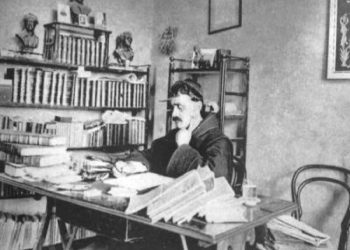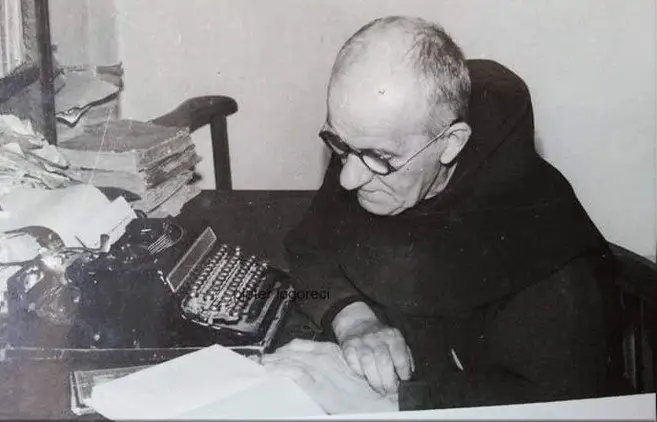

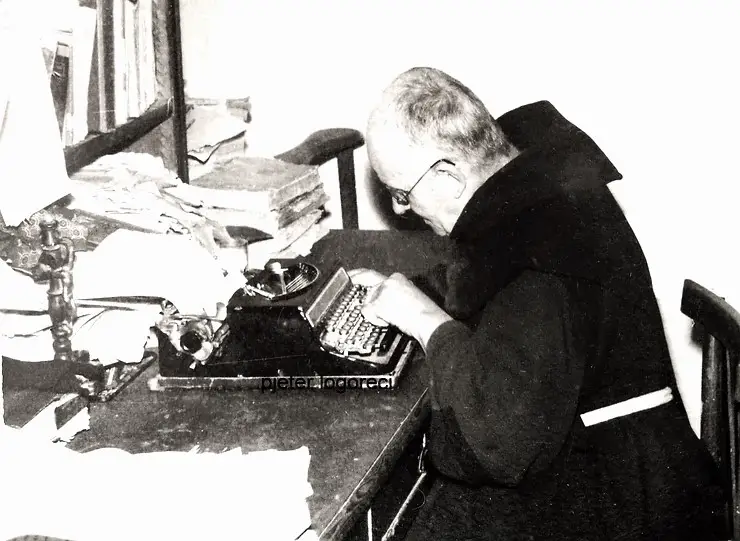
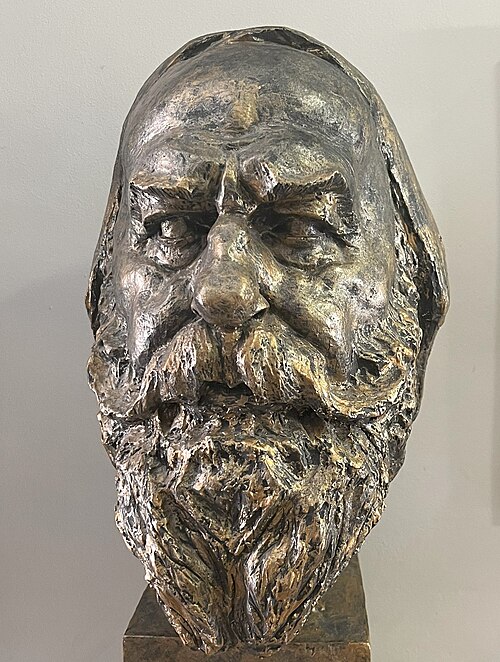
Memorie.al / Justin Rrota, a distinguished personality and scholar of Albanian culture and letters, was born in Shkodër, on February 17, 1889. He was an eminent researcher and cultivator of the Albanian language and Albanian studies. His scientific activity spans nearly half a century, fulfilling his duties as a cleric, a genuine scientist, and a teacher of the mother tongue. Rrota lived in solitude for more than 20 years, awaiting death, exhausted and ill in a convent in the city of Shkodër, until he passed away on December 20, 1964, at the age of 75.
From his life…
Justin Rrota, this personality of Albanian letters, was born in Shkodër, on February 17, 1889, 120 years ago. He was an eminent researcher and cultivator of the Albanian language and Albanian studies. His scientific activity spans nearly half a century, fulfilling his duties as a cleric, a genuine scientist, and a teacher of the mother tongue. Rrota lived in solitude for more than 20 years, awaiting death, exhausted and ill in a convent in the city of Shkodër, until he passed away on December 20, 1964, at the age of 75. The most active part of Rrota’s life was filled with research and publishing activities, although not all of his manuscripts were published during his lifetime, such as his major work “Gjuha e shkrueme” (The Written Language).
Justin Rrota completed his early education in Shkodër, while he pursued higher education in Theology in Villach (Carinthia), Austria. At the age of 22, he was ordained a priest, initially serving as a parish priest in Plan, Dukagjin. Justin Rrota possessed a classical and modern philological culture. He knew several languages, such as Italian, French, German, Slavic, but also some dead languages, like ancient Greek and Latin.
The Franciscan church hierarchy, seeing Rrota’s intelligence, appointed him a professor in Troshan and after 1921, at the “Illyricum” gymnasium in Shkodër. But the cleric-professor also distinguished himself as a skilled teacher, an indefatigable researcher, publishing articles and scientific studies under the pseudonyms “Iris”, “Patër Ndou” (Father Ndou), and “Viator”. Initially, Rrota published his first writings in the magazines “Zani i Shna Ndout” (The Voice of St. Anthony) and “Hylli i Dritës” (The Star of Light), which belong to the disciplines of linguistics and literature. He is among the first publishers of textbooks for secondary schools.
In 1940, the Institute of Albanian Studies in Tirana elected him as a member in the capacity of a language cultivator. In the later period, Justin Rrota’s scientific activity declined, as a consequence of the communist regime coming to power and the serious illness that had troubled him for years. After 1990, with the overthrow of the regime in power, his work was recognized, awarding him the title “Teacher of the People” (1994) with this motivation: “A devoted and passionate teacher. He worked with dedication, making a distinguished contribution as a linguist and researcher.” A year later, in 1995, he received another title, “Distinguished Worker of Science and Technology.” The University of Shkodër “Luigj Gurakuqi” also honored him with the title “Professor of Honor” (1994).
Scientific and Publishing Activity
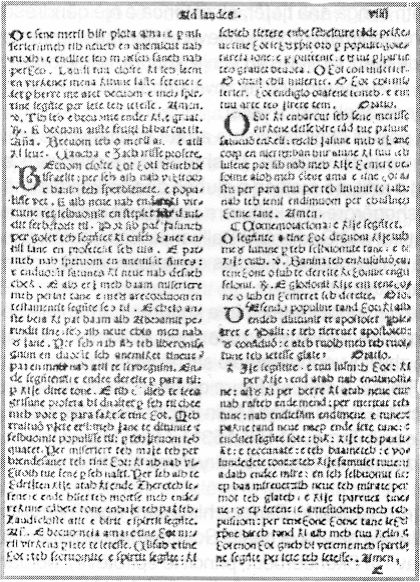
It encompasses several fields of knowledge, but mainly from the field of linguistics and literature. Justin Rrota is also the author of several textbooks. The author paid special attention to the study of the language of Gjon Buzuku and other old authors. He was the first to bring to Albania the photocopy of the first Albanian book, Gjon Buzuku’s “Meshari” (The Missal), 20 years after its rediscovery by Pal Skiroi, and it would take another 40 years to make its transcription by Prof. Eqrem Çabej and to publish it in 1968. It is precisely this scholar, Eqrem Çabej, who would appreciate Rrota for his contribution to the affirmation of this work. According to the author, Rrota “greatly helped among us in the dissemination and recognition of this linguistic monument.”
This interest of Justin Rrota, who at that time was 40 years old, would be accompanied by the publication of the study “Monumenti ma i vjetër i gjuhës shqipe D. Gjon Buzuku 1555” (The Oldest Monument of the Albanian Language D. Gjon Buzuku 1555), selected and commented pieces for secondary schools (Shkodër, 1930), which he reprinted with slight changes from the first in 1938. Although not large in volume, Rrota found space to raise quite important issues regarding the author of the “Meshari” and his work, some of which, even today, have not found satisfactory and acceptable solutions.
He returned to this topic, which he held dear, after a few years, publishing the article “Hulumtime dhe shënjime mbi Gjon Buzukun” (Research and Notes on Gjon Buzuku) (BSHSH Tirana, 1956, no.3) and raising again debatable issues, but emphasizing again that idea expressed 20 years earlier, that the author of the Missal “was an Albanian Catholic priest, an authentic Gheg.” For Justin Rrota, Gjon Buzuku was a highlander from Kraja, a locality west of Lake Shkodër, thus rejecting other versions about the work and its author.
Through an article published in the magazine “Nëntori” (1955), Rrota informs the reader about the work he did for the first-time photographing of the first work of the Albanian language, “Meshari”, bringing three copies to Albania, which served researchers in their work on Gjon Buzuku’s work. One year before his death, in the Bulletin of the State University of Tirana (1963, no.2), he published a short article entitled “Pasthirrmat buzukiane ‘hinje’ dhe pjesëza toskënishte ‘tuke'” (Buzuku’s Interjections ‘hinje’ and the Tosk Particle ‘tuke’). His interest in the life and work of old authors was early. In the volume “Shkrimtarët shqiptarë” (Albanian Writers), 1941, he treated writers starting from the first documents, continuing with Buzuku, Budi, Bardhi, Bogdani, the Kuvendi i Arbënit (Council of Arbën), etc.
Another study, published as a separate volume, was dedicated to the first author of Arbëresh literature, titled “Shkrimtari ma i vjetri i italo-shqiptarëvet, D. Luka Matrënga (1592)” (The Oldest Writer of the Italo-Albanians, D. Luka Matrënga (1592)), Shkodër, 1931, which he reprinted 8 years later. He followed the same method as he did with Buzuku and his work, accompanying it with written texts and comments. Justin Rrota’s studies on old authors and their work, and in particular on Gjon Buzuku, retain their value in some directions even today and should be taken into consideration.
On the History of the Albanian Language Alphabet
Another problem that Justin Rrota touched upon and studied was that of the history of the Albanian language alphabet. He began such work by publishing several writings on this subject in the magazine “Hylli i Dritës” from 1931-1936 and summarizing them in a separate volume in 1936 under the title; “Për historinë e alfabetit të gjuhës shqipe” (On the History of the Alphabet of the Albanian Language). Justin Rrota’s contribution in this field has been significant and valuable, entering the history of the Albanian language alphabet as the first author to publish such a history. There were subjective and objective factors that prompted him to undertake such a work.
Shkodër and the patriots of this city had distinguished themselves in their efforts to solve this problem from the second half of the 19th century until the Congress of Manastir (1908). This meant that out of the 32 delegates with voting rights, who participated in the Congress of Manastir, 5 were from Shkodër and each of them, especially Gjergj Fishta, Luigj Gurakuqi, Ndre Mjeda, and Hilë Mosi, distinguished themselves for particular contributions at the Congress, being elected to important forums of this assembly. And this tradition, even today, would be continued by Shkodër-based researchers, publishing studies and monographs on this topic.
Justin Rrota began writing on this topic to respond to the desire and interest that Albanians had in solving the issue of a unified alphabet for the Albanian language. The author had gained the necessary authority as a researcher, so the interest was not insignificant, so much so that even today it is considered a scientifically valuable work. It spanned five centuries, covering 22 authors and societies. This was not an easy task, as it involved dealing with their graphic systems, letter by letter, to distinguish their values, weaknesses, and influence. Such work could only be done by a researcher with solid philological training. Rrota’s study was not long, but he set clear benchmarks for many debatable issues in the history of the Albanian alphabet.
The object of the study was clear. The author would begin the work with the first documents of Albanian writing and would continue until the final resolution of this problem at the Congress of Manastir in 1908. He was a scientist, so he also raised problems. For Rrota, the first document of Albanian writing was the “Pericope of the Easter Gospel,” a debatable thesis, as there has been a different ordering in later studies. More acceptable to us is such an ordering of the first documents: 1. ‘Formula e pagëzimit’ (Baptism Formula) (1462) 2. ‘Fraza e mallkimit’ (Curse Phrase) (1483) 3. ‘Pericope of the Easter Gospel’ (15th-16th cent.) 4. ‘Fjalori i von Harffit’ (von Harff’s Dictionary) (1497).
Then the author continued in chronological order to discuss authors and societies that dealt with this problem. Although several decades have passed since the publication of this study, the contribution was valuable because he knew how to objectively and with scientific accuracy present the work done in this field, opening a path that other researchers would follow.
Thoughts on the Common Albanian Language
Since the Renaissance onwards, but particularly Albanian society has been concerned with the resolution of a common language, as several issues of Albanian culture were being resolved. Many personalities in the press of the time gave opinions, also proposing the path to a solution. But this problem was discussed with particular seriousness in the ‘Albanian Literary Commission’, held in Shkodër during the years 1916-1918. It accepted the dialect of Elbasan as the main basis for the common language, as it would also serve as a bridge between Gheg and Tosk.
But this issue was not considered completely resolved by some intellectuals. For this reason, many writings on this topic began to be published in the press of the time. A little over ten years after the ALC, J. Rrota published the article “Rreth problemit të gjuhës letrare” (Around the Problem of the Literary Language). It is a valuable article not simply because it raises an important, acute problem for that time and later, but at the same time it showed Justin Rrota’s philological preparation. From the beginning, the author appreciated the stance of the Albanian people and the Albanian language, which did not manage to be assimilated but preserved with fanaticism what they inherited from our ancestors: the Albanian language. The author also addressed another issue, the introduction of foreign words into the lexicon of the Albanian language, explaining the factors that influenced it. But his preparation enabled him to distinguish internationalisms from foreign words.
He also noted at that time that some feared the cultivation of the language, although he drew attention to the fact that until that time a common language had not been used, “but a dialectal language according to the region to which the writer belonged.” Therefore, he advised that we should not write Albanian “carelessly, kneaded and unkneaded.” He always emphasizes the idea that a common literary language should be adopted. Rrota was not a localist. He wanted us to accept the best of any region for the common language. And this is achieved “only by giving in to one another,” but preserving the dialect. Another issue raised by Rrota regarding the common language was the stance towards the language of the old authors.
Although he knew well the language of their work and its values, he did not accept that some of their forms should be generalized, as he considered them archaic. For the author, language develops and progresses. He accepted the dialect of Elbasan, which was in the center of Albania, as the basis for the common language. For Rrota, the resolution of the common language was related to the cultural development of a people, and thus for Albanian as well. The author did not accept the resolution of this problem by a group of people who might form a commission or academy since, “the treatment of the literary language should not be a violent thing.” This problem, according to the author, “will come naturally and each one will go along accepting in their writing those correct methods, used by the most diligent.”
Justin Rrota also dealt with problems of morphology, syntax, and historical syntax, where he particularly focused on the ablative case in the study “Analyzimi i rasavet t’emni te zhvillimi historik i tynvet” (Analysis of Noun Cases in Their Historical Development) (1931). Also of interest is Rrota’s article “Mbi refleksin e vlerën fonike të disa tingujve të latinishtes në shqipe” (On the Reflex and Phonic Value of Some Latin Sounds in Albanian) (1965). A valuable work not only in the field of school textbooks but also of syntax in general was “Sintaksi i shqipes” (Syntax of Albanian) published in 1942 and reprinted in 1943.
This was a text elevated both scientifically and methodically, and it stood out from its predecessors for its high level, which allowed it to endure for several years. This work places Justin Rrota among the best syntacticians of our country for the period in which he wrote. But Rrota’s most important work, which he left in manuscript, is entitled “Gjuha e shkrueme ose vërejtje gramatikore” (The Written Language or Grammatical Observations), which for a long time remained in the archives of the Institute of Linguistics and Literature, but saw the light of publication in 2006, by the Academy of Sciences of Albania and the Franciscan Library “At Gjergj Fishta”, Shkodër, 612 pages.
It contains these parts: ‘Brumi i shqipes’ (The Essence of Albanian) (Lexicology), ‘Tingujt i shqipes’ (The Sounds of Albanian) (Phonology), ‘Trajtat e shqipes’ (The Forms of Albanian) (Morphology), ‘Fjalia e shqipes’ (The Sentence in Albanian) (Syntax), ‘Të përbërit e fjalëve’ (Word Formation) (Etymology), ‘Lëvruesit e shqipes’ (Cultivators of Albanian) (Albanology). The Franciscan Library “At Gjergj Fishta” is to be commended, as it has so far reprinted almost all of Justin Rrota’s works, publications which in many cases have been rare. To this day, Justin Rrota remains one of the distinguished personalities and representatives of Albanian linguistics and culture, mainly of the first half of the 20th century, leaving us a rich publishing legacy. / Memorie.al