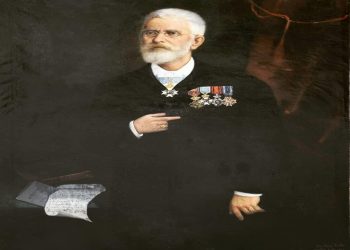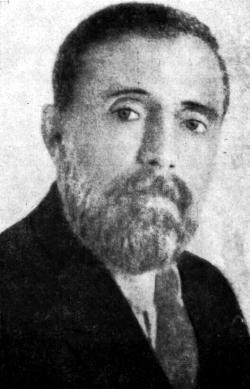
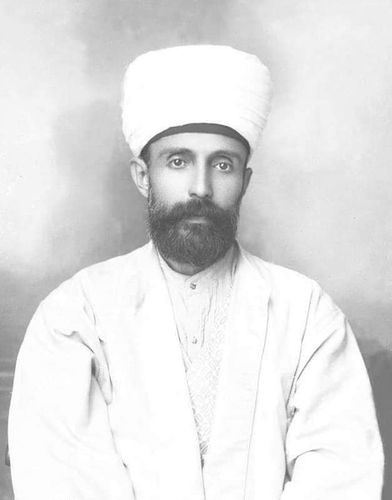
Memorie.al / Hoxha Kadri Prishtina has been and will remain one of the most prominent national figures, an inspiring model for the Albanian cause. Hoxha Kadriu, besides being a believer, was a scholar, patriot, politician, diplomat, publicist, jurist…! He was born in 1878, in the historical year when the “League of Prizren” was founded, the political-military organization that awakened national consciousness in all Albanian territories…! He completed his elementary education in Prishtina, in the Turkish language, while his secondary education was in Skopje, at the well-known “Dar ul-Mualimin” school.
He continued his studies in Istanbul, at the school called “Dar-ut-Tedris,” which was a Higher Pedagogical School. Then, immediately, he enrolled in the famous “Fatih” Madrasa, where he also graduated with excellent results. In 1904, at the age of 26, Hoxha Kadri Prishtina was not only a jurist, but he had already won the title of Myderriz (Professor) and the title of Hoxha (Scholar).
In the same year, 1904, Kadri Prishtina, being a jurist, professor, and hoxha, at the age of 26, was arrested in Istanbul and imprisoned for patriotic activity…! During the five years he was in prison, in Yedikule, where other political prisoners were also serving sentences, Hoxha Kadriu became seriously ill, so ill that he had to have his leg amputated above the knee…! Although with an amputated leg, Hoxha Kadriu never gave up, and he continued his activity for Albania to become independent, united, and progressive…!
He proved this when, in Shkodër, in 1915, he created a committee named “The Secret Committee,” and three years later, with a group of patriots and intellectuals, mainly from Kosovo, he founded a political organization that would organize the Albanian people in the fight for national liberation and unification…!
Thus, as a result of this activity, under the leadership of Hoxha Kadriu, the Committee “National Defense of Kosovo” was founded in Shkodër on May 1, 1918.
The Committee “National Defense of Kosovo” included a Central Council, composed of seven members, who elected Hoxha Kadri Prishtina as chairman, Hysni Curri as vice-chairman, and Bedri Pejani as secretary…!
The Committee “National Defense of Kosovo,” besides having branches throughout Albania, had its own organ, the newspaper “Populli” (The People), which was published in Shkodër, under the direction of the patriotic teacher, Salih Nivica. In 1919, to assist the insurgents, the Committee “National Defense of Kosovo,” under the leadership of Hoxha Kadriu, prepared the general program of the uprising in Kosovo with this content:
- No insurgent dares to harm the local Serbs, except for those who stand armed against the Albanian objective.
- No insurgent dares to burn houses, destroy churches, or other things.
- Looting is jasak (forbidden) by the uprising.
- No insurgent dares to commit any mutilation on the bodies of the enemy dead, or to strip those enemies who die, are wounded, or are taken prisoner.
- \The most vigorous action is against the army, gendarmerie, and against the enemy komitajis who resist with arms in hand…!
- A traitor who opposes the war, alongside the enemy or separately, is against the Albanian objective and shall be killed without trial or delay, whoever they may be. However, an unarmed traitor shall be judged before the uprising’s court (later) and shall be punished based on documents, and not merely on the crowd’s rumors.
- Upon entering a Serbian village, and not yet liberating it, the local Serbs, as well as the bazaar/market, shall be guarded by loyal people. The uprising’s loyalty must relentlessly pursue the enemy without wasting a single minute, through cities and villages.
- Unnecessarily and pointlessly, neither the blood of our people nor the blood of the enemy’s people should be spilled. But where necessary, an insurgent must not spare his own blood at all.
- What concerns these matters shall be guarded by the most loyal and understanding people.
- The killed Albanians shall not be buried until a foreign commission arrives. The atrocities committed by the enemy shall be recorded and shown to Europe and America. (Dr. Limon Rushiti, “The Kaçak Movement in Kosovo,” Prishtina, 1981, pp. 94 – 95).
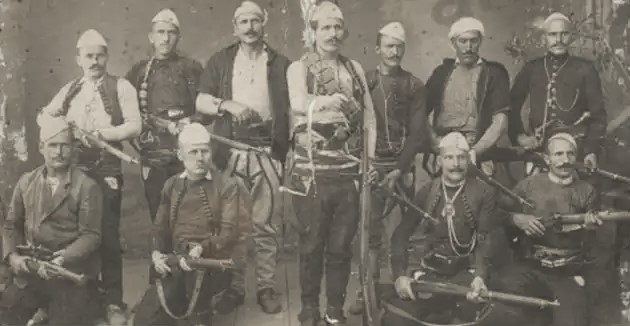
On April 24, 1919, the calls for an uprising began to be distributed. Among other things, they wrote: “Brothers, the time is extremely important…! We don’t have a minute to spare for sleep.” The start day of the uprising was set for St. George’s Day, May 6, 1919.
The signal for the start of the general uprising in Kosovo, which would become known as the Llapusha Uprising, was given by Azem and Shotë Galica, in the legendary Radisheva. The uprising had also started simultaneously in other centers of Kosovo. In Llapusha, the fight had erupted very fiercely. There, the well-known heroes Sadik Rama of Gjurgjevik, Ramadan Shabani of Kijeva, and Beqir Rexha of Kërnica were leading.
The uprising encompassed all of Kosovo. The number of insurgents reached about 10,000 people…! At the Congress of Lushnjë (January 27 – 31, 1920), where the foundations of Albania were laid, the new Albanian government, resulting from the congress’s decisions, was elected. It was headed by Prime Minister Sylejman Delvina, while Hoxha Kadri Prishtina was elected Minister of Justice.
In the government of Prime Minister Sylejman Delvina, besides the Minister of Justice, Hoxha Kadri Prishtina, the following ministers were also elected: Ahmet Zogu, Minister of Internal Affairs, Mehmet Konica, Minister of Foreign Affairs, Ndoc Çoba, Minister of Finance, Sotir Peci, Minister of Education, Ali Riza Kolonja, Minister of War, Eshref Frashëri, General Director of Public Works, and Idhomene Kosturi, General Director of Post-Telegraphs…!
Hoxha Kadriu was elected several times as a representative of the people (deputy) in the Albanian parliament in Tirana, while in Shkodër, where he worked as a lawyer, he published the monthly magazine titled “Udha e s’Vërtetës” (The Path of Truth), the first issue of which was released in October 1923…!
Many articles, works, and studies have been written about the patriotic activity of Hoxha Kadriu, scientific sessions have been organized, and he has been written about in the History of Albania, the Albanian Encyclopedic Dictionary, and the Encyclopedic Dictionary, (‘Toena’, Tirana, 2002).
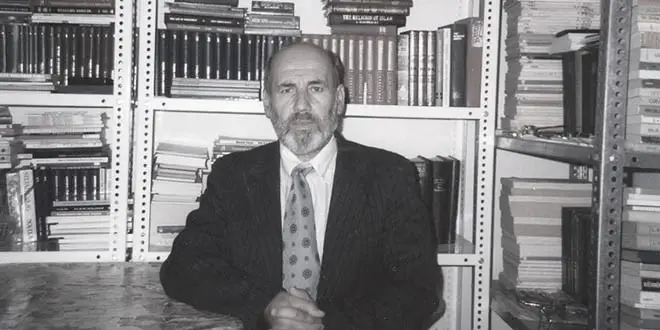
A monograph by Eqber Skëndi was also published, titled: “Hoxhë Kadriu (Kadri Prishtina),” 1992, but nowhere has his religious activity been written about, except by the researcher, Mr. Qemajl Morina, professor at the Faculty of Islamic Studies in Prishtina, who, as early as 1997, in the monthly religious, cultural, and scientific magazine “Dituria Islame” (Islamic Knowledge), wrote a serialized study titled: “The Islamic Ideas of Hoxha Kadriu, in the magazine ‘Udha e s’Vërtetës’”…!
Hoxha Kadriu passed away on January 20, 1925, at the age of 47, but he left an indelible mark on the religious-national cause. Considering that Hoxha Kadriu remained disabled from a young age, as a result of imprisonment in Turkey, he deserves to be a role model for Albanians, for Albania…! Memorie.al