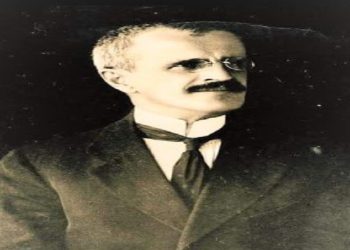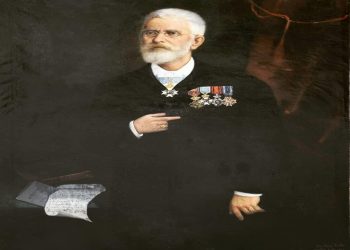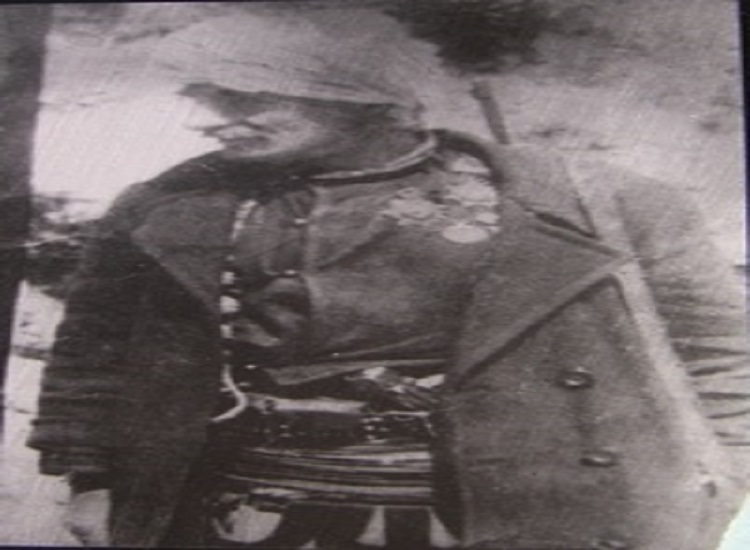
Memorie.al / Sak Fasllia was born in 1885 in Koshutan, Rugova. He belongs to the Kurtdedaj family, known for its bravery and generosity since the 18th century. Saku is the grandson of Sali Jaha, the standard-bearer (bajraktar), commander (major), and distinguished leader of Rugova, who fought to defend the Albanian border against the Montenegrin forces of Knjaz Nikola and Mark Milan. Sali Jaha was also a participant in the Albanian League of Prizren in 1878. He fought and acted alongside renowned men of Rugova such as Ker Sadria, Sali Rama, Jashar Haxha, Tahir Coli, etc.
The year was 1911, a year when the Ottoman Empire was experiencing its end in the Balkans and Montenegro wanted to expand at the expense of Albanian lands; the year when Sak Faslia’s combat activities began. That year, the Battle of Berana took place against Montenegrin forces, and Saku distinguished himself as a leader and strategist, even though he was quite young. After a fierce battle, the Montenegrins were badly defeated.
In 1912, Montenegrin forces again attacked Rugova and the Rrafsh of Dukagjin. Sak Fasllia, together with the men of Rugova, ambushed them at a place called Mokna and completely routed the Montenegrin forces. This battle is known as the Battle of Mokna. The resistance of the Rugova highlanders, led by their standard-bearer Sak Fasllia, continued throughout the entire period from the occupation of Kosovo by Serbia until the Second World War. There is hardly a year in this period when bloody battles against Serbs and Montenegrins did not take place.
With the crushing of Versailles Yugoslavia in 1941, Albanian lands were carved up and divided among Germany, Italy, and Bulgaria. The region of Rugova was part of the Peja prefecture, which fell under the Italian protectorate and later the German one. This protectorate propagated full freedom for Albanians, even though the axes of the Lictor were added to the flag. In Peja, at the end of June 1941, Albanian forces arrived from Albania led by Major Rexhep Gilani and Kolë Bibë Mirakaj, whose aim was to defend the Albanian ethnic border from Serbs and Montenegrins. These forces were joined by Albanian volunteer forces from Kosovo.
On July 1, 1941, Sak Faslia met with the military and administrative representatives of the Albanian government in Peja. The military representative, Major Kolë Bibë Mirakaj, appointed Saku as the leader of the war for the defense of the border against Montenegro, addressing him with these words: “Since you are a descendant of the renowned Sali Jaha, the standard-bearer of Rugova, and have proven yourself a worthy fighter for the national cause, we express our confidence in you for the organization and leadership of the war to defend the border against Montenegro,” and honored him with a decoration (medal) for his merits in war.
Immediately after this, the Albanian volunteer forces led by Sak Faslia and the military units of the Albanian army were positioned along the border line of Morinë – Qafë e Diellit – Qafë e Çakorrit – Mokna – Qafë e Dasmorve – Smilovicë. Sak Faslia took command of the “Gramos” Battalion, whose commander was Rexhep Gilani. Upon hearing the news that the Albanian army had arrived in Rugova, the people of Rugova, some with weapons, some without, joined those forces. Here is how the rhapsody describes the arrival of the Albanian army in the Battle of Mokna:
“Into the gorge of Rugova they entered,
Sak Faslia is said to have led them,
Led them, Sak the Standard-Bearer,
Commander Rexhep Gilani,
Rexhep Gilani was a major,
Commander of a battalion,
And when they came to Kuqishta,
They appeared before the people…”!
After positioning on the border, the war and resistance of the Rugova highlanders and the Albanian army for the defense of the border continued for three years. Sak Fasllia led the army in every battle with the flag in his hand. He placed this flag on the tower of Mokna on the border and became an unyielding guardian of the border. There are many testimonies of the bravery shown by Saku during these years. Here is one of them. Since Saku had become a terror for Serb-Montenegrin soldiers, the command of the Serb-Montenegrin army decided to launch an operation to liquidate the standard-bearer.
This task was entrusted to Officer Vukosav Keniq. He challenged Saku to a face-to-face fight, saying to him: “If you are the true standard-bearer of Rugova, come out and face me, because either I will take that rag (the flag) or I will not call myself a man.” Two other Montenegrins were tasked with treacherously attacking Saku from behind and liquidating him. Without any hesitation, Sak Fasllia, with flag and rifle in hand, faced him. The rhapsody also describes this:
“The cannon roared, the storm raged,
Sak Fasllia fought hard,
Sak Fasllia, the standard-bearer,
Vukosavi made a vow,
Vukosavi made a vow,
He wants to snatch the flag,
Sak Faslia shot him down,
He gave him two bullets in the chest…”
As they approached, Saku and Vukosavi both aimed their weapons at each other. Saku shot Vukosavi in the mouth and also killed one of his soldiers. Only one managed to escape. The bravery of Saku and the other Rugova men is particularly well known in the war for the defense of Plav and Gucia. On July 16, 1941, at Qafë e Çakorrit, the Rugova forces joined forces with volunteers from Rrafshi i Dukagjinit led by Ali Bajraktari of Junik, Selim Shabani of Isniq, Demë Alia of Pozhar, Haxhi Bajraktari of Vranoc, etc., and headed for Plav and Gucia. There they also chose the joint leadership of all forces. Sak Fasllia was appointed Standard-Bearer (Bajraktar).
Montenegrin forces attacked at Morina and Velika, and then at Zhaniça, Pepaj, and Nokshiq. The volunteer forces, numbering about 3,000, confronted them and forced the enemy forces to retreat. After this victory, Saku and his forces returned to the border. On November 4, 1941, Chetnik forces attacked Novi Pazar (Pazari i Ri), which was under the protection of the volunteer forces of that region. The Rugova forces under the command of Sak Fasllia and Sali Rama also went to help defend Novi Pazar.
Other forces from various regions of Kosovo also came to help, such as from Istog, Mitrovica, Drenica, etc. The forces of Drenica were led by Miftar and Cenë Bajraktari, Shaban Polluzha, Mehmet Gradica, etc. The forces of Peja and its surroundings were led by Kurt Abazi, standard-bearer of Radac, Mulla Zekë Bërdyna, Adem Bajraktari of Vranoc, Demë Ali Pozhari, etc. The Albanian volunteer forces numbered over 6,000. In one of the battles against the Chetniks in Novi Pazar, standard-bearer Sak Fasllia was wounded in the leg, but he did not let go of the flag. Here is how the rhapsody describes this event:
“From Rugova they went to Pazar,
Where they fought for three full weeks,
They fought for three weeks and days,
It was then that Saku was laid low!
What do you say, Demë Haxhia?
I, Sako myself, have been laid low!
I cannot go to the hospital,
To the hospital they sent us.
Dema died, Saku recovered.
Dema died, alas,
While fighting for his homeland…”!
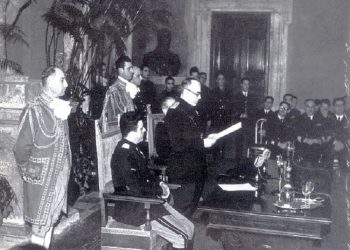
After his hospital stay, Saku returned to Rugova and continued the war to defend the border. The Prime Minister of the Albanian government, Mustafa Merlika Kruja, visited Kosovo in June 1942. On June 29, at 12:30 PM, he arrived at the railway station in Peja, accompanied by many activists from Kosovo and Albania. To greet him had turned out Sefedin Begolli, Mayor of Peja, Xhevat Begolli, Prefect in Peja, etc. Also present was the standard-bearer of Rugova, Sak Fasllia, whom Mustafa Kruja honored with a decoration, as a symbol of border resistance. This was the third time Saku was decorated for heroism and for victories in battles against Serbs and Montenegrins.
The medal with which Sak Faslia was decorated in 1942 by the Prime Minister of Albania, Mustafa Kruja. The medal has 4 letters in the middle, S. F. B. R., which are the initials for Sak Fasllia, Standard-Bearer of Rugova (Bajraktar i Rugovës). On April 30, 1944, the standard-bearer was wounded for the second time, but even this time he did not release the flag from his hand. The Albanian press of the time wrote about his wounding. For example, the newspaper “Lidhja e Prizrenit”, issue no. 13 of 1944, reported on Saku’s wounding. After recovering from his wounds, he continued his post on the border until he was killed in battle with Montenegrins in 1944, at the peak of Smilovica, around 2:00 PM, struck by a hand grenade.
As his comrades-in-arms recount, his last words before being killed were: “Oh, wait a minute, Montenegro, we will never give up these lands, and this place is called Rugova.” His comrades-in-arms buried their leader and standard-bearer, right where he fell for the freedom of Albanian lands, on the Albanian-Montenegrin border, in Smilovica.
On June 3, 2004, on the occasion of the 60th anniversary of the killing of Sak Fasllia, at a commemorative academy, the President of Kosovo, Dr. Ibrahim Rugova, proclaimed Sak Fasllia a “Hero of the Nation.” / Memorie.al