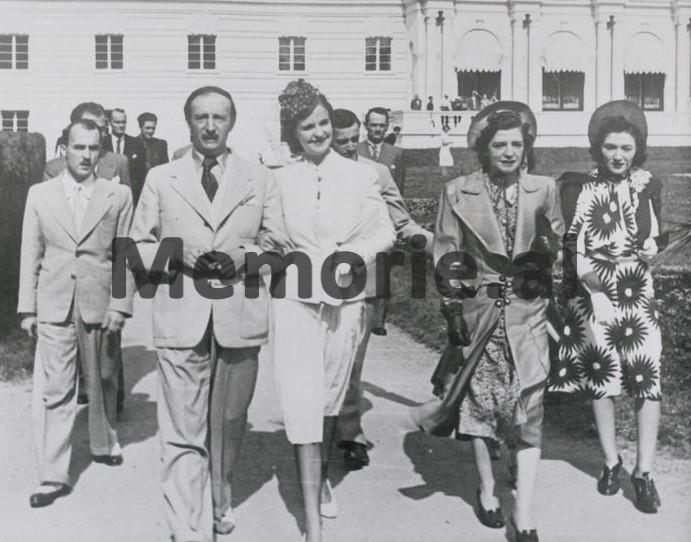

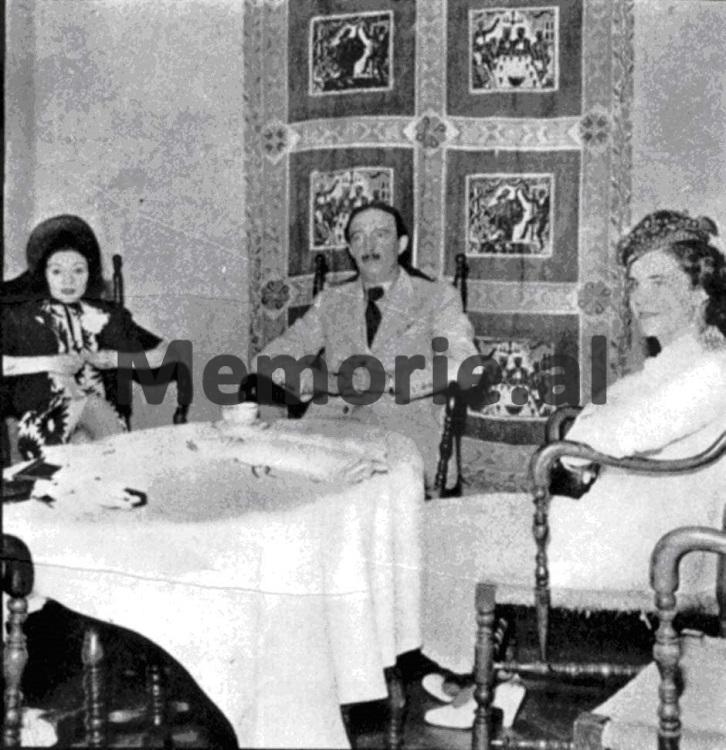
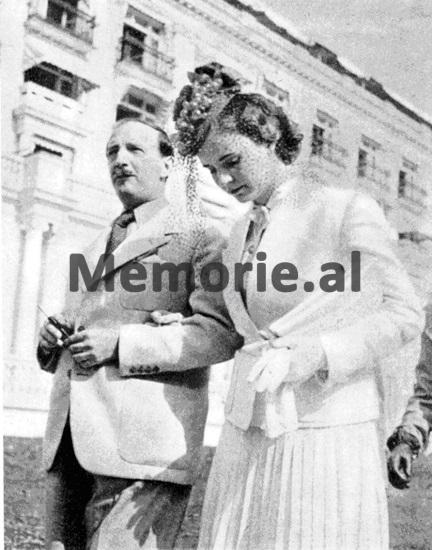
Memorie.al / Much has been spoken and written about the charismatic King of the Albanians, Ahmet Zog, but there still exist undiscovered mysteries regarding his life. His six years of living in England have been simply overlooked until now, mentioned merely as a fact, but this will not last for long. An Englishman passionate about Albanian history, Neil Rees, has undertaken a mission of “discovery” regarding the life of King Zog in England. Soon, the King’s modern followers and his opponents will have much more “ammunition” to ignite old debates.
“I have consulted all archival documents, the secret files of the intelligence services, but all of these will be secondary. What interests me most are the witnesses themselves; those who lived at that time and were close to the King. To my luck, some of them are still alive and represent a treasure that must be utilized now. Time does not wait,” says Neil Rees.
In his reception room, he has already hung a red and black flag, a gift from the researcher Bejtullah Destani. In the Buckinghamshire area, where he lives, a small “army” has been mobilized to help him in his project to put into a book that part of Ahmet Zog’s history in England.
Bucks and the King
Ahmet Zog and his circle arrived on British soil on June 26, 1940. Greece expelled him in the hope of avoiding an attack by fascist Italy, while France did not guarantee his safety on the eve of the Second World War. The person who took charge of moving the King from France to England was Ian Fleming himself, the famous British agent and author of the books on “James Bond.” He was initially settled at the “Ritz” hotel in London, together with his family and his escort of 35 people.
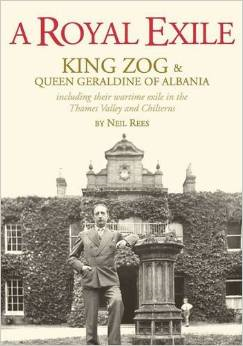
For the safety of his family, on the eve of the bombing of London by the German Nazis, Ahmet Zog rented a large manor house in the small village of Frieth, in the Buckinghamshire area (shortened to “Bucks”), which today is known as one of the wealthiest areas of the United Kingdom, somewhere between London and Oxford. The house belonged to Lord Parmoor, a former member of the British Parliament of the time, who had just passed away.
“Parmoor” house had 40 bedrooms and several lounges and bathrooms, a giant garden with extravagant decor. Besides this, the King’s bodyguards lived in another house, not far from the first one. Meanwhile, at the “Ritz” hotel, Ahmet Zog kept a room with a lounge blocked for official meetings, which his nephews often used for personal amusement with local girls. In all the books written about Zog’s life, it is nowhere mentioned that he and his family lived in “Bucks” and not in London.
Extravagance
The King lived in a house with 40 rooms together with his wife, Queen Geraldine, and Prince Leka. In his close family circle, there were also five princess sisters, four nephews and nieces, Prince Tati (Esad Murad Kryeziu – the son of the King’s sister) of Kosovo, three dogs, and a goat. In the service personnel, there were cooks, two Swiss nurses, a secretary, and political advisors. He kept eight bodyguards near him at every moment, but they lived in a separate house.
In Parmoor House, the furniture used by the King is preserved to this day, except for the curtains and tablecloths which the goat regularly shredded. According to local witnesses, no one from the personnel dared to drive the goat out of the house, and it would be near the King even in official meetings. In one of the testimonies gathered by Rees, it is said that the King’s goat had on one occasion overturned the dining table while chewing its tablecloth.
King Zog had ordered the furnishing of the bathrooms and the construction of a special bath for his dogs and the goat. Even today, in Parmoor House, in a large bathroom, is the bathtub of King Zog’s dogs. Such a renovation, at that time, was extremely expensive. Several now-elderly local women recall visits to the room at the “Ritz” Hotel as special guests of the King’s nephews. However, the details will be clearer in the book, which is expected to be ready by the end of this year.
The Unwelcome Gift
Neil Rees says that many people remember or have heard about Zog’s time in “Bucks.” “Some remember him with adoration and respect; many others did not like him at all. He and his escort roamed the streets and villages of ‘Bucks’ in a scarlet Mercedes (Cabriolet) and in the eyes of the locals; he was seen as a collaborator of Hitler. In fact, there is no evidence that Ahmet Zog collaborated with Hitler. On the contrary, he exchanged correspondence with Churchill and personalities of the Resistance,” relates Rees.
The car had been gifted to King Zog by Hitler himself on the occasion of his marriage. It was the same type of “Mercedes” that the Nazi dictator used himself. Among other things, Rees has discovered how Ahmet Zog avoided English state taxes and his silent agreement with the British authorities.
“If the British state were to demand the collection of taxes by the force of law, then the King could raise his voice in the media regarding the state that played ‘deaf-mute’ in the case of Albania. The British state was exhausted by the war and no longer had the resources or the desire to engage in another war against communism in Albania,” Neil Rees discovered in the secret archives of MI-5.
According to him, absolutely all correspondence of the King and his close associates with the outside world was regularly intercepted. This “silent agreement” heavily damaged the King and his cause. In 1946, the British government officially recognized the communist regime of Tirana and the state of Enver Hoxha. Zog’s hopes were exhausted, and he decided to move toward Egypt, following the invitation of King Farouk himself.
Rees and the Love for Albanians
Neil Rees is a new, amateur author. History is a passion of his, but not a profession. His first book was published two years ago and concerns the first prime minister of Czechoslovakia and the Czech fighters who lived in the Bucks area during the Second World War.
Rees traveled to the Balkans for the first time in 1998, and his first contact with Albanians was in Macedonia. During research to write a local history of “Bucks,” Neil also found materials on the life of Ahmet Zog in that area. He withdrew from the first project and began to deal with the second project: “The History of the King of the Albanians in England.”
“I was surprised by the interest of the locals in this project. After they learned about this, a mini-army gathered around me and now I am not alone. Every day people call me and give me new information. I have gathered plenty of memories, photographs, and I have even found the descendants of those people Zog left behind,” says Rees.
According to him, at that time, about 40 Albanians remained in England – from those who came together with Zog, the personnel of the Albanian embassy of the time, and others who came later from Europe. Almost all have been assimilated and lost within the crowd, but the tracks are still clear. / Memorie.al