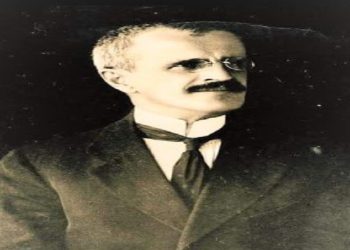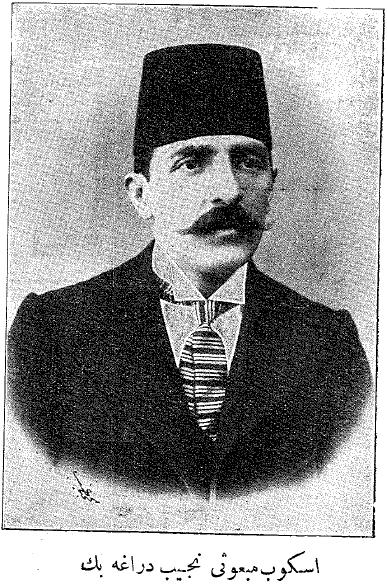
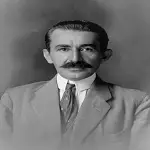
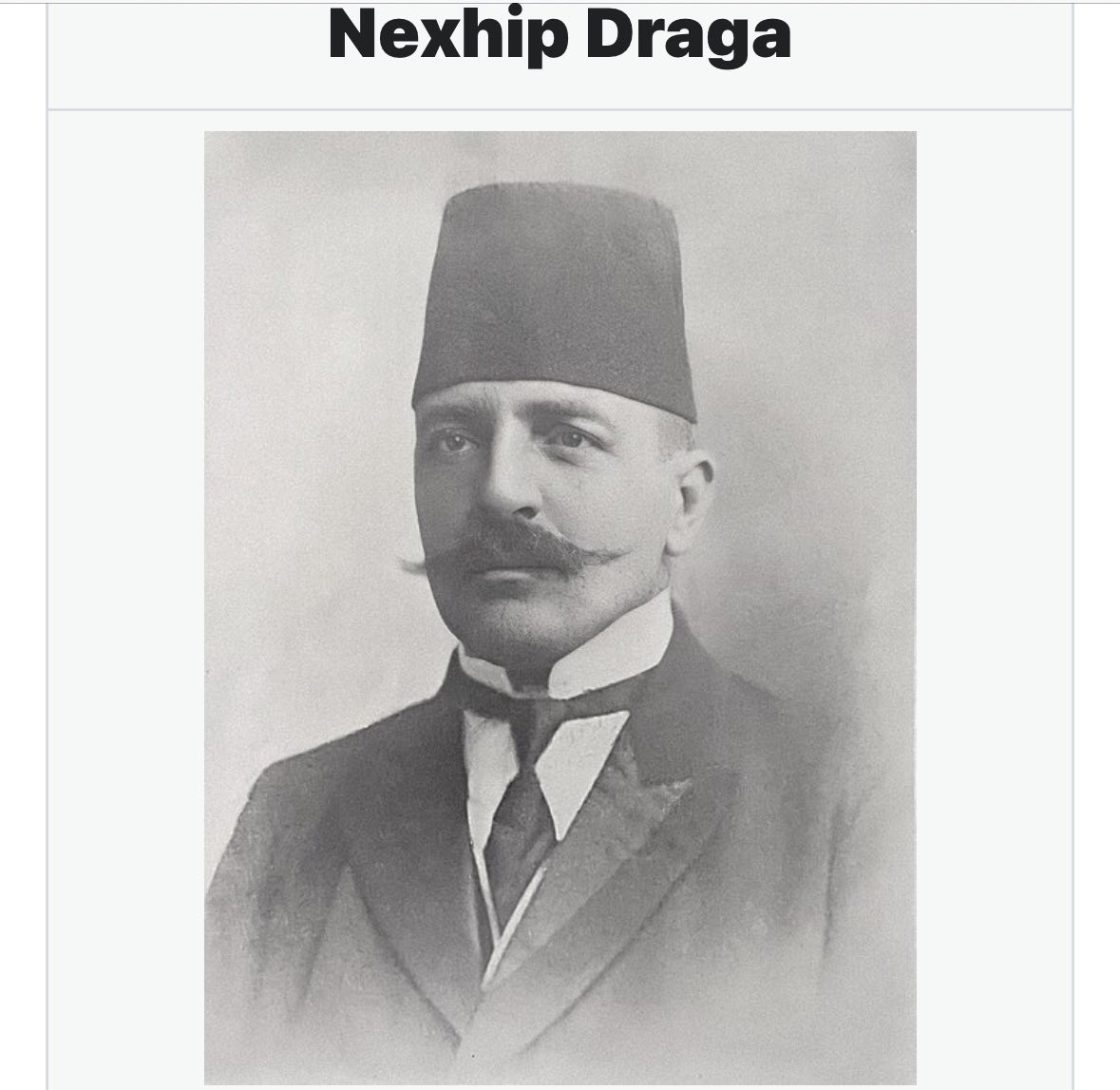
Memorie.al /In the first elections for the Parliament of Turkey in December 1908, Nexhib Bej Draga was elected deputy (representative) of the people for the Sanjak of Skopje in the Kosovo Vilayet. This is evidence that Nexhib Bej Draga had become known among the people even before 1908, outside his native district as well, and precisely in the capital of the most rebellious and revolutionary Vilayet of the Ottoman Empire. The Albanian newspaper “Bejsa” of Istanbul, dated January 26, 1909, speaking of the election of the representatives of the four vilayets of Albania: Ismail Qemali, Hasan Prishtina, Nexhib Draga, Shahin Kolonja and others as representatives of the people, called them; “Flowers of the homeland that Albania has sent here (to Istanbul)”, who “will strive for our homeland”.
As one of the most prominent activists of the Albanian Club “Bashkimi” in Skopje with permanent influence in the Young Turk – military, political and administrative circles in the Kosovo Vilayet, even before 1908, Nexhibi now, under the conditions of Young Turk constitutionalism – Hyrriet (Liberty), became a strong pillar of the Albanian school and alphabet in the Kosovo Vilayet and beyond in Albanian lands, the most Bej-like, most devout follower and supporter of Hasan Prishtina in these fields of Albanian culture, life and future.
The correspondent of the Boston newspaper “Dielli”, signed Benjamini, on November 26, 1909, speaking of the efforts of Hasan Bej Prishtina for the Albanian school, for his struggle in the Istanbul parliament and in the Albanian field, would state: “…I have no right to refrain from mentioning here also Lord Nexhib Draga, who is also striving for knowledge and even more for the good of the nation; only it is necessary that this patriot have a little more will, because he could be of more help to the nation than anyone else in Kosovo, especially materially, for he has immense wealth”.
In the national struggle for the realization of the program and resolution of the Alphabet Congress in Bitola (November 14-22, 1908), Nexhib Bej Draga never wavered and remained faithful to his militant principle: “With the Latin alphabet we open the doors of the European Fortress, whose sons we are”! With wisdom, courage and authority, he completely undermined the Young Turk Congress of Dibra (July 23, 1909), which aimed to remove and discard the Latin Albanian alphabet for the Albanian language.
At this time, alongside Hasan Bej Prishtina and Shahin Bej Kolonja, he was the strongest arm of Ismail Qemali regarding the opposition liberal party “Ahrar” and contributed to the cultural and national-educational activity of the Central Club “Bashkimi” in Istanbul, which had the role of an Albanian ministry of education and culture under conditions of the Albanian state in the making.
By the end of 1909 and the beginning of 1910, Nexhib Bej Draga was the most attacked deputy by Young Turk political and journalistic circles, but also by Serbian anti-Albanian propaganda circles. Nexhibi was the uncompromising fighter in the Albanian struggle for the Albanian alphabet approved in Bitola, and among the deputies who advocated the Latin alphabet for Albanian in the Ottoman Imperial Parliament, he had his place among the foremost. This was proven by his engagement in the meeting of Albanian deputies in the Istanbul neighborhood – “Pare Palace” (where most of the world’s representative offices were located), in which the issue of the Albanian alphabet was discussed.
According to data from the correspondent of the newspaper “Bashkimi i Kombit” of Bitola, the most outspoken Albanian deputies for the Latin alphabet for the Albanian language were: Myfid Bej Libohova, Hasan Bej Prishtina and Nexhib Bej Draga, who on behalf of the partisan deputies of the Latin alphabet for Albanian “went before the Minister and gave him a protest” against the provocation of unrest in the field to the detriment of the Latin alphabet for Albanian, and for the introduction of Arabic-Ottoman script. Nexhib Bej Draga, a politically and scientifically elevated personality, as will be seen, stood at the forefront of Albanian forces to defend the national alphabet and to expel the Arabo-Ottoman alphabet of foreign Young Turk, Serbian, Bulgarian and Greek propaganda for Albanian.
These propaganda efforts focused their work primarily in the areas of the Kosovo and Bitola Vilayets, but also elsewhere in Albania. The newspaper “Bashkimi i Kombit” of Bitola carefully followed the national political activity of Nexhib Draga in the face of the storm against the Alphabet of the Bitola Congress in the capital of the Kosovo Vilayet, on January 20, 1910, and wrote: “The honored deputy of Mitrovica, Nexhib Bej Draga, went to Skopje” – to stop the unrest provoked against the Albanian alphabet by enemies of the Albanian nation, supported by a hand of the Albanian Islamic ulema.
The reality, because Skopje at this time had become one of the centers of Serbian and Bulgarian anti-Albanian propaganda, the issue of the Albanian alphabet in Skopje and its surroundings took on the proportions of a national division. In particular, Serbian propaganda spared no means to divide Albanians in the field of the alphabet, hoping that Albanians would even take up arms for bloody settling of scores between opponents of both camps – fighters for the Latin alphabet for Albanian and supporters backed for the Arabic alphabet.
They would especially try to compromise Nexhib Bej Draga and Hasan Bej Prishtina, who were considered pillars and would also successfully crown the most sensitive point of the Resolution of the Bitola Congress, that of definitively establishing the Latin alphabet, the current one, as the national alphabet of the Albanian nation.
The chauvinistic Young Turk political circles and a part of the Albanian ulema, certainly instigated by foreign propaganda that pretended to be friends of the Albanian nation, formed in Skopje the “Society for Writing the Albanian Language with the Arabic Alphabet”, which had set itself the task of removing the Latin alphabet from Albanian schools, precisely “in the northern part of Arnautluk” – of Albania, i.e., from the Kosovo Vilayet, where Serbia and Bulgaria aimed.
According to information from a Serbian agent, on January 20, 1910, sent to the Serbian consul in Skopje, Nexhib Bej Draga was the helmsman of the entire Albanian cultural movement in the Kosovo Vilayet, who helped establish the National Cultural Club in Skopje and supported its work.
Foreign propaganda caused even the Albanian deputies in Parliament to split into two camps, called by foreigners: “Latinists” and “Arabists”. In the first group there were 10 or 11 deputies, while in the second group there were 14 or 13 deputies. Among the “Latinists”, Hasan Bej Prishtina and Nexhib Bej Draga proved to be among the most active.
On February 20, 1910, anti-Albanian Young Turk circles and foreign propaganda, especially Serbian, held a meeting of the ulema, sheikhs and compromised and fanatic notables in the “Sultan Murat Mosque” in Skopje against the Latin alphabet in Albanian schools and for the introduction of the Arabic alphabet for the Albanian language, believing that thus they had “taken under protection the holy Islamic faith and our unshakable steadfastness in national efforts”. On the occasion of the holding of the meeting in Skopje against the Latin alphabet, which was organized by the Vali of Kosovo, Mazhar Bejdri Beu, Arif Hikmeti, an intellectual from the Kumanovo area, and Sahit Efendi, the deputy of Skopje, Nexhibi contributed the most to the failure of the meeting.
Moreover, as an unknown person informed the Serbian consul in Skopje, on January 22, 1910, Draga also held meetings with adherents of the Latin alphabet for Albanian at the “Liria” Hotel in Skopje. But besides this, he directly participated in the meeting, in which he spoke with open letters against the Vali Mazhar Bedri Bej Pejani and the Gendarmerie Commander, Ismail Efendi, blaming them for the disturbances regarding the alphabet, but – “As the first consequence of this meeting is the fact that immediately after the meeting Istanbul was notified that from now on the deputy, Nexhib Bej Draga, is not recognized as their deputy, since he ‘has lost all trust among the people and has become a traitor'” – an informant of the Serbian consul in Skopje reported on January 22, 1910.
Thus, the Sublime Porte and the Committee of the Young Turks did not spare means to suppress the alphabet movement in Albanian-inhabited areas, – “But when one takes into account that Nexhib Draga and Hasan Prishtina, fighters for the Latin alphabet, enjoy considerable respect among Albanians – it is likely that the Albanian idea will quite easily triumph in all parts of Northern Albania” – emphasized Spiro Haxhi Ristiq, in his report dated January 23, 1910, addressed to the Serbian consul in Skopje.
While the newspaper of the Ottoman Serbs, “Vardari” of Skopje, on January 24, 1910, among other things wrote that; – “It is said that even government circles envy this Albanian leader, but we do not know whether he has submitted his deputy’s mandate” – concluded “Vardar”. On the contrary, as they informed the Serbian consul in Skopje, on January 24, 1910, Nexhib Draga’s morale was not broken and he continued on his way to Veles and elsewhere, to deepen agitation for the Latin alphabet for the Albanian language. Since, at this time, there were private and state schools in which some taught the Latin alphabet, while others taught the Arabic one, “Nexhip Bej Draga became a powerful arm for the Latin alphabet in all schools” – the Serbian consul was informed on January 27, 1910.
The agitation of government circles regarding the Latin alphabet continued even more. Other meetings were also organized, in which adherents of the Latin alphabet were unmasked. Thus, as the person signed “Sabah” reports, on January 28, 1910, at the meeting in Kaçanik held sometime between January 20 and 25, 1910 – “In this meeting, distrust was manifested towards Nexhib Draga, the people’s deputy for Skopje”.
The far-sighted patriot, Nexhib Bej Draga, bravely and wisely opposed the current of supporters of the Arabic alphabet for Albanian, denouncing it as a movement harmful to the future of the Albanian people, while the Istanbul newspaper “Stamboul”, on January 31, 1910, would write: “A Congress was held here (in Skopje) by some notables of the Muslim Albanian land, who decided to use the alphabet with Arabic letters for the schools of Albania. This decision was voted by a large majority of people. That alphabet which these gentlemen decided to use, no one keeps for themselves nor knows nor will know, nor will they know, and all Albania rises up saying shame on these people (we say people so as not to say otherwise).
The Congress of Bitola is here alive to show not only us but the whole world, that we accept no other alphabet except that which Tosks and Ghegs, Muslims and Christians, all with one voice decided to use for the Albanian language. So all men and women, old and young, will shout with one voice – Long live Albania!, Long live the Albanian alphabet!, Long live the Congress of Bitola”!
After many efforts by Hasan Bej Prishtina and Nexhib Bej Draga, the Albanian language was introduced into the “Darul Maulim” (Normal School) of Skopje, into the “Idadi” (high school) and into the Educational School “Mekteb-i Edeb” of Skopje. In these schools, Albanian was taught by two distinguished revivalists and publicists from Peja: Bedri Bej Pejani and Salih Gjukë Dukagjini. “In Skopje it was decided to teach the Albanian language with its own letters” – “Bashkimi” of Shkodra would state, on February 6, 1910. The Minister of Education of Turkey provoked and instigated by foreign propaganda and by a part of the ulema and fanatical Islamic leaders, on January 23, 1910, issued an order that “the Albanian language in all schools within the Vilayet be taught only with Arabic letters”.
This order further empowered reactionary anti-Albanian circles in many areas of the Kosovo Vilayet. On January 28, 1910, a meeting was organized in Kaçanik against the Latin alphabet and against Nexhib Bej Draga. The meeting demanded the closure of all Albanian schools where teaching and writing were done with the Latin alphabet. Whereas only a few days later, two teachers of the Albanian language would be persecuted from the Albanian schools of Gjilan. The distinguished activists, Nexhib Bej Draga and Hasan Bej Prishtina, stayed in the Kosovo Vilayet for over a month, until February 24, 1910.
During this time, without stopping, they propagated for the Albanian school, for the national Latin alphabet and clarified the paths of struggle for the victory of freedom over the centuries-old enslaver and the external enemies of Albania. During this time, they sent about 40 activists of the Albanian National Movement to Europe, tasked with propagating for the Albanian school and for the national Latin alphabet, as well as collecting aid for the Albanian school endangered by the centuries-old Ottoman enslaver and by foreign propaganda.
For the efforts of these two men of the nation, supported by “a part of the notability of Kosovo” in the parliamentary struggle for the defense of the national alphabet and the Albanian school, the Boston “Flamuri” would also write, on February 18, 1910. The best response of Hasan Bej Prishtina and Nexhib Bej Draga to the Ottoman-Young Turk government and to anti-Albanian circles was also the sending of a contingent of young Kosovars to the “Normal School” of Elbasan.
The correspondent of the Boston newspaper “Dielli”, signed “Freedom-lover”, would state: “These days, the most worthy, most renowned and only men of morale among the deputies of Gegnia, Hasan Bej and Nexhib Bej Draga, were in Skopje and Mitrovica, because of the baseness that Xhemieti sowed against them, denouncing them to their electors and to the entire Albanian people in Gegëria as reactionaries and as about to sell out to Austria and Christendom”.
Furthermore, “Freedom-lover” called on readers to rejoice for the fortune that the people had two representatives like Hasan and Nexhib and pointed out that Hasan had written that; “the fervor and time of the fanatics has passed”, while “Nexhib Beu on the other side, like a giant, holds his brother’s arm, and around them, like a wave that breaks, the fervor and malice of fanaticism, which with such cunning and treachery the rotten Young Turk politics sowed, is shattered”.
The correspondent of “Dielli”, carefully following the actions of Nexhib Bej Draga and Hasan Bej Prishtina in the field of Albanian education, in a truly turbulent time, would state that “Nexhib Bej Draga and Hasan Bej Prishtina returned from the journey they had made in Albania. The exalted patriots proved themselves beyond measure as owners of the truth and manliness. May the nation owe them their services and blessed be they! Another 15 students from Skopje also went to the ‘Normal’ school”.
Likewise, the newspaper “Shqypëja e Shqypënis” of Sofia on March 11, 1910, informed its readers that Hasan Prishtina and Nexhib Draga “with their people opposed the vali” of Kosovo, Mazhar Bedri Beu, a former colleague of Nexhib Bej Draga, and demanded from the Ottoman-Young Turk government that he be withdrawn from the post of Vali of Kosovo, threatening that “otherwise things will turn out differently”. These two devoted patriots rejected the Vali’s decision to ban the Albanian press in the Kosovo Vilayet and demanded the return of teaching the Albanian language in the “Idadi” of Skopje and of its lecturer, Salih Gjukë Dukagjini.
Indeed, the Great Kosovo Uprising of 1910 would become a good pretext to close Albanian schools, Albanian clubs, the Albanian press and Albanian printing presses. Thus, by mid-1910, the “Bashkimi” Club of Skopje, the planner and coordinator of educational work in the Albanian language throughout Kosovo, was also closed. But the strict struggle of the Albanian parliamentarians, among whom Nexhib Draga stood out, would force the Young Turk government to make concessions regarding Albanian schools and the national Latin alphabet of the Albanian language.
In May 1911, the Central Club “Bashkimi” of Istanbul, led by Abdyl Bej Ypi, renewed its activity in a reorganized manner. In the Eldership of this club, among others, were: Gani Bej Frashëri, Myfid Bej Gjirokastra, Hasan Bej Prishtina, Nexhib Bej Draga and Sylejman Pashë Kolonja. From now on, “All clubs in Albania will work according to the central program” of “Bashkimi” of Istanbul.
The role of Nexhib Bej Draga in the struggle for the alphabet and the Albanian school in Kosovo and in other Albanian environments was great and honorable. An activist of the Albanian national cause, Nexhib Bej Draga, would not interrupt the struggle for Albanian school and writing and for the integrity of the ethnocultural and geopolitical unity of Albania until the moment he was arrested by the Serbian army, after the outbreak of the Balkan War.
In the first months of 1911, the “Union and Progress” Party fell from power. The party “Hyrriet-i Itilaf” (Liberty and Accord) came to government, which legalized the Latin alphabet and Albanian schools. Many Albanian schools were opened in all centers of the Kosovo Vilayet and in other Albanian vilayets, but the Freedom did not last long. The Uprisings of Albanians, the Bulgarian VMROists, and the Serbian Chetnik komitadjis continued to line up, so that finally the First Balkan War came, then also the First World War, to the detriment of the Albanian Cause. / Memorie.al