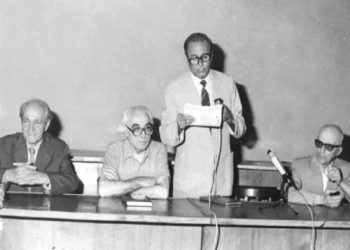
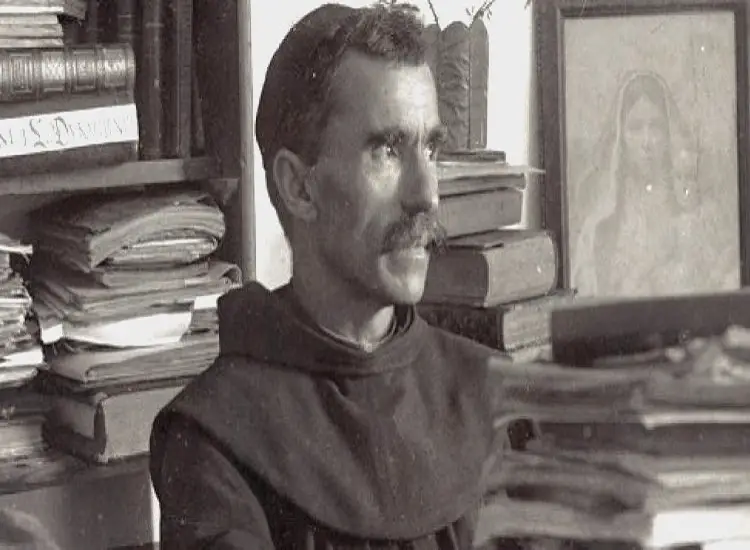
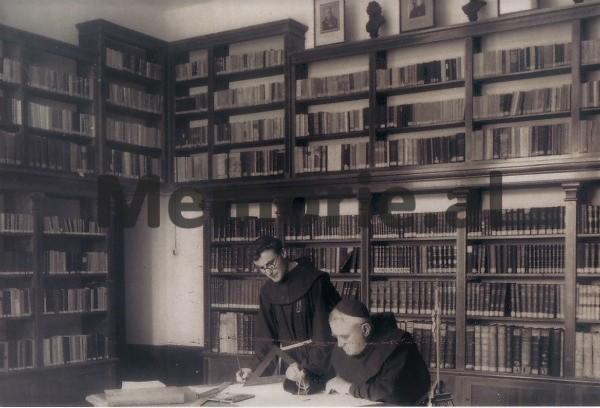
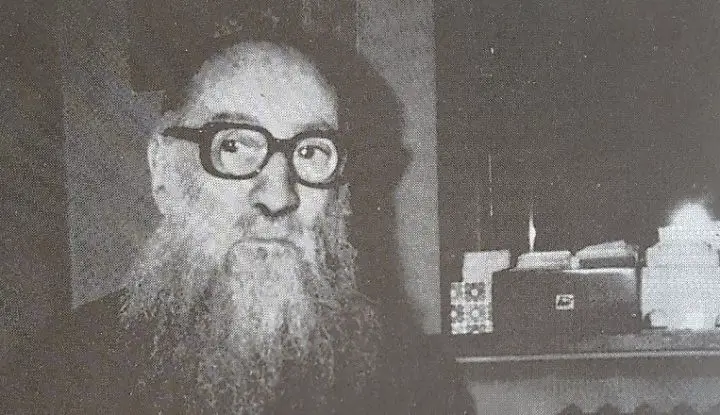
Memorie.al / With great joy and immense pleasure, I accepted the invitation from the directorate of the esteemed magazine “Shejzat” (The Pleiades) to participate in the organizing committee to celebrate, in the most deserving manner, the seventieth birthday of the illustrious and honorable Professor Father Zef Valentini – this brilliant scholar and refined cultivator of Albanian affairs in various fields. I accepted this invitation as an old friend of this valuable writer; this fills me with pride, for it is no easy feat to be a friend of a great man such as Valentini is to me and to many others, and secondly, because I had the honor of being his close collaborator since our youth.
I worked with him at the first Institute for Albanian Studies, founded in April 1940, through the initiative of our mutual friend, Ernest Koliqi – that distinguished writer and poet of Shkodran youth, whose works are immortal. I do not wish to fall into the sin of presumption, nor do I believe these two brilliant friends will take it amiss if I rank myself within this trinity of distinguished Albanians. I worked with them tirelessly, standing by their side as much as my strength allowed, though I remained far behind them in talent and ability.
I have strived, as much as I could, to be of use. I have held, and continue to hold, the honor of being a collaborator to these two prominent Albanians. Let the readers of “Shejzat” not be surprised that I call Father Valentini an “Albanian.” Yes, an Albanian; truly an Albanian, with all the virtues, and all the strengths and flaws of an Albanian. He himself takes pride when we call him Albanian: one must know him closely to verify what we are saying: Valentini is a man of his word, his door is always open, he is a man of few words like the inhabitants of the Albanian highlands, broad-souled, reasonable, and composed.
His character very quickly aligned with that of the Albanian: he dedicated himself to the study of the people, whom he made his own as soon as he stepped onto their land. He familiarized himself with the Albanian world through the abundant publications found in the Jesuit Library in Shkodër, provided by his brethren and masters; he quickly formed friendships within the cultural circles of Shkodër; he connected with those who knew the Albanian soul well. Valentini, with his distinguished intelligence, assimilated, processed, and studied these findings, which later became the object of profound studies on the small Albanian world.
He refined these studies further when he mastered the Albanian language fundamentally, when he could understand the meaning of every word, and when he delved into the Code of the Albanian Highlands (Kanuni) – that Code so masterfully collected by Father Shtjefën Gjeçovi, for whom Valentini held a special admiration. He mastered the Albanian language so beautifully in such a short time that he could write fluently and flawlessly on any subject.
In 1932, at the age of thirty, he created, directed, and headed the esteemed magazine “LEKA,” collaborating regularly every month in the Albanian language with articles of literary criticism, which were read with great pleasure by all. In 1943, we saw in the columns of “LEKA” a series of articles by Valentini titled “Literary Conversations”; we recall the discussions in cafes and social circles about the expressions “Zalvi” used to bring to light the beauty of Fishta’s language.
“Zalvi” was the pseudonym Valentini used to hide behind his articles. The Jesuits in Shkodër maintained the oldest magazine in Albania. Is there a Shkodran who does not know “Elçija e Zemrës së Krishtit” (The Messenger of the Heart of Christ)? Which, adapting to the times, changed its title from “Elçi” (a Turkish word) to the Albanian word “Lajmtar.” Aleksandër Xhuvani used to tell us when we were young that “Elçija” contained precious linguistic treasures in its pages; if we wanted a mirror of the Shkodran dialect, it was enough to read the writings of the Jesuits of Shkodër.
For many, many years, until our Homeland fell under a cruel and anti-religious rule, this magazine was the spiritual nourishment of the people of Shkodër. Many Shkodrans learned to read Albanian through this religious periodical published at the Jesuit Printing House in Shkodër – a press that has immense merit in spreading the Albanian script since 1870. This magazine had renowned writers as directors and famous collaborators like Father Fishta, Father Anton Xanoni, Don Ndre Mjeda, and dozens of others.
Father Zef Valentini could not remain outside this circle. Not only did he direct it for seven consecutive years (1933–1939), but he adorned and gave it significance with his scientific and linguistic articles, occasionally publishing literary translations of world importance, such as Corneille’s Polyeucte in rhythmic prose and Alfieri’s Saul using the original Italian metrics. Both works were later published as separate books with commentaries.
“Saul” was used as an Albanian classic in the literature and language courses at the Faculty of Letters at the University of Palermo. I can personally say that the students benefited greatly from Valentini’s translation, making comparisons between the two languages, especially regarding linguistic structure and the wealth of expression unique to each. During the publication of the magazine “LEKA,” he served not only as a director but also as a first-rate collaborator, providing advice, correcting manuscripts, and proofreading.
In this cultural magazine, we saw the publication of a small treatise on Albanian metrics. After completing it, Valentini gave it to the Ministry of Education in Tirana to be used in schools; as such a book was missing at the time. This was the first book of its kind in Albanian, excluding Luigj Gurakuqi’s 1906 work. Unfortunately, Valentini’s book could not be published due to the turmoil in Albania around 1943–44; the same fate befell his work “Historical Walks in Northern Albania,” an important book for Albanian history, which he translated into Italian himself.
His literary activity was endless: he collaborated with various cultural magazines in Albania and Italy on literary, historical, and folkloric writings. We recall the famous Franciscan magazine “Hylli i Dritës,” where its director, the National Poet Father Gjergj Fishta, published an Albanian ode by Valentini in honor of the Albanian archaeologist Shtjefën Gjeçovi, the martyr of the national idea.
This poem, which received not only the approval but the admiration of the Great Fishta, was reproduced in the major work “The Albanian World” (1943). In this poem, Valentini demonstrates his poetic qualities and his great love for our Albania: “Albanian youths, observe in his writings / How the blood of a benefactor of the Fatherland is taken / For such calamities a sufficient Code / Leka did not issue…”
We do not wish to weary the reader by listing one by one all the writings published by Father Valentini; the readers of “Shejzat” can form an opinion of his merits regarding Albanian issues based on these few pages. It pains us that we are outside the Motherland, where we could have celebrated the seventieth birthday of this learned man as his distinguished personality requires. But our doors are closed, our hands are tied, and our pockets are empty, preventing us from doing what our hearts desire. One thing we can do: we are in a free land. We wish our Valentini a thousand blessings – especially good health, a long life, and a strong will for work. Ad multos annos, Father Valentini!
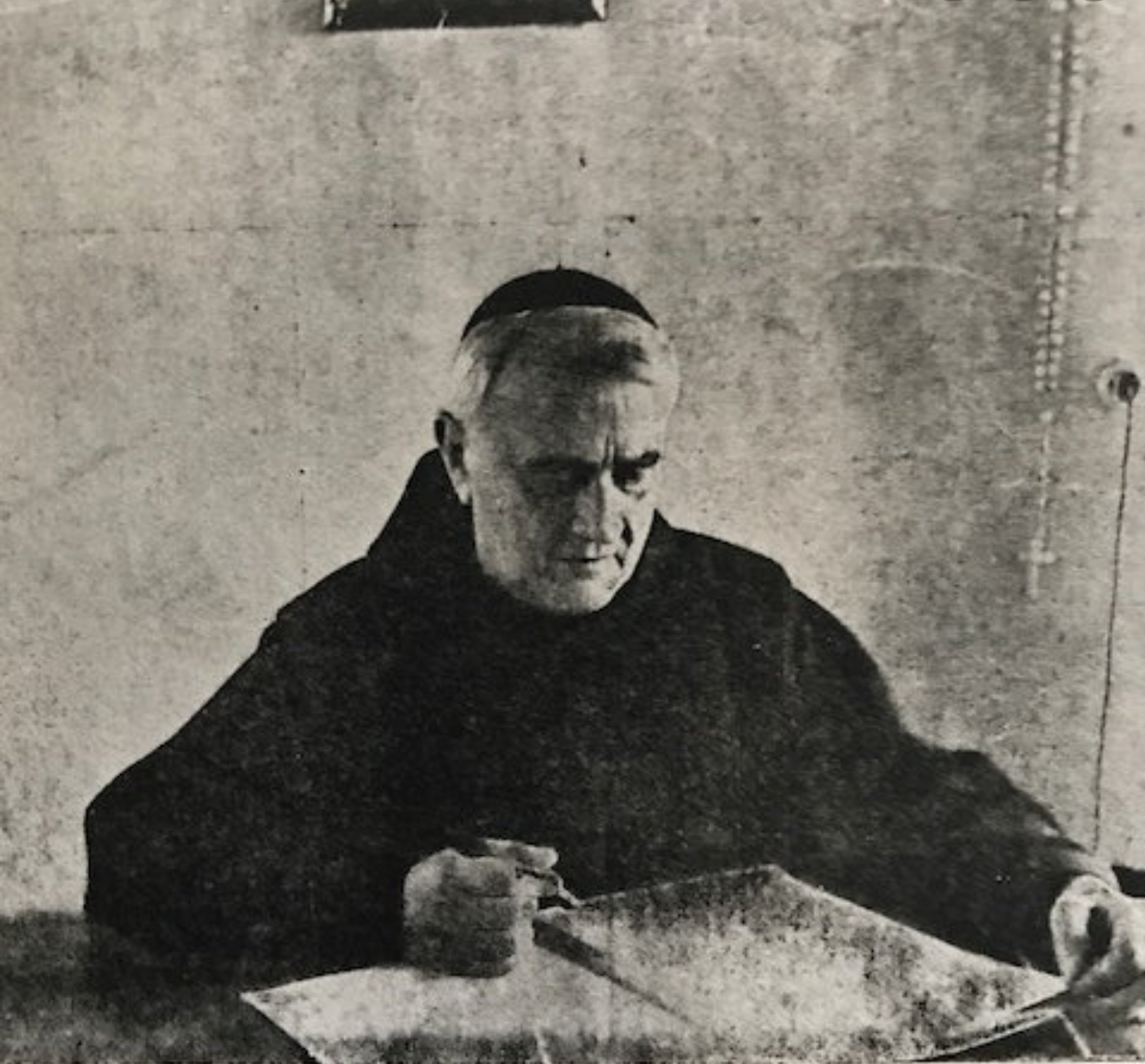
Who is Father Giuseppe Valentini?
One cannot speak of the elevation of Albanian culture without stopping at the contribution of Zef Valentini. An Italian, born in the outskirts of Padua, with degrees in Philosophy (1924) and Theology (1928), he arrived in Albania as a Jesuit missionary at the age of 20. In a very short time, he learned Albanian so well that he was indistinguishable from native Albanians. Between 1922 and 1932, he taught at the Jesuit Gymnasium of Shkodër. His first work on Albania, “The Xavierian College during its first 50 years,” was published in both Albanian and Italian. He published a study on the Albanian blood feud alongside the renowned Italian academic Fulvio Cordignano.
In 1940, he began a chronology of Albanian history from the year 313 to the 13th century. From 1932 to 1943, he directed the famous magazine “LEKA.” He left Albania following the persecution and murder of some of his fellow seminarians in Shkodër in late 1943. He then began the editing of the 30 volumes of his monumental work, “Albanian-Venetian Acts of the 14th-15th Centuries,” which sheds light on a crucial phase of Albanian history and brought the author international fame.
Unfortunately, he lived to see only the first 25 volumes published. In 1955, he became the Chair of the Albanian Language Department at the University of Palermo, where he founded and directed the “International Center for Albanian Studies.” Despite all this, such an important figure is little known by today’s generations due to the total censorship imposed on him by the communist regime.
Quotes about Father Zef Valentini
“Albanians! Love Father Valentini, for he loves you with all his heart. Appreciate him, for he works tirelessly to make your spiritual and artistic values known to the world. He is yours, for he has given his mind and soul to your cause.”
–Pope Paul VI, Rome, April 25, 1968
“He is today the greatest living albanologist. But the history of Albania will remember him above all as the scientist who, in love with the object of his studies – Albania – with a dedication open to all dangers, searched for and found it in archives and libraries…”/Memorie.al
– Ernest Koliqi, 1970
Main Works of Father Zef Valentini
- Albanian-Venetian Acts of the XIV-XV Centuries (Latin) (25 volumes)
- Albanian Legal Acts (Latin) (2 volumes)
- Community Right in the Albanian Legal Tradition (2 volumes)
- The Law of the Albanian Mountains (1880-1932)
- The Family in Traditional Albanian Law
- The Personal Statute of Albania in the Era of Skanderbeg
- Historical Walks in Northern Albania
- Nomenclator: Contributions to Albanian Chronology (2 volumes)
Translations into Albanian:
- “Saul” – Alfieri
- “Polyeucte” – Pierre Corneille
- “Biography” – Garcia Moreno