
Memorie.al / The story of the “Heroes of Vigu” do not seem to have ended –The story of the Heroes of Vigu does not seem to have ended. Five idealistic men, sons of the people, were sent on a mission to Mirdita, as a partisan unit that hurried to connect with other partisans in those areas, but at the entrance to the region, they were met by a murderous ambush. The area was under German occupation, and that is enough to justify their incursion. There have been comments of an ideological, and perhaps malevolent, nature that they were not killed by the Germans – and formally, this is true – but it cannot be said that they were not killed precisely by those who were in the service of the Quisling “puppet” government of Tirana.
They were killed neither by the people nor by the Kapidan (Chieftain) (as is sometimes written in the style of yesterday’s propaganda), otherwise, such a killing of whomever they might be would be treacherous in a place like Mirdita, which is the core of the Kanun (traditional customary law). Instead, they were killed by the Nazi occupation, as anti-fascists. There were residents who opposed that fivefold murder, as those young men had eaten their bread, but the local authorities argued that it was the government at war with them, not Vigu. And this is according to not only the film “The Red Pledge” but also witnesses who are still alive.
Then, as in legends, they were surrounded as if in a natural fortress and asked for water, but no one could break the encirclement, as they would be killed. It is a woman who suddenly appears on the battlefield, hurries to fill her water jug at a nearby spring, and brings the water to the five besieged men. Her name is Drane Jaku. The woman could not be killed or checked by anyone, as her honor would thus be violated. Therefore, the five men wrote a letter, signed it with their wartime pseudonyms, and this rare woman took it to the partisan headquarters.
This may be one of the most distinctive, dramatic stories of the entire Second World War, not only in Albania, but we have not had the time until today to deal with the archives of anti-fascism, as we have been more preoccupied with removing and erecting their busts. The case of the Heroes of Vigu is the most extreme in these two decades of democracy. One wonders what would have happened to these five partisans of World War II if they had been Russian, French, or American. Would they have been treated where they fell as they were in Albania?
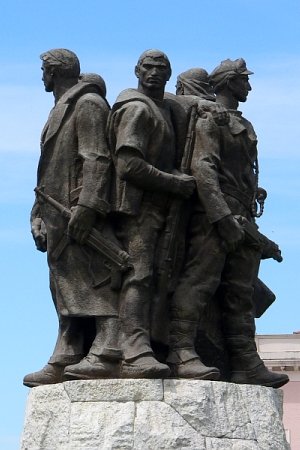
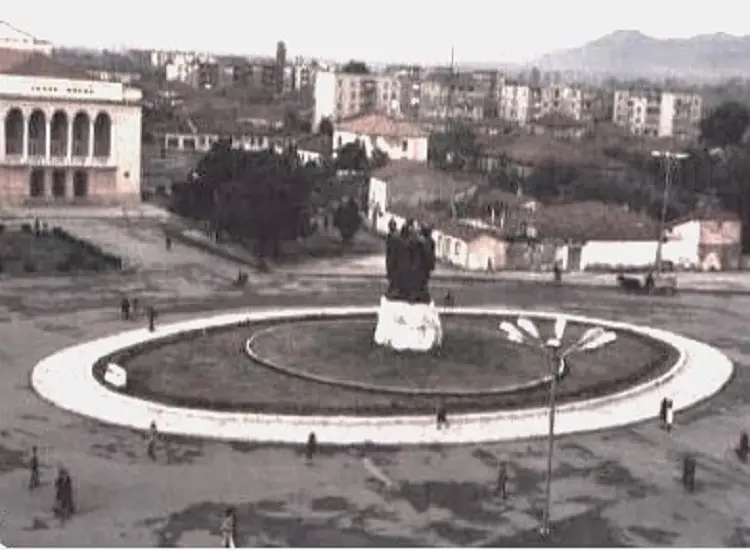
It does not do us honor that we still have not found the proper place for the statues and memorials of this people’s history, including that of the Heroes of Vigu (in which city square or at the place of falling?). But several mistakes have been made with these heroes, even when their relatively small memorial in 1983 was removed from the center of Shkodra and placed at a more prominent city intersection, in larger dimensions, to be more exposed; and when, in 2009, it was removed from there and ended up at the Martyrs’ Cemetery of Shkodra, on the periphery.
The current government again sought to return them to the city, placing them these days in a new square, at the intersection of the Shkodër-Koplik road. Time will tell if this movement, the third so far, is the last! Nevertheless, for this whole odyssey, only they bear no responsibility.
Based on this odyssey, this tearing down and setting up of heroes, one thing is certain: we still do not know how to treat history, its martyrs, and its fallen heroes! Seventy years have not been enough for them to find rest, because we lack a historical consciousness uninfluenced by politics. Today we can call the War whatever epithets we want, but this does not diminish the merited honor for the martyrs’ work.
Especially when, in the case of these five partisans, no homage is paid by local authorities, which is an institutional obligation, just as it is for Perlat Rexhepi, Branko Kadia, Jordan Misja, etc. Meanwhile, some veteran organizations treat the heroes of the War as their uncles, being the only ones to lay wreaths and give the same speeches for seventy years now.
It is ridiculous, both the forgetting of their commemoration by right-wing governments and municipalities, due to political-partisan inspiration, and the appropriation of the martyrs’ wreaths by left-wing governments and municipalities, also due to political-partisan inspiration of the other side, without considering that it is not only National Liberation martyrs who await flowers, but also the nationalist ones of the War, however few, who also deserve wreaths.
But the latter are likely not even officially declared as such by the relevant bodies. On this 70th anniversary, it is moving to hear veterans, like Rahman Përllaku, speak about the anti-fascist epic, but no academic publication has been made in these years, not even as many volumes as “Unextinguished Stars” or the histories of the partisan brigades. The dignity of the War cannot be withered or avoided. Anti-fascism is one of the greatest merits of the Albanians throughout their entire history.
Naturally, this is not about organizing parades, like the old ones, nor about festive gigantomania, but about doing as much and as properly as required. Rarely has any television station produced a program about this event, where in this case, a confrontation of “sides” is not the right approach, because fundamentally in the War, there were no sides among Albanians, but there was an Albanian side that fought against another side, fascist or Nazi.
This does not mean we should not focus on the untold stories of the War era; on the contrary, the more unknown archival testimonies, the better, so that when historians speak in the future, there will be no more dark spots. The War and the dictatorship that was established afterward are two different things. The War was fought by 70,000 Albanians, most without a party card, while the class war was carried out by the PPSH (Party of Labour of Albania), as the vanguard detachment of the working class.
The dictatorship trampled on the ideals of the War, turning Tepelena into a place of mass internment and Spaç into a prison of freedom. Where are the Heroes of Vigu and where are the “sergeant-dads” of the dictatorship of the proletariat, who filled Albania with martyrs of democratic ideals? Civilized people know how to pay homage to the War. Art students from Shkodra recently journeyed to Gëziq and Shpal, near the monuments, where they performed music.
But there were no young people to light partisan fires. Perhaps someone or some will journey to Vigu. And when they go there, they will look for the image of not only Ahmet Haxhia, Naim Gjylbegu, Ndoc Mazi, Hydajet Lezha, and Ndoc Deda, but also that of the Mirdita woman, dressed in white, Drane Jaku. She will still be walking through the blizzard of gunfire, with the water jug in her hands, to quench the thirst of the besieged.
That noble Albanian woman, who defied the ambush to save five human lives… and whose photograph is nowhere in the liberation photo archive, must not be forgotten. She would have performed that act for any Albanian, as this was her Christian upbringing. She did not know what a partisan formation was who commanded it, she did not know the name of the commander or the commissioner; for her, and only one thing mattered: to save five people.
Even if they were of a different nationality. In those circumstances, or in other circumstances. Her message is only this. Just as that woman had stepped between “men in blood feud” and stopped their rifles. But this time, fatally, she could not stop the blood…!
The memorial of the Heroes of Vigu remained suspended! The right place had to be found for it, and not just a place to carry out the next political displacement. But was the right place found this time, by pushing it towards Koplik?! In our opinion, no. Usually, the memorials of the martyrs are placed where they fell. Gjeçov’s statue is erected in Zym of Hasi. Shotë Galica’s statue, in Fushë-Krujë.
But should those five be taken to Vigu? Perhaps yes! … Heroes do not go to the people, but the people go to the heroes, where they fell. It was part of the propaganda to “passportize” them into the cities. Look at the monuments of the last War in Kosovo; they are all where the fighters fell. Not only the martyrs but also the prominent figures of culture are placed where they made a name for themselves. Ndre Mjeda has his statue in Kukël. Lasgush Poradeci in Pogradec. Aleksandër Xhuvani in Elbasan. Eqerem Çabej in Gjirokastër.
Places with which they are identified. If there is no modern infrastructure to Vigu, there are several reasons why that road should be built as soon as possible, because it is part of the old traditional road, Shkodër-Orosh-Prizren, for the revitalization of those abandoned areas and the development of tourism, because a castle of Skanderbeg (of Kastri) is located there, and naturally also because it leads to the place where partisan heroism left its mark.
Let’s take them there to honor them and not to waste them…! Where are the Councillors of Hekal? The Martyrs of Pojska? The Martyrs of Grehoti? The Resistance fighters of Postriba? The Hero of Prekaz, Adem Jashari? They have their memorials where they fought and fell. The name of the Heroes of Vigu is connected only with Vigu, and there they weigh heavily, like anyone in their own place.
This does not make them lesser or more peripheral. It has rightly been said that Shkodra, Durrësi, Tirana, Korça, Gjirokastra, and others still do not have the statues of the Illyrian kings, the princes of Arbëria, Lekë Dukagjini, Papa Albani, and the great Rilindas (National Renaissance figures), not to mention those of the martyrs and heroes of the 20th century.
Vigu is near Vau i Dejës, which now enjoys the status of a large municipality, which will surely prioritize Vigu, inextricably linked with the name of its five heroes. Because I envision them there, somewhere in the Vau i Dejës-Vigu “roundabout,” never to be moved again! The Koplik roundabout might be more suitable for Dedë Gjo Luli…! Memorie.al