By Father Zef Pllumi
Memorie.al / November 28, 1944, was a cold, somber day – perhaps the darkest since the declaration of independence. Since childhood, we had celebrated this day with light, colors, songs, cheers, and flags. Flags had been raised on church bell towers, but they stood as if lonely, and that day, no one looked at them. The Germans had all retreated from their barracks, offices, and guard posts toward Montenegro. Shkodra awaited the entry of the partisans, who were waiting on the hills of Bardhaj, in Postripa, and beyond the Bahçallek Bridge for the full departure of the Germans.
That night, the sound of several massive explosions was heard, so powerful that windows shattered in many houses. A German motorcycle had returned from Hani i Hotit to ignite the mines placed under the bridges connecting the city to the plains. After those thunders that announced the final departure of the Germans, no one slept again during that long night.
In the Franciscan Monastery where I lived, a premonition prevailed that at that very moment, the West was departing from us by a centuries-long stride; that against Catholicism in Albania, a war would begin – one that would likely endanger the very existence of the Catholic element in Albania.
For the Catholic Clergy, this was not unexpected; indeed, we can say it was foreseen. Many years prior, we had begun preparing the youth through lessons and conferences to face a persecution so cruel it might cost us our lives…! During the Morning Prayer hour, from 5:00 to 6:00, the entire Franciscan community gathered with their superior, Father Mati Prendushi, and through special prayers, we sought the protection of the Almighty God. The Catholic Church in Albania found itself in the Garden of Gethsemane:
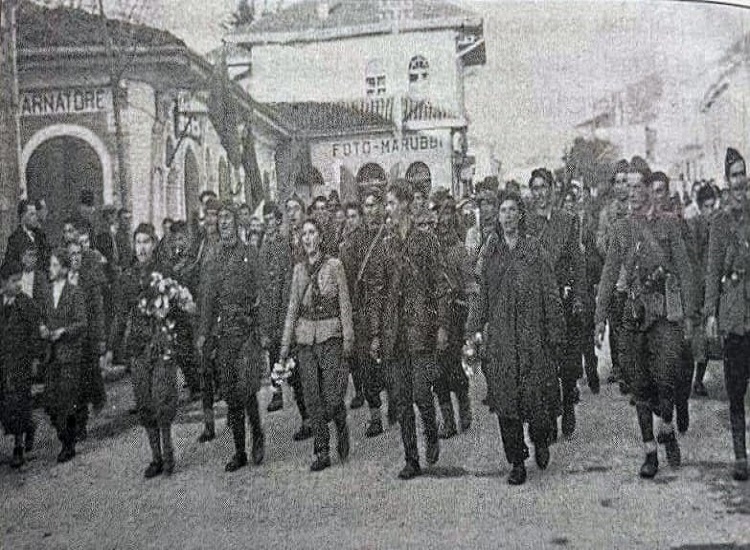
“O Lord, if it be possible, let this cup pass from me!” This was the prayer, but God’s will was done! November 29 dawned dark and cold. Between 10:30 and 11:00 AM, the partisan brigade entered the main streets of the city, led by Major Gjin Marku: to the national flag they brandished in front, they had added a red star.
We watched from behind the window shutters. To tell the truth, it must be testified that the Catholic population of the city did not participate in that manifestation, save for a few rare individuals known to be pro-communist, while a large part of the Muslim population, dressed in festive clothes, gave the appearance of a joyful welcome. The partisan army, dressed in all sorts of foreign uniforms, appeared as an irregular, ragged, hungry army in sandals (opinga). What made the greatest impression were the female partisans. What kind of mothers could those women be, with rifles on their shoulders?!
In the barracks, they had nothing to do, as they had neither bedding nor food; therefore, they were distributed among families: 3 in some houses, 6-7 in others. The people sheltered them, fed them, and became infested with parasites. But they were not people of God: they peered sneakily through the houses, looking for any hidden Germans or “reactionaries.” Their first task was putting the prisons into operation, which were filled to the brim with innocent people.
They didn’t even have bread to give them, so families had to bring it; otherwise, they would die. The food sent by families was mostly consumed by the hungry partisans rather than those wretched, tortured souls. Immediately, rumors began to spread: they have killed X or Y; or about others who had disappeared without a trace. Who was the head of this government?
The name of Enver Hoxha began to be mentioned – until then, entirely unknown to the people of Northern Albania. During the month of December, the new power in Albania was established, though it wasn’t clear if it was military or civil: everyone acted as if they were in charge, yet no one had real power except for the various partisan commanders who had settled in different houses.
The brigades in Shkodra reorganized, and thus Major Gjin Marku, with the first ones who arrived, crossed the Albanian border to provide “brotherly aid” to the peoples of Yugoslavia. Shkodra was filled with partisan brigades, and people wondered where so many soldiers had come from – more than even the foreign armies had ever brought! The partisans said they had come to chase the German all the way to Berlin, but they were shoeless. Generally, they were people one could not talk to, with poor behavior: they ate the bread and then overturned the cup (they were ungrateful). Shkodra had seen many foreign armies, but never one like this!
Immediately after that November 29, 1944, traffic began on the Shkodra-Podgorica road like never before, at a time when communication with Tirana was extremely difficult due to the destroyed bridges, where floating rafts and partisan guards began to be placed. Thus, Montenegrins and Albanians circulated among themselves without borders. Who was the true ruler of Albania? The answer was given by the “trobojnica” (the tricolor).
Numerous Yugoslav tricolor flags fluttered in every street, on every state building, and in every house. Where were so many of those flags found so quickly – flags that the people looked upon with anger, for they signaled a new enslavement of the Albanian nation?!
As soon as the schools opened, in all of them without exception, they came to teach the singing of that foreign flag’s hymn: “Ei sllovenski joshte zhivi”, “ço bajrak në vije”, “zhivi zhivi jugoslovenski”, as well as “Ide druzhe Tito preko Albanie… preko Albanie…”! (To this day, I do not know their meaning or how they are written, but they have remained in my ear since that time along with their melodies).
Our own national anthems were heard no more. A few days passed. Only on the bell tower of the Franciscan church, which dominated the center of the city, the “trobojnica” had not yet been placed. The flag of Albania – the real one, without axes and without a star – shook and struggled, somber and lonely: it saw no other like itself. It tried to withstand the storms of that communist winter: thus, tattered and ragged, it fluttered incessantly. One December day, two partisans knocked on the door of the Franciscan Monastery: “We want to go up to the bell tower!”
The porter called me, because I went up there every day to wind the clock, which the whole of Shkodra looked upon. In truth, Father Filip Mazreku was in charge of this duty; he had been the last to place the true flag of the Albanians on November 27, 1944, but since I was young and ready, he entrusted me with the keys to the bell tower. I ran and found Father Filip and told him that the partisans were at the gate and wanted the key.
“Listen,” he said to me, “I cannot bear to see them! You know they made my brother disappear in Tirana, without a sign, without a trace. We don’t even know where his grave is to say a prayer or send a flower. Please, go with them, you have the keys. But listen here: do not leave them alone for a single moment. God knows what traps they might set?!”
“We are sent by the command to remove that rag fluttering up there. It is a shame,” they said, “that right over the main square of the city that cloth which doesn’t even has the partisan star should flutter!”
“Well, we have no other!”
“We have brought new ones, brand new. Here is the flag of sister Yugoslavia, and this one with the partisan star!”
“Two flags?” I asked. “But we have only one flagpole; two flags have never been placed!”
“Why, didn’t you place the Italian one?!”
“Never!”
“Nor the Vatican one?”
“No, never!”
“Then what shall we do?!”
“As you wish.”
“Fine, we will return; we will bring another pole, so wait for us here and don’t go anywhere!”
When they returned a second time with the other pole, they asked me for the key. I climbed up with them, above the clock, where the flag unfolded. They were amazed looking at the city all around.
“Uaaa! How beautiful?!”
From there, you had Shkodra in the palm of your hand. After acquainting themselves with the city view, they removed the pole from the hook and placed the new flag with the partisan star. My whole body shuddered: that brave, highland, ragged flag remained there like a corpse. But when they wanted to unfold the Yugoslav flag, they found no hook.
“Where shall we place the pole? There is no hook here. Damn it!” they said, then asked: “Do you have some wire so we can tie it here to the railing?”
“No, we don’t. And look, even if we did, wire won’t withstand the storms and tempests up here; we are high up; it needs a hook!”
“Damn it, damn it! What a mess! We need to make a hook. Why didn’t you tell us earlier?”
“I didn’t know either, I didn’t think of it!”
“Stay here, we will bring a blacksmith.”
They went down and left.
After an hour, they returned with a blacksmith. He installed two more hooks. On the other side of the Albanian flag, the Yugoslav flag was unfolded. Two flags. Below, in the center of the city, in the newly built house of the great merchant Zef Koka, was the command of commands: The Party Committee. The two partisans in overcoats, from the bell tower, called out to someone down there.
He stood in the street and gave signals with his hands. Again, they removed the flags and swapped their places: there, in the place where the Albanian flag previously fluttered, the Yugoslav flag was unfolded. Meanwhile, on the other side, the partisan flag was moved, its view largely obstructed by the church’s dome.
During dinner, in the refectory of the Franciscan Monastery, a total silence was maintained, as if someone in the family had died. No one opened their mouth. After dinner, Father Mati Prendushi called me aside and asked:
“Do you have the keys to the bell tower?”
“Yes, Father Filip left them with me to wind the clock.”
“Did you put up the Yugoslav flag?”
“No, absolutely not. Two partisans came and put it up.”
“Do you know,” he said to me, “that in that very spot on June 12, 1913, the Flag of Skanderbeg was raised for the first time in Shkodra, and the friars guarded it with rifles in hand? Do you know that Father Gjergj Fishta was sentenced to death for that flag? Do you know that even the Montenegrins, when they entered Shkodra in 1915, did not unfold that flag? Do you know…?!”
“Father,” I said, “I know it all. Those who put the Yugoslav flag there were two partisans with rifles, sent by the command. What was I to do: get killed by them?!”
“No, no, I am not saying it is your fault. But oh, what a great shame! I wish I had never lived to see this day! How did it come to be that the Yugoslav flag flutters over our church towers? O Lord, look and judge…! Faithless people have only their bellies! But what did those partisans say? Did it make an impression on them, how did they feel when they placed the Yugoslav flag?”
“They said they were carrying out the command’s order; furthermore, they talked among themselves that up there in the bell tower, a machine gun should be placed!”
“A machine gun?!”
“Yes, a machine gun, because they said the bell tower controls the entire city.”
“We have always known what kind of ‘freedom’ the Serbs bring us! But what kind of Albanians are these partisans who fight for the Slavs? They have even sent our boys to be slaughtered there!… Woe to Albania, in whose hands it has fallen!”
A general paralysis fell over normal life. There were no longer roads, telephones, shops, trade, offices, or official documents. Occasionally, only a small piece of paper with the partisan stamp would open all doors. Terrorized Albania had fallen into a coma. Learned people knew nothing anymore, and ignorant people held everything in their hands: that which was unknown!
After a few days, military operations began within the city: searches. All the houses in the city, without exception, were searched by armed partisans, in every corner, every cellar, every chimney, and every stable. Under the pretext of searching for “criminals” and “reactionaries,” these actions were intended to sow terror throughout the population; therefore, in almost all cases, they were accompanied by executions and imprisonments.
Many, to escape the terror, fled to the mountains or went underground, or hid with a loyal friend. The punishments for those who sheltered “reactionaries” were terrible tortures and execution, which sometimes happened simply because a person’s name was similar to that of someone else they were seeking. Most of those people, military or civilian, entrusted with tasks and responsibilities, were illiterate or semi-illiterate.
In early December 1944, an important group of 7-8 people arrived at the Franciscan Monastery of Gjuhadol, accompanied by Kolë Jakova; it was said that this group was headed by Nako Spiru. They brought with them many orders, such as the closure of the cultural magazine “Hylli i Dritës” (The Star of Light), as well as all other religious magazines like “Zani i Shna Ndout”, “Zgjimi i djelmnisë”, “Bijat e Zojës”, etc. They ordered the closure of the printing house, as well as all religious associations.
They also “visited” the Library and Museum of Father Shtjefën Gjeçovi. Kola asked for Gjeçovi’s ring. This was what an antique ring was called, likely from the 1st century, made of gold, a double-crafted masterpiece, featuring a high stone disproportionate to the ring. It was said that a representative of the British Museum had offered 14,000 gold sovereigns for it. Meanwhile, Kola took it and issued a receipt. / Memorie.al