By Ali Buzra
Part Six
– LIFE UNDER PRESSURE AND SUFFERING –
(EVALUATIONS, COMMENTS, NARRATIVES)
Memorie.al / At the request and desire of the author, Ali Buzra – as his editor and first reader – I will briefly share with you what I experienced during my encounter with this book. This is his second work (following the book “Gizaveshi through the years”) and it naturally continues his established writing style. The sincerity and candor of the narration, the simple language without modifications, the accuracy and precision of the episodes, and the absence of deliberate after-the-fact imaginative processing have, in my opinion, served the author positively. He comes to the reader in his original form, inviting us to at least recognize unknown human fates and sorrows – whether encountered by chance or not – leaving us to reflect as a beginning of awareness toward a catharsis so necessary for the Albanian conscience.
Continued from the previous issue
PART TWO: NOBLE FAMILIES OF LIBRAZHD UNDER THE DICTATORSHIP
In the following chapters, we will describe some of the tragic episodes of the Librazhd nobility in the area where I reside, under the pressure of the totalitarian dictatorship. We will highlight how the communist power was constantly involved in open or secret conflicts with these individuals, their tribes, and their families. Furthermore, I will sometimes describe events in detail (apologies to the reader for details that may seem insignificant) with the aim of being as realistic as possible to the authentic testimonies of people whose family branches were caught in the senseless carnage of an often absurd situation.
Additionally, I feel it is an obligation that their contribution, forgotten until now, becomes part of the memory – not only for the history of these families and tribes but beyond. For this reason, I am grateful to all those who entrusted me with that part of their oral heritage to return it to them through this book.
Without claiming to cover everything related to these tribes and individuals, I will focus on their origins (which in most cases became determining factors for their future fate) and their role in this struggle, up to the persecution they faced for the same mindsets and reasons mentioned in the general overview above. I will begin my narration with one of the most prominent families, that of Mustë Balliu, from the village of Funarës in the Çermenika region.
CHAPTER I: THE LEGEND OF MUSTË BALLIU AND THE PRIDE OF THE TRIBE
1.1 The origin of the Balliu tribe. Mustë Balliu, a symbol of anti-Ottoman resistance.
The village of Funarës is located in the heart of Çermenika. It has a plateau and hilly terrain. On all sides, its slopes are covered with forests of oak, ash, and hornbeam, which provide excellent grazing for small livestock. Inside lie flat and slightly sloping lands that are fertile, enabling the cultivation of many agricultural crops, skillfully utilized by the traditional inhabitants of the village. The people of Funarës are skilled farmers, gardeners, and livestock herders.
Under favorable climatic conditions, facing the sunrise, the village has been inhabited since antiquity and is thought to have served as a connecting node between Elbasan, the Shkumbin Valley, and the Highlands of Çermenika and Martanesh. Currently, the village, with a considerable territorial extension, consists of the neighborhoods: “Mashna”, “Lukajt”, “Balliajt”, “Kodra”, and “Funar”. Since the end of the 18th century and the beginning of the 19th century, the Balliu tribe has been known as the most influential tribe, not only in the village but in the entire Çermenika area.
Based on folklore as well as the testimonies of the elderly, it appears that part of the tribe is indigenous, while the other part originates from Martanesh. It is precisely these families who experienced suffering and savage persecution by the dictatorial communist regime after the country’s liberation. From the study conducted and the data obtained regarding the origin of the Ballius, the following results:
Around the mid-18th century, in the village of Martanesh in Mat, there were two powerful tribes: Zguri and Lomajt, who entered into a blood feud with each other. After many years of hostility and blood vengeance on both sides, the Lomajt broke the Zguri tribe, leaving only one son named Sali Zguri. Left alone and without support, he fled abroad, somewhere in the Albanian villages of today’s Macedonia. There he worked and lived alone for many years. After passing his sixties, seeing that he was aging and driven by longing for his homeland, he decided to return to his birthplace.
During his journey, he stopped in the village of Funarës and sought hospitality as a guest from the local Balliu tribe. At that time, the Ballius were three brothers: Islam, Ismail, and Ymer. Today, their descendants are: from Islam comes the Myftari tribe; from Ismail, the Malajt; and from Ymer, the Dushku tribe. The three aforementioned brothers, upon learning the history of the newcomer and the danger he might face if he went to Martanesh, decided to accept him to live with them. Thus, they gave him three dynyms of land, while the women and children of the family served him.
After a few years, the three brothers decided to marry Sali Zguri. They gave him as a wife a 40-year-old woman from the village of Neshtë, from the Cysa tribe. The girl was their niece. She was bald, and for this reason, she had remained unmarried until that age. Sali accepted the marriage without hesitation, as at this advanced age, his wife served him. One day, Sali fell seriously ill. He was now nearly 70 years old. In his final moments, he asked for his wife to come to the room. Those present told him that his wife had just given birth to a boy. Before passing away, the old man left a final wish that they name him Mustë.
A year later, his wife, the boy’s mother, also passed away. Little Mustë grew up as an orphan without a mother or father. He was a very agile and bright boy. Even at a young age, they took him to assemblies (kuvende) and he stayed in the men’s chambers. Thus, Musta matured and became a man ahead of his time. Upon reaching adulthood, he married a girl from the Doda tribe in the village of Lunik. He had children and built a new house, but Musta was not satisfied. In the “Funar” neighborhood on the border with Neshta, the village had communal land that served mostly as pasture, but Musta had not been given a share there.
He requested the village to allow him to buy land in the “Funar” neighborhood, but they refused. In these circumstances, Musta used the upper part of the house made of wooden planks and aimed his weapon at the village houses, declaring: “Either gives me land in ‘Funar’, or I will wipe you all out.” The Ottoman government administration was notified and came to the village, but Musta became an outlaw (kaçak). After the soldiers left, he would return home and again target the village houses, firing his weapon. The village headman contacted him several times, but the problem was not being resolved. The government of the time decided to intern him.
After hearing about this, Musta turned to the village hoxha, Hoxhë Disha, saying: “I am looking to buy land in Funar to be equal with the others. Settle this with the village or we will clash together.” Under these conditions, seeing his persistence, Hoxhë Disha told the government officials (mëdyrët) that they should not intern Musta’s family, as they would resolve the problem themselves. Thus, he gathered the village, which finally agreed to give Musta three dynyms of land in “Funar”. The money received was used for the village mosque. Thus, with the intervention of Hoxhë Disha, the conflict between the village and Mustë Balliu was ended.
Later, Musta built a three-story house in the village, while in “Funar” he built a shepherd’s hut. He married again, as was the custom at that time, taking a wife from the Disha family and another from the Goma family in Funarës. Economically, Musta was well-off, but there was still no peace for him. The Turkish government increased taxes on the population, and he began to oppose them, forcibly expelling the tax collectors from the village. By now, the village supported and loved him. Valuing his courage, bravery, wisdom, and his predisposition to protect the village, they elected him headman (kryeplak).
He created his own band (çeta) and clashed several times with Turkish forces. Since the tax collectors were meeting resistance in Funarës, one day many soldiers landed there, and Musta was forced to become an outlaw. He was forced to remain a fugitive for over three years, as the military forces, which periodically surrounded the village, insisted on capturing him. During these years, he stayed in a cave located on the face of a cliff, which even today is called “Mustë Balliu’s Cave”. In later years, objects used by him during his years as an outlaw were found in the cave.
The position of the cave was very suitable for self-defense. It was difficult to climb there; Musta would climb an ash tree located nearby and enter the cave. From there, he descended from time to time to resupply with food. One day, while Musta was outside the cave, he was caught by surprise by Turkish soldiers and sent to Elbasan. He was taken to court, and the kadi (judge) sentenced him to 3 years in prison in Anatolia. After his release from prison, he returned home and passed away a few years later. Mustë Balliu, the symbol of anti-Ottoman resistance for many years in the Çermenika area, left 7 sons: Ibrahim, Mahmut, Hysen, Sali, Osman, Ahmet, and Hasan.
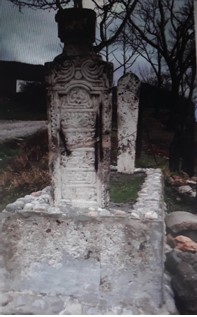
Almost nothing was written about Mustë Balliu during the years of the communist regime. The reason may be the fact that his tribe was persecuted during those years. It is necessary to research and clarify the details of his figure as one of the most prominent leaders of the Çermenika area. His grave is located at the bend of the road to Zdrajsh, arranged by his sons with carved stones and an inscription in the Turkish language. Mustë Balliu’s sons constitute the family trunk of today’s Ballius. Over the years, they increased their land area by purchasing and clearing new land, which today reaches dozens of hectares.
1.2 The Ballius: educated people and local elite in Çermenika, positioned with the National Front (Balli Kombëtar).
After the declaration of Independence, the Ballius, now an influential tribe with a good economic base, had established ties and friendships with the most prominent families in the country, such as in Polis, Dragostunjë, Letëm, Qarrishtë, Dorëz, Gizavesh, and as far as Elbasan, Dibër, Mat, Macedonia, etc. During the years of Zog’s regime, some of the Balliu sons were educated, mainly in religious schooling. Among them, Jakup Balliu, Azis Balliu, and Hasan Balliu were initially sent to Polis. They had a friendship with the Muzhaqi tribe and stayed there for three years in the house of Met Muzhaqi (the father of Nezir Muzhaqi), while receiving religious lessons from Hoxhë Zharri.
Later, they studied for another 4 years in Ohrid, where they graduated, as did many other Albanian compatriots. For the time, the Ballius were also distinguished as intellectuals in the area. Thus, Ismail Balliu was an officer of the Albanian Kingdom with the rank of sergeant during Zog’s time. After the First World War, the first political groupings began to emerge in Albania, though not yet consolidated. These were the People’s Party and the Progressive Party, in which people joined not so much for political conviction, but simply as a positioning according to interests. In the Elbasan District, the groupings were divided between the Pasha (Aqif Pashë Biçaku) and the Bey (Shefqet Vërlaci). The leaders of our villages positioned themselves according to the influence the Pasha and the Bey had in different areas.
Traditionally, from Zdrajsh to deep into Çermenika, the village elites were linked with the Pasha, while Funarës, Zgosht, Letëm, Dorëz, Gizavesh, and up to Dragostunjë were linked with the Bey. The fascist invasion of the country on April 7, 1939, as everywhere in Albania, sparked indignation and anger in Funarës as well. Once this invasion became a fait accompli, the Albanian elite took different positions. Shefqet Vërlaci accepted the post of Prime Minister of Albania, now under the Italian crown. Shefqet Vërlaci was the richest man in Albania. He owned about 3,700 hectares of land and was the brother-in-law of Aqif Pashë Elbasani (Biçakçiu), his political opponent.
Although he accepted the post, a political conflict began between him and the Italians because he did not want to submit to Italian tutelage. For this, the Italian Foreign Minister, Count Ciano, wrote in his diary: “If I had known him earlier, I would not have supported his appointment. He is an ill-tempered man and will bother us.” Thus, in 1941, as a result of the conflicts he had with Jacomoni, the Italian viceroy in Albania, the latter requested his replacement, appointing Mustafa Kruja.
It was natural that Shefqet Vërlaci, during his governance, would place trusted people and his friends in the administration. The Ballius were his friends. Thus, Ismail Balliu, during the Italian period, was appointed deputy post commander in Zdrajsh, while Hasan Balliu was appointed with the military rank of second lieutenant. In 1943, nationalist bands (çeta) were established in many villages of Librazhd for the purpose of self-defense. Most of them were affiliated with the National Front Party (Balli Kombëtar), a party led at the national level by the prominent intellectual Mit’hat Frashëri. Hasan Balliu was placed at the head of the Balli band in Funarës.
This band numbered about 40-50 armed men. Shefqet Vërlaci and Lush Leshanaku, who maintained ties with most of the bands in the Librazhd areas, helped in arming the band. Lush Leshanaku, a determined anti-communist from the village of Bradashesh in Elbasan and a former physical education professor at the Shkodra gymnasium, was a supporter of the Elbasani bey. During the war period in the village, it does not appear that any killings were carried out for political sides; on the contrary, order and peace were maintained. In Zdrajsh, it is said that a clash occurred between the Balli forces and the Çermenika partisan formation, where the Ballius were also present, but there were no casualties from either side.
Apparently, both sides, despite their opposing political beliefs at the time, avoided armed conflict—a merit belonging to both wings. We obtained an opinion about the war period, for the village of Zdrajsh as well as for the Balliu tribe, in 2017 from the 90-year-old Aqif Deda from the village of Zdrajsh, living in Librazhd. He testifies that the Balli chairman in Zdrajsh was Tahir Hoxha, who was linked with Shefqet Vërlaci. His band had about 25-30 people equipped with weapons. He did not allow reprisals to be carried out in Zdrajsh. Tahir was friends with Isak Alla, the Balli commander of the village of Zgosht. Later, Tahir Hoxha’s son joined the First Partisan Brigade.
After liberation, Tahir was arrested and sentenced to 7 years in prison without any reason. His other son, Ramazan Hoxha, was treated as a “declassed” person and was labeled a kulak for many years. There was an attempt at an engagement in the “Funar” neighborhood of Zdrajsh with the partisans, but without damage. The chairman of the National Liberation Council in Zdrajsh was Rexhep Kaca, over 50 years old. Osman Leka was also with the Balli, and he also helped the Movement. “The Ballius of Funarës were noble,” he continues. “The Balli commander, Hasan Balliu, although holding a military rank during the Italian period, behaved well not only in Funarës but also in Zdrajsh. His son Hamit Balliu saved partisans. Likewise, Ismail Balliu, who was on duty in Zdrajsh during the Italian period, behaved well.
There is no fact that Ismail Balliu committed any acts of terror against the population during the war; on the contrary, he is known as a loyal, prudent man and a protector of the village and the area from wartime reprisals. One of the men of the Balliu tribe who enjoyed indisputable authority was Azis Balliu. He was distinguished as a calm, patient, loyal man, impartial in judgment, but also courageous and brave in defense of the honor of his tribe and family. So I say with full conviction – testifies Aqif Deda – that the Ballius were men of their word (burra të besës), patriots, and noble. They did no harm to the people.”
Being an influential tribe, the General Staff of the National Liberation Army tasked Sami Baholli and Kadri Hoxha to talk with them to bring them over to the Communist Party. The envoys made contact with Ismail Balliu, Azis Balliu, and Hasan Balliu. None of them gave their word, while their answer was: “We know that you will win, but we cannot join communism.”
An event known to all the elderly in Funarës, which speaks to their manly and generous stance, is the one involving the family of Hasan Balliu, the Balli commander of this village. In 1944, when relations between the Communist Party (PKSH) and the National Front (Balli Kombëtar) were extremely strained for the reasons analyzed above, and when there were armed confrontations between the parties in many regions of the country, Hamit Balliu, Hasan’s son, found two partisans in a stream near the village – unfortunately, mistreated by a heartless Ballist.
Hamit heard noises in the stream and went there. He spoke harshly to the person who was torturing them. The partisans were in serious health condition. He took them home immediately and told his father about their grave condition. For over two weeks, Hasan Balliu’s family cared for the partisans until they recovered. Afterward, the other son Sherif, Hamit’s brother, was tasked with escorting them to the place called “Bishti i Dheut” and from there they could go wherever they wanted. / Memorie.al