
By Luan Rama
Part One
Memorie.al / The history of the Durazzo family is undoubtedly one of the most brilliant and extraordinary stories of the Albanian diaspora throughout the centuries. Firstly, because this history, which originates in the 14th century, has not only withstood time but also constitutes one of the most astonishing contrasts. In the book Distant In-Laws (Argeta, 2001), I wrote a chapter about the unique life and adventure of this family, which in 1389 – at the time of the “Battle of the Swans” (Battle of Kosovo) of the Serbian-Albanian-Hungarian coalition against the Ottoman hordes – had set off from the shores of Durrës toward the northern Adriatic. Documents of the time confirm this history, passed down in this family from one generation to the next.
It is written about the family of Giorgio Durazzo that: “along with his wife and three sons, he had left Durrës because of the Ottoman hordes. In the port of Messina, they were held as slaves and sold for 40 liras, but upon arriving in Genoa, they requested their freedom from the city’s governor, who granted it to them.”
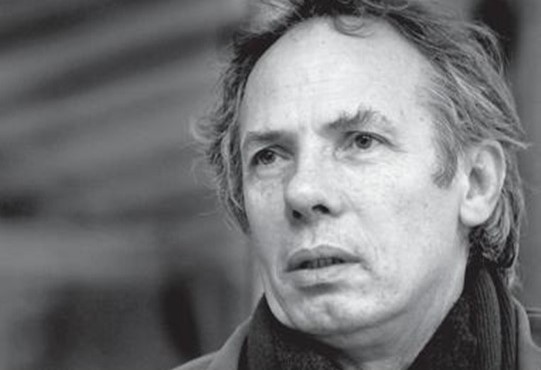
In 1999, chance led me to meet one of the last descendants of this family in Paris, Giuseppe Durazzo, who shortly thereafter would become the “Honorary Consul” of Albania in the Principality of Monaco. I also met his wife, Angela Durazzo, a journalist, whom I immediately encouraged to write a book on the family’s history. The documents still kept by the Durazzos were numerous and unknown, as were the vast collections of paintings by great European masters that have already entered the global history of painting.
We made the first visit to Albania together. For the first time, they would step on the land of their ancestors, in the city of Durrës, amazed by the numerous traces of an ancient civilization. After two years of extensive research, Angela Durazzo published the book I Durazzo – da schiavi a dogi della Repubblica di Genova (“The Durazzos – from Slaves to Doges of the Republic of Genoa”), which will be presented at the end of September this year, alongside the exhibition already open in Genoa: “From Tintoretto to Rubens – the Durazzo Family Collection,” featuring paintings from the famous collections of this family so well-known across Europe in past centuries.
It seems surprising, but facts and history prove a close connection between the Durazzo family and the great painter Van Dyck, who stayed in Genoa during the years 1621–1627, where he created a large number of works that, would remain in the history of world painting. It was, in fact, his father who awakened in the young painter the desire to travel to Genoa, where at that time there was a colony of Flemish painters with whom he had close ties. In fact, many Northern European painters came to Italy at that time to see Da Vinci, Raphael, Veronese, Uccello, Tintoretto, and other painters of the quattrocento and later.
A biographer of Anthony van Dyck writes that the reason for Van Dyck’s departure to Italy was his relationship with the wife of Rubens, who was also his master. For several years, Van Dyck had worked in the great master’s studio, as Rubens could not keep up with the demands made by high aristocrats. Amsterdam, Bruges, and Antwerp were then major centers of art, trade, culture, philosophy, and the utopia represented by Erasmus.
This is why a series of canvases held as Rubens’ were actually painted by Van Dyck. As 17th-century art historians testify, Van Dyck (1599–1641) would set off for Genoa in the autumn of 1621. The Genoese art historian of the 17th century, Soprani, writes that the Flemish artist arrived in Genoa in the autumn of 1621, settling in the house of two well-known Flemish painters: Lucas and Cornelis de Wael.
During that period, Genoa and Antwerp (Van Dyck’s birthplace) were in very close relations and conducted extraordinary trade between them. The Genoese were among the wealthiest in Europe thanks to the textile trade, in which the Durazzo family was particularly involved (in Spain alone, there were 20,000 Genoese bankers). The Genoese fleet was famous worldwide, and wealthy Genoese nobles rented out their warships or merchant vessels.
Christopher Columbus had also set off from there to discover what would later be called America. Not only metals from Mexico and the Andes arrived at the port of Genoa, but also the largest quantity of gold from the “New World.” The Durazzos were already great bankers, where many of Europe’s royal families had deposited money in their banks (one of them being the Austro-Hungarian Emperor himself).
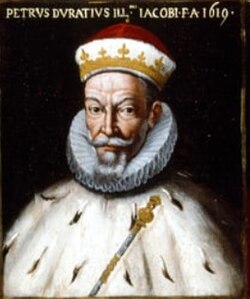
A few months after his arrival at Porto Vecchio (as seen in a wonderful 1616 painting by Bordoni, where the south of the city opens toward the sea in the form of an amphitheater), Van Dyck would soon become well-known in Genoese aristocratic circles. It was the de Wael brothers who introduced him to these families, especially the Durazzos. Pietro Durazzo’s mandate as Doge (Governor) of the Republic of Genoa had just ended.
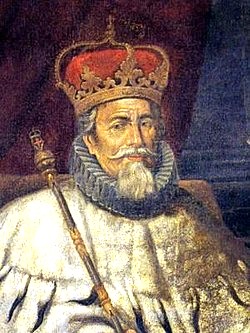
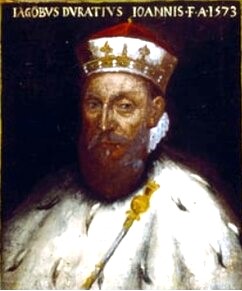
He was the second Doge from this noble family, after Giacomo Durazzo Grimaldi (Doge: 1573–1575), who was the first in a series of 9 Durazzo Doges that the Republic of Genoa would know over more than two centuries. In those years, the family name was also made famous by Agostino Durazzo, who had been elected a Senator of the Republic a few years earlier. He was the second senator in a line of 30 senators that this family would produce.
Biographer Christopher Brown, in a publication on Van Dyck, writes that Van Dyck lived in one of the rooms of the Durazzo Palace on “Via Balbi” when he came to Genoa after his travels to Palermo, Rome, Milan, Venice, Trieste, or Marseille and Aix-en-Provence in France. Van Dyck stayed in Genoa for about 7 years, after a period spent in London, where he would return after finally leaving Genoa.
In Genoa, he painted the figures of that aristocratic world, especially of the great families such as Balbi, Durazzo, Pallavicini, Grimaldi, Adorno, Imperiali, etc., who often formed marital alliances with one another – such as the close ties between the Durazzo family and the princely Grimaldi family of Monaco, or the Balbi and Pallavicini families. In fact, some of Van Dyck’s canvases relate precisely to these connections, such as the magnificent painting dedicated to Elena Grimaldi (married to a Grimaldi), painted in 1623.
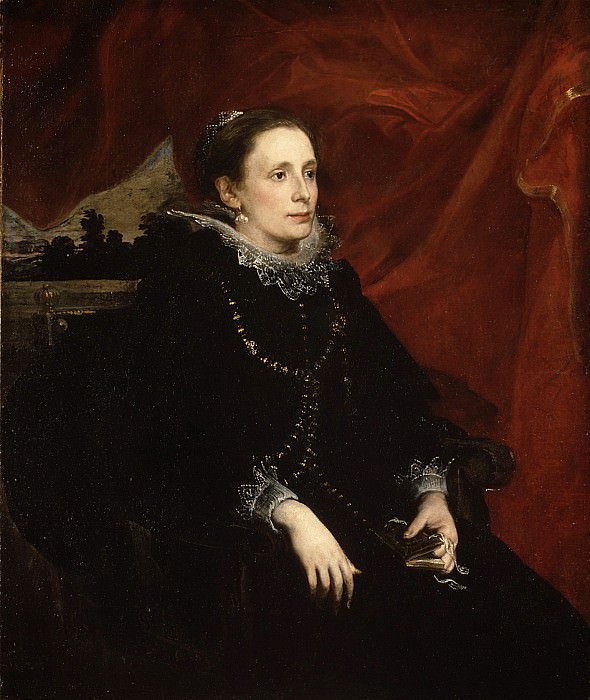
In this painting, a beautiful noblewoman stands out, dressed in a red robe reaching her feet, while an African servant shades her with a parasol. Another canvas is dedicated to Caterina Durazzo Adorno. Another painting is found in the National Gallery in Washington, titled Portrait de la marquise Balbi, just as there is a well-known painting in The Metropolitan Museum of Art in New York titled Portrait of a woman called Marchesa Durazzo.
As soon as he arrived in the Republic of Liguria, Van Dyck encountered the traces of the works of his master Rubens, which he had painted during his stays in this city or some that were in the Durazzo family collections. Such was the painting The Death of Argus, which would later be copied by the famous French painter Honoré Fragonard – also a close friend of the Durazzo family who lived in their palaces, as evidenced by the chronicles of the time.
The Durazzos were, in fact, art collectors, and their collections constituted a wealth of their own. In the salons of their palaces, particularly in the palace on “Via Balbi” and the “Palazzo Durazzo-Reale,” were placed the paintings The Feast in the House of Simon by Paolo Veronese, Susanna and the Elders and Juno and Argus by Rubens, The Trinity by Tintoretto, and many other works by distinguished artists from Da Vinci to Mulinaretto.
In a historical source, it is written that in 1624, when Giuseppe Maria Durazzo was born, the family’s assets included a painting of Judith by Veronese, a self-portrait by Titian, a painting by Tintoretto or Strozzi, Portrait of a Youth by Dürer, Portrait of an Unknown Man by Pisanello, etc. Being a friend and close associate of the Durazzo family, Van Dyck painted several figures of that time. In a way, the Durazzos had become his fans; they had even bought or would later buy his canvases for their collections, such as The Holy Family, etc.
Before he died, Gio Luca Durazzo wrote in his will that, among other things, he left one of the two Van Dyck paintings as and inheritance to his daughter, Tomasina. Thus, she could choose between Our Lady with the Child in her Arms and The Virgin with the Sleeping Child. His Genoese era was quite feverish and productive: a total of 99 canvases, 72 of which are portraits or full-length figures.
He was sought after everywhere, not just in Genoa. It was precisely in Genoa that he created the famous painting The Virgin of the Rosary, a commission from the religious society of the Rosary in Palermo, which he had just left due to the cholera outbreak in that city. During the years Van Dyck lived in the Durazzo court, Pietro Durazzo was still alive; his son Nicolo would later become Doge, while his other son, Stefano, would become a Cardinal.
Similarly, in Genoa during those years lived Cesare Durazzo, whose sons, Pietro-Maria and Marcello, would become Doges of the Republic years later. Van Dyck, being a guest in the Durazzo court, undoubtedly met other Durazzos living in or outside Genoa from other branches of the family, such as Agostino Durazzo (1555–1630), the first Marquess of Gabiano, as well as Marcello I, Giacomo Filippo I, or Gerolamo I, etc.
Among Van Dyck’s most beautiful paintings in Genoa are undoubtedly Battina Balbi Durazzo and Her Two Sons (at the time she was a widow), otherwise titled The Golden Lady, or The Balbi Children (1623), which was found in Palazzo Durazzo. The Golden Lady is perhaps so named because of the golden color that dominates the painting, especially in her long robe, giving her an extraordinary grace and feminine beauty.
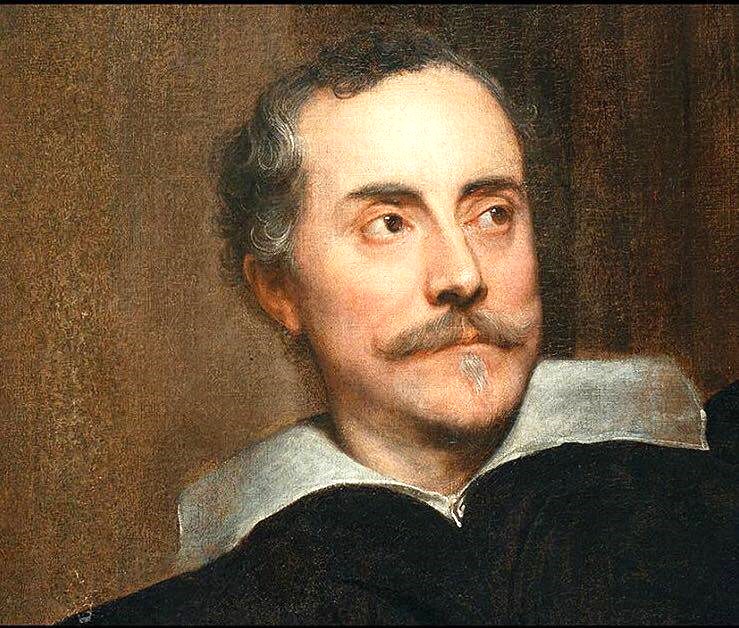
Of course, Van Dyck did not only paint the descendants of the Durazzo family. He preferred to paint children in groups and rarely alone. The human figures of this era are life-sized. The Genoese loved his paintings, and critics of the time called him “Genoese.” One of the special canvases of this period by the Flemish painter is that of Marcello Durazzo, which critics consider “one of the most refined paintings of the great painter.”
In this painting, the portrait of a very sharp man with a piercing gaze stands out, highlighting ambition, strength, and perseverance. In an old family account book, as Angela Durazzo informs us in her book, it is written that his father, Agostino, paid the Flemish painter 373 Genoese liras for this painting, which today is located in Venice, exhibited in the Franchetti Gallery at Ca’ d’Oro.
All critics of Van Dyck’s work are of one mind when they say that the style and spirit of this Genoese era would greatly influence his later painting, particularly the canvases painted at the court of Charles I of England, which were painted with the same style and spirit as the Durazzo portraits.
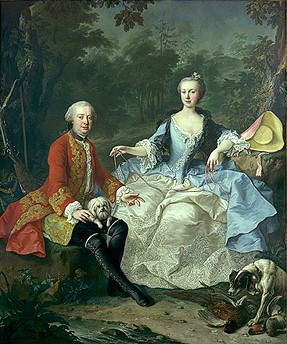
In the Durazzo court, it was not only artists who were friends – mentioning here Goldoni or Dickens, who wrote about the plays performed in the Durazzo court -but also the most prominent figures of European politics of that time, such as Napoleon Bonaparte, Ferdinand II, Emperor of Austria, or General Murat, along with Caroline Bonaparte, Napoleon’s sister. / Memorie.al