
By SAMI REPISHTI
Part Twenty
Sami Repishti: “In Albania, the communist crimes of the past have been neither documented nor punished; there has been no ‘spiritual cleansing,’ no conscious confession or denunciation of the ordinary communist criminals!”
‘In the Shadow of Rozafa’
Memorie.al / During the 30s and 40s of the last century, as the unstoppable fascist and communist storm descended upon Europe, and eventually the entire world, “fate” seized the Albanian nation by the throat. Like all young people, I found myself at a crossroads where a stand had to be taken, even at the risk of one’s life. Back then, I said “no” to the dictatorship and took the path that had no end – a sailor in a vast, shoreless sea. The rebel act that almost killed me simultaneously set me free. I am an eyewitness to life in the fascist and communist hell of Albania, not as a “politician” or a “personality” of Albanian macro-politics, but as a student, as a youth who became aware of his role in that time and place, driven by love for the fatherland and the desire for freedom; simply, as a young man with a profound sensibility, faithful to himself and to a life of dignity.
Continued from the previous issue..
XVI
The closed, banal, and oppressive life imposed on us in prison was interrupted one morning by the guard’s shout and the order for all prisoners – around six hundred victims – to go out immediately into the prison yard. The “veterans” of the Vloçisht extermination camp near Korça realized we were being prepared for a new labor camp. The horrific experience of draining the Maliq swamp froze them in their tracks.
They recounted in vivid detail the indescribable suffering in that extermination camp, and they were conscious of what awaited us. A black shadow covered the prison! In the yard where we were gathered, surrounded by guards holding clubs and others with machine guns in the surrounding towers, they lined us up in long rows. After pulling out the sick, the elderly, and the disabled, the others were subjected to a “medical check.”
At a table before us sat the doctor and the prison director. The doctor asked the questions; the director provided the answers: “You are healthy,” and with a pencil mark on the name list, the prisoner was assigned to camp labor. When my turn came, I tried to explain that a short while ago, I had spent two months in the hospital. Before the doctor could respond, the director interrupted: “You are cured now! No more problems!” and placed the pencil mark before my name.
I was no more shaken than the others. But what surprised me were the director’s behavior and his determination to send me to the camp at any cost… On a hot June day, we were loaded into military trucks, tied hand-to-hand in pairs, and our bodies bound with rope. It was impossible to move for lack of space, packed like sardines in a tin. Surrounding us were guards with clubs, and two others with submachine guns.
We had no right to stand, move, or speak. During the journey, the guards beat with clubs anyone who complained or moved their numb legs. The sun was fierce, and sweat began to flow like a river. The truck moved fast, bringing a blessed breeze, but when it slowed down for the policemen’s comfort, the truck became an oven. We reached the camp in the late afternoon hours.
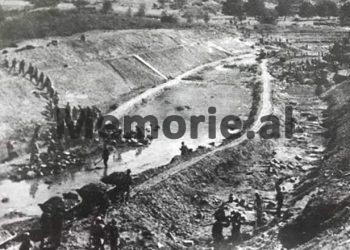
We disembarked one after another in line, and after being counted, we entered through the large gate. The camp was situated on a hillside, overlooking a field covered here and there with pools of water – a half-drained swamp that we later learned was the Beden swamp in Kavajë. The construction of the camp was not yet finished, and the kitchen had no supplies. We were ordered to sleep outside on the ground.
All around us, the camp was barbed wire and four guard towers, each with two soldiers armed with machine guns. The ground was rough, filled with thorns and scraps of wood left over from the unfinished construction. Exhausted beyond measure, without food or water, crushed by the journey, my body was unprepared for such an undertaking. I sat on the ground, found a short piece of a wooden beam, placed it under my head as a pillow, lay down, and before even settling my head properly, fell into a deep sleep.
I heard neither the voices of my comrades nor the shouts of the enraged guards within the camp. The swamp’s dampness in the evening significantly cooled the air on our hill. Toward the middle of the night, I woke up half-frozen. There was a total silence, interrupted only by the coughing of the prisoners. Then, a divine, unexpected gesture opened my eyes and my heart.
The young man from Tropoja, who had been tied to me in the truck, took off the heavy coat he was wearing and covered me. I couldn’t believe my eyes. I sat up slightly and protested, but he insisted. “You are sick,” he said. “I am used to the cold!” But it wasn’t true. Two minutes later, he wrapped his arms around his own body and began to shiver. “Take the coat!” I said in a low voice. “No!” he replied. High in the sky, the clouds were moving north, toward the bloodied mountains.
Oh, what a cauldron of unmerited suffering my country was in those days! Contemplating the summer sky, the stars on a moonlit night, and the clouds passing carelessly over a suffering world, it seemed as if they belonged to another world, with no connection to me! Their height, their calm, uniform, monotonous, and uninterrupted movement seemed to mirror the great silence that covered our suffering on earth. The groans and wailing of men had no echo, no answer.
Before the majesty of nature, our insignificance and physical weakness held no weight and seemed to no longer have meaning. Who else thinks of, worries about, or helps the man abandoned to his fate on earth? Yet, to the sworn silence of the world below and the coldness of the deities in the sky, the abandoned man responded with the pride and determination born of despair, and with the only conscious act left to him: love for another human being!
To the indifference of the eternal deities, the temporary man of this world – the young man from Tropoja – counterposed the solidarity of the condemned, the great Promethean challenge! On this night, a symbol of the darkness swallowing us without a word of comfort or noise, only suffering increased the dimension of the universe, with a dignity strengthened by our refusal of the dehumanization that blind fate imposed upon us! And yet, there were many among us who, in the permanence of the silent deity and the serenity of unfeeling nature, developed a religious sentiment born in such otherworldly hours.
The next day, Sunday, other trucks filled with prisoners arrived at the camp. They came from Vlora and Berat. It was the first time I met such a large number of people from these two cities, which I had never visited before. In the new prisoners from other cities, I saw a concrete manifestation of the abstract concept I had of our “nation.” Now, all of Albania stood before me, as this mass hungry for bread because it wanted to feed on freedom, naked and barefoot because it wanted to preserve for itself and others the garment of human dignity.
In the newcomers, I recognized myself, as if by a reflection. I called them brothers and loved them as brothers! The fatherland appeared before me as the land of Albanians without color, religion, or region. With the barracks still uncovered, they placed us in four rows and two tiers, like slaughtered animals, with no right to change places. Misfortune would have it that near us were also ordinary prisoners – thieves, murderers, immoral individuals – who made our lives even harder. They were also the most dangerous spies. Nevertheless, the solidarity awakened in the majority of us prevented many unexpected troubles.
Upon the barbed wire, a bird watched our camp with fear. Then, shaking its feathers, without understanding what was happening there; it spread its wings and flew toward the wide field… On the second night, we slept in the roofless barracks, waiting for the first day of work. Lying in bed, I watched the evening sky darken. In a moment of twilight, when the light faded and night came slowly but fully, the light withdrew from the sky like a moving white layer, leaving behind the view of the abyss that swallowed us.
Without meeting face-to-face, light and darkness created between them a gray zone, like a battlefield for vanguards that attack, push, and repel one another, and with every step, open one more path for the broad body of the army following behind. At that moment, the night seemed to me like a thick, black shroud, squeezing the light into a corner more and more until it vanished completely.
Yet, wherever the darkness covered the sky and turned the earth below black, stars emerged like solitary soldiers, standing unafraid, faithful to the bright past and islands in an infinite sea. And it seemed to me they shone even brighter whenever the darkness around them became even denser. In the celestial expanse, they multiplied rapidly – islands and atolls, points of support and nests of living hope, perhaps even content with a fate they did not curse, and certainly happier when realizing they were the only bridge between the setting day and the morning of the tomorrow being born.
This, I thought, is how a sailor must feel in the middle of the sea, in the lifeless twilight of a night in a boat, whenever he sees on the shore of the blessed land the lights of a small fishing village – one, two, three, a multitude – each of them a family with a mother and children waiting, with joy mixed with fear and hope, especially hope, for the approaching sailor…!
Outside, the voices of the armed guards could be heard. Inside the barracks, the snoring of the exhausted prisoners wore me down. And before me was the first day of forced labor, with its unknowns. Weak in health, the work with pickaxe and shovel frightened me – not so much for the fatigue it would cause, but for the punishment I would suffer at the hands of the red guards, who tortured especially the weak.
In my solitude, I thought that as long as I remained conscious of the suffering of the communist prison, as an opponent of the red dictatorship and faithful to this consciousness, I would live free and with dignity. That consciousness would hold me high, in the sphere where being human was the fullest honor and glory. Conversely, I would fall into the abyss of silence that stifles the voice of conscience and allows for “compromise” with the evil that annihilates. “This,” I insisted, repeating to myself, “do not forget, O lover of Rozafa, neither in time nor in space!”
On the first day of work, they woke us at dawn. We dressed and lined up in the middle of the camp yard. Divided into five labor brigades, companies, and squads, we were commanded by ordinary prisoners or by some former communist officials imprisoned for serious crimes or abuse of duty. No one spoke! Sitting on the ground with guards holding clubs over our heads, we waited for our turn for bread and stew. The stew was “bollgur” (bulgur), a type of coarsely ground wheat, boiled since the previous evening and kept in the cauldron all night so the starch would thicken like mud and the soup would become a paste.
With a little salt and even less oil, this “stew” given in the morning served as the nourishment that was supposed to strengthen our legs and arms for work that lasted from sunrise to sunset. With unwashed mess tins and empty canteens, because water had not yet arrived at the camp, we set off in formation, surrounded by armed guards, to the work site. A lateral canal on the hillside collected the waters falling from the mountain (they called it a collector).
Several kilometers long, it was the first objective, and upon its completion, the central canal had to be opened to drain the waters of the Beden field in Kavajë. The mountain soil was hard, and the work with the pickaxe was very heavy. I took a shovel and began to move the earth dug up by my squad, but I couldn’t do it because I had no strength. The Red Guard watching from the top of the canal bank approached, saw me sweating incessantly and breathing with difficulty, and scolded me: “Why aren’t you working, you pig?!” – “I am working with all my strength,” I replied, “I just got out of the hospital a few days ago.”
He didn’t speak. A few minutes later, a sergeant, short in stature with a grim face, approached and, without saying a word, pushed me with such force that I fell to the ground. When I tried to get up, he began hitting me with a stick on my back, without stopping, until I fell again. He insisted I stand up. I tried, but my legs wouldn’t hold me from exhaustion, and I trembled while leaning on the shovel. The sergeant lost it. “I’ll take your soul!” he said, “Either you make the quota, or that’s it! Do you understand? You’ll leave your bones here, right here in the canal!” I didn’t answer; he walked away.
The comrades around me looked at me with pity, unable to help. I bent my back and continued the work. But before me, the unmoved earth piled up. Then, from the depth of the canal, a farmer from Skrapar who was part of our squad jumped out, took my shovel, and within five minutes, cleared the entire spot. He looked at me and smiled. It was the face of an unknown brother, recognized only by the brotherhood of the persecuted. In that camp, we were not “prisoners” sentenced by the “law” to serve a punishment set by a “court.”
In this camp, we were simply forced labor slaves, with all the connotations that name implies. This conviction was strengthened by the behavior of the guards upon our return to the camp when, lined up again in brigades, the director entered and, in a harsh voice, called out the names of a dozen workers, among whom was I. According to him, we had not met the work quota. As punishment, for the first time, we were not allowed to have the stew, nor water, or to enter the barracks until midnight.
Sitting on the ground outside, without speaking or moving for six hours, and exhausted from the day’s work, we were subjected to a rigorous discipline that broke us completely. My first experience in a forced labor camp was shattering. In bed, with my back aching from the beating I received during the day, I began to think about tomorrow and the impossibility of continuing like this, until a heavy sleep overcame me. In the morning, I was unable to get up, even for food. Still in bed, I didn’t move when the brigades left for work.
The guards began inspecting the barracks. When they found me lying down, they went completely mad. A few minutes later, the director entered with a stick in his hand, ordered me to get up, and when he realized I didn’t have enough strength to stand, he put the stick in my mouth and, in a cracked voice, threatened: “Not here in bed,” he said, “you will die there, in the canal. You are an enemy of the people and you must pay for the damage you have brought to the people. Tomorrow morning, if I find you here, I will kill you with my own hand. You son of a bitch!” I didn’t speak!
I lay back in bed, without bread, without water, but with the determination not to die under torture. When my comrades returned from work, I told them the events of the day and my determination to go out to work. There was no other choice: to die under the club of the director and the camp guards, or to be consumed by the heavy work of the canal. I accepted the second, with a kind of hope that the fresh air and the sun would do their work and that my squad mates would help me. The next day I went out to work. Still weakened, because in the camp during the first day they had cut off my bread, stew, and water, I began moving the shovel with a stubbornness I couldn’t explain.
My comrades helped me with compassion, and every time the opportunity arose, they assisted me. To our luck, the work quota was measured for each squad, and my group was physically strong. Some were seasoned farmers, used to work with the pickaxe and shovel. When the squad’s quota was met, everyone rejoiced; in the camp, we would get the bread, stew, and water, and we would have the chance to go to bed on time. During the work, from the bank where I was working, I saw the long line of workers, their bent backs, and their fast, rhythmic movements.
The sight gave me the idea of slave galleys: the work in the canal, the supervising officers, the policemen with clubs beating the workers – especially those who dared to raise their heads or stopped to catch their breath. This distorted vision brought to mind readings about the lives of slaves building the pyramids of the Egyptian pharaohs, and the sweat of those bound in chains in the boats or mines of Antiquity – the captive sailors who spent their lives as rowers with long and arduous oars, in rows of two or four, moving without rest, day and night, under the lash and supervision of the executioner, exploited to the marrow, unto death, corpses thrown into the waves of the infinite sea by their comrades who saw in today’s victim their own fate tomorrow. In the waters of the calm sea, the dead slaves found the best and most comfortable bed of their lives, away from the land that despised them, more desirable for their backs broken by the club, crushed by heavy work as long as their very lives. For us, the sea that swallowed our corpses was called the Beden swamp, Kavajë! Memorie.al
To be continued in the next issue.