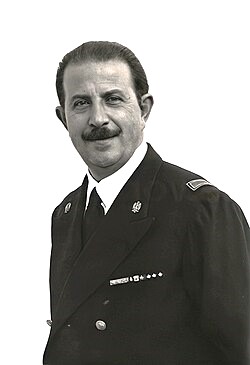
By Nertila Hodo
Part One
Memorie.al / In the southwestern part of the Balkan Peninsula, along the eastern shores of the Ionian Sea – stretching from Lake Butrint and the Pavlla River in the north to the Gulf of Arta in the south – lies a region with unique landscape features known as Chameria. Due to its highly favorable geographical position, the majority of the region’s economic income has always derived from agriculture, leading to significant socio-economic development. Throughout history, this province has been inhabited by an indigenous Albanian population. The simple Albanian character of this land is evidenced by its toponymy and the vibrant presence of its people – Albanian in language, culture, and customs.
Among the most prominent families of this region is the “Dino Family,” a lineage that has produced renowned diplomats, statesmen, artists, and patriots. But what is the genesis of this family? For this household, which the people of Chameria elevated to the status of legend, a folk tale exists:
“The Dinos were initially a poor family from Lopsi i Filatit. The sons of Old Sako Dine worked as farmers in the fields. One day, a beggar came to her house asking for bread. The old woman took him inside, gave him coffee, and then food. The beggar left satisfied with the hospitality and, as he crossed the threshold, he offered this blessing: ‘Dino, may the world say that you hosted me today!’ That night, when the woman went to sleep, she had a joyful dream. It seemed as if she found gold coins in a nearby cistern (well). At dawn, she went to the cistern and indeed found the money there. With those funds, the Dinos built their manors (sarajet), pursued education, and settled in Preveza.”
Beyond being a family with deep patriotic sentiments, it also represented one of the wealthiest houses in the Chameria region. The Dino family owned hundreds of hectares of arable land, pastures, and olive groves in the village of Lops and throughout the villages near the Preveza district, such as Lurë, Çaprazli, Strevinë, Strongjili, etc. Under the ownership of this family were also two large-tonnage ships built by Ahmet Bey Dino in 1848, which were later sold in Trieste.
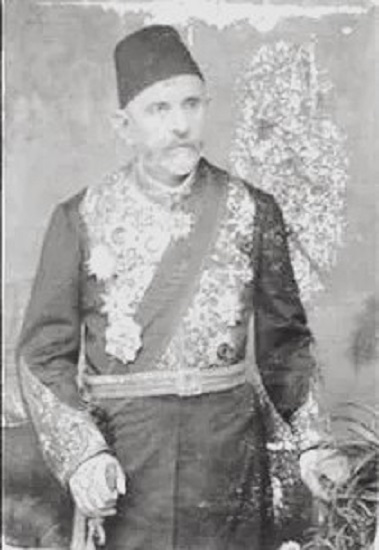
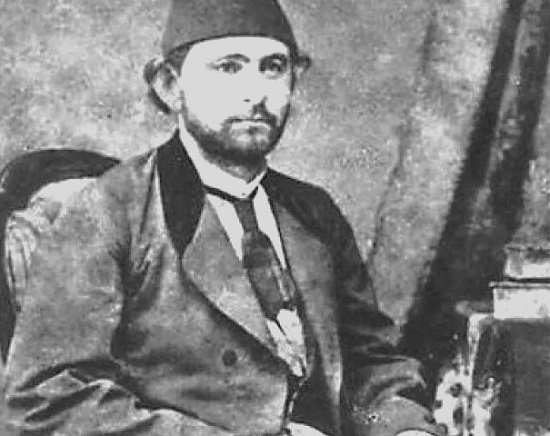
Some of the most notable figures of this family include: Ahmet Bey Dino, who, as one of the patriotic leaders of the 1847 uprising against the Tanzimat, was exiled to Konya, Anatolia, where he died; Abedin Pasha Dino, Vesel Pasha Dino, Rasih Dino, Lejala Dino, Ali Dino, Xhemil Bey Dino, Nuri Dino, Nebil Dino, Mazar Dino, Arif Dino, Abedin Dino (the younger), etc. The distinguished names of the Dino family continue to grow even today.
The Literary Activity of Abedin Dino
In addition to his activity as a diplomat, politician, and statesman, Abedin Dino was also known as a poet, philosopher, theologian, economist, textbook creator, translator, etc. Abedin Dino’s literary work is diverse in both theme and language. The uniqueness of his creativity lies in the fact that Abedin wrote not only in Albanian but also in other languages he mastered, such as Turkish, Greek, Persian, Arabic, etc.
His first poem in the Albanian language is “Këngë për Shqipërinë” (Song for Albania), consisting of 64 verses, published anonymously in the newspaper Zëri i Shqipërisë on December 22, 1879. A poem where the author expresses his patriotic feelings and calls on his compatriots for resistance and the struggle for independence.
“O Albanians, if you desire
From the foreigner to be saved,
You must continue
To build your nation.
Then, achieve liberty,
And the rule of law itself,
To write your own language,
To speak and sing in Albanian!”
Abedin Dino was a supporter of writing the Albanian language with Latin characters, which he praised, emphasizing that it was an advanced and civilized way of writing. This is evident in the aforementioned poem, where he advises Albanians wherever they are to speak and write the Albanian language. Another poem in Albanian is “Të nxiturit e Shqipërisë turke përpjetur” (Urging Turkish Albania Upward), published on March 1, 1880, in the newspaper Zëri i Shqipërisë. This poem echoes the fighting events for the defense of Gucia. Abedin also wrote several epic poems in Greek, published in the newspaper Neologos.
After his resignation as Foreign Minister and his exile as a Vali (Governor) to Adana, Abedin Dino dedicated himself to the exegesis of the Quran. During this period, he began translating from Persian the two-volume work “Translation and Commentary of the Holy Poem” (Masnavi-i Sharif), which he finished a year later while serving as Vali in Sivas. The uniqueness of this translation is that it is accompanied by Abedin’s own commentaries; after providing the original Persian couplet, he offers an artistic translation into Turkish and then continues with the commentary.
Another work translated from Persian is “Commentary on Arabic Stories in the Holy Masnavi,” published during his time as Vali in Ankara. In June 1885, Abedin wrote his autobiography in Turkish, which was published three times during his life and for the last time in 1908, heavily censored. In his autobiography, he wrote that he “felt proud to belong to one of the most noble families of Chameria.”
While serving as Vali in Rhodes, he published “Happiness in This World” (Dunya-y se’adet), dedicated to ethical issues, expressing the extraordinary importance of books and literature. Regarding the importance of books, Abedin wrote: “People may be abandoned by loved ones and friends, but books remain the most loyal friends.” This work was reprinted for a second time in Istanbul. Other works written in Turkish include: “The Ottoman Debt,” a work written during his time as Commissioner at the Bursa Stock Exchange in Istanbul.
This is an important work as he writes about the actions of the Stock Exchange, financial matters, debt problems, and the experience gathered at the Sublime Porte; “Resistance”; the brochure “Useful Treatise on Cholera,” where he gives instructions on measures to isolate the sick, etc., as well as a series of school textbooks written in Turkish.
Abedin also translated from Arabic into Turkish, the most important being the “Translation and Commentary of Kasidatu l-burda,” the first poem dedicated to the life and activity of the Prophet Muhammad. Another work is “Arabic Grammar according to the New Method,” translated in 1884. Abedin Dino also wrote several memoranda in French sent to the Great Powers, protesting the injustices against Albania. His talent was recognized by French, Turkish, and Greek newspapers, and in 1895, he received the “Golden Palm” award from the French Academy.
His patriotic and literary activity also resonated in the Albanian press. On May 10, 1879, the newspaper Shqipëria in Bucharest wrote: “Abedin Bey Dino, a prominent writer and poet, governor of the Aegean Sea, a politician and distinguished man who has also served the muses with success.”
The greatest praise for Abedin came from the people, who immortalized him in folklore. The people of Chameria sing of his bravery:
“The districts rose to their feet,
Ten thousand Chams,
At their head they have Abedin,
Abedin Dino, the banner,
To Europe, you gave the answer.”
Other Members of the Dino Family
During the Albanian National Awakening, Abedin’s younger brother, Vesel Pasha, also made a special contribution. Raised in a patriotic environment, Vesel followed in his brother’s footsteps. A capable soldier, he was granted the title Pasha by the Sultan. Seeing the danger posed to the fatherland by neighboring greed, he placed himself at the disposal of the leaders of the League of Prizren.
In May 1877, Vesel Dino, along with figures like Abdyl Frashëri and Mehmet Ali Vrioni, founded the “Committee of Janina,” which initiated the idea of an anti-Ottoman liberation uprising. In February 1878, when Greek andartes attacked the village of Lëkurës, Vesel and Abedin led 2400 Albanian volunteers to repel the Greek soldiers.
During the Assembly of Preveza in January 1879, Vesel headed the military commission. In August 1879, he was part of the delegation (with Abdyl Frashëri and Mehmet Ali Vrioni) that informed the Sublime Porte that the League was ready to fight both Greece and the Ottoman Empire to protect Albanian lands. Vesel was also a founding member of the “Society for the Publication of Albanian Letters” in Istanbul in 1879. Despite being sometimes unfairly labeled as pro-Ottoman by detractors, his actions alongside the greatest patriots of the era prove that he placed national interests above all else.
The Dino Family during the World Wars (1913 – 1945)
Following the declaration of Independence on November 28, 1912, the Vlora government needed a delegation to represent Albania at the London Conference of Ambassadors. Due to the naval blockade by Greek forces, Ismail Qemali could not lead it himself and appointed personalities already abroad.
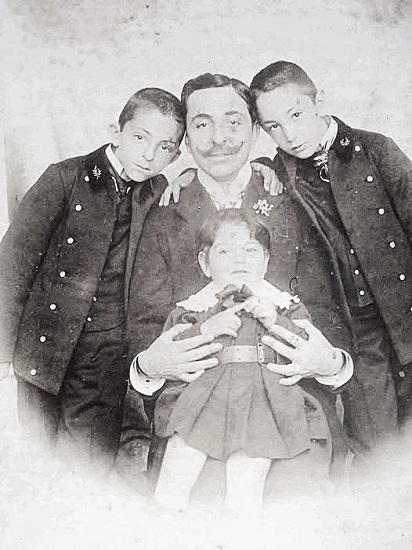
The delegation was headed by Rasih Dino (1875 – 1926). As the son of Abedin Pasha Dino, Rasih held a prestigious name. He had played a vital role in the “Club of Filat” (established in 1908), financing teachers, textbooks, and the newspaper Zgjimi i Shqipërisë.
In late 1912, acting as an observer for the Vlora government in Paris, Rasih kept Ismail Qemali informed of European diplomatic developments. On December 23, 1912, he was instructed by Qemali to lead the delegation in London, including Filip Noga, Mehmet Konica, and Sotir Kolea, to defend the interests of the new Albanian state before the British Foreign Secretary, Edward Grey./Memorie.al