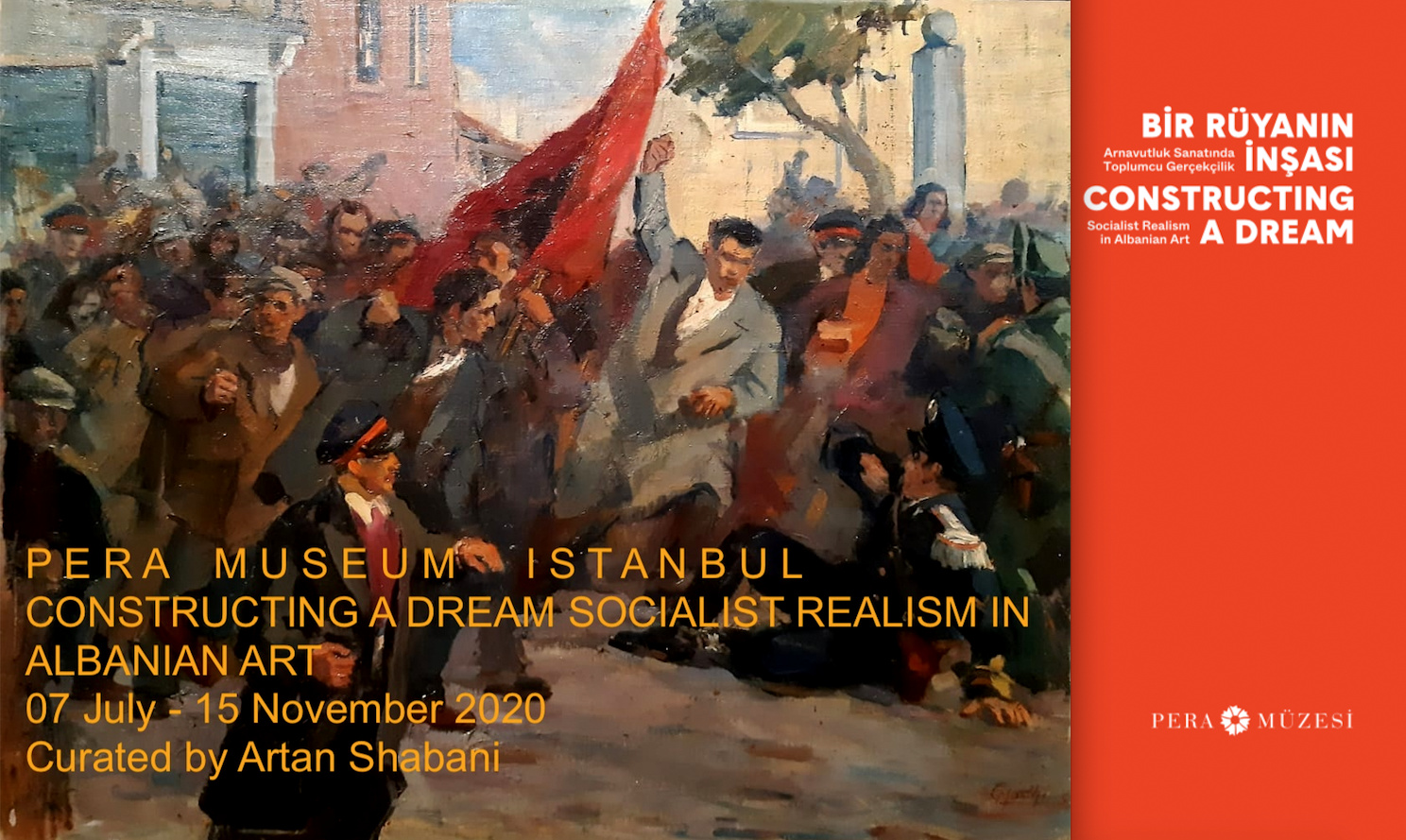


Memorie.al / A special exhibition of Albanian works is going to Istanbul, revealing a unique heritage to a public little acquainted with the “crises of pressure” that suppressed creative freedom, while also creating new paths through which the forbidden thoughts of the artists could be expressed.
The exhibition, “The Dream of Albanian Socialist Realism,” curated by Artan Shabani, brought to the attention of the Turkish public an invitation for a lively dialogue with Albanian visual art under the dictatorship of the so-called “method of Socialist Realism,” as art politically oriented towards disseminating the principles of building socialism among the masses of the victorious proletariat.
For Shabani, embodied in tens of thousands of artistic works – compositions, paintings, sculptures, monuments, murals, graphics, illustrations, drawings, caricatures, posters, placards, and even postcards and postage stamps – which display the history of the dictatorial period of the Albanian state through figurative art over four decades, Socialist Realism, in arts, literature, culture, and everywhere, thus appeared as an ideological tool fundamentally dependent on the dictatorial state.
This state managed to orient and control Albanian artists, dictating its will to them both in their artistic creativity and throughout their entire lives, inside and outside the studios and ateliers.
Acquaintance with the illusory reality and the dogmatic content of the works of this art, which was entirely in the service of the communist ideology – although a primary element that indisputably took over the scene of Albanian figurative arts during the second half of the 20th century – presents one more opportunity to get closely acquainted with the culture and identity of a people isolated for a long time from the rest of the world.
NAMES AND WORKS
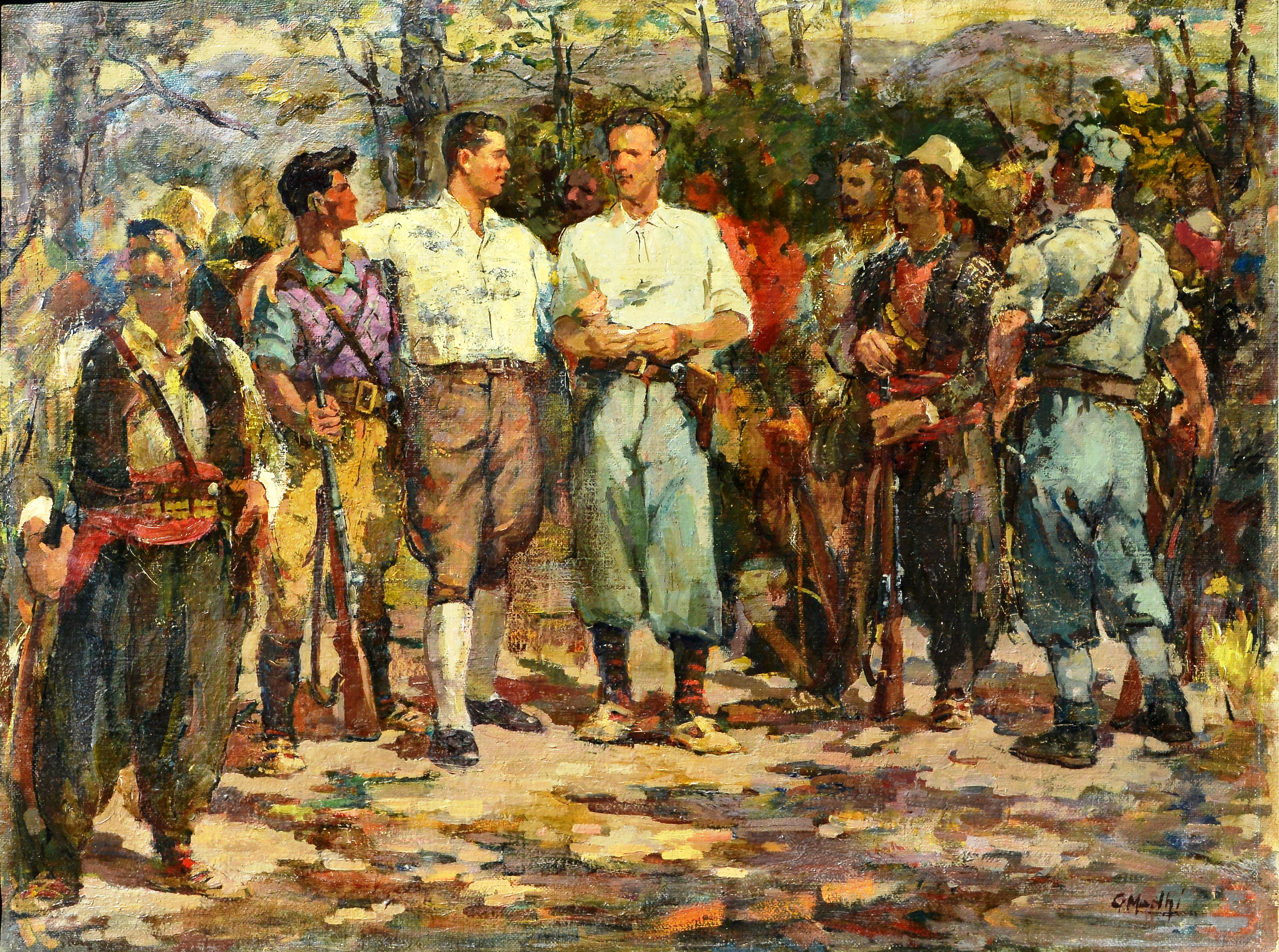
The exhibition at the Pera Museum focused on the creativity of Albanian artists during the second half of the ‘900s, featuring realistic works in the Albanian style. Socialist Realism came to this exhibition with diverse works, such as the painting “The First Conference of Peza,” by the artist Guri Madhi, who holds the title “People’s Painter,” the highest title during the Socialist Realism period.
He places the figure of the leader Enver Hoxha at the center of the composition, where he is framed by local villagers and Albanian fighters. He dominates all attention with the friendly gesture of his hands towards the characters positioned in this tableau, Shabani notes in the exhibition text.
“In this section,” says Shabani, “the Turkish public will find the figure of an adolescent, painted in 1972 by the painter Agron Jakupi, the figure of a boy with a ball who poses in the typical clothing of the time. This was a school assignment for the painter Jakupi, and the work was intended as a study of figure psychology and its pictorial treatment.”
Another work is a composition from 1984 by the painter Robert Përmeti, notable for a group of female athletes training in the stadium of the town of Librazhd, representing the organizing and triumphant spirit of the team of student volleyball players.
“A typical atmosphere from Socialist Realism is brought by the painter Fatbardha Shkupi with a painting done on both sides of the canvas. On one side, the figures of young volunteers building the happiness of Albanian socialism – the youth at that time worked voluntarily on railways, in agriculture, in industry, etc. Voluntarism was one of the projects of the Party of Labor for the ‘New Man.’ every year, young people went to ‘actions’ to open new fronts, and there, the Albanian youth were socialized in their free time through the style and rules of communist morality.
Cultural life was not absent: shows, theaters, concerts, and various exhibitions. The southern region of Albania is an example of the work of Albanian youth volunteers,” Shabani introduces the works to a public that did not experience that era.
According to Shabani, the cult of the individual, the image of Enver Hoxha in visual art, mainly appears through the works of artists Guri Madhi, Robert Përmeti, and Zef Shoshi. These masters of Albanian painting have dedicated many works to the theme of Socialist Realism. A portion of the creativity of Albanian artists was devoted to heroic figures, martyrs fallen in war, leaders of the construction of socialism, high political and historical figures, but especially the figure of Enver Hoxha.
“The New Man,” writes Shabani, “was the high and supreme virtue in the presentation of artistic works of Socialist Realism, from the bronze monuments erected in Albanian cities, numerous monuments placed in populated areas such as squares, main streets, and major industrial environments, representing ‘titanic works’ realized by the Party of Labor.”
Many works by artists such as Skënder Kamberi, Isuf Sulovari, Ramazan Memishi, Dhimitër Theodhori, Agim Faja, Pandi Mele, Namik Prizreni, Aziz Karalliu, Bujar Zajmi, Myrteza Fushekati, etc., were presented in Istanbul. In their works, one can feel the clear spirit of this thematic focus, featuring figures of workers full of vigor and strength.
In these drawn and painted figures, one feels the typical physiognomy of powerful, muscular people, refined in the communist ethical aspect, with high foreheads, never sluggish, never bearded or sad. Their gaze is far-sighted, enlightened, and inspired by the ideals of the Party of Labor and the enthusiasm for building a new Albania with the “New Man.”
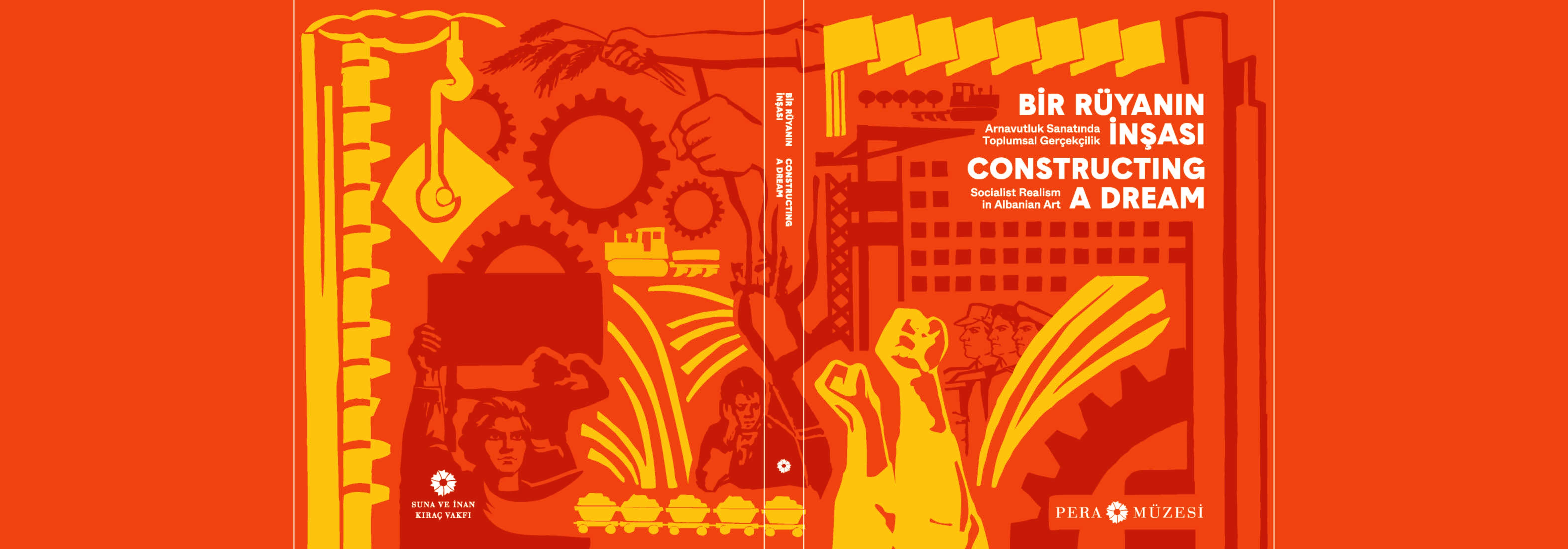
Among other things, political posters and placards also occupy a place in the exhibition, serving as a powerful communication tool for propaganda. “They,” says Shabani, “communicate not only with images but also with quotes from the leader Enver Hoxha. They were mainly for national holidays, Women’s Day, Worker’s Day, Five-Year Plans, Army Day, or everything that was in the ‘cell’ of Albanian society. This propaganda was like a nest within the consciousness of the New Man. Among the most prominent artists were Pandi Mele, Safo Marko, etc.!”
The exhibition also summarizes the technique of the illustrated Albanian film poster, a selection from the years of the “New Albania” Film Studio, which was displayed in the museum hall with several original full-format and industrial-standard posters, as well as original costume design and animation sketches from Albanian feature films, documentaries, and animated films.
The Illustrations section presents the original works of Agim Faja, specifically chosen to reflect the process of education and the creation of the new spirit. Illustrations were considered a voluminous enterprise with state-owned Publishing Houses, with thousands of books being published every year for the education of the new generation, which had to be molded with the spirit and morality of the principles of the Party of Labor. Numerous painters illustrated books, magazines, school texts, calendars, etc. Among the most prominent is the master Agim Faja, who dedicated his entire life to painting and illustration for children./ Memorie.al