
By SAMI REPISHTI
Part Thirteen
Sami Repishti: – In Albania, the communist crime of the past has not been documented and punished, no “spiritual cleansing” has been done, no conscious confession and denunciation of ordinary communist criminals! –
‘In the Shadow of Rozafa’
Memorie.al/ During the 1930s and 1940s of the last century, as the unstoppable torrent of fascism and communism descended upon Europe, sooner or later upon the entire world, “fate” also seized the Albanian nation by the throat. Like all the young, I too found myself at a crossroads where a stance had to be taken, even at the risk of one’s life. At that time I said “no” to dictatorship, I took the road that had no end, a sailor on a wide sea without shores. The rebellious act that almost killed me, at the same time set me free. I am an eyewitness to life in the fascist and communist hell in Albania, not as a “politician”, a “personality” of Albanian macro‑politics, but as a student, as a young man who became aware of my role, in that time and that place, out of love for the homeland and the desire for freedom; simply, as a young man with a marked sensitivity, loyal to myself, to a life of dignity.
Continued from the previous issue
I understood that the role of provocation had been embraced with joy by the internationalist communists, and that they were determined to play that role with boundless cynicism…! The words of the executed friar: “We will not provoke, that is not our role”, were taking on a prophetic weight! After my complete silence, he spoke no more. He called the guard in a loud voice: “Partisan”, and ordered: “Take this dog to the cell”! In the cell, I began to reconstruct the conversation we had had in the office. I was convinced that an internal conflict had begun among some Security officers.
Could it be that the wide scale of torture used against us, and its intensity, had touched even the executioner’s heart?! The fact that, after my answer, he did not give me a proper beating, one I would not forget for life, showed that “changes” were possible in this seemingly granite block. It was the first time I entered a cell without bodily pain and with a feeling of relief from the day’s experience.
I willingly took the dry bread ration and the water the guard gave me, and began my supper with a natural appetite. Bread and water. Miracle! I filled with hope that the dark night surrounding us would not be eternal, and that the first signs of the dawn of a new light were visible on the horizon. Or at least, so it seemed to me. Oh, one does not need much to kindle a prisoner’s hope…! Beside me, a cell door opened. Then, a loud groan reached my ears. It sounded like something new, although the prisoner had been suffering since supper, when they had returned from interrogation.
But at that moment, his voice woke me from the drowsiness into which I had fallen. The sound of the voice, its volume and its regular rhythm came to me as something familiar. A second groan came, even louder, closer, strengthening first my curiosity, and immediately my conviction, that I had witnessed something similar before. Where and when? The curtain of an entire world opened before me: that groan was the same as my father’s, on his deathbed.
Lying in the middle of the room, his head propped on two pillows, my father appeared before me in the final moments of his life. All around was the family. Six children, we wept and wailed. Mother, restraining herself with difficulty, shed tears like a river, and moistened with a small wad of cotton father’s dry lips, as he gave up his spirit. The prisoner next to me was living the final moments of his life… alone! During the first two months in the Security Directorate, with uninterrupted torture, I went through truly difficult moments, physically and spiritually.
When suffering passed the limits of endurance, and bodily pain smothered every feeling, my hatred grew, strengthened, and concentrated. The figure of the torturing officer took on the concrete image of this hatred, and in the dim light of eyes that barely distinguished the moving lines of a monstrous nature, he, the Security officer, was for me everything that fought me, threatened me, and tried to destroy me.
He was for me the incarnation of that evil, inhuman, demonic, destructive dark power of communism, and of the contempt that constantly darkens humanity’s conscience whenever a human being descends as low as the brutal officer who tortures, a man without scruple, a servile tool of the new oppressive order. This brutal being was the product of a movement that trumpeted noble ideals, which we had supported, but which ended up in the hands of a popular mass, with moral values weakened by hard life, uneducated, yet cunning, whose passions were scratched by the demagogues who led with slogans.
It was a mass that could not conceive the possibility of a generous revolution, and supported the regime of terror until it was overcome by the very terror it had brought to power. In my country, this terror was organised, effective, all‑encompassing, and fully conscious of its destructive work, because it was carried out with a sense of absurd pride. In my country, this terror was fully responsible for its everyday acts, which no one controlled any longer.
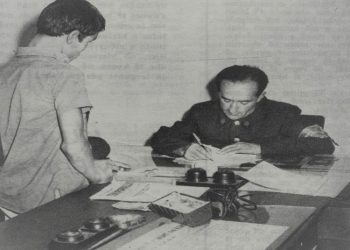
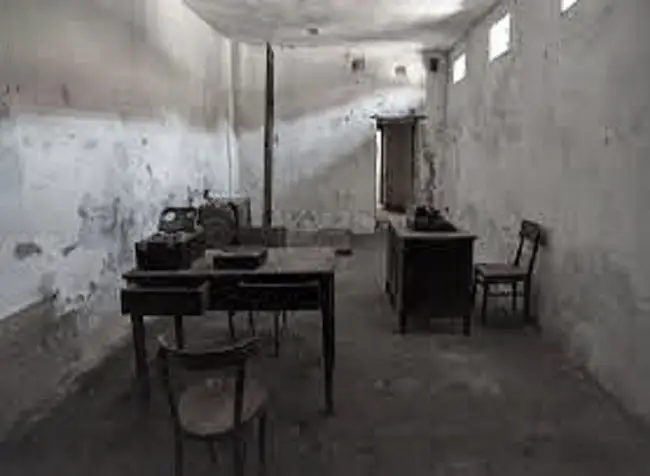
The law and the legal system were an umbrella for the ruler, and a club for the unprotected citizen. The carnivorous beasts of the State Security willingly became ordinary criminals, whom a cruel fate placed in the service of the “Party” and the “State”, two repressive apparatuses for whom the killing of innocents remained their ruling principle! I am in the investigator’s office. The door opens! An officer enters. “Comrade Captain”, he said with a gesture of his hand, making it understood that he was inviting him to follow.
The captain called the guard, instructed him to guard me, and left. I was bound hand and foot. Through the half‑open door, I heard the sound of a guard’s footsteps approaching from the corridor, mingled with another sound of light footsteps, which seemed to me like those of a child. I was not mistaken! In the silence that followed, I heard the door of the adjacent office open after a light knock, a woman’s voice wailing and sobbing, and immediately, without pause, a sharp cry: “Oh! My poor mother”, which pierced the entire building.
A sound of a body scraping against the floorboards made me understand that the “victim” was lying on the floor, trying to get up. “Woe is me!” she repeated, and immediately a child’s voice, “Mother, mother!” would not stop wailing, punctuating the expression of pain that was tearing her apart. “Close the door, idiot!” the officer shouted forcefully. I was speechless! Propping myself on one elbow to keep from falling to the floor, I glanced at the red‑uniformed guard, as if to say: “Where are we, man? What are you doing to this people on their behalf?!”
The guard met my eyes for a second, and as if he had understood the question, he approached the door, pushed it gently and carefully, as if he did not want to break the silence that had again fallen in the room, and leaning his back against the wall, fixed his eyes on the electric lamp that lit the office. Around it, small insects circled innocently, in a world unknown to them. It seemed that only humans went mad in this world of ours…!
When he returned, the “captain” was gloomy. He did not speak at all, paced the room nervously, and called the guard: “Partisan!” – “At your command!” – “Take this dog and hang him outside on a tree…!” With my hands tightly bound, held by the arm by the guard, I left the office. As I descended the stairs, I could not believe my ears. Why was I being punished without having said a single word? On the ground floor, a door led to the building’s courtyard, where three trees of medium height stood.
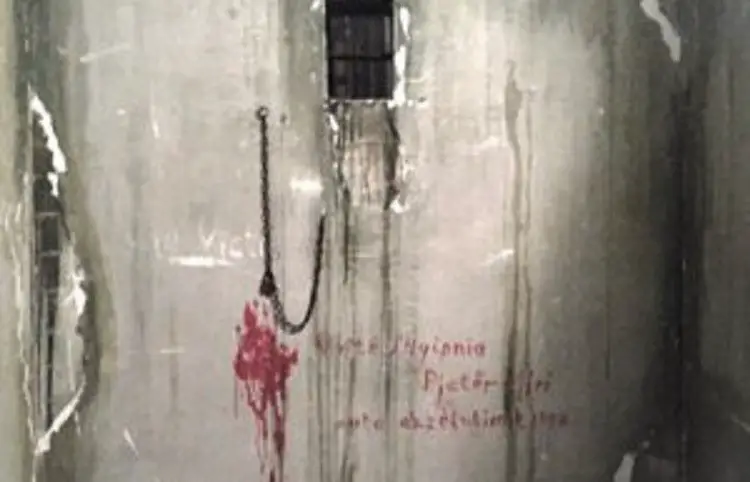
One of them was a peach tree. The guard called the “sergeant of the guard”, and together, after stripping off my clothes, leaving me in my underwear, they tied me with a rope around both shoulders and lifted me into the air, passing the rope over one of the peach tree’s branches, and tightened it. I had the strange impression that I was being raised on a cross! Then they untied my hands from the front and tied them again behind my back. When they finished this “operation”, they let me go, and I remained suspended, hanging a few centimetres above the ground.
The heavy weight of my body, and the rough rope, caused me such unbearable pain that I cried out loudly: “I’m dying, I’m dying!” “Shut up, pig!” the guard with the automatic rifle shouted. “Shut up, or I’ll smash you with a club!” But I did not stop my cries until I began to lose consciousness. The pain was so strong that it drove me mad. Unfortunately, a heavy rain began, lasting several hours that December night. I must have lost consciousness more than once, because I kept waking up from the intense pain. Wet, this pain became even more acute.
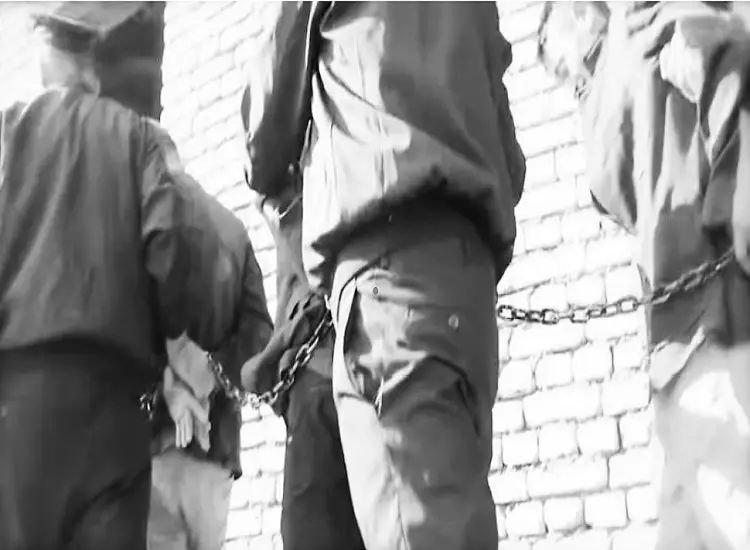
I was losing my voice, I was breathing rapidly, sobs came one after another, and I had no hope that this medieval torture would end before the “captain” came to his office in the morning. When I came to, I was on the floor of my cell, lying motionless. My hands and feet were still chained, but the pain that was driving me mad came from my two armpits, torn by the rope. I tried to move my arms, but I could not; the pain was a real torture.
Wet to the bone, undressed, I began to feel the cold as well. Shivering, with unbearable pain, alone in that dark cell, a rage rose in me against the executioner, such as I had never felt before. I was filled with uncontrollable hatred, the kind that, in special circumstances, kills and destroys. I could not contain myself. The pain had passed every limit. “You must despise, you must scorn, you must hate the man who acts like this,” I said to myself, “so that later you can torture, just as the communists do today”!
In the new society that “they” had created on the blood of the innocent and the sweat of the exploited to the marrow, humanity was being suffocated by such a mentality, which oppressed it, and “they”, the oppressors, did not understand it! How could the moral conscience, now dead in these “leaders”, be stirred, how could the feelings folded in the arms of the heavy, long sleep that had seized the oppressors from the intoxication brought by crimes against the innocent, be awakened?!
I had no doubt that, as in the entire in world, in my country too, only the lowest element of Albanian society agreed to be torturers, Security officers, prison directors, or “party members”. Only that element that found satisfaction in the world of wailing, sobbing, and torture. And unfortunately, in the difficult phases of the humiliation and suffering they caused, they were stronger than the victims, and it was this false sense of superiority that they nourished, to cover the inner insecurity that tormented them.
Around me, from every cell, came the voices of prisoners tortured harshly by the Security officers, whose role was to prepare “processes” of confessions for crimes not committed, and to uncover “enemies of the people”. In this way, they proved the macabre communist thesis that all those arrested were “guilty”. The executioner would not admit to being wrong, and was ready to torture in order to “create” guilt, and to convict the “guilty” without fault.
The stifled sobbing of those beaten to death, or left without food and water for days on end, and unable to perform biological needs, did not cease all day and all night. The guards’ swearing and their threats mingled with the voices of the wretched locked hermetically, creating a cacophony arising from the absurd dialogue between two antagonistic worlds: executioner and victim. It was the circle of a Dantesque hell underground! In this underworld, beyond our world, scenes from our naive meetings, our passionate discussions, and the fear we had of possible exposure, passed before my eyes.
It was clear that in those days, we all lacked experience in organising clandestine groups for “illegal” activities. Each of us suffered from the same naive mentality: what moral right did we have to bring in new members, students and pupils, and especially girls, without informing each about the possible consequences arising from conspiratorial acts? How capable were we of presenting the framework of red terror when we did not know it in those days of “illegal” activity?
None of us had experienced prisons and Security tortures! One evening, an unbearable conscience covered us, and deeply influenced our thoughts in those days of enthusiasm, and consequently our action. We had entered an unknown path, and we had neither the desire nor the will to stop, regardless of the unexpected. But the fact that this evening conscience restrained our enthusiasm proved that we had not yet sunk into the mire of opportunistic politics, which despises no means, and that our action still retained the fundamental ethic of respect for the life and dignity of every person who approached us and offered to cooperate.
This spiritual victory, which severely undermined the effectiveness of our rebellious activity in which we were engaged, remained for me and my comrades the greatest victory we had achieved in those decisive moments. “Man” should not be sacrificed on the altar of the “cause”, for reasons of “victory”. Here lay the essential difference between our stance and that of the “communists”, during the war and later.
Logically, such a stance was a dead end in the world of action, because it made the “victory” of our sincere and justified rebellion impossible. That stance was destined from the beginning to lose, it had no future. That is the “logic” of action. Yet, we continued our way until our inevitable arrest. Noble naivety! In the solitude into which I was plunged, everything from my past seemed unbelievable, a dream that evaporated before the reality of this torture. What a difference from the career communists, the “professionals”!
They were persistent activists; they ran passionately after their own desires and interests. There was no scruple to stop them. They did not think; they acted, they followed the order of the “superior”, or their own selfish instinct. They did not ask questions, nor felt the need for responsibility. They were not tolerant, and they did not fear the opinions of others. They were not afraid of danger, because deep inside, they desired a life of risk.
With this awareness, they did not stop before the crime of killing the opponent. They killed, because the voice of their conscience was smothered. For them, action was amoral. Often their action was deeply immoral, but effective, and that was what mattered, because this optics brought the desired “victory”, absolute power! The cell door opened and a guard in red entered, unchained my feet, and holding his nose against the stench inside the cell, and told me he was going to transfer me to another prison.
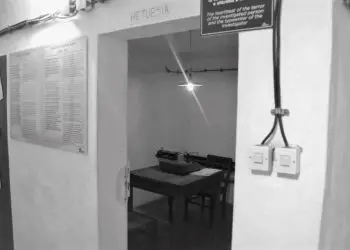
It was a room of the Franciscan Assembly in Shkodër, among a series of rooms on both sides of the long, clean, but dimly lit corridor. My room had a bed, perhaps a friar’s cot. They sat me on the bed, chained one leg to the iron bedframe, and removed my handcuffs. From the dark cell of the Security Directorate to a clean room, the difference was like day and night.
The darkness of the cell had been my “night”, for three months in a row. The window had its shutters nailed so they would not open, but the upper part was made of glass that could be lowered and raised, allowing light to enter, and occasionally fresh air. This was “day” for me. A beautiful, sunny day! From the window, I could see a patch of cloudless sky. An unbelievable beauty! I saw the sun and felt the freshness of the clean air, despite the filth of my clothes, my three‑month‑unshaven beard, and especially the millions of lice of every race…! It did not matter; I was relieved, almost ready to fly…!
In this state of sudden exhilaration, I called out to the breeze. “Oh breeze! Take me with you! Into the boundless space of the blue sky that is denied me, fly me away. Send me where suffering finds no home. Let my chest again fill with the breath of the world without obstacles, without chains. In your flight I dream today to come with you, to taste freedom, to follow your course with joy, and to return home without fear, to rest without dread, and in moments of solitude and dreaming, to savour my youthful days, and the fervour of a heart that beats strongly.” / Memorie.al
To be continued in the next issue