
By URIM ELEZI
Part three
Foreword
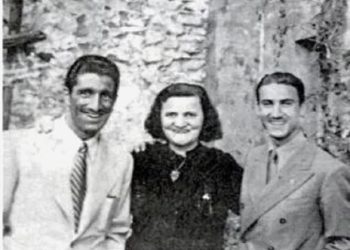
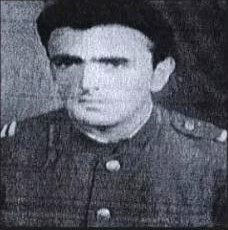
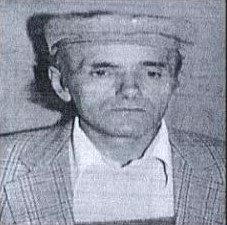
Memorie.al / Urim Elezi, born on October 18, 1941, in Floq, Korça, is among those sentenced twice by the communist regime, enduring many years of suffering. He was imprisoned on October 26, 1963, and released on February 10, 1989. He entered at the age of 22 and left at 48, moreover, blinded. At the age of 18, he completed the Instruction School in Gjirokastra, where he was promoted to non-commissioned officer. During his first sentence, he was a soldier in Unit No. 9357 in Gjirokastra. The first time, he was accused under Article 64, in combination with Articles 10 and 14 of the Penal Code. He was on military service together with his friend, Hekuran Shyti, in Gjirokastra. According to the court, he had proposed to Hekuran that they escape because life was good in capitalist countries, especially in the USA. Hekuran was discharged from the army earlier and during this time found other individuals with whom they would carry out the escape. Hekuran sent a telegram to Urim in Gjirokastra, requesting that he come because his mother was ill.
Thus, Urim joined his friends, Hekuran Shyti, Durim Shyti, and Robert Morava. Poorly oriented and betrayed by a local resident, they were captured by border forces at the Nikolica border post in the Korça district. The Tirana Military Court, by decision No. 21, dated February 27, 1964, declared him guilty and sentenced him to 18 years of imprisonment, confiscation of property, loss of electoral rights for 4 years, and stripping of his rank as a sergeant. This was upheld by decision No. 23, dated March 31, 1964, of the Military College of the Supreme Court. He was arrested for the second time on February 19, 1980. He was accused under Article 55/1 of the Penal Code with very severe articulations. The Fier Internal Affairs Department, by letter No. 112, dated January 15, 1980, requested the Prosecution Directorate to approve the arrests of three citizens, including the aforementioned Urim Elezi. He had been placed under active surveillance on May 17, 1979, for conducting propaganda among the convicts.
Informants “The Penitent” (I penduari) and “The Technician” (Tekniku) reported on him. It was said that he had expressed: “The Sigurimi has stained its hands with the blood of this people. They have committed the most hideous crimes in history; the Sigurimi has treated the people and individuals worse than the fascists and Nazis treated them…! There are none viler than the communists. I call communists all those who have a star on their forehead like a tomato, regardless of whether they believe in Marx’s beard or Stalin’s mustache…! The most monstrous crimes in Albania were committed when the communists came to power… Life here is a prison.”
The Fier District Court, presided over by Sokrat Dautaj, with the participation of prosecutor Kiço Koçi, by decision No. 94, dated April 18, 1980, declared him guilty and sentenced him to 10 years of imprisonment, as well as the loss of electoral rights for 5 years. Convinced of the futility of communist decisions, Urim Elezi did not appeal the decision. After sending a letter to Enver Hoxha, in which he described him as a “colorless monster, sick with a persecution mania,” on December 6, 1981, he was beaten by the police of Burrel Prison until he was blinded. He was released on February 10, 1989, from Unit No. 305 Përparim in the Saranda district.
Continued from the previous issue
I cannot explain how I felt after hearing these words from Riza. My brain flashed through the tortures faster than a film strip, rattling like horse-drawn carriages…!
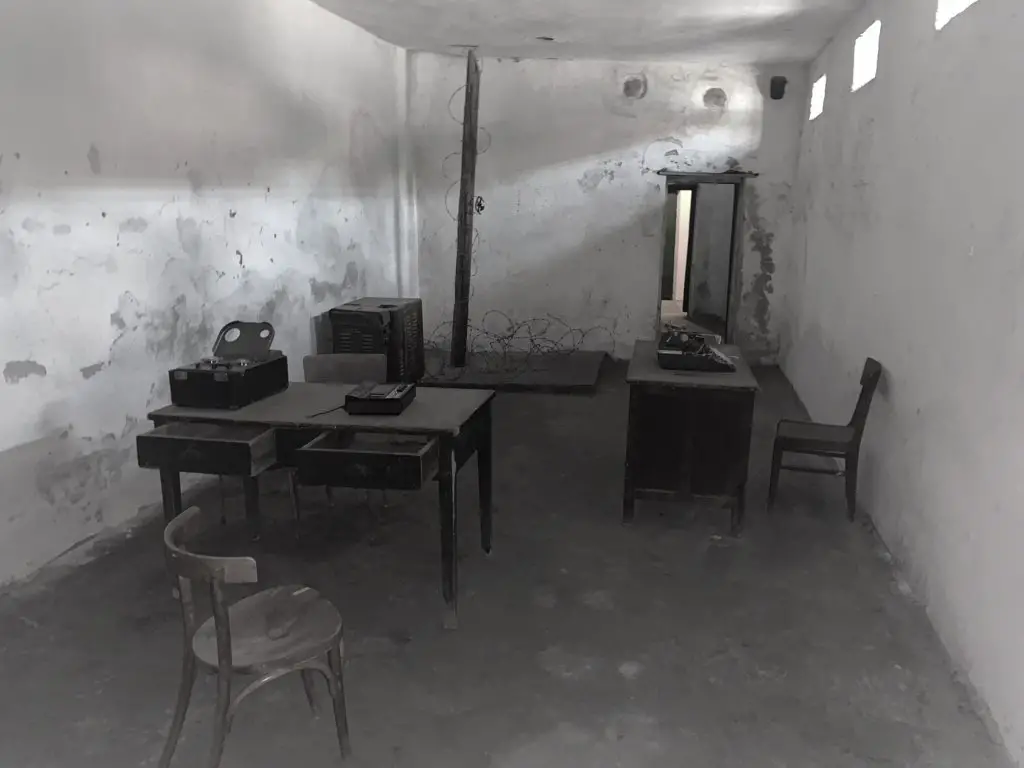
Back at the Korçë Branch of Internal Affairs
Just as Riza had warned me, the following day – as far as I recall, January 3rd or 4th, 1964 – the colonel and Head of the Branch, Jani Naska, summoned me.
-“People are coming from Tirana, so renounce what you said about the leader…! Say that when you spoke those words before, you were not conscious.”
Around midday, two Party delegates arrived, accompanied by Petro Tasellari. After starting the conversation with “sweet” words like, “you are valuable to the Party, you come from an honored veteran family, etc.,” they ended with a foul offer.
Just as they know how to do so well… they wanted me to trap Hysen Mullaj. They claimed, on what grounds I do not know, that he was my maternal uncle. In reality, my uncle is Alizot Zyfer Floqi. Address in the USA: P.O. BOX 375 MASSILLON, OHIO, USA (where I intended to go).
At that moment, the men from Tirana locked eyes with Petro Tasellari and continued:
-“We spared your life. This isn’t what you deposed. You said you were going to your uncle, Hysen Mullaj.”
This was just another of their games; I had never said such a thing, for the simple fact that he wasn’t my uncle. Petro Tasellari opened his bag and held several papers before my eyes. He asked:
-“Is this your signature?”
-“Yes,” I said after looking at it. “It is my signature.”
-“Do you remember what you deposed here?”
-“Two months and then some have passed; I don’t know what I signed.” (They looked at each other again).
-“You signed that Hysen Mullaj is your uncle and that you would go to him!”
-“No, I was going to my uncle, Alizot; I don’t know this man.”
(I heard them whispering to one another. I couldn’t hear the whole conversation, but I heard two names clearly: Ago Sina and another Jani – not Jani Naska, because they said “Captain” and Jani Naska was a Colonel). Praising my parents and my two brothers, Avdyl and Myzafer, hoping for a different result, they called Hodo, the guard officer, to take me away. From that day on, I was not tortured like before, and only Captain Riza Shehu would take me with him to accompany me anywhere.
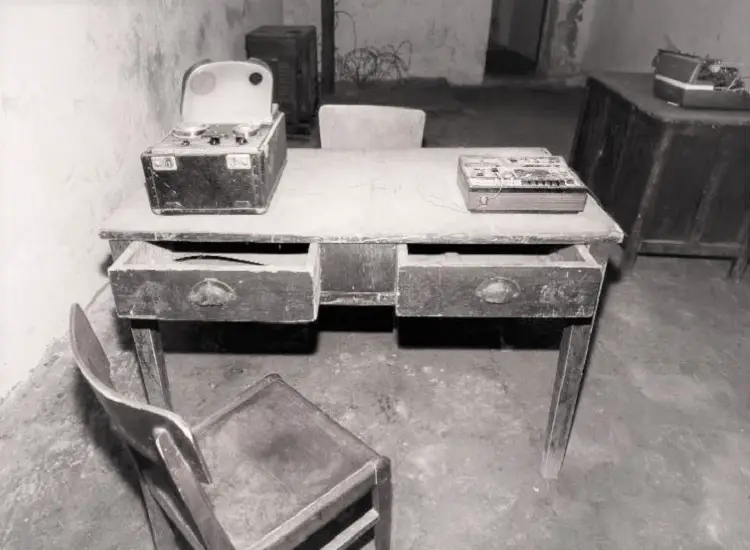
The next morning, Riza himself came to the steps of the Hetuesia (Investigation Office) and took me to the second floor of one of the buildings. Halfway up the stairs, he grabbed my arm firmly and whispered right into my ear:
-“Come on Urim, get moving now, we saved your head…”
I was completely exhausted…!
He took me into his office. As soon as I entered, the air was very heavy because a fire was roaring loudly. Riza sat me on a wooden chair, not an iron one as they usually did. Caught in the heat of the room, I began to shift restlessly in the chair; I couldn’t bear it anymore.
-“Come on Urim, why are you moving? Don’t do anything foolish. I told you, we aren’t building rockets here.”
-“I’m too hot, I’m suffocating,” I told him.
While I was still in the chair, he moved me away from the stove and closer to the door. He also left the door slightly ajar.
-“Are you better now, Urim?”
-“Yes, I’m fine,” I replied.
He took off his shoes and began warming his feet. The heel of one of his socks was completely worn through.
-“Come on Urim, why didn’t you take some others with you to fill my [expletive] properly. I got fifty thousand from you. Myqka brings me whatever I want, even from Shkodra…” etc. etc. (adventurous talk). “You stay here now! You’ll leave this place as an old man!”
(When he said this, as I sat in the chair, tears fell from my face onto my lap, and my eyes immediately went to his exposed heel).
-“You – whether you take 40-50 thousand or own the whole world (I pointed my finger) – your heel is still going to stick out like a Devoll potato…!”
(His chin trembled and his face turned pale; he opened his desk drawer where some bread, cheese, and olives were wrapped in a newspaper).
-“Eat these,” Riza said.
-“No,” I said. “If you really want me to eat them, give them to me like you gave me the slab of bread and marmalade. I won’t eat them here.”
-“Eat, we aren’t poisoning you. We will allow you food now. We have notified your family to send clothes and food.”
He called the guard officer: “Come get this one, and bring in number 15!” The officer took me to the cell. (After the court’s decision, when we met in prison, I found out that ’15’ was Hekuran. There, Riza had reportedly shown Hekuran his heel and asked: “What does this look like to you?”)
-“Well, it’s torn,” Hekuran had replied.
Riza stood up enraged, went behind the files, pulled out a cornel-wood stick, and beat him.
-“Doesn’t it look like a Devoll potato?” Riza asked again.
-“No,” Hekuran replied.
-“Really? Because that’s what your friend, Urim, told me.”
(Riza had told Hekuran that he had no choice because he had orders, otherwise he would have killed us both with his own hands). From that day on, they didn’t insult me anymore. Within the week, my bedding and food arrived. However, the policeman wouldn’t let me eat the whole slab of bread in the cell. No more than 2-3 kg of food was allowed every fifteen days.
The Trial and Sentencing
On February 26, 1964, we were notified that we would go to trial. In those days, even though we had no beards because we were just boys, they shaved us once a week. On the morning of February 26, Demka (an Egyptian), the person in charge of the cells, arrived. (Demka, along with the cell police, Halit – son of Sanije, they called him – were the worst people: the most ignorant, heartless, and provocative).
The door opened. As always, I stood up as required. Demka, with a soul as black as tar, twirling handcuffs in his hands, told me with unprecedented mockery:
-“Come on, come here and put your hands behind your back – you’re going to be sha-a-aved!”
Leaning against the wall, I put my hand to my chin and replied:
-“But I don’t have a beard!”
-“Come on, come on, don’t soil the noose for us. You need to be clean-shaven when we put the noose around your throat.”
(I froze in grief, clinging to the wall; how my heart didn’t stop, I do not know. I didn’t understand what was happening because for two months Riza had been constantly assuring me that they had saved my head and that I wouldn’t be sentenced to more than 20 years).
-“You have an exam todayyyy!!!” said the cruel Demka, laughing!
At this time, Halit, the cell guard who spoke through his nose, arrived: “Why isn’t number 20 coming?!”
-“He’s leaning against the wall and can’t move because he’s scared of the noose that will be put around his throat,” Demka said.
-“Come on, come on,” Halit told me. I walked out to the cell door unconsciously.
They ordered me to put my hands behind my back. I had always done so, but that day I froze. Both of them took my hands by force and twisted them behind me. Pushing me, they took me to the barber. Hodo, who always sat in a chair with a book in his hand where we were shaved, shouted at them: “What are you doing?!”
Halit said, grinning: “Well, this one soiled his pants because he’s worried I’ll have to clean the Kalashnikov he’s going to mess up!”
At that moment, Hodo grabbed my arm and ordered Halit: “Quickly, go and wait for me at the Chairman’s office.” After I was shaved, they put me back in the cell. After 10-15 minutes, Hodo ordered: “Quickly, bring out number 20.” On the stairs, he and another man named Rexhep took me by the arms and led me to the large truck waiting in the Branch square. I put my foot on the step by the door, and both of them pushed me inside.
When I got inside the truck, I saw Halit (son of Sanije) strutting with a rifle/automatic weapon in his hand. Next to Halit, on the floor, I saw Durim. Durim screamed: “What have they done to you?!” – “They won’t shoot you, no!”
At that moment, Halit took aim with the rifle butt to strike him.
-“Durim, please don’t talk, he’s going to hit you!” I said.
-“He won’t hit me, Urim, no. Let him try to strike me. That’s what I want. We’re going to court; no one touches us today.”
-“Oh, so you know. You’ve already passed your exam once!”
-“I have, so you get down here!”
Right after they dropped me to the floor, they brought in Hekuran and Robert. On the way to the court, all four of us were placed in positions where we couldn’t see each other. In the front with another person was the investigator Riza Shehu, while with us were 10-12 policemen standing, some with rifles and some with automatics.
We arrived at the Court, entering through the entrance in front of the Military Court in Korçë. Each of us was escorted by two policemen. I was the first to get out, followed by Durim. As soon as Durim entered the empty hall behind me, a woman with her hands placed below her chest cried out to another woman:
-“Oh my, how young the poor souls are, just as you told me!”
In the hall, there were only three women, employees of the Tirana Military Court; one of them sat with her head bowed. She was the wife of Colonel Mithat Goskova, head of the Tirana Military Court, who was related to Hekuran and Durim: I learned this later from Hekuran in prison. The time was around 9:00-10:00. Our family members entered the courtroom.
On my side was Hilmi Elezi, my second cousin, who came to visit us in prison after the sentencing and brought a Turkish delight (llokume) for each of us who had tried to escape. He is in America today. Also on my side was Petrit Cangonji, my aunt’s daughter’s husband. From Hekuran, Robert, and Durim’s side, their families came.
The judicial panel entered the hall, with Colonel Mithat Goskova as chairman of the Tirana Military Court, and member Major Nasi Joga. The prosecutor was Lieutenant Colonel Anastas Koroveshi. The supposed lawyer for me and Hekuran was Andon Napuçe. From morning until 8:00 at night, the trial lasted two days.
THE INDICTMENT: High crime and treason against the Motherland, by attempting to escape to Greece, a crime provided for in Article 64-10-13 of the Penal Code; (until January 4, 1964, it included 4 capital articles: Article 1: desertion from the army; Article 2: violation of the oath of the Intelligence-Counterintelligence school; Article 3: high treason against the Motherland and leaking secrets; Article 4: group leader. After January 4, Article 64 was reinstated, accompanied by mitigating articles, leaving only high treason against the Motherland).
Although in the group trials of the dictatorship, the accused were usually turned against one another, with us – glory is to God – it was a very special trial, especially my depositions and Hekuran’s, which were in defense of each other!
The First Witness:
… The commander of the post who arrested us along with the soldiers, surprisingly in the courtroom, looked back and forth between us and the judicial panel. This confused him for so long that we all noticed, to the point that the chairman of the panel called his attention and said: “Don’t turn your back on us, face us, not the defendants.” With great regret expressed in both his facial expressions and actions, he testified before the panel to the truth of what happened that night.
The Second Witness:
Esat the Pharaoh appeared in the courtroom like a hero. He spoke without knowing what he was saying, expressing malice: “As soon as I saw them, I kept watch, I kept watch, and I kept watch behind them and ran to the Post to denounce them.” Without the chairman even asking, he continued relentlessly: “I kept watch, I kept watch,” and pointed his finger at Robert: “This one grabbed my bag and tried to take my bread by force. I threatened him with an axe and ordered him to let go, so he let go of the bread bag!” At this moment, Robert stood up without permission from the court:
-“What is he saying?! A hundred like him and his father can’t do anything to me!”
-“Sit down and don’t speak without permission,” the chairman shouted at Robert.
The Third Witness:
Esat’s father, Shabani, disabled in one hand and one leg, with a terrifying face. In what he said, it was clear he had coached Esat. On February 27, 1964, around 20:00, the decision was made.
Urim Elezi is sentenced to 20 years in prison; Hekuran Shyti is sentenced to 15 years; Robert Morava is sentenced to 15 years; Durim Shyti is sentenced to 13 years.
… After the decision, all four of us stayed in the old prison of Korçë (today the city’s maternity hospital) for nearly a month. Necessarily, in separate cells. During the stay in this prison, I met another group, younger than us, from the village of Mborje in Korçë, who had also been sentenced for attempted escape: Nevrus Golka, Vasil and Janaq Tarusha (the latter two being first cousins). In the Korçë prison, there were about thirty other people, some sentenced for agitation and propaganda, others for attempted escape.
After a few days in the Korçë prison, a heartless, criminal policeman named Fuat, who stole the dominoes and food of the prisoners, threw me and Vasil Tarusha into a dungeon for no reason. The cell had black cobblestones and a whole high up for air. I stayed there… I don’t know for how long, because I had fainted. After about a month, about 17-18 of us, all young men from the Korçë prison, were taken to the Superphosphate Plant camp in Laç to work, I can truly say, like slaves.
We stayed there for about a year and a half. To tell the truth, it was the only labor camp that was different from any other, both in food and treatment, despite the fact that I, Hekuran, Petrit Kruja from Shkodra, Zijadin Ftera from Delvina, and many others served several terms in solitary confinement. Here, in solitary, they would bind you in irons and beat you, but it was easier than in the other camps. / Memorie.al