– Lasgush’s love for Ana G., and its experience by Ismail Kadare; Regarding the novel “The Flight of the Stork”!
Memorie.al / A few years ago, the renowned world-famous writer, Ismail Kadare, gifted me his book “Përballë pasqyrës së një gruaje” (Facing a Woman’s Mirror), which contains three short novels together, where besides the title one, and “The Knight with the Falcon”, another is included with the title “Ikja e shtërgut” (The Flight of the Stork), dedicated to the poetic love of Lasgush Poradeci, with the beautiful Ana G. That entire book, like all of his work, had left me with an unforgettable taste, so one afternoon I took it out of my library and started to reread it. While rummaging between the lines, I remembered that expression of M. Nekse: “The extreme compression of material… that is what matters for the creation of a literary work.”
In a few pages, the genius has said so much. And without tiring or straining at all. On the contrary, you feel relaxed, relieved, and spiritually renewed, in these days of depression. Especially with the masterful development of that Olympic story, of our magical poet, Lasgush Poradeci, on which I will dwell at length in this writing. I have spoken at length both about Kadare and his wonderful work, as well as about the symbol of pure human love, his idol, the fire-heart Lasgush Poradeci.
But both of them are universes unto themselves, where the great artistic and aesthetic values, the themes they have chosen, the treatments they give them, the messages they convey, the literary innovations they bring, the emotions derived from the love they have for the homeland, for man, for freedom, for goodness and beauty, and especially the hatred for injustice and dictatorships, are endless. Both were challengers; Kadare with his bold and very refined pen, and Lasgush, with his behavior, with his turned wings, with his silent disagreement with the regime.
And this is self-evident, as clearly stated by the writing of this novel about an “immoral” and unprecedented love, in 1986! A novel that the famous writer closes with the cry: “Where are you heading, great stork, and where will you leave us, the poor wretches?”, as well as in the manner of old Goethe and Lasgush, who acted freely, as if in the court of the Duke of Weimar, and without fear loved the eighteen-year-old Albanian Ulrika von Lievencov, not under the envious surveillance of a monster like Enver Hoxha.
Fyodor Dostoevsky, in one of his books, posed the question: “What is Hell?” and answered himself: “I think it is the suffering of being unable to love.” Lasgush lacked many things: respect, the possibility of publishing what he wrote according to his intellectual formation, public life, freedom of expression, a wife, the possibility of moving around the world, going to Kosovo to his friends, wandering around Albania, as a consequence of economic hardship.
The vilest way had been found to shut his mouth: that of disregard, of leaving him in oblivion, until people thought he had long since died. So, as Kadare says in the book: “For years he was and he wasn’t. He had been set aside, he was absent from all ceremonies.
And perhaps precisely amidst the ceremony, the gilding of the holiday, the reproach for him would begin”! And further: “Something that should not have been abandoned had been abandoned. The dream had been trampled underfoot. From our meeting halls, brutally lit, he, the great absentee, seemed to have taken the humble gilding of the old chandeliers, to adorn his own sarcophagus with it”!
And as if by irony of fate, during this time of oblivion, his great admirer, Ismail, is given almost unbelievable news by the annoying and unbearable R.P.: “Lasgush Poradeci, this summer, had a love story.” But where was there news more beautiful than this? The poet is alive?! His heart has remained untouched! Oh! What bliss! He was now emotionally devoted to that which no tyrant or prejudice could stop him from. And without thinking too long, he gets on the bus and takes the road to him.
It takes Kadare’s bright mind, his attention, which nothing escaped, and that Gogolian veil of his sarcasm, to savor that journey. And not only to savor it, but also to laugh at infinity of stupidities that followed us when we had to go where he, the great one, rested. Checks, after checks.
One policeman or Security officer, more ignorant and suspicious than the other! Perhaps the duty made them so, but what surprised him most was not the question: “Why are you going to Pogradec?” but rather “Do you know Ana G.?” So, R.P. had been not only annoying and unbearable, but also a provocateur; he had spread the word to them.
Perhaps Ana G. had some plan against the leader who came there. But even if not, she wanted to spite the poet with him. I have seen Ana G. and my friend’s people have told me about her intelligence and culture, when she was a literature teacher in Pogradec. I have heard her one evening on a walk, as she spoke with a group of young people. Her portrait would not easily escape the painters of Florentine medieval times.
With a sweet Shkodran accent, confident in what she said, it was immediately understood that she was an intellectual woman who had walked far ahead of her time, so much so that you could more easily believe that she had come out of the pages of Maupassant, Chekhov, or Zweig, than from the gray and narrow apartments of a lost Albanian town, where your eye caught: “Under the merciless light of the sun, the shop windows seemed even poorer.
On the glass, as everywhere, there were again slogans, even more than two years ago, when I had been here on vacation. Men’s trousers, haberdashery. Education, vigilance, shampoo…! Heat and a small provincial town. The Hunters’ Club. Barber shop. Education Center of Neighborhood No. 6”!
So, boredom. Ana G., amidst those ugly buildings, naturally seemed to the novel’s author rightly foreign and scandalous. But also as a gift from Lasgush, unable to change the architecture. And all this, with an incredible means: with his noble love, which he himself had tried to keep undiscovered: “For neither I nor you loved, / But love itself loved, / A love full of secrecy, / More secret than secrecy itself”!
But how could this strange love, where even between two high school youngsters it became the object of endless gossip, not be found out? Maxim Gorky, speaking of the writer’s daily life, that is, of his being human, has said that;
“The writer should not be Robinson… he must live life, call out, laugh, swear, fight, love.” Then think of Lasgush, with his heart as big as the world. Only it must be admitted, that first, he was seen and understood, not to say justified, by another superior mind, that of Ismail Kadare.
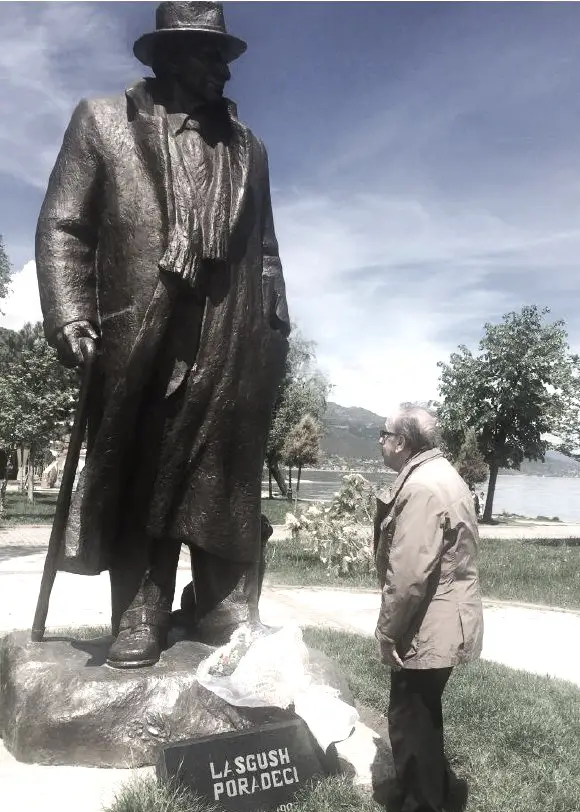
Marcel Proust, regarding the writer’s style, has said that; just as for the painter, it is not a matter of technique, but a matter of worldview. And the worldview on her part is scaled, from the ordinary to the genius. Someone might doubt and say what would the old man Lasgush, with his old coat, the black republican hat serving as a large shelter, and the stick he leaned on, like in Ana G.?
But beyond that, he continued to be; a spirit. An unparalleled, beautiful spirit, full of life, who rejoiced as much from the lake’s wave, as from the creak of a boat’s oar as he rowed back from fishing, as from that eagle escaping far towards Mount i Thatë (Dry Mountain), as well as from the beauty of a woman, almost like Anna Kern.
But why, don’t we know that, everywhere you will find women who continue to love Dante, Pushkin, Lermontov, Burns, Yesenin, even A. Blok (he who wrote: “And before the choir, the old man like a hero, / Stamps his foot: / Burn all of me with voice, with gaze, / Ksyusha, you joy!” and about whom a novel was even written about a Soviet girl who fell in love with him after his death), and many others, even though they are not physically among us.
Wouldn’t each of them wish to be the beloved of one of them, and wouldn’t she feel privileged and lucky, if their pen immortalized her forever? And don’t we have every right to think that even Ana G. remained such, thanks to that Platonism of hers, for the magma of the lover, of the one who raised hymns to the most sublime feeling that man has.
And who, by her action, drew Kadare’s attention, the one who with his inimitable talent, has done and does honor to all of Albania and so masterfully clarifies the renewing power of love, “especially in the twilight of life”. Of a love, for which after the writing of Lasgush himself, “The Visit of Miss Ana G. to my Tower”, fell into his hands, he no longer had a single shred of doubt.
Moreover, his respect for that young lady increased, as she entered that “tower”, taking care not to kill the shadow she had left while climbing those stairs. But the events take a completely unexpected turn: when Ismail meets Lasgush, who “had the same smile as last year”, the latter returned to his rebellious character, which ruined all the visitor’s plans. Right from the start, he told him: “The nation is made by the poets.”
They, up there, remember them only when they need them. And then follows the surprising question: “By the way, how he (Enver) is, is he alive or dead?” And all this, while that monster, with wife, children, sons-in-law and daughters-in-law, would watch at dinners the trial of the family of the Prime Minister declared a poly-agent even though he spent his holidays together with him. There is something Shakespearean here, not to say that a small trick would suffice and anyone would believe it was a work of the fantasy of the great English tragedian from Stratford.
The climax is reached when, amidst the dilemma of who had influenced the name Poradec more; the lake, the city or the poet himself, the author of the novel, casting his gaze further into the darkness of the sky and the twinkling of the stars, is tormented by the verse: “The last majestic stork flew away with a poor soul.”
But the reader must deduce for himself the reason why the poet, the old man – boy, is going away heartbroken: from the official silence and oblivion that followed him, or from the loss of his love for the wise beauty Ana G.?! However, one thing is clear; what Djamé has said that: “The superior purpose of the novelist is to make us sensitive to the human spirit, to make us know it and love it in its grandeur and in its misery, in its victories and its desires.”
There is no reader who does not understand the power of the human spirit in this novel, which is characterized by the Tolstoyan message, for simplicity, laconicism and clarity, thus achieving the perfection of the art form, something that only a writer with great inclination and work, like the ever-living, great and inimitable Ismail Kadare, can do! Memorie.al