
By Ali Buzra
Part Four
– LIFE UNDER PRESSURE AND SUFFERING –
(EVALUATIONS, COMMENTS, NARRATIVES)
Memorie.al / At the request and wish of the author, Ali Buzra – as his editor and first reader – I will briefly share what I experienced during my encounter with this book. This is his second work (following the book “Gizaveshi through the Years”), and it naturally continues his established writing style. The sincerity and candor of the narration, the simple and unembellished language, the precision of the episodes, and the absence of intentional, post-processed fantasy or manipulation, have – in my view – served the author well. He reaches the reader in his original form, inviting us to at least recognize these unknown human fates and sorrows, whether encountered by chance or not, leaving us to reflect as a beginning of an awakening toward a catharsis so necessary for the Albanian conscience.
Continued from the previous issue…
In past historiography, the Borova Massacre and the February 4th Massacre in Tirana have been rightly mentioned, but the extrajudicial massacres carried out by partisan headquarters during the war and in the early post-war years were never acknowledged. Today, many historical researchers, utilizing secret archives from the war and the post-liberation period, have shed light on the communist terror and killings. These instances are numerous, but it is worth noting the massacre of 180 innocent people – targeted merely as suspects – from the regions of Vlora, Korça, and Elbasan in February 1944.
Similarly, in Golem, Lushnja, 67 members of the Balli Kombëtar (National Front) were killed by the First Brigade under the orders of Dushan Mugosha and Mehmet Shehu. It is documented that one of them, when invited to join the partisans, said: “I would rather turn into a pig than join the communists.” In Klos, Mat, 20 men were killed through treachery after being invited for talks by a deputy brigade commissar. During the “Winter Operation,” 24 people from Martanesh were executed, including an adolescent child. On September 14, 1943, following the capitulation of fascist Italy, forces of the National Liberation Army carried out a massacre in the village of Gërhot, Gjirokastra, killing 36 nationalists, led by Hysni Lepenica, the General Commander of nationalist forces for Southern Albania.
Following him, command was taken by Kadri Cakrani, the son of Hajredin Bey Cakrani, a signatory of the Declaration of Independence in 1912. Communist terror during the war culminated in the mass massacre in Tirana from October 25 to November 17, 1944. During these days, over 100 intellectuals with pro-Western views, former military officers, nationalists, and patriots who had not joined the National Liberation Front were killed. Most were killed near their homes, through betrayal and without trial. These and other massacres remained unmentioned by past historiography, yet they remain a reality experienced by the victims and their families.
Evidence of this policy comes from the leaders of the Albanian Communist Party and the National Liberation Front themselves. Sejfulla Malëshova, one of the most enlightened minds of the era, completed his secondary education and medical studies in Rome. Later, from 1926 to 1930, he studied in Moscow. He was appointed a professor at Lomonosov University, winning the position of Dean out of 100 applicants. A man of communist convictions and fluent in over ten foreign languages, he was elected a member of the Central Committee and the Politburo in Albania. After liberation, he was elected a member of the Presidium of the People’s Assembly and appointed Minister of Education. In 1947, he was stripped of all party and government functions, labeled a “liberal.”
He was interned in Fier, where he worked as a pack-saddle (samar) salesman. He passed away in 1971. “Terrorism within the party, among the people, and in the army,” he testified, “shows the weakness of our political line; secondly, our lack of faith in the people; and thirdly, that we have no connection with the masses. We solved everything with terror. I was not surprised when they told me that the more of a terrorist a man was, the more of a communist he was. These are the symptoms of a political party degenerating into a gang of criminals.”
Tuk Jakova was a member of the Shkodra Communist Group and a participant in the founding meeting of the Albanian Communist Party, serving as a political commissar in the First Brigade. After the country’s liberation, he was appointed Minister of Industry. In 1951, he was dismissed from the Politburo, and in 1955 from the Central Committee. In 1957, he was isolated in the Castle of Janina. In 1958, he was arrested and sentenced to 20 years in prison for “softening the class struggle.” He died in 1959 under mysterious circumstances. He stated: “Many people have been killed without trial and without guilt…! This spirit was introduced by Dushan Mugosha. Today, it seems as if the army has come out to drown the people. Partisans kill on their own, without bringing people before a court.”
Returning to the battle for the liberation of Tirana, it must be noted that on October 3, 1944, the German Wehrmacht had already issued the order for the withdrawal of troops from Greece, Albania, and Macedonia. On November 2, they left Greece. Documents show that the evacuation from Tirana took place ten days later than planned because partisan forces of the National Liberation Army blocked their path. Was it not known that the German forces were evacuating? It was certainly known. Therefore, the question arises: why this sacrifice? Why pursue such massive human and material losses?
Would it not have been better to avoid such a violent clash with such consequences in Tirana? Naturally, it must be acknowledged that British missions welcomed such a clash to inflict as much damage as possible on the German forces, even during their retreat. British intelligence states that there were no major German combat forces in Tirana; they were primarily logistics, command centers, hospitals, and workshops. The column that arrived from Macedonia served to reinforce these units because the partisans had surrounded and reached the outskirts of Tirana.
According to testimonies from British officers, retreating German troops were willing to surrender to the British LRDG (Long Range Desert Group), but they refused to surrender to the Albanian partisans. This was because experience had shown that the Albanian National Liberation Army had violated the laws of war by executing prisoners.
On the other hand, they claim that the partisan leadership had attempted to isolate British military personnel during the fighting in Tirana and Shkodër. This was done to prevent them from witnessing the terror – not only against German prisoners but also the reprisals against the civilian population, particularly in Shkodër. That city possessed a strong anti-communist opposition, which the leadership planned to annihilate during the urban combat. (British documents state that the Albanian partisans “finished off what was left.” In many cases, the documentation notes that just 5 German soldiers with machine guns on a truck managed to halt groups of 100 partisans supported by 10 machine guns.)
The battle for the liberation of Tirana cost the partisan army 127 dead, 290 wounded, and significant material damage, while delaying the liberation of the capital by 10 days. Naturally, it was the rank-and-file partisans who were killed, not those from the strategic headquarters. Without British assistance, the losses could have been even greater. This battle was engineered by the APC (Albanian Party of Labor/Communist Party) for two primary objectives:
First, the seizure of power, as Enver Hoxha instructed at the time: “Whoever takes the capital, takes the power.”
Second, the elimination of potential political opponents. Through this practice, crimes, killings, and massacres were carried out using Bolshevik methods, practiced by the APC and encouraged by Yugoslav emissaries to pit Albanians against Albanians. It is now proven that the most devoted executioner of this terrorist practice was Enver Hoxha. Thus, the road to power was paved with the blood of intellectuals, political opponents of the era, and hundreds of innocent people.
CHAPTER III
The involvement and role of the British mission during the war in Albania. Military actions of the National Liberation Army brigades, initiated by Yugoslav representatives within the APC, which led to the neutralization of the resistance from nationalist anti-fascist and anti-Slavic detachments. The tragic fate of the Kryeziu detachment and clan, and the Tivar (Bar) Massacre.
Returning to the issue of cooperation, it can be said that British efforts to foster collaboration between the National Liberation Front and the nationalists failed. Conversely, their aim to launch the nationalists into an organized, massive uprising against the Germans also faltered. Furthermore, several moderate leftist elements who aimed to draw nationalists into cooperation with the Front as a means of national reconciliation were eliminated by the APC and Enver Hoxha.
In his memoirs, Reginald Hibbert writes of Mustafa Gjinishi: “In July and August 1944, he accompanied the First Division and then the First Corps to Northern Albania. He achieved some success by drawing in some of the less compromised nationalist leaders – for example, Dan Kaloshi and Cen Elezi, and as rumored, even Muharrem Bajraktari – into talks with the partisans and even, seemingly, toward the beginning of cooperation…! He was killed in an ambush in late August while walking with Victor Smith…!”
“After his death, nothing more was heard of these efforts; the partisan brigades showed no patience with the northern chiefs and destroyed them one after another. It is difficult not to conclude that Gjinishi was liquidated by a hit squad working for Enver Hoxha, who had no intention of allowing one of his key leaders to become a rallying point for a national coalition!”
The question arises: Were there leaders from the North, Central Albania, or the South who maintained ties with the Germans? Certainly, there were – even influential figures. We have previously discussed the reasons for this cooperation within the context of the war, which never went against national interests. However, no effort was made by the APC (Albanian Communist Party) to collaborate with them; on the contrary, the APC undermined any cooperation, viewing them as a serious obstacle to the establishment of the new socialist social order.
Naturally, these leaders also faced their own internal imbalances; they were not united in creating a common coalition, perhaps due to the question of who would take the leading role – a well-known trait of Albanian pragmatism. According to British mission documents, which we may consider somewhat impartial, there were attempts to form a coalition of nationalist leaders led by Mehdi Frashëri (Chairman of the Regency Council), Abaz Kupi (leader of the Zogists), Fiqiri Dine (representing the Dibra region), and Gjon Marka Gjoni (influential among the Mirdita tribes), but for many reasons, this failed to become a reality.
By September 1944, new officers from the Yugoslav mission, Velimir Stojnić and Nijaz Dizdarević, arrived at the APC headquarters in Albania. This refreshment of Yugoslav representatives at the war’s end had specific objectives: first, the future of Kosovo, and second, preparing the conditions for Albania’s inclusion in the so-called Balkan Federation, led by Serbia. The Yugoslav Communist Party had firmly sunk its claws into the Albanian Communist Party. In mid-1944, the Civil War in Albania – which had primarily ignited after the Mukje Agreement – intensified significantly.
Whether or not it constituted a “civil war” remains a subject of debate among historians today. In my view, regardless of the terminology, a war between Albanians with many casualties did occur during the struggle against the occupier. It was present and is now evidenced by facts. The National Liberation Army forces, while fighting the Germans in the South, Central Albania, and the North, also clashed with the forces of Balli Kombëtar, the nationalists, and the Zogists. Orders from the General Staff of the National Liberation Army and from Enver Hoxha himself for the annihilation of nationalist forces are now well-documented. In the south, this purge was completed quickly, while in Central and Northern Albania, it was achieved with many casualties.
Today, it is clear that this was a political and ideological war for power directed by the APC. It was aimed not only at elements compromised by the Germans but also against Abaz Kupi, who had participated in numerous actions against the Italians and Germans. National Liberation units, by then large in number, moved to shatter the nationalist forces of Muharrem Bajraktari – a symbol of Northern resistance against the occupier. They were also involved in the destruction of the Kryeziu brothers’ detachment in Kosovo, who fought against the Germans until the very end.
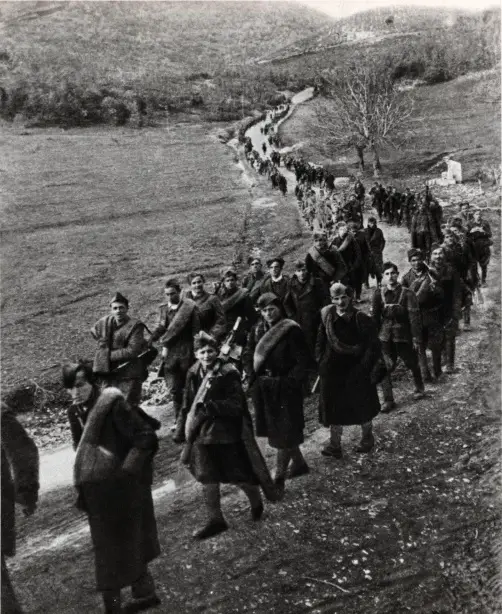
Thus, from September 1944 onward, the 6th Partisan Brigade attacked and purged Elbasan, the 5th Brigade cleared the outskirts of Tirana, the 1st Brigade took Kruja, the 4th Brigade moved into Mirdita, while the 7th and 15th Brigades headed north. At the request of the Yugoslav Staff, two divisions of the Albanian National Liberation Army were sent into Yugoslavia, ostensibly in pursuit of German forces toward Sarajevo.
In October, the 5th Brigade and later the 3rd Brigade were sent to Kosovo. The Albanian 5th Brigade, together with the Kosmet partisans in Kosovo, annihilated the detachment of Gani Kryeziu, which represented the nationalist anti-fascist resistance there. This occurred because the Kosmet partisan forces lacked broad support among the people of Kosovo, whereas the Kryeziu combat formation was the only center of resistance against the re-establishment of Yugoslav administration in Kosovo that enjoyed popular support.
It was precisely this that could have led to a general nationalist uprising of the Kosovars. Apparently, this fact was a major concern for the communist leaders in both Yugoslavia and Albania. We must emphasize that the Kryeziu detachment, consisting of nearly 1,500 fighters, fought against the Italians and Germans throughout the war without compromise, refusing to join either the Kosmet partisans or the Yugoslav National Liberation Army.
It is striking, therefore, that the aim of the Albanian partisan brigades was the destruction of the Nationalist Movement in Kosovo. This is proven by their war against the Kryeziu detachment. By the autumn of 1944, the latter had been weakened by continuous battles against German forces. Left without aid, Gani Kryeziu positioned his detachment behind Qafa e Prushit to defend the entrance to Gjakova. There, they intended to rest and await potential British aid. Under these circumstances, they were attacked by the 5th Brigade and demanded to join the National Liberation Front; Gani Kryeziu refused.
Shortly thereafter, he was arrested through treachery and handed over to Yugoslav forces. This appears to have been a premeditated coordination between the Yugoslav Communist Party and the APC. Indeed, one of the brothers, Said Kryeziu, was invited to talks in Albania and subsequently forced to go south to meet Enver Hoxha. Said was promised a high-ranking position in the Albanian government and asked to cooperate with the APC, but he refused. It was the British Mission Headquarters that managed to evacuate him to Italy.
The fate of the other brothers was tragic. Hasan Kryeziu was killed near Gjakova, while Gani Kryeziu was handed over by the Albanian 5th Brigade to the Yugoslavs, who sentenced him to five years in prison. Following his imprisonment, in 1950, he was physically eliminated. In this manner, with the help of Albanian partisans, the core of a potential nationalist government in Kosovo was liquidated. In addition to the 5th and 3rd Brigades, the two Albanian divisions sent to Sarajevo were also ordered back to Kosovo. The question rightly arises: why were Albanian partisans sent into Yugoslavia in the first place?
At the Berat Plenum in November 1944, the Yugoslav representative Velimir Stojnić stated: “The fighters will go to fight across the border and not return home…! You will cause the Yugoslav people to be gravely insulted if you do not coordinate your actions…! It is not a matter of soldiers, but of communist conscience!” Thus, as we can see, the submission of the APC to the Yugoslav party was evident throughout the war. Documents from the period state that 297 partisans were killed in Yugoslavia, but it is unknown how many died fighting the Germans and how many fell against their Kosovar brothers in the nationwide civil war.
Of these, the bodies of 128 men were never identified, and their burial sites remain unknown. Researcher and historian Uran Butka has provided us with radiograms from the Staff of the 5th and 6th Albanian Divisions in Kosovo, sent to the General Command in Albania during March and April 1945, along with lists of Kosovars who surrendered to their headquarters. Enver Hoxha’s response was: “Send the fugitives who surrendered to your division to the 52nd Serbian Division.” With these prisoners of war, the Yugoslav command filled the military columns sent as cannon fodder to Srem (Serbia) and Tivar (Bar)./Memorie.al
Continued in the next issue…