By Sokol Parruca
Part Two
The rare testimonies of the well-known jurist Sokol Parruca regarding the icons of Shkodran football over the years, such as: Halepiani, Hasa, Rragami, Rakiqi, Bizi, Dani, Zhega, etc., as well as some of the “crazy” fans of “Vllaznia”!
Memorie.al / It are difficult to write about the former players of the “Vllaznia” team of Shkodra throughout the years without being a researcher or a football specialist. However, I am sharing my impressions of those I knew, those I encountered, and those I watched – including the youth coaches – without claiming to say everything they deserve. Undoubtedly, I judge it impossible not to mention Ernest Halepiani. I was about 9 years old; I don’t remember which neighborhood friend I went with for the first time to the “Pioneers’ Park” near the former “11 Janari” school to start training in football. The youth coach there was a short man with fine curly hair and a face that shone with kindness.
Continued from the previous issue
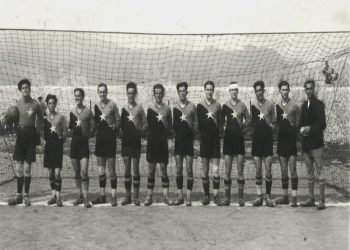
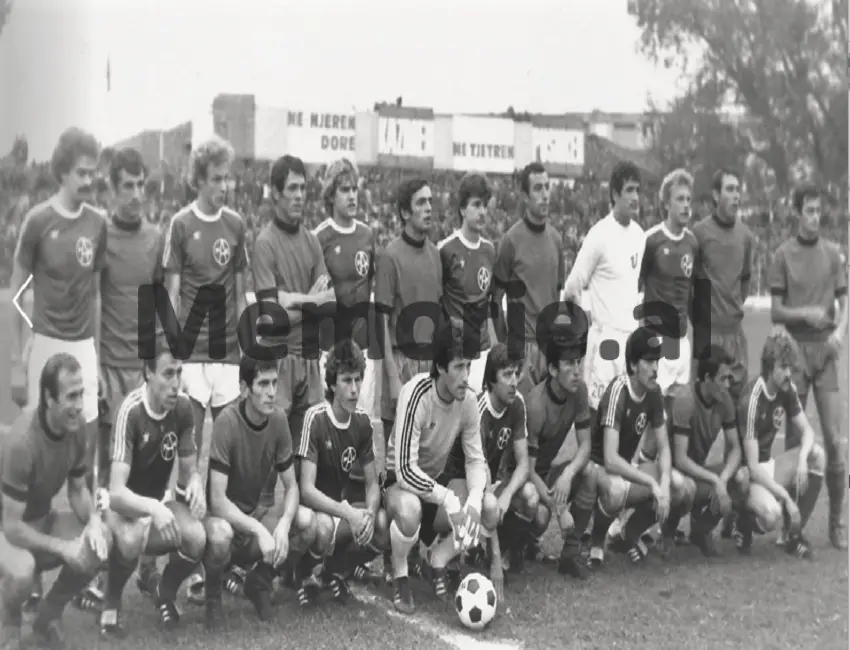
100 YEARS OF “VLLAZNIA” FOOTBALL CLUB
SABAH BIZI
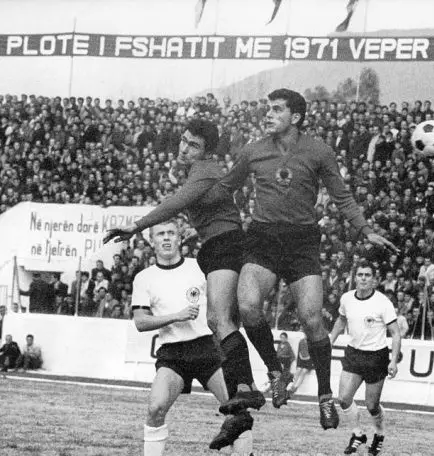
This great name has just turned 75, and on this birthday anniversary, Master, my thoughts turn to… oh, how indebted we are to you, Sabah Bizi, for the joy you have given us over the years! You gladdened the souls of so many Shkodrans and Albanians as they watched you fly, dance, dribble, and score!
You were a phenomenon, you were the breath, and you were the soul. No one like you could lift the hearts of sports fans; no one like you could make us cheer until the heavens shook for the play, the goals, and the victories you gifted us with your talent, your spirit, your dedication, your intelligence, and the sweat you poured for all those years on the green field.
Just a few meters from the house where you were born and raised, you only had to cross the annex to enter the stadium field and leave your name there eternally as the greatest talent that field has ever played or seen.
Football shone with you, and you remained the star that gave it light. I do not know, but for the road that leads to the stadium, no name would fit better than “SABAH BIZI Road.” This should be done today, not tomorrow, because this name has value, weight, and meaning. Shkodrans will always flock to this street of great renown to fill the stadium ranks once again.
They will pass through this road, which almost joins the stadium, with the longing and beautiful memory you left us, and with the hope that the cheers, the jubilant shouts, the victories, and the titles will return once more, because you are an impetus – you were and remain an inspiration.
And while today, as your eyes move toward total blindness and darkness has blurred your vision, we still see each other. We see you, and you see us, because we have always seen each other with the eyes of the soul. This is how every Shkodran and Albanian football lover has seen you, and this is how they will continue to see you in the future. And you, dear Sabah, have always seen us with the eyes of the soul, and so you shall see us eternally!
I bow humbly to you, SABAH BIZI!
DO NOT PLAY POLITICS WITH OUR IDOLS
Sabah Bizi could not see the high decoration “Honor of the Nation”. By then, he was completely blind. However, he did not go blind in a day, a month, or a year. The ordeal of his failing vision spanned years, and had there been timely intervention, his condition would be entirely different.
But none of the governments, whether left or right, took an interest in him; they let him drift toward blindness. When the title was finally granted, we wept – as much from joy as from the pain of seeing our champion, our phenomenon, walking within the darkness that surrounds him.
In the ceremony, we saw only politicians in the front rows. Instead, I would have wanted to see those who influenced the growth of this star. I would have wanted to see the families of the famous coaches: Ernest Halepiani, Xhelal Juka, Xhevdet Shaqiri, and Zushi – the first coach who could distinguish, even when you were a child, the birth of a star.
I would have wanted to see the family members of the players who played with Sabah, whom we have sadly lost: Hajro Lekaj, Menduh Dedja, Selman Cukali, Millan Vaso, Suat Durraj, Ardian Arra, and others.
Above all, Honorable President, I would have wanted this decoration to be handed to Sabah by him – our great captain, Zan Rragami, with Vali Zhega (the wife of Din Zhega) and the legend of the Shkodran goal, Paulin Ndoja, by his side. Sabah would have recognized Zan and Paulin even without them speaking; he would have known them by their sweat and the scent of their bodies, for they spent a lifetime sweating together and embracing for every goal and victory of Vllaznia.
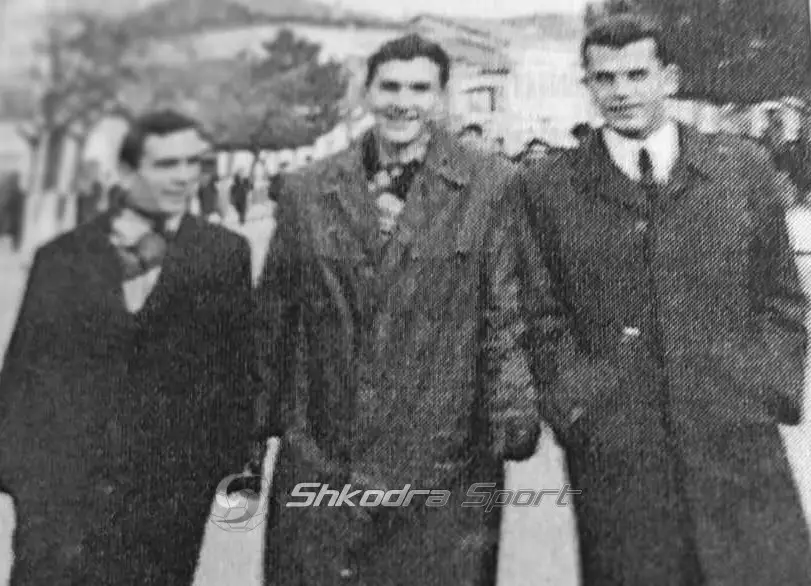
For the record, we never separated them; we called them “The 4 Musketeers” – ZAN, DIN, SABAH, and PAULIN. Their glory and names will be passed down through the years as legends of an era. Legends remain, they are remembered, and they are honored across generations. Therefore, I beg you, politicians: do not play politics with our idols! They belong to everyone, regardless of religion or ideology.
PAULIN NDOJA: The Legend of the Shkodran Goal!
You were only 19 when you took on the heavy burden of defending the Shkodran goal. At that time, many looked at you with suspicion, and whispers were not lacking. Could you, with your slender, not-so-tall, slight frame… looking even younger than you were, and appearing even smaller in the middle of the goal… could you do it?
But you proved yourself from the very first match. You were the goalkeeper Vllaznia had prayed and waited for. Time proved you were the best of them all. You were a phenomenon. I, who had the luck to follow you even in training, felt and was certain that you would be the right one – the best of Vllaznia for sure, and perhaps the best of the Albanian goal,.
No matter how cold the weather – temperatures often dropped several degrees below zero back then – in snow, rain, and storm, you were there training… soaked in water and sweat. Others would finish and head to the dressing rooms, but you continued until you had no strength left. This training ritual was repeated every day, twice a day.
In you, the gift of talent was harmoniously joined with grueling, exhausting training. You, more than anyone, showed us that talent without work, sweat, seriousness, and dedication is nothing. And so, the results had to follow. You were among the most important players of “Vllaznia.”
Thanks to your mastery, brilliance, and contribution, the people of Shkodra called you “The 4 Musketeers”: Zani, Sabahi, Dini, and Paulini.
Oh, Paulin Ndoja, the defense was calmer with you, and the team entered the field with more confidence! We, in the stadium stands, only thought about the attack, about scoring a goal, because we had left the worry of the goal to you. We had so much faith that the goal, which once seemed like it would swallow you, had now shrunk and looked small – utterly small – before your majesty.
What elasticity you had, Paulin! Your legs were like springs; you flew to every corner of the goal! You would dive, fall, and rise. What reflexes you had when we anxiously followed the ball headed for our net. Like an acrobat, you would leap and change the ball’s direction. The net remained untouched. You were like a lightning rod for the ball!
And as for penalty saves, you were fantastic. I don’t know the statistics of how many penalties you saved, but I saw how many you stopped. I cannot fail to mention the penalty save in the Republic Cup final against “Besa” of Kavaja, after seven penalties were converted by the great Zan Rragami… it was so thrilling, and the fans’ enthusiasm reached its peak.
I ran toward you, and you and Zani were embracing with tears in your eyes, a stadium thundering… a stadium weeping with joy. All the players embraced you. And while you were a guarantee for victory – with you, we won cups and championships – others in Tirana were overshadowed by your success, so much so that the head of the State Security (Sigurimi) himself ordered: “Why should we listen to cheers for Paulin Ndoja?!” The stadium thundered with your name: “Paulin!” “Paulin!”
That was all it took… they cut our cheering, they cut our enthusiasm… But you… Ah, they killed you; they killed you right at the peak of your brilliance! How terrible was that moment when the team was ready to travel and play abroad: a representative of the Sigurimi accompanying the team read the list of names allowed to travel. All the players were in agony; no one was safe.
Who knew what was being played in those dark offices of the Sigurimi? The names were read one by one… we waited outside, ah, how we waited for your name to be read! But no… from the voice of the Sigurimi representative, your name was never read, nor that of the great Xhelal Juka, nor the wonderful Frederik Çapaliku. The Sigurimi had raised the sword and struck you right in the heart.
That list was like a bolt of lightning, like a thunderbolt falling on your bodies. It was like a court verdict announcing your death sentence. Your souls were torn to pieces, crushed and mutilated! It wasn’t just that you were deprived of the pleasure of going abroad; with this gesture, you were stained; it was shown that you were “undesirable.”
In short, the Party did not want you, which meant a life lived in endless terror, an insecure life! Meanwhile, we loved you even more… it was a love mixed with gratitude for what you gave us and regret for how unjustly you were being treated. Oh, dear Paulin, how those days come to mind, when “Vllaznia” was abroad and you were in Shkodra!
Do you remember? We stayed together; pain could be read within your silence. The tear of the soul dripped like a drop of blood! We both walked the city streets, speaking with our silence! Words do not heal pain. Oh God, why were we built like that? You amazed us, you made us happy… you guarded our goal… you kept it untouched… while we did not guard you, we did not protect you; we left you with our silence to become the prey and victim of the State Security.
And now what can we say to you… to ask for your forgiveness is offensive to you, even cynical. To tell you that “that was the time, that was the system” is a disgusting excuse. We were simply sheep. We were without dignity.
SUAD DURRAJ
It was that October day in 1981 when the heart of one of the most talented Shkodran footballers stopped beating: the 30-year-old youth, SUAD DURRAJ. He passed away on the green field while training, where he poured his sweat and toil for “Vllaznia.” As if this were not enough, he gave his heart and life to the team of the city that birthed and raised him—his Shkodra. That day was a day of mourning for Shkodra, which sadly escorted its son to his final resting place.
No one failed to participate in that funeral procession. Pain was expressed on every face, and in tearful eyes, there was bitterness. Today, there is longing and memories. This shining sports figure deserves to be honored today and forever. We, who knew him closely, training together since childhood and early youth, saw the growth of an athlete with excellent physical, technical, and athletic qualities.
We knew his virtues, his kindness, and his big heart. Ah, that heart! It never crossed our minds that it would stop beating at such a young age, at the peak of sporting mastery, and right there, on the green field – as if to say: “Always remember me this way.” This is how we remember him, and this is how we will continue to remember this eternal champion of the green field.
ARDIAN ARRA
I do not know if I will be able, in these few lines, to say what I would like to say, what I feel and think, what deserves to be said and written about him. In the years he played, he was affirmed as one of the most talented among Albanian footballers. But I will dwell on how this talent was born and created, because I knew him since he was 5 or 6 years old.
We lived in the same neighborhood, near the former “Republika” cinema; he lived on the second floor at the corner of the building. He was the only son of Shaban Arra, a “Teacher of the People,” the youngest of the family, with two sisters, Rudina and Mike, several years older than him. Being an only son and the youngest, he was raised with much love.
When he grew to be 7 or 8 years old, he began to join us in our games. In front of his building’s entrance, at the Gjomarkaj Tower, in a space of about 400 square meters with pebbles, we played, using stones as goalposts and a 50-lek rubber ball. We played for hours every day. That is where Ardian played for the first time. He was no older than 8. What a sight – he used the ball with a technique unusual for his age. Even though we were a bit older, by about 2 or 3 years, he would dribble past us effortlessly.
He had a habit of nutmegging us whenever he wanted; no matter how much we guarded ourselves, I don’t know how he found that space, but he would penetrate and pass. He “toyed” with every one of us. It was impossible to take the ball from him, so we were forced to grab him with our hands, push him, or trip him, and then we would rise, embracing. No one dared to speak harshly to him; no one took it badly; we all loved him. He enjoyed the authority of being the best.
Even then, we saw that he was not like us; he was different. We began to see him as a talent. We spent our childhood playing, from the Gjomarkaj Tower to the “cement” area next to the dormitory, to the field of the former “11 Janari” school, and finally at Mr. Ernest’s park. You should have seen Mr. Ernest, how attentively and focused he followed Ardian’s every move, mesmerized and marveled by this boy who hadn’t even grown up yet. He, better than anyone, earlier than anyone, saw with a professional eye the birth of this talent.
This was the beginning of Ardian Arra’s journey. Later, at 15, he went to the Sports Mastery School in Tirana and then graduated from the Sports Academy, only to return to the “Vllaznia” team, where he stood out for his high technique and mastery and athletic preparation. We all saw how he performed magic with the ball; he was a juggler.
Was it Ardian who, through patience, zeal, and training, managed to become a footballer? I tell you openly: he was born that way. I don’t know how much Ardian loved football, but I know how much football loved him. It was football that followed him even when he wanted to move away. Apparently, this is what happens with phenomena, and Ardian was a phenomenon. He left before the fans could satisfy their longing for him.
With you, Ardian, it was like those Hollywood movies with two parts, where you appeared as a great actor only in the first part – and only at its beginning. And just when we were waiting for you – ah, how we waited! – you left, our unlucky phenomenon! An injury took you away from the green field at your very peak.
You left like a Grand Cavalier, like a general who, after triumphing, transformed football into art. Eh, like generals who cannot live without battles, you too could not stay away from the field! You grew weaker… and year after year, we watched you fade away, until on October 7, seven years ago, you closed your eyes and went up there where geniuses belong, leaving us with the pain and the beautiful memory of a star.
At the funeral ceremony, as we escorted you with bowed heads and broken hearts, another phenomenon, Sabah Bizi, under the weight of pain and with tears in his eyes, said in a mournful voice: “You, Ardian Arra, were God’s gift to football.” A phenomenon knows better than anyone what it means to lose a phenomenon.
Today we would like to remember you differently; I would like the Ministry of Education and Sports to remember you, the Football Federation to remember you, I would like the Municipality of your city – my city – to honor you… but these institutions are not focused on this; they have other “worries”!
No matter, you are a tear in every moment, every day, in the souls of Nina and Reno, Rudi and Mike! You are remembered by the childhood friends who grew up alongside you, by your sports comrades, by the sports lovers… with us are thousands of Shkodran citizens who honor your name and talent, expressing gratitude for all you gave to the team of our hearts, and with deep pain and sorrow, they weep for the dark fate of your premature departure from this life, to rest peacefully in the eternal world. Memorie.al
To be continued in the next issue